


CPT code 48152: Whipple procedure without pancreatojejunostomy
CPT code 48152: Official description and procedure overview CPT code 48152 descr...

Last Updated: Nov 13, 2026
CCSD code P2420 is a UK private healthcare procedure code for a gynecological operation, repair of the vaginal vault. It sits in the P24 range, which mirrors OPCS-4, the NHS procedure classification.
In the OPCS-4 P24 category, every code is a repair of the vault of the vagina, and P24.2 is sacrocolpopexy. So P2420 most likely describes a sacrocolpopexy-type repair.
The catch is that the exact descriptor and complexity band sit behind the CCSD login. Vault repairs also split by approach and by whether mesh is used, so a code picked because it looks close tends to get queried. That’s why a P2420 claim starts with a descriptor check, before the patient calls their insurer for authorization.

CCSD code P2420 sits in the P24 vaginal vault repair range, a gynecology procedure in the UK private healthcare schedule.
OPCS-4 lists sacrocolpopexy at P24.2, so P2420 most likely describes a sacrocolpopexy-type repair.
The exact descriptor and complexity band are login-gated, so confirm them in the CCSD schedule before you bill.
Insurers that recognize the CCSD schedule, such as Bupa, AXA Health, Aviva and Cigna, pay under their own fee schedules and rules.
Practice software such as Pabau keeps authorization codes on the patient record and sends the claim through Healthcode.
The CCSD schedule is the shared list of procedure and diagnostic test codes used across UK private healthcare. It is maintained by Clinical Coding and Schedule Development, a group made up of Bupa, AXA Health, Aviva and Vitality.
Its procedure codes take their letter and first digits from OPCS-4, which is how you can place P2420 without a login. Our CCSD codes library holds the other chapter P codes we have written up.
In OPCS-4, chapter P covers the lower female genital tract. Category P24 then splits vault repair by approach and technique:
P2420 most likely lines up with P24.2. In a sacrocolpopexy, the surgeon suspends the top of the vagina from the sacrum, usually with mesh or a graft. Still, the OPCS-4 wording only tells you the neighborhood. Only the CCSD descriptor belongs on a claim. A rebuild of the vagina itself, rather than a vault repair, is coded P2100.
If you also see US patients, the same operation is billed under CPT instead, where the laparoscopic version is 57425.
The full schedule sits behind a login on the CCSD website, and its public code pages show no descriptor. Individual consultants don’t pay a license fee, but they must apply online and accept the terms before they can view it. Hospitals, insurers and billing agencies need an annual license.
Once you have access, the check takes a few minutes:
For Bupa-funded patients, our guide to Bupa CCSD codes and fees explains how Bupa applies the schedule.
Vault repair is planned surgery, so most of the billing work happens before the operation. Three of the seven steps in the usual path for an insured patient come before the patient reaches the operating room.
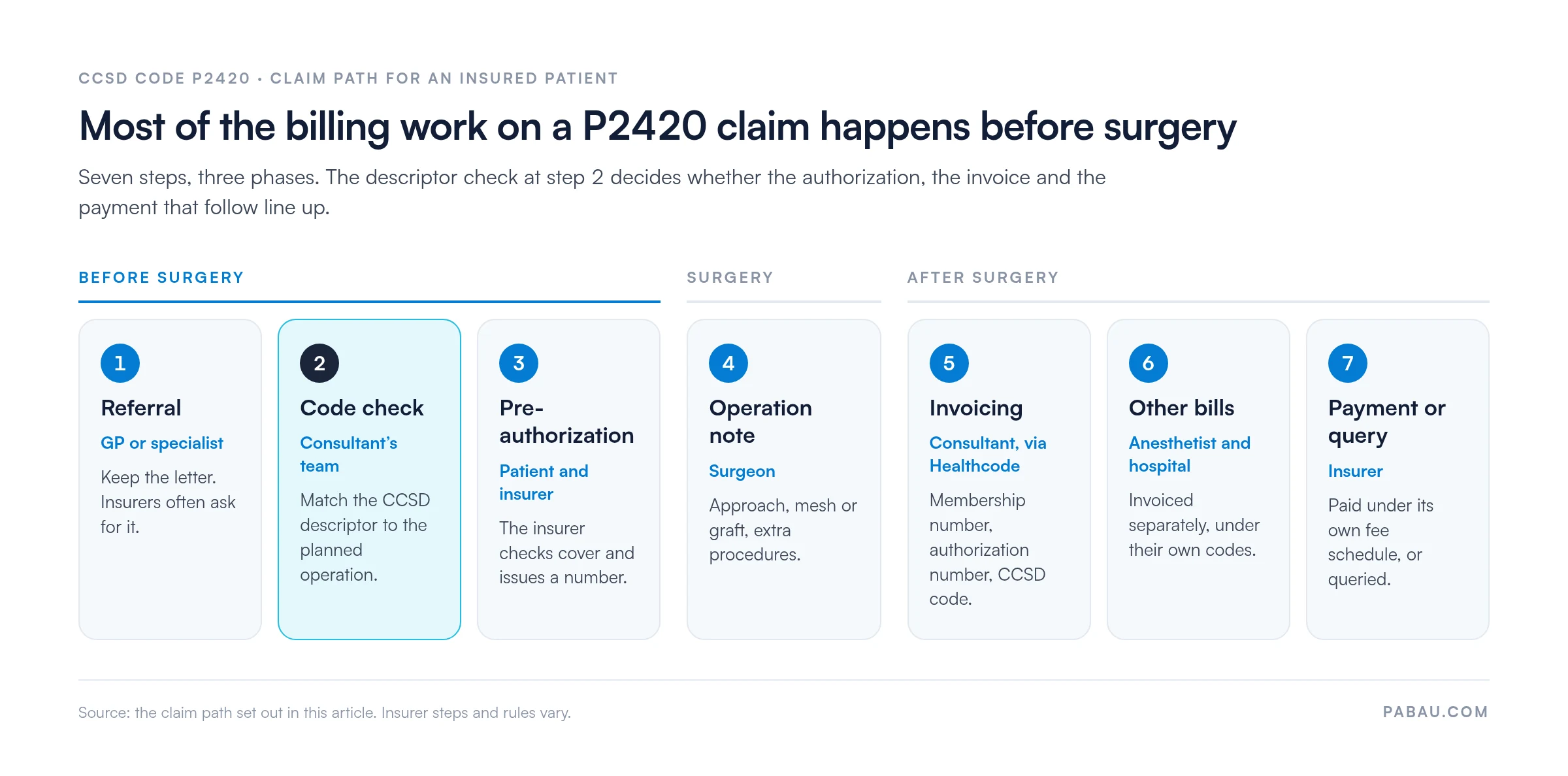
Log every pre-authorization call, with the authorization number, the code it covers, the date and who you spoke to. If the claim is queried months later, that log is the first thing you will need.
Each insurer runs its own checks, so it helps to know where to look before you call.
Insurer rules change, so confirm them with each provider team before the surgery date.
Take an illustrative case. A patient had a hysterectomy several years ago and now has symptomatic vault prolapse. Her consultant gynecologist plans a laparoscopic sacrocolpopexy with mesh, funded by her Aviva policy.
The practice manager logs in to the CCSD schedule and reads the P24 codes side by side. OPCS-4 separates sacrocolpopexy from other mesh repairs, so she checks which CCSD wording fits the plan. If the P2420 descriptor matches, it goes to the patient for the authorization call. If it doesn’t, she picks the neighboring code that does.
The patient phones Aviva with the code and receives an authorization number. After surgery, the operation note confirms the laparoscopic approach and the mesh used. The invoice then goes through Healthcode, and the anesthetist bills Aviva separately.
Can P2420 be billed with another procedure? Yes, when a separate procedure is done in the same session, such as a hysterectomy or another prolapse repair. Each one takes its own CCSD code. The insurer then decides how the second is paid, under the CCSD principles and its own rules.
Two prolapse repairs that can share the session have pages of their own. Our P2310 page covers colporrhaphy, and P2340 covers enterocele repair. Repair of the perineum itself, such as a perineorrhaphy, is coded P1300.
Does an assistant surgeon bill separately? That depends on the insurer and the procedure. Ask before surgery, so the assistant knows whether to send an invoice at all.
What if the surgery is urgent? Vault repair is almost always planned. If an urgent case does arise, contact the insurer as soon as you can, since emergency authorization rules vary.
A query or rejection is often fixable. Start by pinning down exactly why the insurer declined or queried the claim.
In a busy practice, the authorization number often arrives by phone and lands on a sticky note or spreadsheet. Weeks later, someone retypes it into the invoice, and one wrong digit holds up the claim.
Pabau, the practice management software we build for private practices, keeps those details on the patient’s record. Your team records the insurance policy, opens a case for the episode and stores the authorization code against it. When the invoice is ready, it goes to the insurer through Pabau’s Healthcode integration.
Your team still checks the descriptor, but nobody hunts for an authorization number at invoice time. With several consultants billing the same insurers, that saves a retyping step on every claim.
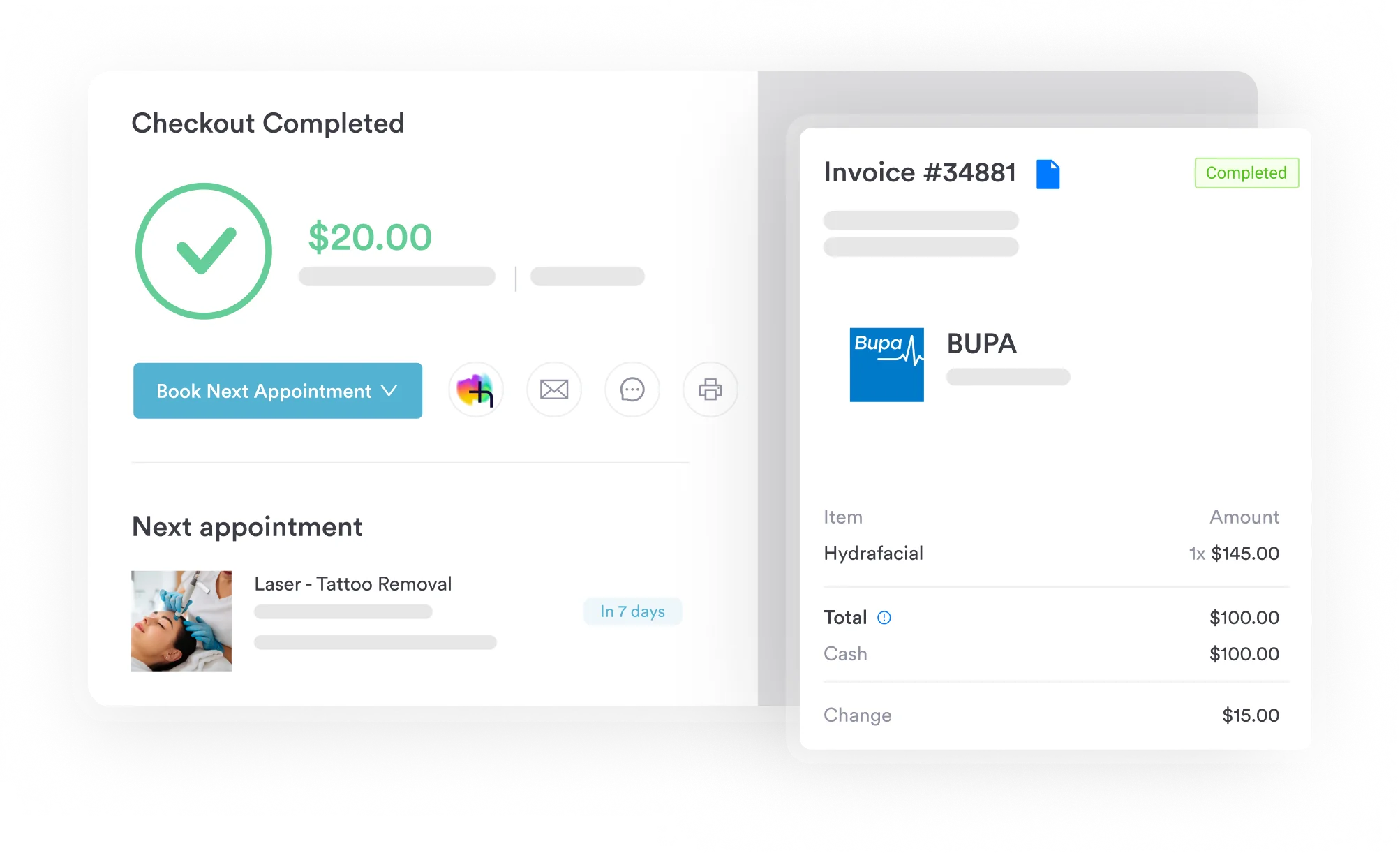

Pabau records each patient’s insurance policy, case and authorization code, then sends the claim through Healthcode. Your team stops retyping numbers between systems.

P2420 is easy to place and hard to bill blind. The range tells you it’s a vault repair, but only the CCSD descriptor tells you whether it fits the operation your consultant has planned.
So make the descriptor check a fixed step at booking, done before the patient calls their insurer. It takes minutes, and it spares you weeks of back-and-forth on a claim coded from memory. File the dated note beside the authorization number, and a later query already has its answer.
Pabau’s claims management software keeps authorization codes and Healthcode claims together on each patient’s record. Book a demo to see how it handles your P2420 claims from booking to payment.

Need a full Bupa CCSD code reference? Bupa CCSD codes and fees covers the Bupa procedure code schedule with fee guidance for UK private practice teams.
Billing another vaginal repair? CCSD code P2510 is our billing guide for vesicovaginal fistula repair.
Coding a vaginal reconstruction? CCSD code P2100 walks through billing for reconstruction of the vagina.
Trying to reduce queries across all your CCSD claims? Insurance claims management shows how Pabau handles private insurance claims from authorization to submission.
Vaginal vault prolapse is when the top of the vagina sags down into the vaginal canal. It most often follows a hysterectomy. Patients may notice a bulge, pressure, or bladder and bowel symptoms.
Not for NHS care. NHS hospitals record operations in OPCS-4, the national procedure classification. CCSD codes are for private treatment billed to UK insurers, and they carry their own descriptors on top of the OPCS-4 structure.
Often, if the policy covers surgery for the condition and it isn’t excluded as pre-existing. Cover depends on the policy terms, so the patient should get pre-authorization before a date is booked.
Sacrocolpopexy suspends the vaginal vault from the sacrum, usually with mesh, through open, laparoscopic or robotic abdominal surgery. Sacrospinous fixation stitches the vault to the sacrospinous ligament through the vagina. OPCS-4 codes them separately, at P24.2 and P24.7.



