ICD-10 Code S42.444P: Medial epicondyle fracture, right humerus
ICD-10 Code S42.444P: full descriptor and code validity ICD-10 Code S42.444P car...

Last Updated: Oct 13, 2026
Billable Code Specific Code
M34.9 is the billable ICD-10-CM code for systemic sclerosis, unspecified.
Let Pabau's smart automation suggest the right codes, reduce claim denials, and keep your practice compliant—effortlessly.
Automate repetitive tasks and focus on what matters most—your patients.
Reduce coding errors and ensure compliance with the latest regulations.
Clean claims, fewer denials, and faster reimbursements.
Powerful insights and reporting to help your practice thrive.
HIPAA compliant SOC 2 certified GDPR-compliant Trusted by 4,000+ clinics worldwide

ICD-10 code M34.9 is a billable diagnosis code for systemic sclerosis, unspecified (scleroderma NOS), valid for FY2026 from October 1, 2025
Use M34.9 only when documentation does not specify a subtype; choose M34.0 (progressive), M34.1 (CREST syndrome), or M34.2 (drug-induced) when the record supports it
Excludes1 applies to circumscribed scleroderma (L94.0), meaning the two codes can never be assigned together for the same encounter
Pabau’s clinical notes and claims management workflows help practices document subtype specificity and submit M34.9 claims accurately
ICD-10 code M34.9 is a billable code for systemic sclerosis, unspecified (scleroderma NOS). Use it when the documentation says only “scleroderma” or “systemic sclerosis,” without naming a subtype such as progressive systemic sclerosis or CREST syndrome. It is valid for HIPAA-covered transactions in FY2026.
Systemic sclerosis is a chronic autoimmune disease characterized by fibrosis of the skin and internal organs. The broader M34 category covers all coded variants, from progressive systemic sclerosis to CREST syndrome. This guide covers the code’s metadata, hierarchy, synonyms, includes and excludes rules, related codes, and documentation requirements for billing.
According to the CDC/NCHS ICD-10-CM web tool, M34.9 became effective on October 1, 2025, and is valid through the end of FY2026. The table below captures its core metadata at a glance. Practices using claims management software can map this code directly to invoicing and reporting for clean claim submission.

M34.9 sits within a well-defined hierarchy under the diseases of the musculoskeletal system and connective tissue chapter. Understanding where it falls helps coders navigate the tabular list and select the right level of specificity.
The parent code M34 groups all systemic sclerosis variants, from progressive and drug-induced forms to CREST syndrome. M34.9 is the unspecified leaf code at the bottom of that branch. Documented drug causation steers code choice across the M30-M36 block, so medication-triggered lupus belongs to M32.0 rather than an unspecified lupus code.
For coders working in dermatology EMR software environments where autoimmune skin conditions appear regularly, knowing this hierarchy prevents miscoding to sibling categories like L94.0 (circumscribed scleroderma), which belongs to the skin disorders chapter rather than systemic connective tissue disorders.
The same M00-M99 chapter also covers unrelated bone conditions such as M83.4, so confirming the subcategory before assigning a code matters as much as confirming the subtype.
A chiropractic platform connects each spinal or joint diagnosis to its treatment schedule and outcomes.
The ICD-10-CM alphabetical index routes several clinical terms to M34.9. Coders encountering any of the following in a diagnosis statement should consider this code when no subtype is specified.
The “NOS” designation (Not Otherwise Specified) is the operative signal: When the clinician documents scleroderma without specifying whether it is limited or diffuse, CREST-related, or drug-induced, M34.9 is the correct assignment. Good patient care management documentation practices, however, should push toward capturing subtype detail whenever clinically established, since payers increasingly scrutinize unspecified codes on chronic disease claims.
Run a quarterly audit of M34.9 claims in your practice. Any encounter where a rheumatology or dermatology note mentions CREST features, ANA patterns, or disease subtype should be flagged for possible recode to M34.0 or M34.1. Specificity supports medical necessity and reduces payer queries on autoimmune diagnoses.
The ICD-10-CM tabular list attaches two excludes notes to the M34 category. These are code-level instructions, not clinical judgments, and applying them incorrectly can result in claim rejections or compliance risk. Practices using HIPAA-compliant practice software need these rules embedded in their documentation workflows.
Both excludes notes attached to M34 are Excludes1: L94.0 (circumscribed scleroderma) and P83.88 (neonatal scleroderma) can never be coded together with M34.9.
Circumscribed scleroderma (morphea) is a localized skin condition with no systemic involvement, while systemic sclerosis (M34.9) involves internal organs, so the two are distinct diseases. Assigning both codes to the same encounter is a coding error that may trigger a payer audit.
The same applies to P83.88: Neonatal scleroderma is a separate, unrelated condition, not a subtype of adult systemic sclerosis, so the two are mutually exclusive by definition rather than optionally combinable.
The M34 category contains eight specific subcodes. Coders should select M34.9 only after confirming the documentation does not support a more specific assignment. According to the CMS ICD-10 codes guidance, code specificity directly supports medical necessity and reduces claim scrutiny on chronic autoimmune diagnoses.
The same principle applies to M31.4 and other connective tissue diagnoses that default to an unspecified code too often.
Selecting M34.9 correctly is a documentation-driven decision. The code is appropriate in specific, defined circumstances – not as a default when the coder is unsure.
Practices that route provider queries through a structured client record system capture subtype detail at the point of care rather than after the fact. This reduces the cycle of claim submission on M34.9 followed by payer queries on chronic autoimmune diagnoses. The same specificity-first approach applies to M71.9 and other musculoskeletal diagnoses coded as unspecified by default.
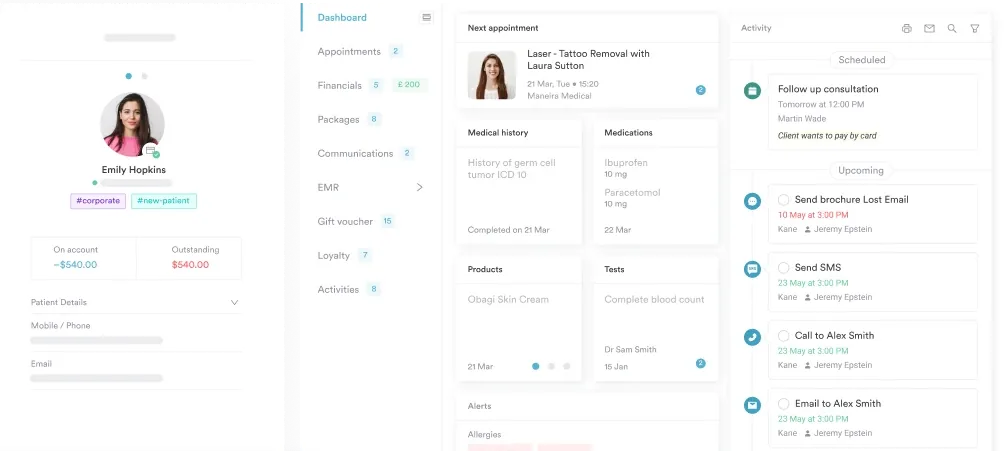

Pabau helps practices link diagnosis codes like M34.9 directly to clinical notes, invoicing, and reporting. See how structured documentation workflows reduce coding errors and support clean claim submission.

A billable M34.9 claim needs a medical record that supports the diagnosis and demonstrates the provider considered and ruled out more specific subtypes. Payers reviewing autoimmune diagnoses look for four elements. Some payers require prior authorization for this service, and a claim without it is denied regardless of coding.
When the medical record establishes that a drug or chemical caused the systemic sclerosis, code M34.2 applies instead of M34.9. The ICD-10-CM guidelines require an additional external cause code from the adverse effect range (T36-T65) to identify the specific causative substance.
Practices managing complex rheumatology patients can use structured medical forms to capture medication history and causation language at each visit, reducing the risk of missing the dual-code requirement on drug-induced presentations. Separate documentation of the drug and the systemic sclerosis diagnosis in the same encounter note is mandatory for M34.2 coding.
Check every M34.9 claim for medication history before submission. If the patient record includes bleomycin, vinyl chloride exposure, or solvents linked to scleroderma-like reactions, the diagnosis may warrant M34.2 rather than M34.9, along with the corresponding external cause code for the substance.
For conditions like systemic sclerosis, miscoding usually comes down to documentation: The clinical detail needed to select M34.0 or M34.1 over M34.9 exists in the notes, but it was never captured in a codeable form. Pabau addresses this at the workflow level, rather than after the claim is submitted.
Pabau’s AI-powered clinical documentation tool transcribes consultations and structures them into chart notes, capturing subtype language, clinical findings, and medication history in a format coders can act on directly.
This means what the clinician documents during the visit matches what the coder needs at billing time. Practices using claims management software link diagnosis codes like M34.9 directly to invoicing and reporting, creating an audit trail that supports payer review and demonstrates medical necessity for chronic autoimmune diagnoses. Front-desk data entry and back-office coding both feed cash collection, so errors compound downstream.
For practices managing rheumatology or integrative medicine patients, Pabau also centralizes patient records, medication history, and diagnostic findings in one place, so the documentation needed for accurate systemic sclerosis coding is always accessible at the point of care. Explore how EHR integration connects clinical and billing data for practices with complex diagnostic coding needs.
Unspecified codes like M34.9 are clinically valid, but they carry audit risk when a more specific subtype is documented and not coded. That risk usually sits in documentation workflows, not coder knowledge.
Pabau’s AI clinical documentation and structured note templates help practices capture the subtype language that drives accurate systemic sclerosis coding. If your team is routinely submitting M34.9 on chronic autoimmune accounts, it’s worth checking whether your documentation workflows prompt for the specificity payers expect.
Book a demo to see how Pabau handles the coding and billing workflow end to end.

Coding another unspecified diagnosis? N85.3 walks through the same specificity-first approach for a gynecological diagnosis.
Tracking complications in transplant patients? T86.892 applies the same documentation-first logic to post-transplant tissue infections.
Need a walkthrough of an infectious-disease code? K67 breaks down billing rules for peritoneal disorders linked to infection.
ICD-10 code M34.9 is used to report a diagnosis of systemic sclerosis, unspecified (scleroderma NOS) when the clinical documentation does not specify a subtype such as progressive systemic sclerosis (M34.0) or CREST syndrome (M34.1). It is billable for HIPAA-covered transactions and valid for FY2026 from October 1, 2025.
Yes. M34.9 is a billable and specific ICD-10-CM code valid for HIPAA-covered transactions in FY2026. It became effective on October 1, 2025, and can be submitted for reimbursement on professional and institutional claims where systemic sclerosis, unspecified is the documented diagnosis.
M34.0 is for progressive systemic sclerosis, which is a specific subtype with documented clinical features of diffuse cutaneous involvement. M34.9 is used only when the provider records “scleroderma” or “systemic sclerosis” without specifying the subtype. If the record supports M34.0, it should be used in preference to M34.9.
CREST syndrome (CR(E)ST syndrome) is a form of limited cutaneous systemic sclerosis characterized by calcinosis, Raynaud phenomenon, esophageal dysmotility, sclerodactyly, and telangiectasia. Its ICD-10-CM code is M34.1. It should not be coded as M34.9 when CREST syndrome is explicitly documented in the record.
The medical record must include an explicit diagnosis statement of systemic sclerosis or scleroderma, relevant clinical findings supporting the diagnosis, and no subtype-specific language that would support M34.0, M34.1, or M34.2. The diagnosis must also be relevant to the current encounter rather than only appearing on the problem list.
Use M34.2 when the medical record establishes that a drug or chemical caused the systemic sclerosis. M34.2 also requires an additional external cause code (from the T36-T65 range) identifying the specific causative substance. Do not assign M34.9 when drug causation is documented.