ICD-10 Code S42.444P: Medial epicondyle fracture, right humerus
ICD-10 Code S42.444P: full descriptor and code validity ICD-10 Code S42.444P car...

Last Updated: Oct 13, 2026
Billable Code Specific Code
H90.8 is the billable ICD-10-CM code for mixed conductive and sensorineural hearing loss, unspecified.
H90.8 gets used more often than it should. Audiograms almost always report laterality, so a more specific code, H90.6 or H90.7, is usually the correct choice instead.
Let Pabau's smart automation suggest the right codes, reduce claim denials, and keep your practice compliant—effortlessly.
Automate repetitive tasks and focus on what matters most—your patients.
Reduce coding errors and ensure compliance with the latest regulations.
Clean claims, fewer denials, and faster reimbursements.
Powerful insights and reporting to help your practice thrive.
HIPAA compliant SOC 2 certified GDPR-compliant Trusted by 4,000+ clinics worldwide

ICD-10 Code H90.8 is a billable ICD-10-CM diagnosis code for mixed conductive and sensorineural hearing loss, unspecified, valid for the 2026 edition effective October 1, 2025
Use H90.8 only when laterality is not documented; if bilateral or unilateral laterality is known, use the more specific H90.6 or H90.7 instead
Documentation must confirm both a conductive component and a sensorineural component of hearing loss, with no laterality specified in the clinical record
Practice management software like Pabau helps audiology and ENT practices document laterality accurately before H90.8 reaches a claim, using structured clinical note templates that prompt for the missing detail at the point of care
ICD-10 Code H90.8 is a valid, billable ICD-10-CM diagnosis code. Its full official description is: Mixed conductive and sensorineural hearing loss, unspecified. The code is current for the 2026 edition of ICD-10-CM and became effective on October 1, 2025, as confirmed by the CDC/NCHS ICD-10-CM web tool.
H90.8 sits within the H90 category (Conductive and sensorineural hearing loss), which falls under the H60-H95 chapter range covering diseases of the ear and mastoid process. It is the least specific code in the H90 mixed subgroup, reserved for encounters where the chart confirms both loss types but does not document laterality.
Accurate use of ICD-10 Code H90.8 starts with understanding what distinguishes the three hearing loss types. Conductive hearing loss involves a problem in the outer or middle ear that blocks sound transmission. Sensorineural hearing loss (SNHL) involves damage to the inner ear cochlea or the auditory nerve. Mixed hearing loss means both components are present simultaneously in the same patient.
A common clinical scenario: a patient with chronic otitis media (a conductive cause) who also has age-related cochlear damage (a sensorineural cause). The audiogram shows an air-bone gap alongside a depressed bone conduction threshold, confirming both pathways are affected.
For medical forms serving ENT or audiology patients, documenting the audiometric basis for the mixed classification is essential. A note that says “mixed hearing loss” without referencing audiometric results will not meet payer documentation standards for H90.8.
Excluding the H90.A series (covered separately below), the H90 category contains 12 billable codes organized by hearing loss type and laterality. Three of the subcategory codes, H90.1, H90.4, and H90.7, aren’t billable on their own: each needs a sixth character marking the right or left ear before a claim can be submitted. H90.8 is the unspecified-laterality code for mixed hearing loss. Understanding the full hierarchy prevents the most common error: defaulting to H90.8 when a more specific code is available and documentable. A small billing team benefits more from a documented billing process than from extra hours. Box-by-box requirements on the professional claim form change by payer, so one filled sample is not a universal template.
The decision tree is straightforward. ICD-10-CM official guidelines require the highest level of specificity available. For mixed hearing loss, that means laterality must be coded when documented.
The most common error is using H90.8 as a default when the audiologist’s report clearly identifies bilateral involvement. That constitutes undercoding under ICD-10-CM Section I.C guidelines, and payers may flag it during retrospective audits.
The H90 category also includes the H90.A subgroup, added for unilateral hearing loss where the unaffected ear isn’t fully normal either. This changes the applicable code family, not just the laterality digit.
H90.A3 is itself a non-billable subcategory: H90.A31 codes the right ear as affected, with restricted hearing on the left, and H90.A32 codes the left ear as affected, with restricted hearing on the right. The same right/left split applies to H90.A1 (conductive-only) and H90.A2 (sensorineural-only), giving coders a parallel structure to H90.1 and H90.4 whenever the unaffected ear has hearing loss of its own.
Inside software built for GPs, eye and ear diagnoses route to the right specialist with history attached.
Meeting the documentation standard for ICD-10 Code H90.8 requires the clinical record to satisfy three conditions. Missing any one of them creates coding or audit risk. Practitioners managing clinical compliance requirements across allied health specialties will recognize this same specificity standard in broader ICD-10-CM guidance.
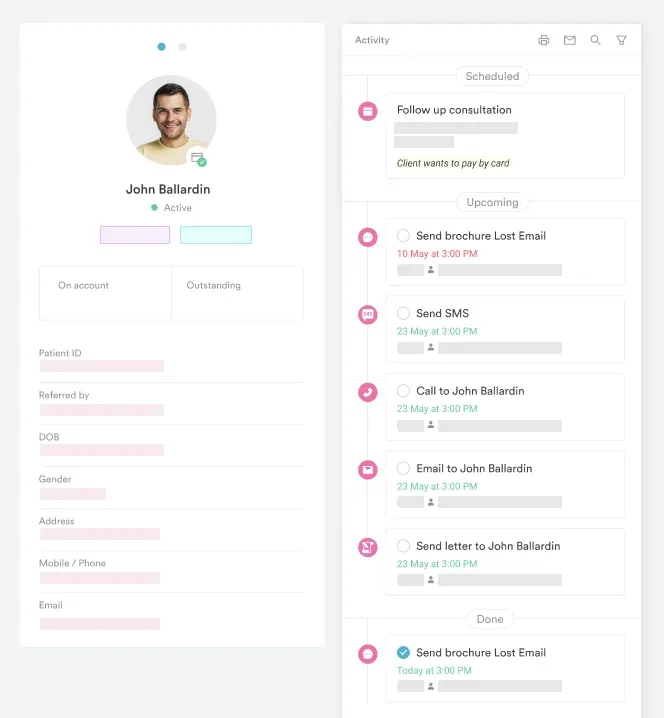
Using structured patient records with fields that prompt for laterality at the point of documentation can prevent the undercoding problem before it reaches the billing stage. The fix is upstream in the clinical workflow, not at the claim.
Before coding H90.8, run a laterality check against the audiogram report. Audiograms almost always document right ear and left ear thresholds separately. If those figures appear in the chart, laterality is documented and H90.6 or H90.7 should be coded instead. H90.8 should be rare in well-run audiology practices.
The H90 category carries official ICD-10-CM includes and excludes notes that govern all codes within it, including H90.8. These notes are not optional guidance. They are binding coding rules.
The following conditions are explicitly excluded from H90 and must be coded elsewhere. Using H90.8 for any of these is a coding error.
H90.8 is also not the appropriate code for hearing loss where the etiology is noise-induced or medication-related, even if the resulting audiometric pattern resembles mixed loss. The etiology-specific codes take precedence under ICD-10-CM’s code-first and use-additional-code rules.
ICD-10 Code H90.8 is accepted by Medicare, Medicaid, and most commercial payers as a valid primary or secondary diagnosis code for audiology and ENT encounters. Reimbursement is not automatic, however. Coverage depends on the payer’s local coverage determination (LCD), the nature of the encounter, and the CPT codes paired with H90.8. The CMS ICD-10 codes page provides the authoritative reference for annual updates and coverage guidance.
Common CPT codes paired with H90.8 in audiology and ENT billing include audiometric testing codes (92551-92557), hearing aid evaluation codes, and tympanometry. Pairings vary by payer. Never assume a specific CPT code is automatically covered with H90.8 without reviewing the applicable LCD.
Audiology and ENT practices that want diagnosis coding and clinical documentation working from the same system can use speech therapy practice software that carries the ICD-10-CM code from the note into the billing queue, cutting the manual step of re-entering H90.8 on a claim.

Pabau’s structured clinical note templates help audiology and ENT practices code H90.8 accurately, prompting for laterality documentation before it becomes a billing problem.

For practices reviewing historical records, legacy system imports, or retrospective claim audits, H90.8 crosswalks to ICD-9-CM code 389.20. This crosswalk is an approximation. The AAPC Codify ICD-10-CM lookup and the CMS General Equivalence Mappings (GEMs) file confirm 389.20 (mixed hearing loss, unspecified) as the primary predecessor.
The crosswalk is approximate because ICD-9-CM 389.20 did not distinguish laterality. The more granular bilateral and unilateral variants in ICD-10-CM (H90.6 and H90.7) have no direct ICD-9 equivalents. When converting legacy records, review the original documentation to determine whether H90.6, H90.7, or H90.8 is the appropriate ICD-10 assignment.
When importing historical records coded with ICD-9-CM 389.20, do not auto-map all encounters to H90.8. Review the original audiogram and chart notes. Many will have sufficient laterality documentation to support H90.6 (bilateral) instead, which is a more specific and defensible code.
H90.8 is involved in a predictable set of errors that coders in audiology and ENT see regularly. Most stem from documentation habits rather than misunderstanding of the code itself.

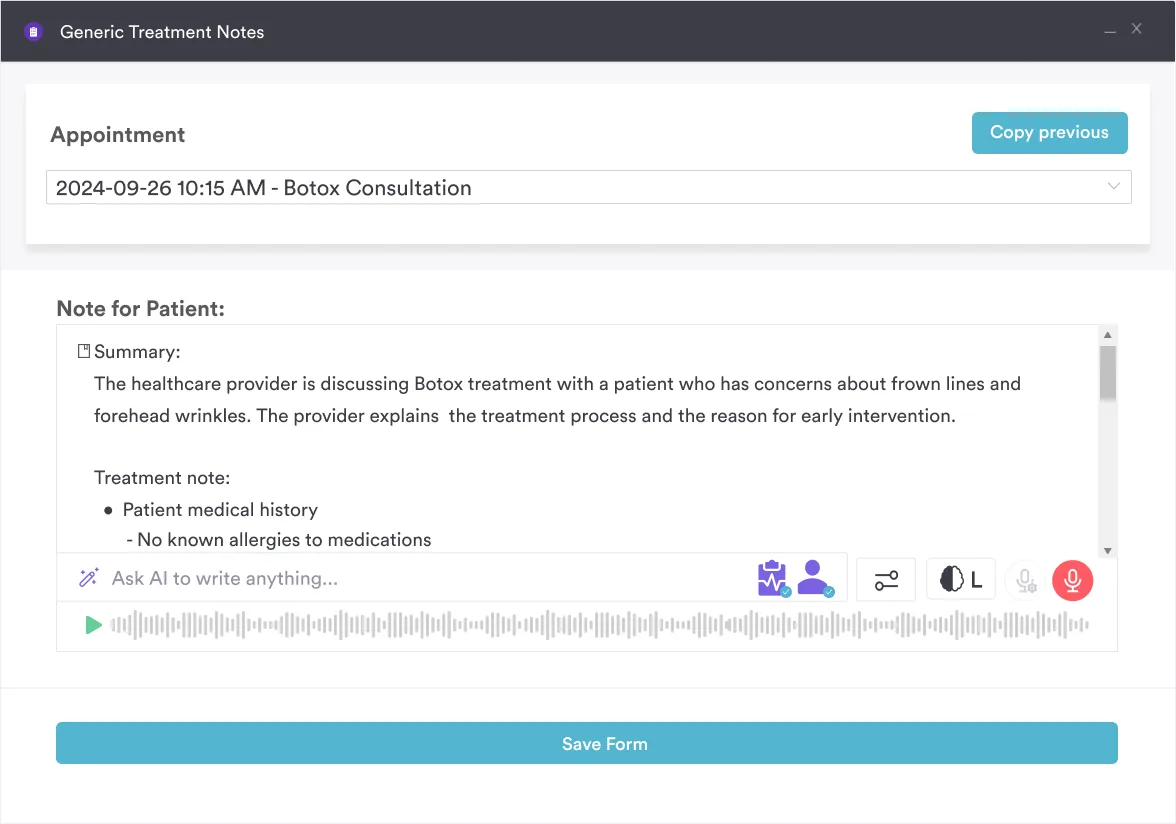
For practices using AI-assisted clinical documentation, structured note templates that prompt for hearing loss type and laterality at the point of care reduce the missing documentation that forces coders to default to H90.8. The fix belongs in the clinical workflow, not the billing queue.
Reference-only ICD-10 lookup tools identify the code but don’t connect it to the clinical note, the billing queue, or the submitted claim. Coding errors tend to start at that disconnect.
Pabau’s practice management platform integrates ICD-10-CM code selection directly into clinical documentation for audiology and ENT practices. Clinical note templates can be configured to prompt for hearing loss type and laterality before a note is finalized, reducing the conditions that lead to H90.8 being used when H90.6 is warranted. Once the diagnosis code is confirmed in the note, it carries through to billing without a separate re-entry step.
Practices also benefit from EHR integration that connects the coding context to the full patient record, so laterality documented in a prior visit’s audiogram isn’t missed when coding a follow-up encounter. Because sensorineural damage often brings vestibular symptoms too, some ENT and audiology practices also run balance rehab through physical therapy EMR software, keeping the audiogram findings and the therapy notes in the same record.
H90.8 is a billable code with a narrow intended use: mixed hearing loss where laterality is genuinely undocumented. Most denials and audit findings tied to this code come not from the code itself but from applying it when a more specific code was available and documentable. The laterality check, the excludes notes, and the distinction between unspecified type versus unspecified laterality are the three points where coders most often need to pause.
If your practice sees frequent H90.8 submissions, the most effective intervention is a documentation workflow change, not a coding policy change. Pabau’s structured clinical templates help audiology and ENT practices get laterality into the note before it becomes a billing problem. To see how Pabau supports hearing loss documentation, speak with the team.

Coding a different diagnosis today? ICD-10 Code M83.4 covers the billable status and documentation rules for aluminum bone disease and osteomalacia.
Coding bilateral sensorineural hearing loss? Bilateral sensorineural hearing loss guide explains how cochlear or auditory nerve damage differs from middle ear conditions like otitis media.
Billing for a swallowing evaluation in the same encounter? CPT Code 92610 covers documentation and reimbursement rules for that service.
ICD-10 Code H90.8 is a billable ICD-10-CM diagnosis code for mixed conductive and sensorineural hearing loss, unspecified. It applies to encounters where both a conductive component and a sensorineural component of hearing loss are confirmed, but the clinical record does not document laterality (which ear or ears are affected). It is current for the 2026 ICD-10-CM edition, effective October 1, 2025.
Yes, H90.8 is a billable, specific ICD-10-CM code valid for claim submission in the 2026 edition. It can be used as a primary or secondary diagnosis code for audiology and ENT encounters where mixed hearing loss is confirmed but laterality is not documented.
Use H90.8 only when the clinical record confirms mixed hearing loss but contains no documentation of laterality. Use H90.6 when the chart documents bilateral involvement, and H90.7 when unilateral mixed loss is documented with the opposite ear having normal hearing. Because audiograms routinely separate right and left ear results, H90.8 should be used infrequently in well-documented audiology encounters.
The clinical record must document: (1) a confirmed conductive component, (2) a confirmed sensorineural component, (3) audiometric evidence supporting the mixed classification, and (4) the absence of any laterality documentation. If any of these elements is missing or if laterality can be determined from the audiogram, H90.8 is not the appropriate code.
H90.8 crosswalks to ICD-9-CM code 389.20 (mixed hearing loss, unspecified). The crosswalk is approximate. ICD-9-CM 389.20 did not distinguish laterality, so historical records coded 389.20 may warrant H90.6 or H90.7 in ICD-10-CM if the original chart contained laterality documentation.
H90.8 is most commonly used by audiologists and otolaryngologists (ENT specialists). It also appears in primary care encounters where a hearing loss screening identifies a mixed pattern without a detailed laterality evaluation. Noise-induced hearing loss is excluded from H90 entirely and must be coded H83.3 instead, so H90.8 is not appropriate for occupational or noise-exposure cases.