

ICD-10 code S61.201A: Open wound of left index finger without nail damage
ICD-10 code S61.201A covers a left index finger wound of unstated type ICD-10 co...

Last Updated: Oct 16, 2026
Billable Code Specific Code
F44.9 is the billable ICD-10-CM code for dissociative and conversion disorder, unspecified.
Let Pabau's smart automation suggest the right codes, reduce claim denials, and keep your practice compliant—effortlessly.
Automate repetitive tasks and focus on what matters most—your patients.
Reduce coding errors and ensure compliance with the latest regulations.
Clean claims, fewer denials, and faster reimbursements.
Powerful insights and reporting to help your practice thrive.
HIPAA compliant SOC 2 certified GDPR-compliant Trusted by 4,000+ clinics worldwide

F44.9 is a valid billable ICD-10-CM code for 2026, covering dissociative and conversion disorder when no specific subtype can be identified.
Use F44.9 only after ruling out more specific F44.x codes such as F44.0 (dissociative amnesia) or F44.4 (conversion disorder with motor symptom or deficit).
The ICD-9-CM equivalent is 300.15 (Dissociative disorder or reaction, unspecified); include this crosswalk in legacy billing reconciliations.
Pabau’s mental health EMR supports structured clinical documentation and claims management workflows that help mental health practices bill F44.9 accurately.
F44.9 is the ICD-10-CM code for dissociative and conversion disorder, unspecified. It is assigned when a patient presents with symptoms consistent with the F44 category but the clinical picture does not align clearly with any specific diagnosis within that category.
Dissociative disorders involve a disruption in the normal integration of consciousness, memory, identity, emotion, perception, behavior, and sense of self. Conversion disorder, also known as functional neurological symptom disorder (FND), refers to neurological symptoms such as weakness, seizures, or sensory disturbances that have no identifiable organic neurological cause.
When a patient’s presentation does not fit a more precise subcategory, F44.9 is the appropriate catch-all code, provided documentation supports the clinical rationale.
Excluding an organic cause is part of the record behind F44.9, and any imaging ordered during that workup is coded to the presenting symptom. A soft-tissue head and neck ultrasound reported under 76536 carries the neck or thyroid finding as its diagnosis pointer. A normal result does not, on its own, support the psychiatric code.
F44.9 is a billable, specific ICD-10-CM code valid for the fiscal year 2026. It may be used for reimbursement purposes on claims submitted to Medicare, Medicaid, and commercial insurers. For accurate ICD-10 diagnosis coding, a billable code must reach the highest level of specificity the clinical record supports. The billing process starts at registration, not at the point the coder opens the note.
F44.9 sits at the terminal node of the F44 category. Because it carries the “unspecified” qualifier, payers may request medical necessity documentation before processing the claim. Some commercial insurers scrutinize unspecified codes and may generate additional information requests or denials when documentation does not clearly explain why a more specific code could not be assigned.
Component billing works differently on the procedure side of the claim. Radiology codes that bundle supervision and interpretation, such as 74420 for retrograde urography, split into modifier 26 and TC lines by who owns the equipment. The diagnosis pointer must stay identical across both lines.
Practices billing wraparound behavioral health services alongside F44.9 may also reference HCPCS Code H2015 for comprehensive community support services billing requirements. Practices billing in Australia check the current MBS descriptor before submitting, because descriptors are revised on a schedule.
Per CMS ICD-10-CM coding guidance, coders should assign the most specific diagnosis code the documentation supports. F44.9 is appropriate only after considering whether a more precise F44.x code applies.
Several clinical terms map to F44.9 through the ICD-10-CM “Applicable To” annotations. Coders and clinicians may encounter these terms in legacy records, DSM-5 language, or payer correspondence.
| Synonym or related term | Notes |
|---|---|
| Dissociative disorder NOS | NOS (not otherwise specified) is the legacy qualifier; maps directly to F44.9 |
| Acute hysterical psychosis | Older clinical terminology; retained in ICD-10-CM Applicable To annotations |
| Conversion disorder, unspecified | Used when conversion symptoms are present but no specific motor, sensory, or seizure subtype is documented |
| Dissociative disorder or reaction, unspecified | ICD-9-CM carryover language; see crosswalk below |
The term “acute hysterical psychosis” reflects older psychiatric nomenclature. When it appears in historical records, F44.9 is the current ICD-10-CM equivalent. Clinicians should use contemporary DSM-5 diagnostic language in current clinical notes rather than these legacy terms.
F44.9 is the residual code within the F44 ICD-10 block. Understanding where each F44 diagnosis code sits helps coders select the correct specific code before defaulting to the unspecified option. The WHO ICD-10 browser provides authoritative navigation of the full classification structure.
| Code | Description |
|---|---|
| F44.0 | Dissociative amnesia |
| F44.1 | Dissociative fugue |
| F44.2 | Dissociative stupor |
| F44.4 | Conversion disorder with motor symptom or deficit |
| F44.5 | Conversion disorder with seizures or convulsions |
| F44.6 | Conversion disorder with sensory symptom or deficit |
| F44.7 | Conversion disorder with mixed symptom presentation |
| F44.81 | Dissociative identity disorder |
| F44.89 | Other dissociative and conversion disorders |
| F44.9 | Dissociative and conversion disorder, unspecified |
Before assigning F44.9, review each specific code in this table against the patient’s documented symptoms. A patient with documented episodic memory loss without identified cause maps to F44.0, not F44.9. A patient with non-epileptic seizures (psychogenic non-epileptic seizures, PNES) may fit F44.5. Only when no specific subtype is supportable does F44.9 become the correct choice.
Within the F44 block, the dissociative disorder ICD-10 codes cover disruptions to memory, identity, and consciousness. F44.0 (dissociative amnesia), F44.1 (dissociative fugue), and F44.2 (dissociative stupor) each capture a distinct dissociative presentation. F44.81 is the ICD-10 code for dissociative identity disorder, assigned when two or more distinct personality states are documented. F44.9 absorbs dissociative presentations that cross these subtypes or stay undifferentiated at the encounter.
The conversion disorder ICD-10 codes sit in the same F44 block and describe functional neurological symptoms with no organic cause. F44.4 covers conversion disorder with motor symptom or deficit, F44.5 with seizures or convulsions (psychogenic non-epileptic seizures), F44.6 with sensory symptom or deficit, and F44.7 with mixed symptom presentation. When conversion symptoms are documented but the subtype is not, F44.9 serves as the unspecified conversion disorder ICD-10 code.
For related mental health diagnoses outside the F44 category, depersonalization-derealization disorder is coded to F48.1.
Dependency rules differ between the two code sets. F44.9 can stand alone on a claim, while an add-on CPT code cannot. 3D rendering reported as 76377 is only payable alongside the CT, MRI, or ultrasound study it reconstructs.
Run a documentation review before assigning F44.9. Check whether any conversion or dissociative symptom in the record (motor deficit, sensory loss, amnesia episode, identity alteration) meets criteria for a specific F44.x subcode. Use F44.9 only when the presentation genuinely spans multiple subtypes or remains undifferentiated after clinical evaluation.
Practices transitioning legacy claims or reconciling pre-2015 records need the ICD-9-CM equivalent. F44.9 maps to ICD-9-CM code 300.15.
| ICD-10-CM | ICD-9-CM | Description |
|---|---|---|
| F44.9 | 300.15 | Dissociative disorder or reaction, unspecified |
This is an approximate crosswalk. The ICD-9 code 300.15 covered a broader range of dissociative presentations than what current ICD-10-CM subcategories now distinguish. When conducting payer audits or appeals on legacy claims, note that the two code sets do not map with full clinical precision.
For reference on how similar transitions affected other diagnostic categories.
Additional context on how ICD-9 to ICD-10 transition data appears in Medicare claims records can assist with retroactive billing reconciliation.

Pabau’s practice management platform supports clinical documentation, digital intake forms, and claims management workflows built for mental health and psychiatry practices.

The American Psychiatric Association’s DSM-5 uses different terminology and organizational structure from ICD-10-CM, but the two systems are mapped for billing purposes. Understanding the relationship helps clinicians write documentation that supports accurate coding.
In DSM-5, what ICD-10-CM classifies within F44 is largely captured under two primary categories: dissociative disorders (including dissociative identity disorder, dissociative amnesia, and depersonalization-derealization disorder) and somatic symptom and related disorders (which includes functional neurological symptom disorder, the DSM-5 equivalent of conversion disorder).
The ICD-10 code F44.9 most closely corresponds to DSM-5 presentations of functional neurological symptom disorder, unspecified, or dissociative disorder, other specified or unspecified.
For practitioners working in psychiatry EMR software environments, the DSM-5 diagnosis should appear in the clinical note alongside the ICD-10-CM code used for billing. Payers require the ICD-10-CM code on the claim; the DSM-5 diagnosis belongs in the clinical record as supporting documentation.
Using crisis intervention strategies and structured clinical frameworks during assessment helps ensure the presenting symptom profile is fully documented before assigning F44.9.
F44.9 fits presentations where dissociative or conversion symptoms are clearly present but cannot be categorized further because the symptoms are mixed, early, or insufficiently differentiated at the time of the encounter. Three common scenarios include:
Structured screening tools can help narrow the presentation before an unspecified code is assigned. Pabau’s Internet Addiction Test template is one example of a standardized instrument that captures behavioral symptom detail during intake for related presentations.
F44.9 should not become the default choice simply because a more specific code requires more detailed documentation. If a specific F44.x code is clinically supportable, use it and document accordingly.
Payer policy can cap how often a service is reported, a separate question from code specificity. Medicare limits corneal pachymetry under 76514 to once per lifetime for glaucoma suspects, and a repeat needs a signed ABN. F44.9 carries no such frequency ceiling.
Payer scrutiny of unspecified codes is high. Documentation supporting F44.9 must demonstrate that a dissociative or conversion disorder is present and that no specific subtype could be assigned at the time of the encounter. A strong clinical record for F44.9 typically includes:
Using a psychiatric evaluation template during the initial assessment helps capture the clinical elements that payers expect when an unspecified code is submitted. Reviewing eating disorder worksheets for recovery can also provide a reference for structured symptom documentation frameworks used in mental health settings.
Structured notes reduce the risk of additional documentation requests and support cleaner first-pass claims.
Sequencing matters while the workup is still open. An extremity angiography billed as 75710 points to the documented limb or vascular indication, not to an unestablished psychiatric diagnosis. F44.9 is assigned once the clinical assessment supports it.
The CDC/NCHS ICD-10-CM web tool allows practitioners to verify the current-year validity of F44.9 and review any annual tabular list updates that may affect coding requirements.
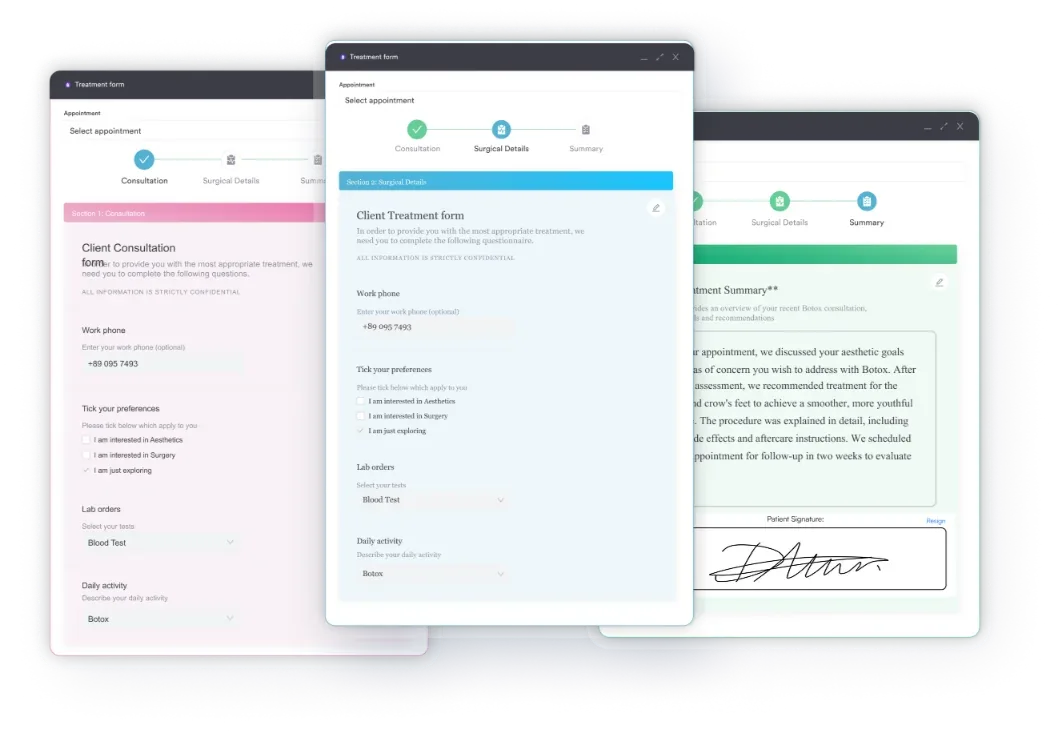
Pabau’s digital intake forms allow mental health and psychiatry practices to build structured intake workflows that capture the clinical detail needed to support F44.9 at the time of the encounter.
Flag F44.9 encounters for documentation review before claim submission. Confirm the note includes: symptom description, organic rule-out, a rationale for using the unspecified code, and a treatment plan tied to the diagnosis. This reduces additional information requests from payers and improves first-pass claim approval rates.
Dissociative presentations rarely occur in clinical isolation. Coders and clinicians should be aware of adjacent codes that may apply as additional diagnoses or that may be more appropriate than F44.9 in specific presentations.
| Code | Description | Relationship to F44.9 |
|---|---|---|
| F44.0 | Dissociative amnesia | Use instead of F44.9 when amnesia is the primary, isolated symptom |
| F44.81 | Dissociative identity disorder | Use instead of F44.9 when two or more distinct personality states are documented |
| F44.5 | Conversion disorder with seizures or convulsions | Use instead of F44.9 when PNES is the documented presentation |
| F48.1 | Depersonalization-derealization disorder | Use instead of F44.9 when depersonalization or derealization is the primary complaint |
| F43.10 | Post-traumatic stress disorder, unspecified | Common comorbidity; code additionally when criteria are met |
| F41.1 | Generalized anxiety disorder | Frequent comorbidity with dissociative presentations; code separately when present |
Practices using psychology practice software with integrated coding support can configure code selection workflows that prompt clinicians to review the full F44 hierarchy before submitting F44.9. Reviewing related ICD-10 unspecified code documentation patterns can offer useful context for building these review workflows.
Practices coding across specialties encounter similar specificity requirements elsewhere in ICD-10-CM. ICD-10 Code G14 (postpolio syndrome) and ICD-10 Code M31.9 (necrotizing vasculopathy, unspecified) both require the same rule-out documentation discipline as F44.9 before an unspecified code is billed.
Auditors apply the same descriptor discipline in CPT. A limited breast ultrasound reported as 76642 is denied when the report omits which region was scanned and why a complete study was unnecessary. Unspecified diagnosis codes draw the same question.
Claims management workflows in Pabau’s claims management software can help practices flag common denial patterns for unspecified codes and route F44.9 claims through an additional documentation review step before submission.
F44.9 covers dissociative and conversion presentations that do not yet meet criteria for a specific subtype. Billing staff and clinicians must ensure documentation actively supports the “unspecified” designation rather than defaulting to it.
Pabau’s mental health and psychiatry practice management platform supports structured clinical documentation.
For practitioners billing injectable treatments alongside mental health services. To see how Pabau handles mental health billing end to end, book a demo.

Billing a Skyla IUS insertion? Skyla IUS billing guide covers the matching CPT and ICD-10 codes for J7301.
Looking to reduce clinical documentation burden? Pabau’s AI medical scribe supports AI-assisted clinical note generation for mental health and psychiatry practices.
Billing a durvalumab infusion? durvalumab (Imfinzi) billing guide shows how to calculate units for a 1,500 mg dose under J9173.
ICD-10 Code F44.9 is used to code dissociative and conversion disorder, unspecified, when a patient presents with symptoms of a dissociative or conversion disorder but the clinical picture does not clearly fit any specific subcategory within F44. It is a billable code valid for 2026.
Yes, F44.9 is a valid billable ICD-10-CM code for fiscal year 2026. It can be submitted on claims to Medicare, Medicaid, and commercial insurers, though payers may request supporting documentation when an unspecified code is used.
Use F44.9 only when the patient’s symptom profile cannot be assigned to a more specific F44.x code after clinical review. If a specific subtype such as dissociative amnesia (F44.0) or conversion disorder with seizures (F44.5) is clearly documented, that code takes priority over F44.9.
The ICD-9-CM equivalent of F44.9 is 300.15 (Dissociative disorder or reaction, unspecified). This approximate crosswalk is used when reconciling legacy claims from before October 2015, when ICD-10-CM replaced ICD-9-CM in the United States.
Documentation for F44.9 should include a description of dissociative or conversion symptoms, evidence that organic causes were ruled out, a rationale for why a more specific F44.x code was not assigned, and a treatment plan demonstrating medical necessity. Structured clinical notes reduce payer queries and improve first-pass claim rates.
The F44 category covers dissociative and conversion disorders, including dissociative amnesia (F44.0), dissociative fugue (F44.1), dissociative stupor (F44.2), conversion disorder subtypes (F44.4, F44.5, F44.6, F44.7), dissociative identity disorder (F44.81), and dissociative and conversion disorder, unspecified (F44.9).
Conversion disorder is coded within the F44 block. Documented presentations use F44.4 through F44.7 depending on whether motor, seizure, sensory, or mixed symptoms are recorded. When the symptom profile is not differentiated, F44.9 (dissociative and conversion disorder, unspecified) applies.
Dissociative identity disorder maps to F44.81, assigned when the record documents two or more distinct personality states. Use F44.81 rather than the unspecified F44.9 whenever the identity disturbance is clearly established.



