

CCSD code G5100: Bypass of duodenum billing guide
CCSD code G5100 bills a bypass that leaves the duodenum in place CCSD code G5100...

Last Updated: Oct 16, 2026
Billable Code Specific Code
F22 is the billable ICD-10-CM code for delusional disorders.
Let Pabau's smart automation suggest the right codes, reduce claim denials, and keep your practice compliant—effortlessly.
Automate repetitive tasks and focus on what matters most—your patients.
Reduce coding errors and ensure compliance with the latest regulations.
Clean claims, fewer denials, and faster reimbursements.
Powerful insights and reporting to help your practice thrive.
HIPAA compliant SOC 2 certified GDPR-compliant Trusted by 4,000+ clinics worldwide

ICD-10 code F22 is a billable ICD-10-CM diagnosis code for delusional disorders, valid for adult diagnoses and billable since 2016.
F22 requires documentation of one or more persistent non-bizarre delusions lasting at least one month, per DSM-5-TR criteria.
Paranoid personality disorder (F60.0) carries an Excludes2 note under F22, meaning both codes can be reported together when clinically justified.
F22 also carries an Excludes1 note for paranoid schizophrenia (F20.0) and mood disorders with psychotic symptoms (F30.2, F31.2, F31.5, F31.64, F32.3, F33.3), which can never be coded with F22 on the same claim.
Pabau’s claims management software helps psychiatric and mental health practices submit F22 claims accurately and track documentation requirements across the patient record.
ICD-10 code F22 describes delusional disorders characterized by psychotic behavior accompanied by persecutory or grandiose delusions, with few other signs of personality or thought disturbance. The code is maintained by the World Health Organization under ICD-10 and adopted into the U.S. ICD-10-CM system by the Centers for Medicare and Medicaid Services (CMS) and the National Center for Health Statistics (NCHS).
F22 sits within Chapter 5: Mental, Behavioral and Neurodevelopmental disorders (F01-F99), under the block F20-F29: Schizophrenia, schizotypal, delusional, and other non-mood psychotic disorders. It is the delusions ICD-10 entry coders reach for when beliefs are persistent and non-bizarre but fall short of schizophrenia. It has been a valid, billable code since 2016 and remains active for fiscal year 2026.
For emergency department encounters where delusional disorder may first present.
The code captures conditions indexed under it, including delusional dysmorphophobia and fixed delusions about bodily functions or shape. These presentations, sometimes encountered in dermatology or plastic surgery referrals, appropriately map to F22 rather than somatic symptom disorder codes when the belief meets the full delusional threshold. When a somatic delusion fixates on the eyes or vision, the workup should still document and rule out genuine ocular pathology, which is captured separately under a code such as ICD-10 Code H57.89 (Other specified disorders of eye and adnexa). An eligibility check at booking and again at arrival catches mid-month plan changes. A code lookup that lives beside the desk gets used; one buried in a shared drive does not.
Practices providing home-based psychiatric services should also review the CPT code 99345 home visit billing guide for new patients presenting with delusional symptoms in non-clinical settings.
Practices evaluating behavioral health practice management software should confirm the platform supports F22-level code specificity, since capturing the delusional disorder distinction accurately is critical to claims acceptance. Misclassification to F20.0 or F23 triggers medical necessity reviews and, in many cases, automatic denials from commercial payers.
Practices that also bill for medical team conferences when coordinating complex delusional disorder care can reference the CPT Code 99366 medical team conference billing guide.
Understanding where F22 sits within the broader psychotic disorder code range helps coders select the most specific code and avoid common sequencing errors. The table below maps F22 against the most frequently confused neighboring codes, including which relationships are governed by Excludes1 or Excludes2 notes.
Mental health practices using structured client records can map each differential diagnosis to its own encounter note, creating a clear audit trail when payers question code specificity. Practices also coordinating preventive counseling alongside psychiatric care may find the CPT Code 99404 preventive medicine counseling billing guide useful for 60-minute sessions that include psychoeducation.
An F22 diagnosis corresponds to delusional disorder in the DSM-5-TR, and the DSM-5 code for delusional disorder is F22 itself — ICD-10-CM and the DSM-5-TR share the same code. The alignment matters for billing: payers increasingly require that diagnostic codes map to a recognized framework, and the F22 DSM-5-TR criteria provide the clinical anchoring that supports F22 claims.
According to DSM-5-TR criteria, a diagnosis of delusional disorder requires:
The bizarre vs. non-bizarre delusion distinction carries coding implications. Non-bizarre delusions (plausible scenarios such as being followed, poisoned, or having an illness) are the hallmark of F22. Bizarre delusions (physically impossible scenarios such as organs being removed without surgery) suggest schizophrenia and typically point toward F20.0 instead.
The DSM-5-TR recognizes several subtypes, all coded under F22 in ICD-10-CM. Clinicians should document the specific subtype in the clinical note to strengthen medical necessity:
Practices providing mental health EMR services benefit from intake and progress note templates that prompt clinicians to document subtype, onset date, and functional impact. This documentation directly supports payer medical necessity reviews for F22 claims.
Document the delusional subtype explicitly in every clinical encounter note. Payers reviewing F22 claims look for subtype-level specificity to distinguish delusional disorder from paranoid schizophrenia. A note that says only ‘patient endorses persecutory beliefs’ without establishing duration, non-bizarre quality, and preserved functioning outside the delusion creates unnecessary denial risk.
Searches for F22.0, F22.8, or F22.9 usually trace back to the World Health Organization’s international ICD-10, which splits persistent delusional disorders into three subcodes. United States billing does not use them, and mixing the two systems is a frequent source of rejected claims.
So when a reference lists an F22.9 unspecified option, or when coders look for an ICD-10 code for delusions unspecified, that granularity belongs to the WHO version. On a U.S. claim, an unspecified delusional presentation still codes to F22.
The ICD-10-CM tabular list carries two different excludes notes under F22, and confusing the two is one of the most commonly misunderstood coding rules in the F20-F29 block.
An Excludes1 note under F22 lists paranoid schizophrenia (F20.0) and mood [affective] disorders with psychotic symptoms: F30.2, F31.2, F31.5, F31.64, F32.3, and F33.3. Excludes1 is an absolute exclusion — these codes can never be reported together with F22 on the same claim, because ICD-10-CM treats them as mutually exclusive conditions.
An Excludes2 note under F22 lists paranoid personality disorder (F60.0), along with paranoid psychosis, psychogenic paranoid psychosis, and paranoid reaction, which are classified to F23 rather than F22.
An Excludes2 note does not prohibit coding both conditions together: it signals only that the excluded condition is not part of F22, so F22 and the Excludes2-listed condition may be reported on the same claim when clinical documentation independently supports each diagnosis.
The distinction between F22 and F20.0 is the most frequent coding confusion in this block. A search for “paranoia ICD-10” usually resolves to F22 when persecutory delusions occur without the hallucinations and thought disorder of schizophrenia. Both codes involve paranoid or persecutory content, but the clinical differentiators are clear:
F20.0 carries an Excludes1 note under F22, so the two codes can never be reported together on the same claim. Coders must choose one based on the documented clinical picture rather than listing both as co-occurring diagnoses.
Coding F20.0 when F22 is clinically appropriate (or vice versa) creates audit exposure. Payers use MS-DRG groupings partly to benchmark expected inpatient stays, and misclassification between these two codes can result in claim adjustments in both directions.
The duration criterion is the primary differentiator between F22 and F23 (brief psychotic disorder). F23 applies when symptoms have been present for at least one day but fewer than one month, with eventual full return to premorbid functioning. Once symptoms persist beyond one month without meeting schizophrenia criteria, F22 becomes the appropriate code.
Practices that track psychotic disorder coding across patient populations benefit from review workflows that flag encounters where a provisional F23 code may need updating to F22 once the one-month threshold passes. For psychiatric crisis billing.

Pabau helps mental health and psychiatric practices manage ICD-10 documentation, claims submissions, and patient records from one platform. Reduce denial rates and keep your clinical notes audit-ready.

Under the current MS-DRG version, ICD-10 code F22 maps to MS-DRG 885 (Psychoses), a single-tier DRG with no CC/MCC severity split. Inpatient psychiatric facilities and acute care hospitals billing for delusional disorder admissions should confirm current MS-DRG assignments using the CMS MS-DRG Classifications and Software page to validate the specific grouper version in use for the fiscal year.
For outpatient and office-based settings, F22 functions as the principal diagnosis or as a secondary diagnosis accompanying a therapeutic service CPT code. Common pairings include:
Prior authorization requirements for F22-coded services vary by payer. Commercial insurers frequently require a clinical justification letter for ongoing antipsychotic medication management billed alongside F22, particularly for newer atypical agents. Practices using claims management software can configure authorization tracking flags at the patient level to prevent inadvertent billing without required approvals.
For intensive outpatient program billing that often follows an F22 admission. For inpatient nursing facility follow-up billing after psychiatric admission.
For legacy data reconciliation or value-based care analytics projects requiring historical coding comparison, F22 crosswalks to ICD-9-CM code 297.1 (Delusional disorder). The crosswalk is approximate: the ICD-9-CM classification grouped paranoid states more broadly than the current ICD-10-CM specificity allows. When comparing pre-2016 and post-2016 patient cohorts, this distinction affects prevalence calculations and longitudinal reporting.
The AAPC Codify ICD-10-CM lookup provides bidirectional crosswalk functionality for practices needing to map historical ICD-9 codes to their current ICD-10-CM equivalents. For chronic care coordination billing that often accompanies long-term psychiatric treatment.
Run a periodic audit of encounters coded F20.0 where the clinical notes do not document auditory hallucinations or negative symptoms. These encounters are candidates for recoding to F22 and can often be corrected through a clinical amendment process within your EMR before the claim filing deadline. Practices with a high volume of psychotic disorder billing should build this audit into their monthly billing review cycle.
Medical necessity documentation for ICD-10 code F22 must establish four elements to withstand payer review. Missing any one of them is the primary reason F22 claims are returned or denied on audit.
Practices using digital clinical forms can embed these four documentation prompts directly into the psychiatric progress note template, and a ready-made family genogram template can further support documenting psychiatric history context, ensuring clinicians address each criterion at every relevant encounter without adding significant documentation burden.

Delusional parasitosis (Ekbom syndrome), the fixed belief of being infested by parasites despite no medical evidence, is a somatic-type delusional disorder. In ICD-10-CM it has no dedicated code and maps to F22, so a delusion of infestation is billed as F22 rather than a dermatologic or somatic symptom code.
These patients often reach psychiatry through a dermatology or primary care referral after repeated visits for skin sensations, which makes the documentation trail easy to fragment across specialties. The note should record the somatic subtype, the one-month duration, and that genuine dermatologic or medical causes were ruled out before F22 is assigned. When infestation beliefs are secondary to stimulant use or another medical condition, F22 does not apply, and the underlying cause is coded instead.
A repeatable coding workflow reduces denial rates for F22 claims across practice settings:
For practices seeing patients with co-occurring diagnoses. For practices looking at broader psychology practice workflows, structuring claims around primary psychiatric diagnoses with secondary co-occurring codes follows the same sequencing logic.
Patients with delusional disorder sometimes present with co-occurring emotion dysregulation, particularly when persecutory beliefs drive anxiety or anger episodes. The ABC PLEASE handout for emotion regulation skills gives clinicians a structured skills tool to use alongside F22 treatment planning, without replacing the psychiatric evaluation documentation described above.
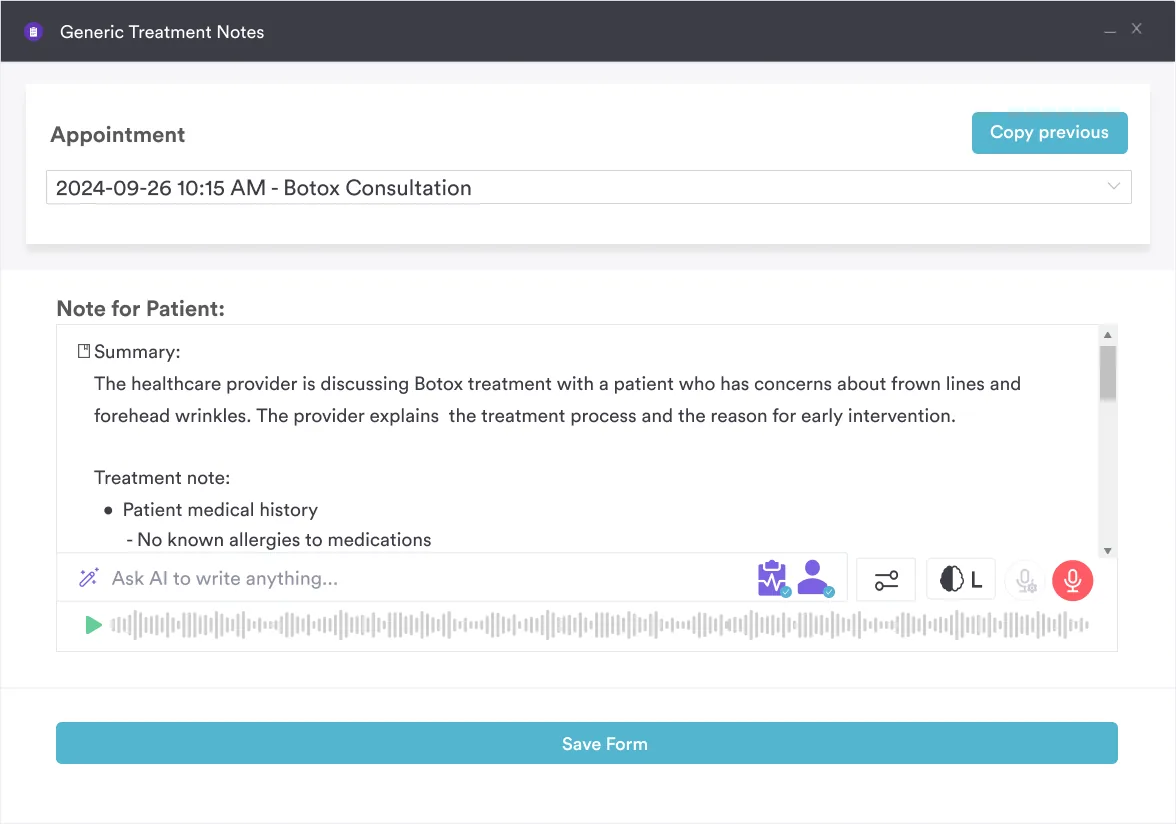
Practices that have transitioned to EHR systems built for private practice report fewer F22 coding errors when structured diagnostic documentation templates replace free-text notes. The combination of prompted documentation fields and integrated Pabau Scribe reduces the risk of omitting a criterion that triggers a payer audit.
F22 documentation carries more audit risk than most outpatient psychiatric codes because delusional symptoms can be described in ways that sound similar to the psychotic features found in F20.0 or the psychotic mood disorders excluded under F22.
Structured note templates that separate delusion duration, content, and functional status from a running free-text narrative reduce this risk more effectively than an unstructured note. Practices comparing options for this level of specificity can review this clinical documentation software breakdown built for behavioral health charting.
ICD-10 code F22 has a narrow clinical definition that payers review closely. Accurate coding depends on documentation that establishes non-bizarre delusion type, duration beyond one month, preserved general functioning, and rule-out of competing diagnoses — not just a diagnostic label in the problem list.
Pabau’s practice management platform helps psychiatric and mental health practices build F22 documentation requirements directly into clinical workflows, so clinical notes meet payer requirements at submission.
For a wider view of how documentation accuracy affects reimbursement timelines. Book a demo to see how Pabau supports accurate diagnostic coding and billing across complex mental health caseloads.

Billing group diabetes education sessions? Diabetes group training billing guide sets out the accreditation and referral rules that keep this claim from being denied.
Looking for EMR tools built for psychiatric practices? Psychiatry EMR software covers the features that help psychiatric clinicians manage diagnostic coding, medication management, and claim documentation from a single platform.
Trimming dystrophic toenails on a claim? Dystrophic nail trimming coding guide explains the systemic condition and modifier documentation this claim needs to pay.
ICD-10 code F22 is a billable ICD-10-CM diagnosis code for delusional disorders, characterized by psychotic behavior accompanied by persecutory or grandiose delusions with few other signs of personality or thought disturbance. It falls under Chapter 5 (Mental, Behavioral and Neurodevelopmental disorders) within the F20-F29 block, and has been valid for adult diagnoses since 2016.
F22 applies when delusions are non-bizarre and hallucinations are absent or minimal, with personality and functioning largely preserved outside the delusional system. F20.0 (paranoid schizophrenia) requires prominent hallucinations, typically auditory, often alongside formal thought disorder and negative symptoms. When auditory hallucinations are clearly documented, F20.0 is the more appropriate code.
Yes. F22 is a billable and specific ICD-10-CM diagnosis code, valid for adult diagnoses and billable for fiscal years 2016 through 2026. It can be used as a principal diagnosis for inpatient psychiatric admissions or as the primary diagnosis on outpatient claims paired with appropriate psychotherapy or evaluation and management CPT codes.
Use F22 when psychotic symptoms, specifically non-bizarre delusions, have persisted for one month or longer without meeting the full criteria for schizophrenia. F23 applies to episodes lasting at least one day but fewer than one month with eventual full return to premorbid functioning. If a patient was initially coded F23 provisionally, update to F22 once the one-month duration threshold is documented.
Under the current MS-DRG version, ICD-10 code F22 maps to MS-DRG 885 (Psychoses). Unlike many MS-DRGs, 885 is a single-tier DRG with no CC/MCC severity split, so all qualifying psychosis diagnoses group to DRG 885 regardless of complicating or major complicating conditions. Facilities should validate current grouper assignments using the CMS MS-DRG Grouper/Definitions Manual or their facility’s grouper software, as MS-DRG mappings are updated annually.
Yes. The ICD-10-CM tabular list carries an Excludes2 note under F22 for paranoid personality disorder (F60.0), which means both codes can be reported together when clinical documentation independently supports each diagnosis. An Excludes2 note signals that the excluded condition is not part of the primary code but does not prohibit dual coding when both conditions are clinically present and documented. F22 also carries a separate Excludes1 note for paranoid schizophrenia (F20.0) and psychotic mood disorders, which can never be coded with F22 on the same claim.
Delusional parasitosis, also called Ekbom syndrome or delusion of infestation, is a somatic-type delusional disorder and codes to F22 in ICD-10-CM. There is no separate code for the infestation belief itself, so the encounter is billed as F22 once the note documents the somatic subtype, the one-month duration, and that no true infestation or medical cause was found.
Delusional disorder coded F22 tends to run a persistent, often chronic course, with the delusional belief lasting at least one month and frequently far longer. F22 itself carries no acute-versus-chronic split in ICD-10-CM, so the same code applies whether the presentation is early or long-standing.
The DSM-5-TR lists delusional disorder under the same F22 code used in ICD-10-CM, so the DSM-5 code for delusional disorder is F22. The manual then specifies the delusional subtype — persecutory, erotomanic, grandiose, jealous, somatic, or mixed — rather than changing the code.



