









CPT Code 20700: drug delivery device billing guide (2026)
Add-on codes are where billing errors quietly accumulate. CPT Code 20700 enters ...

Last Updated: August 19, 2026


CPT code 19000 covers puncture aspiration of a breast cyst, performed without imaging guidance.
Code 19001 is the add-on for each additional cyst aspirated in the same breast.
Bilateral aspiration needs modifier 50 or separate LT and RT lines, and Medicare pays 100% for each side.
Modifiers 26 and TC never belong on 19000, because the code has no professional or technical split.
Practice management software like Pabau pre-fills the claim, but the coder still chooses the modifier.
CPT code 19000 covers puncture aspiration of a cyst of the breast, performed without imaging guidance. The rule is one line per session, and these claims still come back denied more often than the work deserves.
Under-billing is the quiet version of the problem. A second cyst goes unpaid, or a bilateral case bills as one side, and nobody notices until the remittance arrives. Payer modifier policy causes most of the rest. What follows tracks the claim from the procedure note through to the remittance.
Official AMA descriptor: Puncture aspiration of cyst of breast. Report 19000 when a physician puts a needle into a breast cyst and withdraws fluid, with no imaging guidance. The American Medical Association (AMA) maintains and publishes the CPT code set.
Within the Surgery chapter, 19000 opens the Breast section, which runs 19000-19499. It sits in the incision group at the top of that section, 19000-19030.
The procedure is clinically distinct from a breast biopsy. Aspiration withdraws cyst fluid for diagnosis or symptom relief, and it removes no tissue. Code 19000 applies only when the physician works without real-time imaging. If ultrasound or fluoroscopy guides the needle, the guidance code goes on the claim as its own line.
Coders in breast-specialty and OBGYN practices meet this code often, usually next to 19001 and a guidance code. Getting that interaction right is what keeps the claim clean.
Code 19001 is the add-on for each additional cyst aspirated beyond the first in the same session. It never stands alone, so 19000 has to lead the claim.
Under-billing is common here. When a physician aspirates three cysts in one visit, the claim reads 19000 x1 plus 19001 x2. Three units of 19000 is wrong.
Where those extra cysts sit changes how you report them. Coding guidance from AAPC puts 19001 on additional cysts within the same breast. When cysts come from both breasts, the bilateral modifier on 19000 covers the second side.
Add-on codes are not subject to the multiple procedure payment reduction, so a second cyst does not pay at half price. The same primary-plus-add-on pattern runs through breast biopsy coding with 19084. Most payers take 19001 as a standard add-on line. Check the plan’s policy before you submit an unusual unit count.
Payers check that the diagnosis justifies the aspiration, so the ICD-10-CM code carries as much weight as the CPT code. The AAPC CPT-to-ICD-10 crosswalk lists the pairings billers use most for this procedure. Keep a medical coding cheat sheet at the desk for the ones your practice bills every week.
These pairings are examples, not an approved list. The diagnosis has to match the finding written in the record, coded to the highest specificity the note supports. Laterality drives both the diagnosis code and the modifier, so read the note before you choose either.
Four modifiers cover almost every 19000 scenario. Applying the wrong one, or leaving a required one off, is a reliable path to a denial.
The AAPC Codify CPT lookup lists what applies, though payer policy still decides. Check the payer rule before submission, not after the rejection.
Modifiers 26 and TC do not belong here. Medicare gives 19000 a PC/TC indicator of 0, which means the code has no professional or technical split to divide. Those two modifiers belong on the imaging guidance codes instead, where that split does exist.
When a physician aspirates cysts from both breasts in one session, the payer decides the format. Two approaches are accepted, and the wrong pick for that payer triggers an automatic denial.
Software will not make this call for you. Claims management software pre-fills the claim from the patient record, and the choice between modifier 50 and LT/RT stays a payer-policy question. Keep that preference in a shared payer matrix your billers read before submission.
In 2026, Medicare pays roughly $80 to $110 for 19000 in the office, and about $35 to $40 in a facility. The CMS Physician Fee Schedule lookup tool publishes the official rates. Payment moves with your locality and with the place of service, so treat the figures below as national benchmarks.
Rates move every year with the fee schedule update, so check the current figure before you build a revenue forecast. Contracted commercial rates can sit well above or well below the Medicare benchmark for the same aspiration.
CPT code 19000 carries a zero-day global period, listed as 000 in the fee schedule file. Only the pre- and post-procedure work on the day of the aspiration sits inside that payment.
A related visit the next day bills on its own. Bill a separate same-day visit with modifier 25 on the E/M code.
Coverage itself turns on medical necessity. The Centers for Medicare and Medicaid Services (CMS) covers 19000 when the documentation supports it.
Local Coverage Determinations (LCDs) from your Medicare Administrative Contractor (MAC) can add criteria locally. Check the NCCI edits for bundling restrictions when 19000 shares a claim with another breast procedure.
Imaging guidance is never included in 19000. When a physician uses real-time ultrasound to place the needle, the guidance code goes on the claim as a separate line. NCCI edits and plan policy then decide whether the pair survives adjudication.
Conflicting guidance is normal here, because NCCI edits and plan policy do not always agree. Confirm the rule for the payer in front of you, rather than applying one rule to every 19000 claim.
Code 19000 sits in a family of breast and aspiration codes, and the neighbors look similar on paper. Knowing what each one covers prevents both unbundling and under-coding.
New coders mix up 19083 with 19000 more than any other pair. 19083 is a biopsy that removes tissue and always includes imaging, so reporting it for a plain aspiration is upcoding. The other trap is 10021. When the needle samples a solid mass for cytology, the fine needle aspiration family applies, not 19000.
A clean 19000 claim starts in the note. Payers audit these claims regularly, and a missing element is the usual reason a paid claim gets recouped later. The medical forms your team fills in at the visit decide whether the record holds up.
Practices on HIPAA-compliant systems can build this into a structured note template for breast aspiration. The template prompts the provider for each field at the point of care, instead of leaving it to a chart addition three weeks later. That timing is what keeps documentation denials down.
Build the documentation checklist for 19000 into your procedure note template. Flag fields for laterality, cyst count, imaging guidance (yes or no), and fluid description. A complete note at the point of care removes the most common denial reasons before the claim exists.
Most 19000 denials trace back to the same short list. Each one is preventable with a workflow control, and each one costs more as volume rises. The same controls carry over to the other aspiration codes your practice bills.
The double denial is the one worth watching for. A claim with a missing bilateral modifier and a vague diagnosis gets denied on two grounds at once. Fix one reason and the corrected claim comes back for the other. Catching both before submission is what stops one visit becoming three trips through the revenue cycle.
You can catch almost everything that fails on a 19000 claim in under a minute. Read the note, then read the claim line, and confirm that the two agree.
After that, the claim path is short. The charge line leaves the record, a scrubber checks the required fields, the clearinghouse forwards it, and the payer answers with a remittance. Every field the CMS-1500 form needs has to be complete before that first hop, which is where membership and authorization numbers usually go missing.
Plans that ask for prior authorization are the exception worth planning around. Send the prior authorization form before the appointment, because a retroactive request rarely rescues the claim.
In most practices the 19000 claim gets rebuilt by hand after the visit. A coder reads the operative note, then retypes the procedure and diagnosis codes into the payer’s form.
Then comes the hunt for the membership number or authorization code that form needs. Each retype is another chance to drop laterality or the second cyst.
Practice management software like Pabau removes the retyping rather than the judgment. The code attached to the service lands on the charge line by itself. Diagnosis slots pull from the problem list in the client’s chart. What lands there is what the clinician documented.
For breast cyst aspiration billing, these are the parts of that workflow worth knowing:
None of this picks your codes. Pabau will not suggest modifier 50 over LT/RT for a given payer, prompt you for 19001, or crosswalk a diagnosis to the procedure.
Those three decisions belong to the coder, working from the note and the payer’s own policy. Build the controls for them into your procedure note template and your payer matrix.
The practical effect is narrower than a coding engine, and more useful day to day. Fewer claims come back for a missing authorization number or a transposed code, and the ones that do sit in one place. Breast and surgical practices can see the same workflow in our plastic surgery EMR.
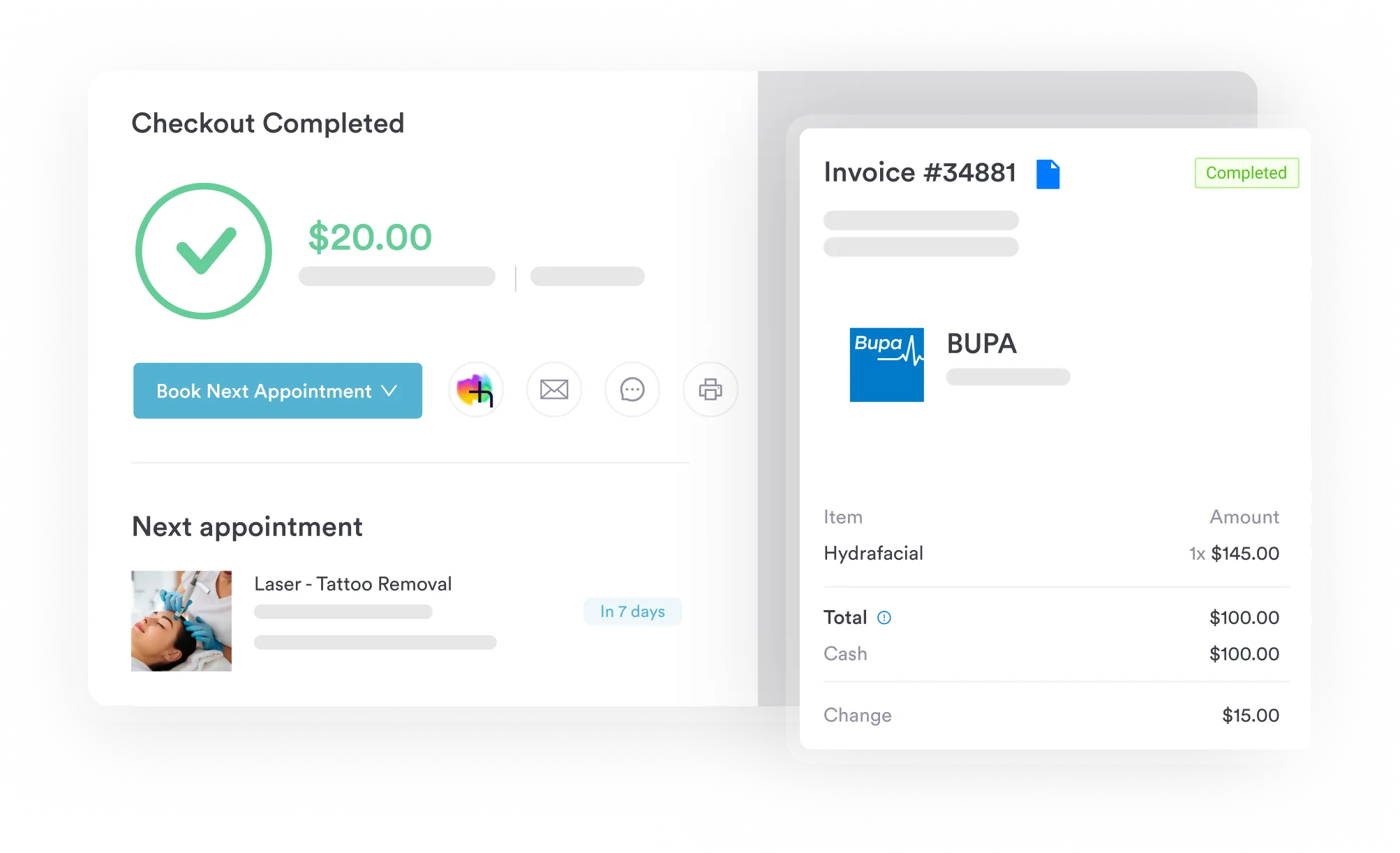

Pabau pre-fills the claim from the patient record, checks that payer-required fields are complete, and submits it electronically through Claim.MD. Your coders keep control of every code and modifier decision.

Getting 19000 paid at full value comes down to three lines in the note. The cyst count drives 19001, the documented side drives the bilateral modifier, and the imaging statement decides whether 76942 is billable. Write those three at the point of care and the claim almost builds itself.
The trade-off worth remembering is that no software picks the modifier for you. Payer policy does that, and the durable fix is a payer matrix your billers actually read.
Pabau clears the retyping and the missing-field denials around it, so your coder spends the time on decisions that need judgment. Book a demo to see how breast and surgical procedure claims move from the record to the payer.

Comparing claims tools before you commit? Pabau vs Waystar sets the two claims workflows side by side for a small billing team.
Draining an abscess rather than aspirating a cyst? 19020 covers the mastotomy code and where drainage stops being an aspiration.
Coding a deep soft tissue biopsy somewhere else? 21925 walks through depth, site, and the documentation each one needs.
Want the indication captured before the needle goes in? History and physical form gives you a structured intake record to build the procedure note on.
Billing a self-pay patient for the aspiration? Superbill guide sets out what the patient needs on the document to claim it back.
Yes, when the visit is genuinely separate from the procedure. Add modifier 25 to the E/M code, and document the separate problem or decision that earned it. If the patient came in only for a planned aspiration, bill the procedure alone.
CMS publishes a medically unlikely edit, or MUE, for each code. Check the current MUE table before you submit a high unit count. Keep the cyst count in the note, so those units have support behind them.
The lab that examines the specimen reports the cytopathology code. Your practice bills the aspiration only, unless it runs the study in house. Document where the fluid went, so the two claims tell the same story.
Medicare does not require prior authorization for an office aspiration. Some commercial plans do, particularly when the visit follows imaging. Check the plan’s list before the appointment rather than after the denial.
Yes, where state scope of practice and payer enrollment allow it. Bill under the performing provider’s own NPI, or as incident to a physician when the payer permits that. Credentialing rules vary by state.