Speech therapy practice management software puts scheduling, SOAP notes, billing, and telehealth on one system instead of four.
US insurance billing depth varies widely. ClinicSource and Fusion Web Clinic go deepest, while Pabau suits private-pay and hybrid billing.
Ambiki and Fusion Web Clinic ship SLP goal banks out of the box, while Pabau fits practices where SLPs work alongside OTs and PTs.
On several platforms the feature you came for sits a tier above the entry price, so check where it lands before you sign.
Most speech-language pathologists spend more time on admin than they planned to. Scheduling recurring sessions, writing a SOAP note after every appointment, chasing insurance claims, and handling intake paperwork all eat into clinical hours. In turn, software that removes each of those steps buys that time back.
This guide compares six platforms speech therapy practices run on. SimplePractice suits most solo and small private practices. ClinicSource goes deepest on US insurance billing, and Pabau, the practice management software we build, fits practices where speech therapy sits alongside other disciplines. Ultimately, your billing model and the mix of practitioners in your building narrow the list fast.
One thing the review sites rarely surface: on several of these platforms, the feature you came for sits a tier above the advertised entry price. For example, TheraPlatform’s interactive therapy apps start on Pro, not Basic. Similarly, Ambiki’s cheaper plan caps you at 60 visit notes a month. The pricing tables under each review show exactly where those limits fall.
Found our content helpful?
How the six platforms compare at a glance
The table below covers each platform by best-fit use case, standout feature, published entry price, and available rating data. First, use it to shortlist, then read the two or three reviews that apply to you.
Name
Best for
Standout feature
Starting price
Rating
SimplePractice
Solo SLPs and small private practices
Polished client portal and telehealth
From $49/month
4.6/5 (2,800+)
ClinicSource
Multi-discipline practices with heavy insurance billing
Therapy billing with clearinghouse integration
From $74.95/month
4.3/5 (Capterra)
Fusion Web Clinic
Pediatric speech therapy practices
Pediatric-focused documentation and billing
From $25/month
4.4/5 (Capterra)
Pabau
Multi-specialty and multi-clinician practices
One platform for SLPs, OTs, PTs, and other disciplines
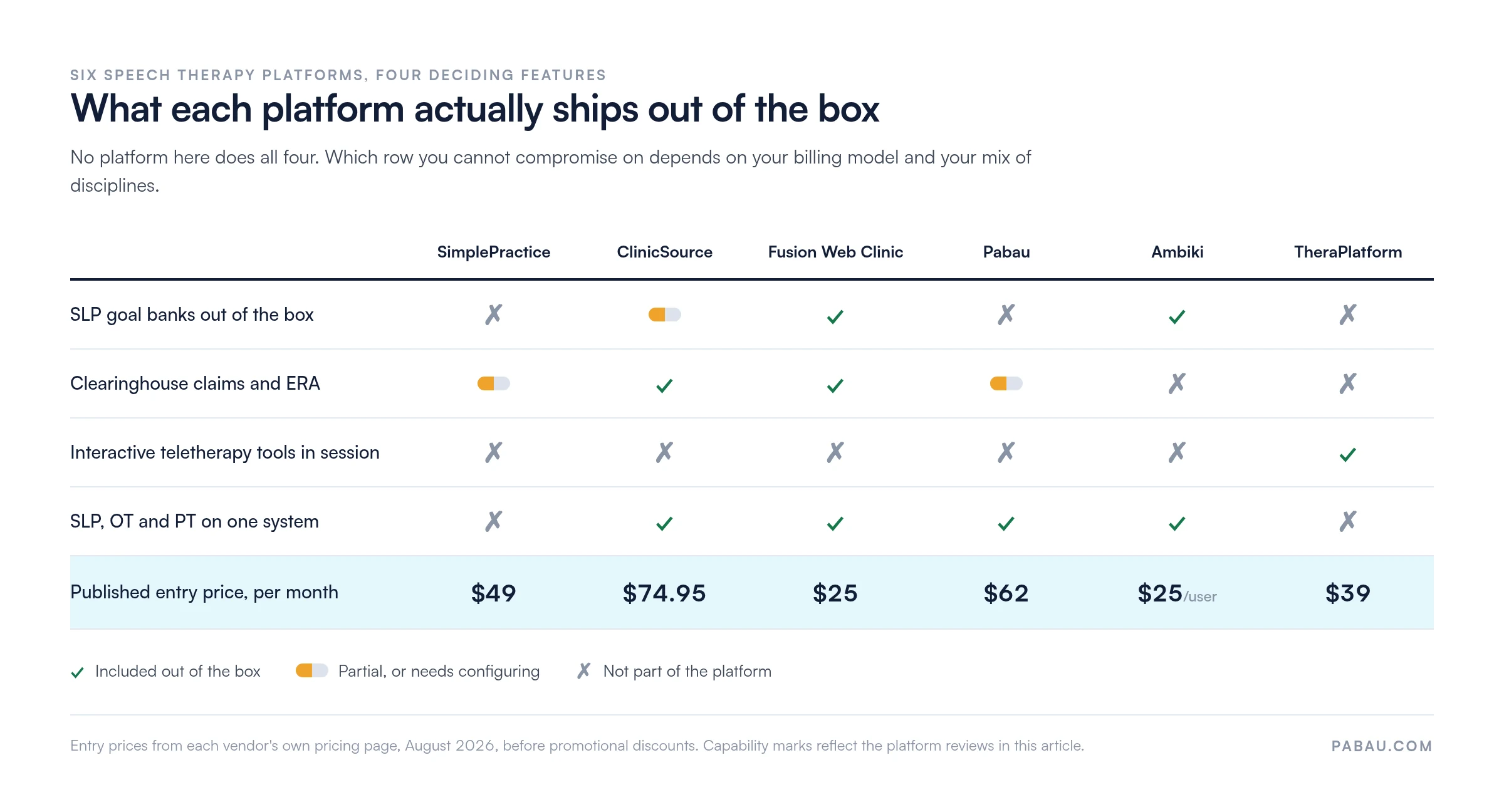
Four features decide most of these purchases, and no platform here carries all four. Accordingly, the matrix below shows which one ships what, next to each vendor’s published entry price.
The cheapest entry price and the deepest SLP documentation never sit in the same column, which is why billing model has to come first. Prices from each vendor’s own pricing page, August 2026.
1. SimplePractice – best for solo SLPs and small private practices
Rating4.5/5★★★★★Top pick
The bottom line
The most widely adopted option for solo and small speech therapy practices, and the quickest to set up alone.
Who it’s for
Solo speech-language pathologists in private practice
Client portal handles intake, booking and secure messaging
Telehealth, notes and billing in one workflow
Easiest setup of the six platforms here
What doesn’t
No SLP goal banks out of the box
Cost climbs with every clinician added
Note templates are less configurable than rivals
SimplePractice is one of the most widely used practice management platforms among solo and small-group therapy providers in the US. As a result, its reputation with speech-language pathologists rests on a clean interface, a strong client-facing portal, and reliable telehealth. According to Capterra reviewers, it holds 4.6 out of 5 from over 2,800 verified reviews, making it the most reviewed therapy platform in this comparison.
Key features
Scheduling and calendar: Online booking, recurring session scheduling, and automated appointment reminders
Documentation: SOAP note templates, progress notes, and a library of pre-built session formats
Billing and insurance: Claims submission, ERA processing, and invoicing for private-pay clients
Telehealth: HIPAA-compliant video sessions tied to scheduling and billing
Client portal: Clients complete intake paperwork, book appointments, and message you securely
Mobile access: iOS and Android apps for practitioners managing sessions between visits
Where SimplePractice shines
Ease of use: Consistently praised for an intuitive interface, especially by solo practitioners setting up without IT support
Client portal: One of the strongest client-facing experiences here, covering intake forms, scheduling, and secure messaging
Telehealth integration: Video sessions, billing, and documentation connect without a third-party tool
Where SimplePractice falls short
Group practice pricing: Costs rise meaningfully as the practice grows, and reviewers flag that adding clinicians erodes the value
Documentation flexibility: Note templates are less customizable than rivals built for therapy documentation
Customer support: Some reviewers report slower response times during high-volume periods
Customer reviews
Practitioners highlight how fast the platform is to get running, plus the quality of the telehealth and billing tools. However, negative feedback centers on group-practice pricing and the pace of support responses. Still, reviewers rarely complain about the interface itself, which is unusual in this category.
Who SimplePractice is best for
Solo speech-language pathologists in private practice
Small practices of two to four clinicians where simplicity is the priority
SLPs offering telehealth who want video, billing, and notes on one system
Pricing
Plan
Price
Users
Starter
$49/month
1 clinician
Essential
$79/month
1 clinician
Plus
$99/month
1 clinician, group practices add clinicians
Prices come from SimplePractice’s own plan sheet and exclude the introductory discount offered to new accounts. Group practice costs scale with the number of clinicians on the account, so a four-SLP practice pays four times the headline figure.
2. ClinicSource – best for insurance billing in multi-discipline practices
Rating4.3/5★★★★★Our pick for insurance billing
The bottom line
The deepest insurance billing here, built for therapy practices where claim volume drives the workload.
Who it’s for
Multi-discipline practices with high claim volume
Practices needing clearinghouse submission and ERA processing
SLP practices that also treat OT and PT caseloads
Billing staff working denials in house
PricingFrom $74.95/monthentry plan, tiers not published
Clearinghouse integration with ERA and EOB workflows
Denial management built into the billing module
Therapy-specific notes and progress reporting
What doesn’t
Interface feels dated next to newer platforms
Mobile experience is limited
Support quality varies between reviewers
ClinicSource is a practice management system for multi-discipline therapy practices with a particular strength in insurance billing. Specifically, it handles SLPs, OTs, and PTs on one system, and its billing module includes clearinghouse integration for US claims processing. Where claim volume drives the operational workload, that billing depth is the differentiator.
Key features
Insurance billing with clearinghouse integration: Electronic claims submission, ERA and EOB processing, and denial management workflows
Therapy-specific documentation: SOAP note templates and clinical documentation tools for speech therapy and allied health
Scheduling: Appointment management across multiple clinicians and disciplines
Progress monitoring: Goal tracking and progress reporting for therapy caseloads
Multi-discipline support: One system covering SLPs, OTs, and PTs in the same practice
Where ClinicSource shines
Insurance billing depth: Clearinghouse integration, ERA and EOB workflows, and denial management run deeper here than on general platforms
Front-end claim accuracy: Pairing it with disciplined eligibility verification keeps avoidable denials off your worklist
Therapy-specific workflows: Documentation and progress monitoring were shaped for therapy rather than retrofitted from a generic platform
Where ClinicSource falls short
Interface design: Reviewers describe the interface as older-feeling than newer platforms in the category
Mobile experience: More limited than competitors with purpose-built mobile apps
Support consistency: Some reviewers report variability in support response quality
Customer reviews
According to Capterra reviewers, ClinicSource holds 4.3 out of 5. Positive feedback focuses on the billing workflow and multi-discipline support. However, critical feedback centers on the dated interface and inconsistent support quality.
Who ClinicSource is best for
Multi-discipline therapy practices where US insurance billing is the main operational challenge
Practices with high claim volume needing clearinghouse integration and ERA processing
SLP practices that also serve OT and PT clients on a single billing system
Pricing
Plan
Price
Users
Entry plan
From $74.95/month
Not published
ClinicSource publishes a starting price on its own site but no tier breakdown and no user limits. Consequently, that makes it the hardest platform here to budget for without a sales call. Ask for the per-therapist cost at your headcount before you compare it with anything else.
3. Fusion Web Clinic – best for pediatric speech therapy practices
Rating4.4/5★★★★★Our pick for pediatrics
The bottom line
Pediatric therapy documentation and billing, now published at a solo price that undercuts most of this list.
Who it’s for
Pediatric speech therapy practices
Multi-discipline pediatric practices with SLPs, OTs and PTs
Practices billing early intervention and school-age programs
Fusion Web Clinic, now sold as part of the Ensora Health suite, focuses on pediatric therapy practices. It serves SLPs, OTs, and PTs who work with children. Specifically, its documentation and billing tools are shaped around pediatric workflows, including the progress note formats and payer structures common in that setting. According to Capterra reviewers, it holds 4.4 out of 5.
Key features
Pediatric-focused documentation: Clinical note templates and progress reporting designed for therapy with children
Insurance billing: Claims submission and billing workflows for pediatric payers and plans
Scheduling: Appointment management for therapy caseloads, including recurring sessions
Progress monitoring: Goal tracking and outcome reporting tied to each therapy plan
Multi-discipline support: Serves SLPs, OTs, and PTs within the same practice
Where Fusion Web Clinic shines
Pediatric specialty focus: Documentation and billing shaped around pediatric therapy, which general platforms do not prioritize
Screening and referral paperwork: Pediatric caseloads lean on tools like the the M-CHAT-R, and note formats here already assume that work
Published entry price: The Foundation plan gives solo therapists the cheapest published start of the six
Where Fusion Web Clinic falls short
Interface design: Some reviewers describe the interface as feeling dated next to newer platforms
Setup complexity: Configuration can be involved for practices without dedicated IT support
Cost at scale: The jump from the Foundation plan to the Premier tier is steep for a growing team
Customer reviews
Reviewers cite the pediatric therapy focus and documentation quality as consistent strengths. They also note that the interface feels older than newer platforms, and that setup takes a meaningful time investment before the practice sees the benefit.
Who Fusion Web Clinic is best for
Pediatric speech therapy practices serving children and school-age clients
Multi-discipline pediatric practices with SLPs, OTs, and PTs under one roof
Practices that value specialized pediatric billing over a modern interface
Pricing
Plan
Price
Users
Foundation
$25/month
1 user, solo only
Essentials
$99/month
1 user, solo only
Advanced
$159/month
1 user, then $45 per extra user
Premier
$229/month
1 user, then $75 per extra user
Figures come from Ensora Health, which now owns and prices Fusion. Additionally, list prices are shown here, so check the current promotional rate before you budget. The jump from Foundation to Essentials is where most growing practices land.
Pro Tip
If your practice serves both school-age children and adult clients, check that the platform supports the session note formats and billing structures for each population. Pediatric-specific platforms optimize for child therapy workflows. Platforms like Pabau and SimplePractice stay more flexible across age groups.
4. Pabau – best for multi-specialty and multi-location practices
Rating4.7/5★★★★★Our pick for multi-specialty
The bottom line
One system for a practice where speech therapy sits alongside OT, PT and other disciplines.
One calendar, record and invoice across every discipline
Every subscription includes every feature
Multi-location management built in
What doesn’t
No pre-built SLP goal banks, templates need configuring
Less out-of-the-box US insurance depth than ClinicSource
Broader platform takes longer to set up
Pabau is built for practices running several disciplines under one roof. SLP-specific platforms assume you only see speech therapy clients. By contrast, Pabau puts the same scheduling system, client record, and billing workflow behind SLPs, occupational therapists, physical therapists, and other practitioners at once. Plenty of private speech therapy practices work that way, and running separate software per discipline fragments the admin.
The platform covers scheduling, customizable clinical documentation, invoicing, payment processing, telehealth, and a client portal. In addition, its speech therapy software setup supports solo SLPs and multi-clinician group practices, with multi-location management built in. Consequently, documentation runs on customizable templates rather than pre-built SLP goal banks, which suits a practice treating a mixed caseload.
Key features
Multi-location scheduling: Manage several SLPs and treatment rooms across sites from one calendar view
Customizable clinical notes: Adapt templates for SOAP notes, progress notes, and speech therapy goal tracking
Online booking and client portal: Clients self-book, complete intake forms, and read pre- and aftercare instructions online
Telehealth video consultations: Integrated telehealth software with scheduling and records in one workflow
Invoicing and payment processing: Private-pay billing, package management, and online payment collection
HIPAA-compliant data handling: Protected health information managed in line with HIPAA requirements
Automated reminders and recalls: Configurable SMS and email reminders to cut no-shows
Reporting and analytics: Track revenue, appointment volume, and practitioner performance across the practice
Where Pabau shines
Multi-specialty operations: One system for SLPs working alongside OTs, PTs, and other practitioners, with no second subscription to manage
Scalability: Multi-location support and team management grow with the practice as it adds clinicians and sites
Private-pay billing workflows: Strong invoicing, deposits, and package management for practices working outside insurance networks
Integrated client experience:Digital forms, automated reminders, and a client portal cut front-desk admin
Where Pabau falls short
SLP-specific documentation: No pre-built speech therapy goal banks or discipline-specific SOAP templates, so these need configuring first
US insurance billing depth: Practices billing mainly through US plans with ERA and EOB processing will find more depth in ClinicSource or Fusion Web Clinic
Setup time: The platform’s breadth means a longer configuration period for small practices that need only a slice of it
Customer reviews
According to Capterra reviewers, Pabau earns 4.7 out of 5 from over 600 verified reviews. Positive themes center on scheduling, multi-location support, and onboarding quality. However, reviewers note that reporting customization could go deeper, and that smaller practices feel the price against simpler tools.
Who Pabau is best for
Multi-specialty practices where SLPs work alongside OTs, PTs, or mental health practitioners
Group speech therapy practices managing several clinicians and locations
Private-pay or hybrid-billing practices that do not depend on deep clearinghouse workflows
Practices that want one platform across every workflow rather than a silo per discipline
Pricing
Plan
Price
Users
Solo
From $62/month
1 user
Team and group
Scales with users and locations
2 to 15 users
Enterprise
Custom quote
16+ users, multiple locations
Every Pabau subscription includes every feature, so the tier changes how many users and locations you cover rather than what the platform can do. Pricing also varies by region. The current breakdown sits on Pabau’s pricing page.
5. Ambiki – best for therapy-specific documentation
Rating/5★★★★★Our pick for SLP documentation
The bottom line
Built for SLPs, OTs and PTs, so the goal banks and note formats arrive ready to use.
Who it’s for
SLPs who want goal banks on day one
SLP, OT and PT practices sharing one system
Practices where progress reporting drives the clinical workflow
Teams leaving an older therapy platform
PricingFrom $25/month per userProfessional Plan (Limited)
Goal tracking and outcome reporting across a caseload
Cleaner interface than legacy therapy platforms
What doesn’t
Insurance billing still developing
Small integration ecosystem
Almost no independent review data
Ambiki was built specifically for speech-language pathologists, occupational therapists, and physical therapists, and that focus shows in the documentation. General platforms need configuring before they produce an SLP-appropriate note. By contrast, Ambiki ships discipline-specific templates, goal banks, and progress monitoring designed for therapy caseloads.
Key features
SLP, OT, and PT documentation templates: Pre-built clinical note formats and goal banks for each therapy discipline
Progress monitoring: Goal tracking and outcome reporting across a therapy caseload
Scheduling: Appointment management for solo and small-group therapy practices
Billing and payroll: Full billing and payments on the Professional plan, with an automated double-entry ledger
Teletherapy: Video sessions for remote therapy delivery
Custom form builder: Build your own intake and assessment forms on the Professional plan
Where Ambiki shines
Therapy-specific documentation: SLP goal banks and discipline-appropriate note templates remove the setup work other platforms hand you
Progress monitoring: Goal and outcome tracking across a caseload serves both clinical review and payer reporting
Developmental caseloads: Formats sit close to instruments like a developmental assessment, so less gets retyped
Where Ambiki falls short
Insurance billing maturity: As a newer platform, billing is still developing, and practices with complex payer relationships will notice
Third-party integrations: A smaller integration ecosystem than the established platforms here
Review data: Almost no presence on major review sites, so independent verification is hard to come by
Customer reviews
Ambiki has no meaningful presence on the major review platforms. Feedback from therapy community forums points to the therapy-specific documentation as the genuine differentiator. However, the same posts flag that the platform is young and its billing depth is still growing. Therefore, ask for reference customers before you commit a billing-heavy practice.
Who Ambiki is best for
SLPs, OTs, and PTs who prioritize therapy-specific documentation over billing depth
Practices where goal tracking and progress reporting sit at the center of the clinical workflow
Teams moving off a legacy therapy platform toward a more modern interface
Pricing
Plan
Price
Users
Professional Plan (Limited)
$25/month per user
Priced per user
Professional Plan
$59/month per user
Priced per user
Ambiki publishes both plans on its own site, so the earlier assumption that it hides pricing no longer holds. The Limited plan caps clinical documentation at eight plans of care, eight evaluations, and 60 visit notes a month. However, a full-time SLP caseload will pass that quickly.
6. TheraPlatform – best for teletherapy-first SLPs
Rating4.7/5★★★★★Our pick for teletherapy
The bottom line
The only platform here with therapy activities built into the video session itself.
Who it’s for
SLPs running fully or mostly online practices
Solo teletherapy practitioners
Therapists who need session activities, not just video
Practices where telehealth is the main delivery model
Whiteboards, games and flashcards inside the session
Unlimited telehealth on every plan
Quick to set up and start seeing clients
What doesn’t
Billing is thinner than dedicated billing platforms
Note templates are less configurable
Interactive therapy apps start on Pro, not Basic
TheraPlatform was designed around remote therapy delivery. It covers scheduling, documentation, and billing like everything else here, but the interactive teletherapy toolset is what sets it apart. As a result, SLPs running mostly online practices get session tools that general practice management platforms do not offer.
Key features
Interactive teletherapy tools: Built-in whiteboards, digital games, flashcards, and therapy activities for live sessions
HIPAA-compliant video: Secure sessions that meet US healthcare data requirements, as compliant telehealth platforms must
Scheduling: Appointment booking and calendar management for solo and small-group practices
Documentation: SOAP notes and session notes built into the platform
Billing: Invoicing plus insurance billing, with electronic claim filing charged per use
Resource library: Therapy materials reachable inside the session window
Where TheraPlatform shines
Teletherapy toolset: Whiteboards, games, and flashcards were purpose-built for SLPs working remotely, not bolted onto a video call
Affordable entry: An accessible starting price for a practitioner building an online practice
Ease of setup: Reviewers consistently highlight how quickly the platform gets running
Where TheraPlatform falls short
Billing depth: Insurance billing is less comprehensive than dedicated billing platforms like ClinicSource
Documentation flexibility: Note templates are less configurable for practices with non-standard requirements
Community and support: A smaller user community and support ecosystem than SimplePractice
Customer reviews
TheraPlatform holds 4.7 out of 5 on Capterra. Reviewers praise the built-in teletherapy tools and the affordable starting price, while flagging that billing may not stretch to a practice with complex insurance workflows.
Who TheraPlatform is best for
SLPs running primarily or fully online practices
Solo practitioners delivering teletherapy who want interactive session tools
Practices where the teletherapy experience matters more than billing depth
Pricing
Plan
Price
Users
Basic
$39/month
1 provider, no extras
Pro
$69/month
1 provider, then $39 per extra provider
Pro Plus
$79/month
1 provider, then $49 per extra provider
Read the tiers carefully. The interactive therapy apps that make TheraPlatform worth shortlisting start on Pro, not on the $39 Basic plan. Additionally, electronic claim filing is charged per use on top of the subscription.
How to choose the right platform for your practice
No single platform wins across every practice type. Five factors decide it, and the first two do most of the work.
Billing model: If you bill mainly through US insurance plans, prioritize clearinghouse integration and ERA processing, which points to ClinicSource or Fusion Web Clinic. Private-pay and hybrid practices carry less of that overhead, so Pabau or SimplePractice fit better.
Practice composition: Solo SLPs and small single-discipline practices are well served by SimplePractice or TheraPlatform. Where SLPs share a building with occupational therapists, PTs, or mental health practitioners, a platform built for mixed disciplines earns its keep.
Delivery model: Practices delivering mostly remote therapy should test TheraPlatform’s session tools before assuming any compliant video tool will do. In a live speech therapy session, whiteboards, therapy games, and digital flashcards change what you can actually run.
Documentation depth: If SLP goal banks and progress note formats matter from day one, Ambiki and Fusion Web Clinic provide them out of the box. A practice treating several disciplines usually needs flexible templates instead, which is where Pabau’s configurable approach pays off.
HIPAA requirements: All six platforms are designed with HIPAA compliance requirements in mind. Confirm a signed Business Associate Agreement is available before any platform touches protected health information, as the HHS Office for Civil Rights requires.
Start with your billing model, then your practice composition. Those two factors alone cut six options to two or three. A demo then tells you whether the documentation and scheduling workflows match how your practice really runs.
If your practice…
Consider
Is a solo SLP with private-pay or simple insurance billing
SimplePractice
Runs high US insurance billing volume across disciplines
ClinicSource
Serves primarily pediatric clients
Fusion Web Clinic
Runs several disciplines (SLP plus OT, PT, or mental health)
Pabau
Needs SLP-specific goal banks from day one
Ambiki
Delivers primarily remote sessions
TheraPlatform
How Pabau keeps a multi-discipline practice on one system
In a practice where two SLPs share a building with an occupational therapist and a physical therapist, the admin usually splits four ways. Each discipline keeps its own calendar, its own note format, and sometimes its own subscription. As a result, the front desk ends up holding the whole picture in their head.
Practice management software like Pabau puts all of it on one record. A single calendar and scheduling view covers every practitioner, room, and location. For instance, a client who sees the SLP on Tuesday and the OT on Thursday has one file, one intake form, and one invoice. In addition, consent and medical forms arrive before the visit, so nobody chases paperwork at the door. That includes disclosure authorizations when records move between providers.
Documentation is configurable rather than pre-built, so you set up your own SOAP and progress note templates once. That takes longer on day one than a platform shipping SLP goal banks. However, it pays back in a practice where the note format differs by discipline and the same client record has to serve all of them.
Every subscription includes every feature, so the tier you land on changes your user and location count rather than your capability. Additionally, getting started runs through structured onboarding with a dedicated client coordinator. A platform this broad works best when it is configured around how your practice really operates.
Run every discipline on one client record
Pabau handles scheduling, clinical notes, invoicing, and telehealth for practices where SLPs work alongside OTs, PTs, and other disciplines. See how it fits your caseload and your billing model.
Two questions settle this faster than any feature list. How much of your revenue arrives through insurance, and how many disciplines share your building? Answer both honestly and four of these six platforms drop off your shortlist.
The trap worth avoiding is buying at the advertised entry price and finding the feature you came for one tier up. For example, interactive teletherapy, unlimited documentation, and extra clinicians all sit above the headline number on at least one platform here. Therefore, price the tier you will actually use, at the headcount you will actually have.
If speech therapy is one service among several in your practice, a single system across disciplines earns its keep. It beats any discipline-specific template you can rebuild yourself. Book a demo to see how Pabau runs a mixed caseload on one client record.
Continue your research
Screening a client’s speech sound production?articulation test guide shows how SLPs administer, score, and interpret results by age.
Screening for signs of dyslexia?dyslexia worksheet covers phonological awareness, decoding, spelling, and writing, plus how to score and re-test.
Documenting a swallowing assessment?dysphagia care plan template documents swallowing assessments, nursing diagnoses, interventions, dietary modifications, and aspiration precautions.
Want families more involved between sessions?Engaging families in speech therapy covers the communication habits that keep carry-over work happening at home.
Working on a client’s R sound?R worksheets for speech therapy gives a warm-up, practice syllables, minimal pairs, sentences, and a progress tracker.
Frequently asked questions
What is speech therapy practice management software?
Speech therapy practice management software combines scheduling, clinical documentation, billing, and client communication in one system for speech-language pathologists. It replaces disconnected tools, such as a separate calendar, note system, and billing package, with a single workflow covering booking through to payment.
What is the best practice management software for speech therapists?
It depends on your practice model. SimplePractice is the strongest all-round option for solo and small private practices. ClinicSource leads on US insurance billing, Fusion Web Clinic on pediatrics, Ambiki on SLP goal banks, and TheraPlatform on teletherapy. Meanwhile, Pabau fits practices running speech therapy alongside other disciplines.
Is speech therapy software HIPAA compliant?
All six platforms reviewed here are designed with HIPAA compliance in mind. Compliance takes more than software features, though. Confirm that a signed Business Associate Agreement is available with any platform that stores or processes protected health information. The HHS Office for Civil Rights requires it. Therefore, verify availability with each vendor before you commit.
What is the difference between a speech therapy EMR and practice management software?
A speech therapy EMR stores and manages clinical documentation: notes, assessment results, and treatment history. Practice management software covers a wider operational scope, including scheduling, billing, client communication, and reporting. Many modern platforms do both, while older systems handle one and need an integration for the rest.
Can speech therapists use the same platform for telehealth billing?
Yes, most modern speech therapy platforms include telehealth billing. The rules vary by payer and by US state, though. Some plans reimburse teletherapy at the in-person rate, while others apply different modifiers or coverage limits. Therefore, check your payer contracts and state regulations before you assume a session will be reimbursed.
Is there free practice management software for SLPs?
No major speech therapy platform reviewed here offers a permanently free plan. Some run free trials or limited demo access. Entry-level paid plans start at $25/month for Fusion Web Clinic, $39/month for TheraPlatform, and $49/month for SimplePractice. However, generic calendar apps lack the clinical documentation, billing, and HIPAA features a private practice needs.