Anja Dodevska
Skin clinic software Australia: 6 best picks, AUD prices
Skin clinic software in Australia costs a two-practitioner practice between A$84...

Last Updated: Sep 22, 2026
Free PDF 1 page, print-ready Clinician-reviewed
The national inpatient medication chart (NIMC) is the standardized form Australian hospitals use to prescribe, dispense, and administer medications to inpatients. The Australian Commission on Safety and Quality in Health Care developed it so that every ward works from the same seven-section layout.
That consistency is what cuts transcription errors. A prescriber and the nurse giving the dose read the chart the same way, on any ward in the country. Whether you are a new graduate or a manager writing medication protocols, correct completion is a patient safety requirement.
This guide walks through each section of the chart and explains who signs what. You can also download a free National Inpatient Medication Chart template and adapt it for your hospital or practice.
A printable seven-section chart with fields for patient identification, allergies, regular and PRN orders, once-only and pre-operative doses, infusions, and the administration record. Print it on colored paper and start using it on the ward today.
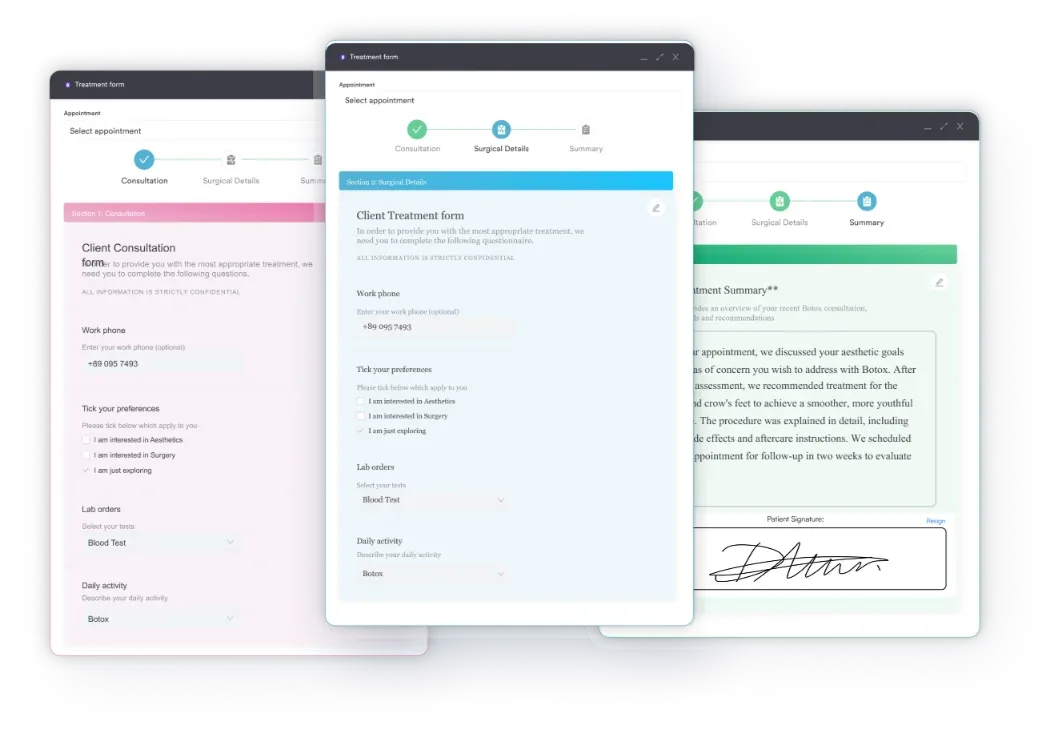
Upload this PDF, or any form you already use, and Pabau's AI Form rebuilds it with tick boxes, text fields and a signature. Attach it to the treatment once, and every patient gets it on time.
AI Form rebuilds the consent, history and aftercare forms you already use. You review each one, then publish.
Patients complete forms on their phone before they arrive, so the front desk stops retyping paper.
Every signed form is versioned and attached to the treatment record, ready when you need it.
Set how long a consent stays valid. Returning patients skip forms they have already signed.
Supports HIPAA and GDPR compliance AES-256 encryption 4.8 on G2 4.7 on Capterra Trusted by 4,000+ practices worldwide

The National Inpatient Medication Chart is the nationally standardized medication form for Australian hospital inpatients, developed by ACSQHC.
The NIMC has seven core sections: patient identification, allergies, regular orders, PRN, once-only and pre-operative doses, infusions, and the administration record.
Correct completion depends on clear prescriber orders, nursing administration records, and allergy details written down before any drug is ordered.
Practice management software like Pabau handles medication documentation in outpatient and private-practice settings, but it does not replace a hospital ward’s paper NIMC.
The National Inpatient Medication Chart is a structured, standardized medication chart mandated in most Australian public hospitals and widely adopted in private facilities.
The Australian Commission on Safety and Quality in Health Care (ACSQHC) designed it to standardize how medications are prescribed, documented, and administered to inpatients.
The chart does three jobs at once.
The chart is divided into distinct sections, each serving a specific purpose in the medication management workflow. Knowing what each section covers helps clinicians complete it correctly and catch safety issues before they reach the patient.
Knowing what a section is for is only half of it. The matrix below shows which role writes each part of the chart and which role only checks it.
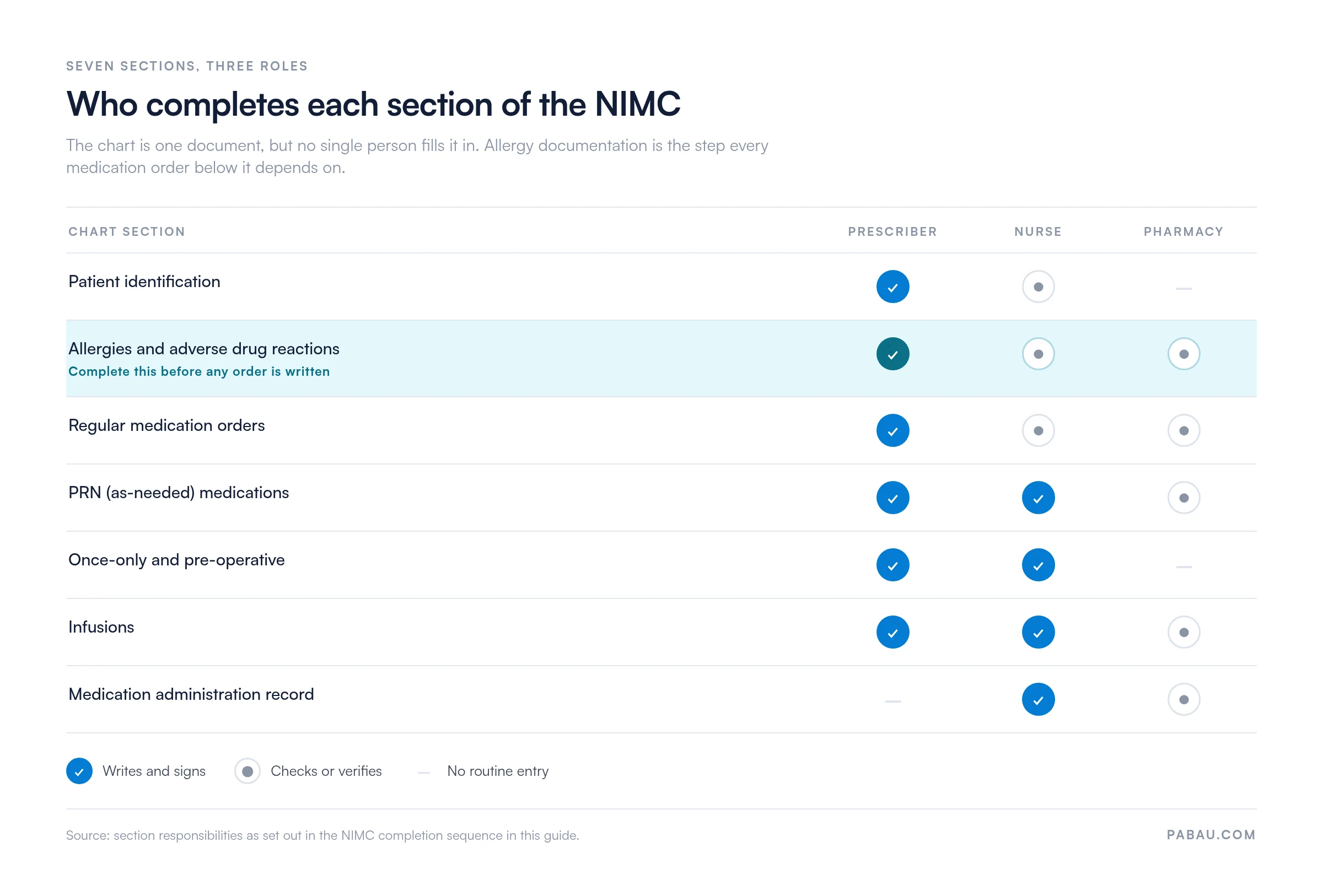
Completing the NIMC is a shared responsibility between prescribers, pharmacists, and nursing staff. Each step builds on the one before it, so missing information creates risk further down the chart.
Steps 2 and 3 are where paper costs the most time. The same allergy and medication history gets copied out by hand at every point of contact. Collecting it once with patient intake software gives the prescriber a written list to work from instead of a verbal one.
Step 7 is the one auditors read first. If you are setting standards for a new team, review nursing documentation practice alongside the chart itself. The signature rules are the same in both.
Some medications need extra scrutiny on the NIMC because a prescribing or administration error carries serious clinical consequences. These include anticoagulants such as warfarin, heparin and DOACs, plus insulin, opioids, and chemotherapy agents.
Many Australian hospitals add alert stickers or highlighted sections to flag these drugs for the nursing team. Prescribers write the orders with full strength and dose details, and many facilities require pharmacist verification before a dose is given.
Read Therapeutic Goods Administration (TGA) guidance on high-alert medications alongside your own institutional policy.
The official NIMC template is available free from the ACSQHC website. Most Australian hospitals print it on colored paper, often yellow or blue, so it stands out from the rest of the notes. Some facilities laminate the patient identification section so it carries across several pages during a long admission.
Some facilities run clinical software with medication ordering built in. There, the patient identification and allergy sections are pre-populated from electronic patient records and printed as a completed chart.
For patients continuing treatment after discharge, a simple medication log is easier to hand over than a ward chart.
Paper NIMC charts remain the legal standard in most Australian hospitals and are mandated across many public health services. Outside the inpatient ward, more practices are moving medication documentation onto software to cut administration time and give the team access from any device.
The safest digital setup mirrors the NIMC structure rather than replacing it with a free-text note. That keeps the discipline of the standardized chart while adding timestamps, search, and instant sharing with a dispensing pharmacist. If you are comparing options, start with what clinical documentation software has to record before it is worth adopting.
Most outpatient and private practices still carry medication history in three places at once. It sits on an intake form, in a clinician’s note, and on whatever chart was printed for the visit. When a patient returns six weeks later, someone re-asks the allergy question because nobody trusts the last answer.
Practice management software like Pabau keeps that history in one patient record instead. Allergies and current medications are captured on the intake form, carried into the clinical note, and shown to whoever opens the record next. Administration notes and follow-up doses are recorded against the same timeline, with a timestamp and a user on each entry.
This does not replace a hospital ward’s paper NIMC, and it is not meant to. What it does is remove the re-keying between visits, so the medication history a prescriber reads on admission is already written down and already current.


Pabau’s digital forms and electronic patient records hold allergies, current medications, and administration notes in one place. Your team stops re-keying the same details at every visit.

The NIMC works because it is predictable. Every ward uses the same seven sections in the same order. A clinician who has never met the patient can still read the chart correctly, and that is the whole point of standardizing it.
Download the template above, print it on the paper color your facility uses, and start with the allergy section. If your outpatient records still sit in a separate system, that is the part worth fixing next. The chart is only as good as the medication history behind it.
Book a demo to see how Pabau keeps allergies, current medications, and administration notes in one patient record.

Need a simpler chart for outpatient care? Medication log template gives patients a one-page record of doses taken between appointments.
Setting dose times for a treatment course? Medication schedule template lays out timing and frequency in a format patients can follow at home.
Training staff on drug information? Drug card template covers indication, dose, route and adverse effects in the format nursing programs use.
Writing your ward’s signature standards? Nursing documentation explains what a defensible administration entry has to contain.
Moving charts off paper? Clinical documentation software compares what these systems record and where they still need a printed form.
The National Inpatient Medication Chart is a standardized form used in Australian hospitals for prescribing, dispensing, and administering inpatient medications. It was developed by the Australian Commission on Safety and Quality in Health Care (ACSQHC). The aim is a consistent national format that reduces medication errors and improves patient safety.
The ACSQHC developed the NIMC as a national standard. It is mandated in most Australian public hospitals and adopted in many private facilities, but the specific requirements vary by state and territory health jurisdiction. Check your local health authority’s guidance for your setting.
The NIMC includes seven core sections. They are patient identification, allergies and adverse drug reactions, regular medication orders, PRN medications, once-only and pre-operative medications, infusions, and the medication administration record. The last of those is where nursing staff document each dose given.
The NIMC is the complete chart, covering patient identification, allergies, and all medication orders. The medication administration record (MAR) is one section inside it, where nursing staff document the time and administration of each dose.
The prescriber writes the medication name, the indication such as pain or nausea, the dose, the route, and a maximum frequency. Nursing staff then record each administration by noting the time and signing the PRN part of the administration record.
Common abbreviations include PRN (as needed), BD (twice daily), TDS (three times daily), and QID (four times daily). Route abbreviations are IV (intravenous), IM (intramuscular), and PO (by mouth), with O for a once-only dose. NA or DNS marks a dose not given, always with a reason.
The official template is available free from the ACSQHC website, and a downloadable PDF version sits at the top of this guide. You can print it directly, or adapt the sections to match your facility’s branding and workflow.
Medication reconciliation is the process of obtaining a full list of what the patient took before admission, then documenting it on the NIMC. The step is mandatory for patient safety and prevents accidental omissions and dangerous interactions.