The best CareCloud alternatives for medical practices are Pabau, DrChrono, Kareo (now Tebra), and AthenaHealth. Pabau, the practice management software we make, is the strongest pick for aesthetic and wellness practices. DrChrono suits mobile-first workflows, Tebra handles independent practice billing, and AthenaHealth fits larger multi-specialty groups.
CareCloud bundles an EHR, practice management, and revenue cycle management (RCM) into one platform. Practices still leave it, usually over opaque pricing, slow support, or a platform that feels rigid for specialty workflows. This guide compares the four alternatives on features, pricing, and practice fit, so you can decide before you commit.
Key takeaways
1. Pabau — Best for aesthetic, wellness, and multi-discipline practices billing on a self-pay or package basis.
2. DrChrono — Best for physician practices that chart on an iPad at the point of care.
3. Kareo (Tebra) — Best for independent primary care practices that run billing from the front desk.
4. AthenaHealth — Best for large multi-specialty groups that need network-benchmarked claims management.
Found our content helpful?
CareCloud alternatives compared: Quick overview
Here is how the four CareCloud alternatives compare on the dimensions that matter most when you switch.
Platform
Best for
Standout feature
Starting price
Capterra rating
Pabau
Aesthetic and wellness practices
Online booking, clinical notes, and automated patient workflows in one record
From $62/month
4.7/5 (650+)
DrChrono
Mobile-first and iPad-native practices
iPad-native EHR with customizable clinical templates
Contact sales
3.9/5
Kareo (Tebra)
Independent practice billing and RCM
Billing-first workflow with a clear claims dashboard
Contact sales
3.9/5
AthenaHealth
Large multi-specialty groups
Network-based RCM and performance-driven claims management
Contact sales
3.8/5
Why practices look for CareCloud alternatives
CareCloud (formerly MTBC, which acquired the original CareCloud in 2020) serves multi-specialty medical practices with a combined EHR, practice management, and RCM platform. It works well for practices with straightforward insurance billing and a dedicated IT resource. For many others, a few recurring frustrations push them toward alternatives.
Pricing opacity. CareCloud does not publish its pricing. Practices report quotes that vary widely, plus add-on costs for support tiers and RCM modules that were not clear upfront.
Customer support response times. Slow responses and inconsistent resolution quality rank as the top complaints across reviewer threads. For a small practice with no in-house IT, that is a meaningful risk.
Implementation complexity. After the MTBC rebrand, several reviewers report a steeper learning curve and an interface that needs more configuration than they expected.
Specialty fit. CareCloud is built around traditional insurance-billing workflows. Practices in aesthetics, wellness, IV therapy, or cash-pay models often find it over-engineered for their billing and thin on consumer-facing booking.
CareCloud pros and cons
CareCloud has clear strengths and clear limits. Here is an honest summary before the alternatives.
Pros
Cons
Integrated EHR, PM, and RCM in one platform
No publicly listed pricing
Strong claims management and denial handling for insurance-heavy practices
Customer support response times frequently criticized in reviews
Cloud-based with telehealth capabilities
Steep learning curve after the MTBC rebrand
Multi-specialty workflows supported
Limited fit for self-pay, aesthetic, or wellness practice models
Lab interfaces and health information exchange integrations
Implementation complexity and onboarding overhead
Key features to evaluate in a CareCloud alternative
No platform handles all three pillars (EHR, PM, RCM) equally well. Before comparing tools, decide which of them your practice leans on hardest.
Capability
Why it matters when switching from CareCloud
EHR / clinical documentation
Notes, templates, and patient records should match your specialty workflow, not a generic template
Scheduling and online booking
Consumer-facing booking with automated confirmations and reminders cuts no-shows without staff overhead
RCM / billing model
Insurance billing, self-pay, and package billing need different architectures. Pick the one that matches your revenue model
Patient engagement tools
Automated recalls, pre-care instructions, and post-care follow-ups protect revenue and patient retention
HIPAA compliance design
All US healthcare software must be designed to support HIPAA compliance under 45 CFR Parts 160 and 164. Verify BAA availability
Pricing transparency
Opaque pricing is a primary CareCloud complaint, so prioritize alternatives with clear per-provider or per-location pricing
Onboarding and support quality
If support issues drove you away from CareCloud, verify response SLAs and onboarding resources before committing
1. Pabau — Best CareCloud alternative for aesthetic and wellness practices
Rating4.7/5★★★★★Top pick
The bottom line
Pabau keeps online booking, clinical notes, and package billing inside one patient record.
Who it’s for
Aesthetic medicine and med spa practices
Wellness, IV therapy and longevity practices
Multi-discipline practices billing self-pay or packages
Booking, notes, payments and messaging in one system
Package and deposit billing without claims configuration
Automated recalls, pre-care and post-care messages
Every subscription includes every feature
What doesn’t
Insurance claims and clearinghouse work is not the focus
Configuring workflows and forms takes time at setup
Pabau is practice management software built for aesthetic medicine, wellness, and multi-discipline health practices. CareCloud is optimized for insurance-heavy multi-specialty groups. Pabau is built around aesthetic and wellness operations: Consumer-facing booking, package billing, and clinical documentation with before-and-after photos.
For practices in medical spa, dermatology, IV therapy, laser, or integrative medicine, Pabau usually fits better out of the box than CareCloud.
The automation layer is the clearest difference. Practices configure recall workflows, pre-care and post-care message sequences, and deposit rules once. From then on, the system sends the routine follow-up that a busy front desk tends to forget.
Pricing is published openly, from $62/month, which answers one of the most common frustrations with CareCloud.
Key features
Clinical notes and EHR: Customizable templates, before-and-after photo management, and injection plotting for aesthetic documentation
Online booking: Consumer-facing online booking with deposit collection, waitlist management, and multi-location support
Automated workflows:Automated workflows for recalls, reminders, pre-care and post-care messaging, and review requests
Billing and payments: Treatment package billing, invoicing, and integrated payment processing with deposit collection, plus Klarna for package and full-service payments
Digital forms: Paperless consent forms, intake questionnaires, and pre-treatment assessments delivered and signed digitally
Team and multi-location management: Timesheets, commissions, and scheduling across multiple practice locations
Pricing
Plan / Tier
Price
Details
Starter
From $62/month
Per practitioner, billed monthly
Team / Group
Scales by location and user count
Volume-based pricing
Enterprise
Custom pricing
Contact sales for a quote
Every Pabau subscription includes every feature, so moving up a tier buys scale rather than unlocking functionality.
Where Pabau shines
Scheduling, clinical documentation, and patient communications are native, so staff are not juggling separate tools
Package and deposit billing supports the self-pay model common in aesthetics and wellness, with no insurance claims configuration
Automated recall and follow-up workflows run without manual input, protecting revenue between appointments
Published subscription pricing removes the quote-and-negotiate overhead that frustrates CareCloud evaluators
Where Pabau falls short
Insurance claims processing and clearinghouse integration sit further from the core than they do in CareCloud or AthenaHealth. Practices with heavy insurance billing may need a separate RCM solution
New users report a learning curve at setup, particularly when configuring automated workflows and digital forms to their own requirements
Customer reviews
According to Capterra reviewers, Pabau holds a 4.7/5 rating from more than 650 verified reviews. Positive themes include the feature set for aesthetic practices, the onboarding support, and having booking and billing in one platform. Occasional glitches during updates and the time needed for initial configuration appear as recurring constructive points.
Who Pabau is best for
Aesthetic medicine and med spa practices that need consumer-facing booking alongside clinical documentation
Wellness, IV therapy, and longevity practices billing primarily on a self-pay or package basis
Multi-discipline practices that want scheduling, notes, communications, and payments under one subscription
Practices prioritizing published pricing and responsive onboarding after a difficult CareCloud experience
2. DrChrono — Best CareCloud alternative for mobile-first practices
Rating3.9/5★★★★★
The bottom line
An iPad-native EHR for physicians who would rather chart at the point of care.
Built for the iPad from the start, with Apple Pencil support
Customizable specialty note templates
Claims submission and denial tracking included
What doesn’t
Billing module complexity and support times draw complaints
No published pricing for higher tiers
Weaker experience on non-Apple devices
DrChrono is an iPad-native EHR and practice management platform for physicians who work primarily from Apple devices. Charting, scheduling, and billing were designed for the iPad from the start. Practices that see patients away from a fixed workstation, or that want charting done at the point of care, find the approach useful.
Key features
iPad-native EHR: Clinical documentation built for the iPad, with a touch-optimized interface and Apple Pencil support
Customizable templates: Specialty-specific clinical note templates the practice can build out or adjust
Practice management: Scheduling, appointment reminders, and patient check-in workflows
Medical billing: Integrated billing module with claims submission and denial tracking
Pricing
Plan / Tier
Price
Details
EHR and practice management
Contact sales
No published pricing
Medical billing / RCM
Contact sales
Priced as an added module
DrChrono publishes no prices, so every figure comes out of a sales conversation. Expect the quote to move with your specialty, your practice size, and the modules you take.
Where DrChrono shines
Mobile-first design that holds up for practices using iPads as their primary clinical device
Customizable note templates that adapt to a wide range of specialties
Strong Apple ecosystem integration for practices already standardized on iOS devices
Where DrChrono falls short
Reviewers consistently flag billing module complexity and support response times, the same issues that drive practices away from CareCloud
Pricing for higher tiers is not published, and practices report unexpected costs when adding RCM capabilities
Users on non-Apple devices will find the experience noticeably less polished
Customer reviews
According to Capterra reviewers, DrChrono holds a 3.9/5 rating. Users praise the iPad-native interface and the customizable clinical templates. Billing complexity and support response times are the most common frustrations.
Who DrChrono is best for
Physician practices standardized on Apple devices that want EHR charting on iPad at the point of care
Smaller specialty practices that need customizable clinical templates more than deep billing automation
If DrChrono is on your shortlist, our guide to DrChrono alternatives compares it against the platforms practices weigh it against most often.
3. Kareo (Tebra) — Best CareCloud alternative for independent practice billing
Rating3.9/5★★★★★
The bottom line
A billing-first platform that a front desk can run without a dedicated billing specialist.
Who it’s for
Independent primary care and general medicine practices
Solo and small groups with insurance-heavy billing
Claims, denials, statements and collections in one dashboard
Clear enough for non-specialist billing staff
PatientPop adds reputation and acquisition tools
What doesn’t
Limited customization outside primary care
Support quality reported as inconsistent
Not built for self-pay or package billing
Kareo is now rebranded as Tebra, following a merger with PatientPop. It is built for independent medical practices that put billing and RCM at the center of the workflow. Where CareCloud tries to serve the whole practice management stack, Tebra has always favored the revenue side: Claims submission, denial management, patient statements, and collections.
For a solo or small-group practice where the front desk handles billing, the dashboard-driven approach is easier to navigate than CareCloud’s interface.
Key features
Billing and RCM dashboard: Claims management interface with denial tracking and patient collections workflows
EHR module: Clinical documentation with standard note templates and e-prescribing
Patient engagement: Appointment reminders, patient messaging, and online reputation tools from the PatientPop merger
Practice management: Scheduling and patient check-in workflows for small to mid-sized independent practices
Pricing
Plan / Tier
Price
Details
EHR and practice management
Contact sales
No published pricing
Billing and RCM services
Contact sales
Quoted by practice size and services taken
Tebra publishes no prices, so a quote is the only way to get a number. Terms may also have shifted since the Kareo rebrand, so confirm what applies today before you budget.
Where Kareo shines
The billing and RCM workflow is straightforward enough for front-desk staff to run without dedicated billing expertise
Strong fit for primary care, family medicine, and other general specialties with straightforward insurance billing
The PatientPop integration adds patient acquisition and reputation management alongside the clinical suite
Where Kareo falls short
Limited specialty customization for practices outside primary care and general medicine
Reviewers note inconsistent support quality, and the Kareo-to-Tebra transition confused some existing users
Not a strong fit for aesthetic, wellness, or cash-pay practices that need consumer booking and package billing
Customer reviews
According to Capterra reviewers, the platform holds a 3.9/5 rating. The listing now sits under the merged Tebra brand and carries more than 1,380 reviews, so it spans both the Kareo and Tebra eras.
Positive feedback centers on the clear billing dashboard and the fit for small independent practices. Support quality and specialty limits appear consistently as areas for improvement.
Who Kareo is best for
Independent primary care and general medicine practices with insurance-heavy billing that want a clearer interface than CareCloud
Solo and small-group practices where front-desk staff handle billing and want a tool built around the revenue workflow
4. AthenaHealth — Best CareCloud alternative for large multi-specialty groups
Rating3.8/5★★★★★
The bottom line
Network-scale claims intelligence for large groups that can absorb a long implementation.
Who it’s for
Large multi-specialty physician groups
Organizations with a complex payer mix
Practices that want benchmarking against peers
PricingContact salespercentage-of-collections model
Denial management informed by the whole provider network
Reporting and benchmarking across large patient panels
Patient portal, reminders and care notifications
What doesn’t
High cost and a long implementation for smaller practices
Clinical templates are hard to adapt
More RCM machinery than most practices need
AthenaHealth targets the upper end of the medical group market: Large, multi-specialty physician organizations with complex insurance portfolios. Its RCM model is performance-based, though terms vary by contract, so verify the current structure on athenahealth.com.
The rules engine updates continuously from claims data across the whole client network. Denial patterns found at one practice can therefore inform coding improvements at many others. For a large group with a wide payer mix, that network effect can matter.
Key features
Network-based RCM: Claims management informed by performance data across the full AthenaHealth provider network
Multi-specialty EHR: Clinical documentation with specialty-specific templates and patient records management
Patient engagement: Patient portal, automated reminders, and care notifications
Reporting and analytics: Practice performance dashboards with benchmarking against network peers
Pricing
Plan / Tier
Price
Details
EHR and practice management
Contact sales
No published pricing
Revenue cycle management
Contact sales
Has historically included a percentage-of-collections component
AthenaHealth publishes no prices either. Ask for the current structure in writing, because the collections-based component and the contract terms vary by practice size.
Where AthenaHealth shines
Network-based denial management and claims intelligence that improves with scale across the provider base
Strong fit for large multi-specialty groups that can absorb the complexity and the cost
Robust patient engagement infrastructure for practices managing large patient panels
Where AthenaHealth falls short
High cost for smaller practices, and a complex implementation that needs dedicated project resources
Rigid clinical templates that reviewers in specialist workflows find difficult to adapt
More platform than a practice needs if network-scale RCM performance data is not the goal
Customer reviews
According to Capterra reviewers, AthenaHealth holds a 3.8/5 rating. The Capterra listing is now published under the athenaOne name and carries more than 910 reviews.
Reviewers value the RCM capability and the network-driven insights for large organizations. High cost, implementation complexity, and rigid templates come up consistently as limits.
Who AthenaHealth is best for
Large multi-specialty physician groups that need network-benchmarked RCM and can support a complex implementation
Practices that found CareCloud insufficiently powerful for their billing complexity, rather than too complex
CareCloud alternatives: Feature and compliance comparison
The table below compares the four CareCloud alternatives across the clinical, billing, and compliance dimensions that matter most when switching. All US-facing healthcare software must be designed to support HIPAA compliance under 45 CFR Parts 160 and 164 (HHS). No platform is “HIPAA certified”, because no such certification exists. Verify BAA availability with each vendor before you commit.
Feature
Pabau
DrChrono
Kareo (Tebra)
AthenaHealth
EHR / clinical documentation
✅
✅
✅
✅
Consumer-facing online booking
✅
⚠️ Limited
⚠️ Via PatientPop
⚠️ Via patient portal
Insurance RCM and claims
⚠️ Not primary focus
✅
✅
✅
Treatment package billing
✅
❌
❌
❌
Automated patient workflows
✅
⚠️ Reminders only
⚠️ Reminders only
⚠️ Care notifications
Mobile-first / iPad-native EHR
⚠️ Mobile app available
✅
⚠️ Mobile-responsive
⚠️ Mobile-responsive
HIPAA-designed compliance
✅
✅
✅
✅
Public pricing listed
✅ From $62/month
❌ Quote only
❌ Quote only
❌ Quote only
What a CareCloud migration involves
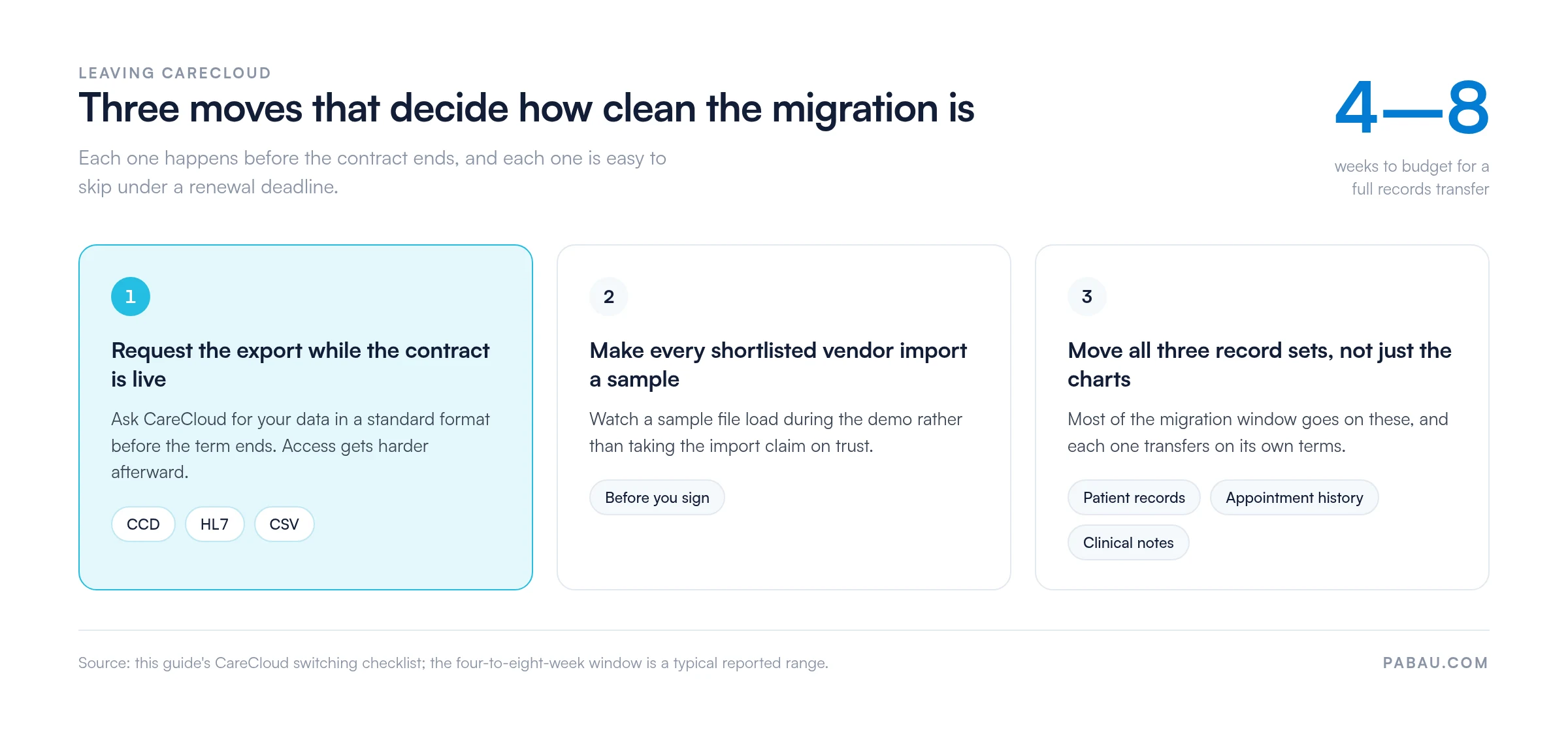
Most practices underestimate the switch itself. The platform choice is the easy half. Moving years of patient records, appointment history, and clinical notes is what decides how the first month on the new system feels.
Budget four to eight weeks for a full transfer, and get three moves right before your CareCloud contract ends.
The export request is the step practices leave latest and regret most, because leverage disappears the day the contract lapses. Source: this guide’s switching checklist.
Pro Tip
Put the export request in writing and name the formats you need: CCD, HL7, or CSV. Keep your own copy of the exported files after the new platform imports them. A records request years from now is easier to answer from your own archive than from a former vendor.
How to choose the right CareCloud alternative for your practice
The right CareCloud alternative depends on your billing model, your specialty, and your scale. Use this quick-pick framework before you request demos. Our side-by-side comparisons set each platform against Pabau on the same criteria.
If your practice is…
Consider
Reason
Aesthetic, wellness, or cash-pay
Pabau
Built for consumer booking, package billing, and automated patient workflows, with no insurance configuration overhead
Apple-device-first, specialty physician
DrChrono
iPad-native EHR with specialty template customization
Independent primary care or general medicine
Kareo (Tebra)
Billing-first workflow with a cleaner interface than CareCloud for small independent practices
Large multi-specialty group with a complex payer mix
AthenaHealth
Network-scale RCM intelligence justifies the higher cost and implementation load for large organizations
How Pabau runs a self-pay practice day to day
In most CareCloud practices, the consumer-facing side lives outside the platform. Bookings arrive by phone, deposits get taken on a separate terminal, and pre-care instructions go out by hand when someone remembers. The clinical record and the reception workflow sit in different places.
Pabau puts them in the same place. Patients book online and pay a deposit at the point of booking. Pre-care and post-care messages send themselves on the schedule you set. The note, the photos, the consent form, and the invoice all attach to one patient record.
For a practice leaving CareCloud over pricing or support, that changes two things. Staff stop reconciling a booking tool against a clinical system every morning. And the subscription price is published, so budgeting no longer waits on a quote.
See Pabau handle your practice’s workflows
Book a personalized demo and see how Pabau handles bookings, clinical notes, billing, and patient messages in one place. Pricing is published up front, and onboarding is structured rather than self-serve.
Three things decide this choice: How you bill, what the platform costs, and how fast support answers. CareCloud serves insurance-heavy multi-specialty medicine well. Outside that profile, the fit is rarely as clean.
Pabau answers the two frustrations that show up most often in CareCloud reviews. Pricing is published from $62/month, and onboarding comes with hands-on support. The platform is built around the clinical and operational work of aesthetic medicine, wellness, and multi-discipline practices.
If you bill mostly on a self-pay or package basis and need consumer booking alongside clinical notes, Pabau is the natural landing point. Book a demo to see how it handles your own workflows.
The best CareCloud alternatives are Pabau, DrChrono, Kareo (now Tebra), and AthenaHealth. Pabau fits aesthetic and wellness practices, DrChrono works for mobile-first Apple-device practices, Tebra handles independent practice billing, and AthenaHealth serves large multi-specialty groups. The right choice depends on your billing model, specialty, and practice size.
Why do practices switch from CareCloud?
Four reasons come up repeatedly. Pricing is not published, and add-on costs surprise practices later. Support response times are slow and resolution quality is inconsistent. Implementation got more complex after the MTBC rebrand, and the insurance-billing architecture fits self-pay and aesthetic practices poorly.
Is there an affordable CareCloud alternative with transparent pricing?
Yes. Pabau publishes its pricing publicly from $104/month, which directly addresses the pricing opacity that drives many practices away from CareCloud. DrChrono, Kareo, and AthenaHealth all use quote-based pricing that requires a sales conversation before costs are disclosed.
How hard is it to switch from CareCloud to another platform?
Switching complexity depends on your data volume and the new platform’s import capabilities. Budget four to eight weeks for a thorough migration covering patient records, appointment history, and clinical notes. Request a CCD, HL7, or CSV export from CareCloud before your contract ends. Then ask each shortlisted vendor to demonstrate their import process before you sign.
Does CareCloud have good customer support?
Customer support is the most frequently cited complaint in CareCloud reviews on Capterra and G2. Reviewers note slow response times and inconsistent resolution quality. If support responsiveness matters to your practice, test it directly with any alternative before you commit.
What is CareCloud’s pricing?
CareCloud does not publish pricing. You have to request a demo or contact sales for a quote. The number varies by practice size, specialty, and which EHR, PM, and RCM modules you take. Several reviewers report that add-on costs for support tiers and RCM services were not clear upfront.