Skin clinic software Australia: 6 best picks, AUD prices
Skin clinic software in Australia costs a two-practitioner practice between A$84...

Last Updated: Sep 22, 2026
A skin clinic business plan turns a treatment menu into a funded business. In Australia it has to carry the compliance layer too. AHPRA, the TGA and your state health department each set requirements that land before your first client does.
This guide gives you the nine sections to write, the Australian requirements that belong in each, and current figures in AUD. The rules and their costs sit in one table, the Skin Clinic Compliance-Cost Matrix, so you can price compliance instead of discovering it.
Two numbers set the scale. A two-room clinic on its own lease costs about $160,000 to $460,000 to open. Cosmetic laser licensing applies in only three jurisdictions, so the same build costs different money in Brisbane and in Sydney.

An Australian skin clinic business plan needs nine sections, and compliance costs belong inside the financial plan.
The Skin Clinic Compliance-Cost Matrix below prices every AHPRA, TGA, state and council requirement against the role it applies to.
A two-room clinic costs roughly $160,000 to $460,000 to open, and a rented room about $19,000 to $78,000.
Cosmetic lasers are licensed in Queensland, Western Australia and Tasmania only, so your state sets part of the startup budget.
A registered nurse needs a year of full-time general nursing experience before performing non-surgical cosmetic procedures.
A skin clinic business plan is the written case for your clinic, covering services, market, compliance, staffing and the numbers behind them. The plan is the document three different readers ask for, and each reads a different part of it.
A lender financing your first laser reads the financial plan and the repayment cover. Equipment finance for a startup usually needs a deposit of 10% to 30%, plus a director guarantee. The forecast has to survive a credit assessor.
A landlord reads the same forecast to decide whether you can carry a five-year lease. A prescriber deciding whether to work with you reads the compliance and staffing sections, because your paperwork becomes their regulatory exposure.
Write the executive summary last. The summary is a one-page version of the finished plan, and writing it first produces intentions with no evidence underneath.
Nine sections cover an Australian skin clinic. Two of them rarely appear in a generic template. Compliance is one, and the advertising limits on a regulated health service are the other. Both decide whether the rest of the plan is legal to run.
Write sections four and seven before you write section three. Your treatment menu is limited by who can prescribe, who can inject, and what you are permitted to say publicly about any of it.
Opening a skin clinic in Australia requires a registered business entity, AHPRA-registered practitioners, a notified or licensed premises, and a laser license in three states.
Four regulators sit above a cosmetic clinic, and each one covers something different. AHPRA regulates people. The TGA regulates products and what you may say about them. Your state health department regulates devices and premises. Your council regulates the room.
No registration on that list is issued to a business called a skin clinic, because no Australian register uses that term. Your plan names the individuals who hold each registration, and the document that proves it.
AHPRA registers individual practitioners, so a cosmetic nurse brings their own registration to your business. General registration with the Nursing and Midwifery Board of Australia costs $193 for the year running from June 1, 2026.
AHPRA’s guidelines for non-surgical cosmetic procedures took effect on September 2, 2025, and they changed who may start in cosmetics. A registered nurse now needs a year of full-time general nursing experience before performing cosmetic procedures, plus training specific to the treatments performed.
Three more requirements change how a clinic is staffed and scheduled. Cost each one into the plan, because each consumes chair time:
No Australian law requires a medical director. What the law requires is a named prescriber for every Schedule 4 patient, and that duty stays with the prescriber after the injection. Our guide to cosmetic nurse requirements sets out the qualifications behind each role.
Botulinum toxin and dermal fillers are Schedule 4 prescription-only medicines, which puts them outside consumer advertising entirely. The TGA prohibits naming them to the public, and the prohibition reaches further than most treatment menus assume.
Brand names are caught. So are acronyms, nicknames, abbreviations and hashtags that a consumer would read as a reference to a prescription medicine. Descriptive workarounds such as “wrinkle reducing injections” are caught too where they promote the supply of one.
Two practical consequences belong in the plan. Your treatment menu and price list have to describe services, never the products used to deliver them. Your device list has to be included in the Australian Register of Therapeutic Goods before those devices can be supplied lawfully.
Advertising penalties reach $1.65 million per breach for an individual and $16.5 million for a corporation. Advertising directed exclusively to health professionals sits outside the prohibition, which is why supplier and referral communications are treated separately.
State rules are where two identical clinics end up with different paperwork. The three largest markets each take a different approach to the same treatment list.
Two smaller jurisdictions change the shape of the plan again. Western Australia issues a health service permit for a cosmetic procedure clinic. The permit goes to a medical practitioner or nurse practitioner, so the entity has a named clinical holder. Tasmania licenses IPL as well as lasers.
Facility licensing under the NSW Private Health Facilities Act 2007 applies to surgical cosmetic procedures and deeper sedation. A non-surgical clinic sits outside it, which is worth stating explicitly in the plan if a lender asks.
A skin laser clinic needs a license in Queensland, Western Australia and Tasmania, and no device license at all in New South Wales or Victoria.
Queensland runs the fullest process, and the order matters. The possession license comes before the purchase, not after it. A business possession license costs $938.72 in the first year, and each operator’s use license costs $184.13.
Queensland also wants a radiation safety and protection plan, an appointed radiation safety officer, and 25 to 100 supervised practical hours depending on the procedure. Those hours delay revenue, so the cash flow has to carry them too.
Western Australia registers devices with the Radiological Council at about $300 a year for up to two devices. Tasmania charges $250.88 to apply, then $403.76 a year, plus $403.76 to register the premises.
Device choice drives four costs at once, and a device evaluation belongs in the plan on those four axes:
The Skin Clinic Compliance-Cost Matrix puts every requirement, its regulator, the role it attaches to and its published cost in one place. Read the “applies to” column first, because a requirement with no name against it is the one that fails an audit.
| Requirement | Regulator or body | Applies to | Indicative cost or timeframe | State variation |
|---|---|---|---|---|
| Company registration | ASIC | The business | $636 once, then $342 a year | None, national |
| Business name | ASIC | The business | $47 for one year, $108 for three | None, national |
| GST registration | ATO | The business | Free, compulsory at $75,000 turnover | None, national |
| Practitioner registration | AHPRA and the Nursing and Midwifery Board | Each nurse | $193 a year | None, national |
| Professional indemnity insurance | NMBA registration standard | Each practitioner | From $385, or $925 with laser and threads | None, national |
| Cosmetic procedure guidelines | AHPRA | Practitioners and the clinic | One year of general nursing experience first | None, national |
| Schedule 4 prescribing | TGA and state medicines law | The prescriber | A consultation each time, in person or by video | Medicines law is state based |
| Advertising compliance | AHPRA and the TGA | The clinic and its staff | Penalties to $1.65m individual, $16.5m corporate | None, national |
| Skin penetration approval | Local council | The premises | Free to a few hundred dollars | NSW notifies, Victoria registers, Queensland licenses |
| Cosmetic laser license | State health department | The business and each operator | Queensland $938.72, plus $184.13 per operator | Queensland, WA and Tasmania only |
| Health service permit | Department of Health WA | A medical practitioner or nurse practitioner | Held before the clinic opens | Western Australia only |
The matrix also corrects a budgeting assumption owners often start from. Registration is cheap, and the costly part is the clinical time each rule consumes. Company registration and a year of nurse registration together cost less than one laser service visit.
Liability and headcount settle the structure question, and turnover rarely changes the answer. Three options cover almost every Australian skin clinic, and the choice is usually settled by whether you sign a lease and employ anyone.
| Structure | What it suits | Setup and running cost | The trade-off |
|---|---|---|---|
| Sole trader | One practitioner renting a room | ABN is free, no annual fee | Personal assets sit behind the business |
| Pty Ltd company | A lease, employees or financed devices | $636 to register, $342 a year | More reporting, and directors still guarantee finance |
| Company with a service entity | Several practitioners or two owners | Accountant designed, ongoing advice fees | Complexity that only pays off at scale |
The decision rule fits in one line. Treat alone in a rented room and a sole trader is enough. Sign a lease, employ anyone or finance a device, and a company is the answer before day one.
Opening a skin clinic in Australia costs about $19,000 to $78,000 for a rented room, and $160,000 to $460,000 for a two-room lease.
A four-room build with a premium fit-out reaches about $1,000,000. The model you choose moves the number far more than your city does. Fit-out is the line that disappears when you rent a furnished room.
| Cost line | Room rental | Two-room clinic | Four-room clinic |
|---|---|---|---|
| Bond and rent before trading | Usually none | $15,000–$38,000 | $24,500–$84,000 |
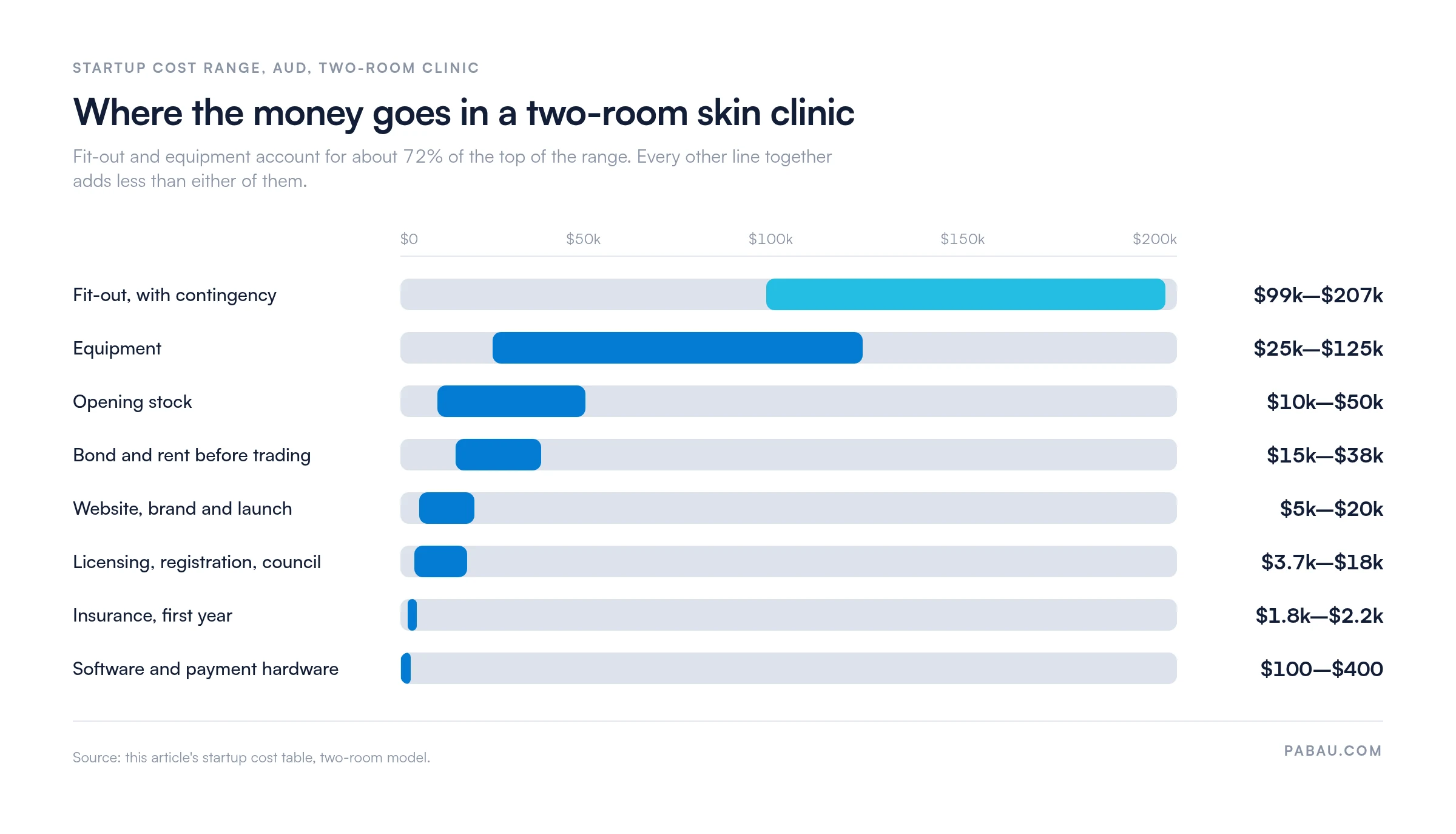
| Fit-out, with contingency | None, the room is furnished | $99,000–$207,000 | $198,000–$414,000 |
| Equipment | $5,000–$11,000 | $25,000–$125,000 | $80,000–$350,000 |
| Opening stock | $10,000–$50,000 | $10,000–$50,000 | $20,000–$80,000 |
| Licensing, registration and council | About $240 | $3,700–$18,000 | $3,700–$25,700 |
| Insurance, first year | $385–$925 | $1,800–$2,200 | $2,500–$6,000 |
| Software and payment hardware | $100–$400 | $100–$400 | $200–$1,500 |
| Website, brand and launch | $3,000–$15,000 | $5,000–$20,000 | $10,000–$35,000 |
| Total, before wages | $19,000–$78,000 | $160,000–$460,000 | $340,000–$1,000,000 |
Two lines carry most of the risk, and the chart below shows how lopsided the build is. Our line-by-line breakdown of skin clinic startup costs prices each of them against Australian supplier quotes.
Startup capital gets the attention, and monthly burn is what closes clinics. A two-room clinic with one employed cosmetic nurse carries the following lines every month, before marketing.
| Monthly line | Two-room clinic | What moves it |
|---|---|---|
| Rent, gross | $1,750–$3,500 | Floor area and street position |
| One cosmetic nurse, with 12% super | $7,933–$8,400 | Commission of 5% to 15% sits on top |
| Insurance | $150–$185 | Treatment mix, not turnover |
| Clinical waste collection | $150–$280 | Collection frequency and bin rental |
| Equipment finance | $410 per $20,000 borrowed | Deposit and term |
| Practice management software | $35–$50 per user | User count and locations |
| Merchant fees | 1.4%–1.6% of card turnover | Card mix and provider |
Software is the smallest line on that table and the one owners research hardest. If you are comparing platforms, our roundup of aesthetic clinic software covers what each one includes at that price.
No Australian dataset publishes a break-even timeline for cosmetic clinics, so a figure in months is guesswork. Active clients are the better unit, and the arithmetic is short enough to run in the plan.
The model below uses illustrative figures to show the arithmetic. Swap in your own rent, wages and finance, then run the same three divisions.
Retail moves the margin without moving the client count. Australian cosmeceutical houses publish wholesale discounts of 35% to 48%, so retail attach adds contribution per visit without adding visits. Model it as a percentage of treatment revenue, and keep it separate from the treatment forecast.
Your treatment menu is a compliance decision and an insurance decision before it is a marketing one. Adding laser and threads to an injectables-only scope multiplies the professional indemnity premium by 2.4 with the same underwriter, from $385 to $925.
Define the menu by what you can staff and license, then by what your catchment will pay for. A skin clinic offering skin health programs needs different room time and different stock from one built around laser hair removal.
Differentiation is the hard part of this section, because competing on price per unit is the default and it erodes margin. Three positions hold up better than a price cut:
Set four measures as targets in the plan, then track them from day one:
Forecast those four here, then report them monthly once you are trading. Where those numbers come from day to day is covered further down.
Market a new skin clinic on its practitioners, its consultation and its skin outcomes, because naming the injectable products you use is prohibited.
Two regulators police the same advertisement. AHPRA prohibits testimonials, misleading claims, inducements offered without terms, unreasonable expectations of benefit, and anything encouraging unnecessary use of a health service. The TGA prohibits reference to the prescription medicines themselves.
Since September 2, 2025, influencer testimonials for a regulated health service have been banned outright, and advertising aimed at under-18s is prohibited. A full breakdown of the AHPRA advertising guidelines walks through each prohibition with a cosmetic example.
What remains is a narrower channel mix than most launch budgets assume. Local search, your own before-and-after policy, consultation offers and practitioner-led content all survive the rules. Referral relationships survive them comfortably, because communication directed exclusively to health professionals sits outside the advertising prohibition.
Budget 5% to 10% of revenue once trading, and expect regulation to bind you before the budget does. Build referral relationships with GPs, dermatologists and cosmetic physicians early, and give each one a written treatment scope they can refer against.
Retention is cheaper than acquisition in a market this crowded, and it runs as a workflow. In practices we onboard, the clinics that fill a new room fastest book the next visit before the client leaves.
A plan written in a document becomes a clinic run across five tools. Consents get printed and scanned. Batch numbers live in a notebook. Bookings arrive by direct message, and the four measures from your plan get rebuilt from a spreadsheet each quarter.
Practice management software like Pabau holds those pieces on one client timeline. Pabau captures consent digitally against the client record. The signed form, the treatment note and the before-and-after photos then sit in the file an auditor asks for.
Pabau’s stock tracking records product and batch detail against the treatment note as the treatment is charted. For Schedule 4 injectables that turns traceability into a by-product of charting, so nobody reconciles a notebook on a Sunday.
Pabau’s reporting covers the four measures you forecast in the plan. Acquisition cost, average client value, rebooking and retail conversion come from the data the clinic already creates. Online booking fills the calendar without the front desk retyping enquiries from three inboxes.
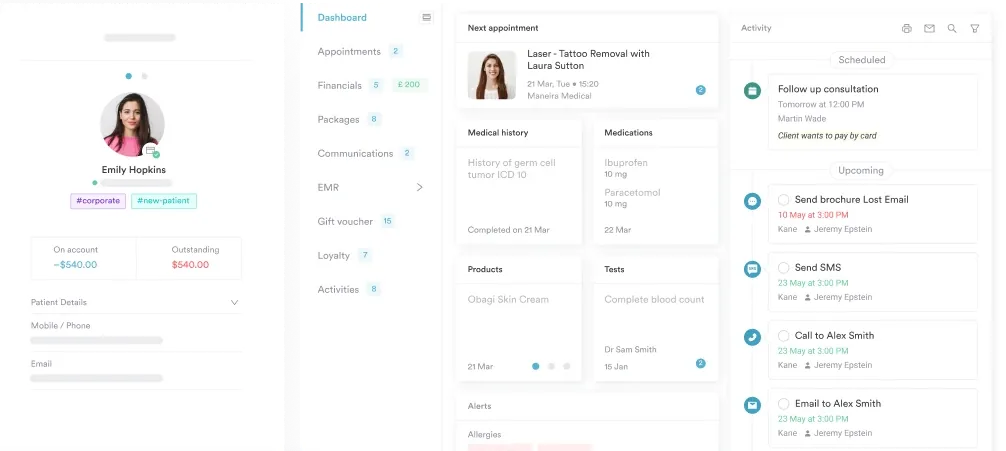
Every subscription includes every feature, so a single-nurse clinic gets the same records, reporting and marketing tools as a three-site group. New clinics get structured onboarding, so nobody has to configure software for cosmetic clinics alone.

Pabau keeps consent, treatment notes, product batch detail, payments and reporting on one client timeline. A new Australian clinic can evidence its AHPRA and TGA obligations without a second spreadsheet.

Write the compliance section before the revenue forecast. Who may prescribe, who may inject and what you may advertise set the ceiling on revenue. So does the device licensing in your state.
Then put a dollar figure against each rule. The Skin Clinic Compliance-Cost Matrix exists for that reason. A plan that names AHPRA and the TGA without a dollar figure against either one has not been costed.
The trade-off worth remembering is that compliance is cheap and clinical time is expensive. The fees add up to a few thousand dollars. The consultations, cooling-off periods and supervised hours behind them consume the chair time that pays for the lease. Book a demo to see how Pabau keeps consent, batch records and clinic reporting together from day one.

Need the revenue side of the forecast? How much do cosmetic clinics make in Australia sets out turnover and margin bands by clinic stage.
Working out who signs the prescriptions? Medical director for a cosmetic clinic in Australia separates the prescriber duty from the job title.
Planning to own the clinic as a nurse? Can a nurse own a cosmetic clinic in Australia covers ownership and supervision rules in one place.
Considering buying instead of building? Cosmetic clinic for sale in Australia explains what to check before taking over an existing site.
You need a registered business entity, a premises your council has cleared, professional indemnity insurance, an AHPRA-registered practitioner for any medical treatment, and opening stock. A skin clinic offering injectables also needs a named prescriber before it treats anyone.
Between about $19,000 and $1,000,000, depending on the model. A cosmetic nurse renting a furnished room starts at roughly $19,000 to $78,000. A two-room clinic on its own lease runs $160,000 to $460,000, and fit-out is the reason for the jump.
Practitioner registration with AHPRA, council approval for skin penetration, and a cosmetic laser license in Queensland, Western Australia or Tasmania. No state issues a skin clinic license as such, because registration attaches to the practitioners and the premises.
No. A clear skin clinic uses the same skin clinic business plan structure and the same compliance requirements as any other cosmetic clinic. Only the services and target market sections change, because acne and congestion programs run on different room time and different stock.
For skin clinics, it is differentiation in a crowded market and the retention economics underneath it. Competing on price per unit shrinks margin without winning loyalty, while a clinic that rebooks reliably earns more from the clients it already has.