Receptive one word picture vocabulary test: What it measures and how to interpret scores
The receptive one word picture vocabulary test is a norm-referenced assessment o...

Last Updated: Sep 23, 2026

The free download is one two-page R practice sheet, not a set of worksheets split by R position or difficulty level.
Seven numbered parts run from an isolated /r/ warm-up through syllables, words, minimal pairs, sentences, and tongue twisters.
The progress tracker sits on page one, right below Part VII, with space for session notes, wins and challenges, and goals.
The word list mixes R positions, so plan any position-specific drill or R blend work with your own targets.
Logging each part’s accuracy score in practice management software like Pabau turns a paper tally into progress you can chart.
Inside the PDF you get an isolated /r/ warm-up, R plus vowel syllables, a ten-word practice list, minimal pairs, sentences, and tongue twisters. A dated progress tracker follows on the same page, and page two is left blank for extra notes.
Download templateR worksheets for speech therapy give clients a structured way to drill one of the hardest sounds in English. The free printable on this page is a single practice sheet. You can hand it to a child, a parent, or an adult client at the end of a session. It also works as home practice between visits.
This guide covers what sits on the sheet, why the /r/ sound resists remediation, and how to sequence practice from words to conversation. For speech-language pathologists, or SLPs, it also explains how speech therapy software keeps each worksheet score with the session note.
The file is a two-page PDF. Page one carries seven numbered parts in a fixed order, from easiest to hardest. The progress tracker sits under Part VII on that same page, and page two is a blank Additional Notes sheet.
Two things are worth knowing before you print it. The word list mixes R positions rather than separating them, so River and Rocket sit beside Carrot and Farmer. Part II drills ar, er, ir, or and ur, which leaves the AIR and EAR contexts off the sheet.
There are also no difficulty tiers. You set the level by choosing how far down the page a client works. Part VII is where you add the targets a specific client needs. That makes the sheet a general R warm-up and home-practice tool rather than a position-by-position program.
The /r/ sound requires precise tongue positioning and a complex neuromuscular sequence. That is why it is among the last sounds acquired in typical development. Children usually master /r/ between ages 6 and 8, according to American Speech-Language-Hearing Association (ASHA) developmental norms. Many still need intervention well into school age.
Two factors make R remediation slow. First, the sound has more than one correct production. A bunched R pulls the tongue body back, while a retroflex R lifts the tip up and back, and both are acceptable. The motor patterns behind them differ, so a cue that works for one client can confuse another.
Second, R appears in several phonetic contexts. It opens words (run), sits inside them (robot), closes them (car), and joins consonant blends (friend). Each context asks for slightly different tongue placement. Practice therefore has to reach every context a client actually uses in speech.
Three R categories shape most articulation plans. The download does not separate them into their own worksheets, so treat the table below as a planning reference for your own targets.
Prevocalic R, the /r/ sound at the start of words, is usually the easiest position and the first target in therapy sequencing. Words like run, rabbit, red and ring belong here. On this sheet, River, Rainbow, Roar, Rocket, Round and Raindrop all give you prevocalic practice.
Prevocalic work often adds picture naming and carrier phrases such as I see a ___, which ease the move to sentence level. Part V of the download does that job with five R-loaded sentences. Keep structured client records alongside it so you can document which words a client produced accurately, session after session.
Vocalic R is the /r/ sound in vowel contexts, either inside a syllable or at the end of a word. The six standard positions are AR, AIR, EAR, ER, IRE and OR. They usually come after prevocalic R is established, and they are harder, because the R shows up as vowel coloring rather than a consonant onset.
Many SLPs introduce vocalic R through a coarticulation approach. It targets R in several vowel contexts at once rather than in isolation, and generalization to conversation often comes faster. Part II of the download gives you ar, er, ir, or and ur at the syllable level. Carrot and Farmer cover vocalic R at word level.
AIR and EAR are not on the sheet, so add them yourself in Part VII when a client needs them. Hair, bear, ear and cheer are enough to build a short list.
A body parts worksheet is a quick source, since hair covers AIR and ear covers EAR. From there, move the same targets through carrier phrases, sentences and conversational prompts.
R blends are consonant clusters where R joins another sound, and they are the most complex R category. The main ones are BR, CR, DR, FR, GR, PR and TR, as in bring, frog and tree. Most SLPs target them once prevocalic and vocalic R are stable, because the client has to coordinate two consonant positions in quick succession.
This download has no dedicated blend section. Blends do appear inside a few items, such as Crown, Raindrop and Treasure in the word list, and brother, drives and bright in the sentences. For dedicated blend practice, write a blend list into Part VII, or run a separate blend sheet next to this one.
Sequence blends the way you sequence single sounds: initial position first (tree, frog), then medial (crazy, bring), then final clusters. Using digital intake forms lets you record which blends a client has mastered and which still need work.
The sheet already follows the therapy hierarchy: isolation, syllable, word, sentence, then connected speech. Work down it in order, and stop at the level where accuracy drops below about 80 percent.
Coarticulation is worth exploiting when you choose the Part VII words. Some clients produce AR (car, star) more easily than ER (butter), because the vowel sets the tongue up differently. Pick the context that already works, then build outward from it.
The tracker sits at the foot of page one, with dated space for session notes, wins and challenges, and goals for next time. It gives you somewhere to answer three questions. Is the client improving, at what rate, and which contexts still need work?
The paper tracker works for a single client, but it does not aggregate. Copying those scores into clinical documentation tools keeps them organized and retrievable. Most SLPs add the part-by-part score to the session note, which turns a stack of sheets into one visible trend.
Articulation is rarely the only goal on the plan. Standardized results, such as those from an expressive vocabulary test, belong in the same record, so one file answers what changed and when.
The PDF is two pages and prints in black and white, so a home-practice copy costs almost nothing. Print one per client per week if you want a dated record of every session.
You can also send the file digitally instead. Emailing it, or attaching it to the client record before the visit, means the parent has it on a phone at practice time. Either way, keep the completed tracker, and copy the scores into your clinical progress notes the same day.
For an SLP with a full caseload, the worksheet is the small part of the job. The rest is booking the next session, writing the note, and keeping consent and insurance paperwork straight. Then a parent asks whether anything has changed, and you go hunting for last month’s scores.
Practice management software like Pabau brings those pieces into one record. Therapy practice software keeps scheduling, client notes and form templates in one place. A worksheet score, a treatment note and the next appointment all attach to the same client, so nothing depends on someone remembering to file it.
Pabau Scribe, our AI scribe, drafts the session note while you work. Scoring each part of the sheet then costs you no writing time afterward. Add automated workflow reminders and the follow-up gets booked and chased for you, which keeps home practice from stalling between visits.
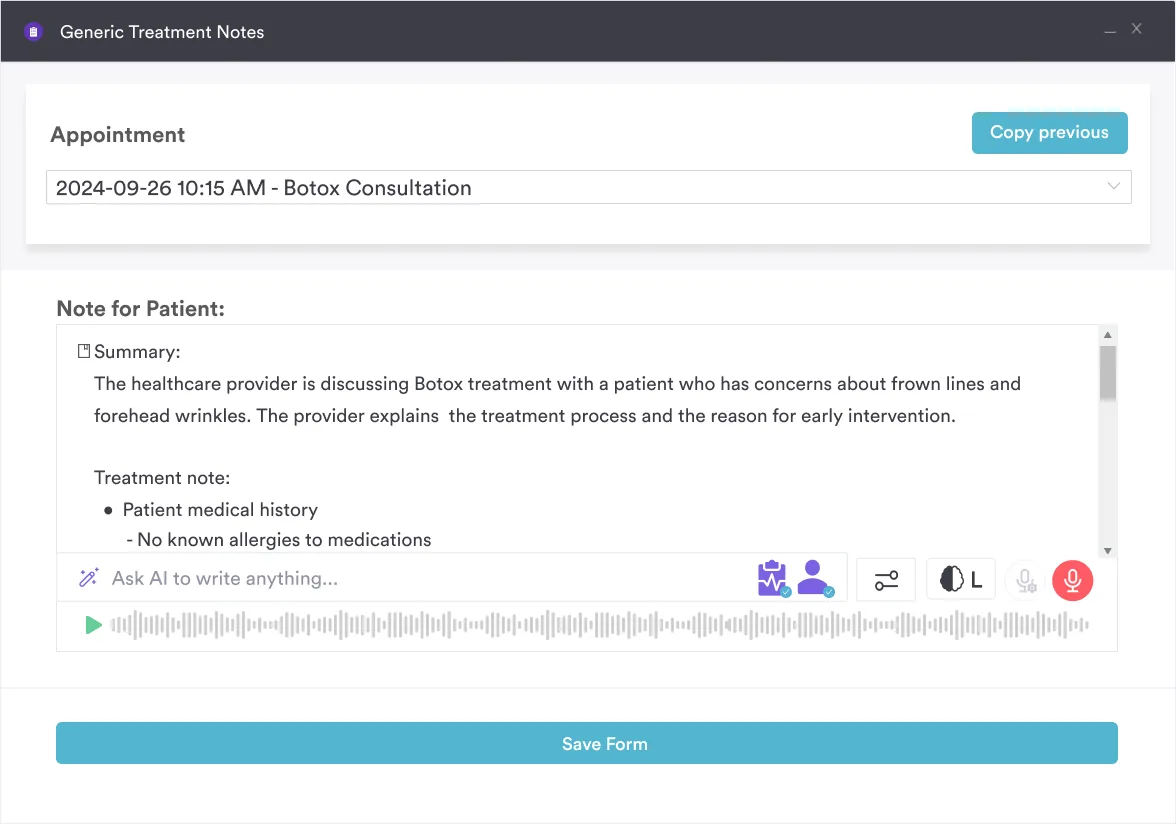

Pabau holds worksheets, treatment notes and appointments in one client record. Score a session, send the sheet home, and see the trend without opening a spreadsheet.

Print this sheet for the job it does well. It warms up the /r/ sound, moves a client from syllables to connected speech in one page, and leaves a dated tracker behind. As a weekly home-practice sheet, that is most of what you need.
It will not replace a position-by-position program. If a client’s error pattern sits in one vowel context, or in blends, write those targets into Part VII. Treat the printed list as the warm-up. The trade-off is deliberate, because one general sheet suits home practice better than six specialist ones nobody remembers to use.
What decides progress is whether the scores get recorded and read. Book a demo to see how Pabau keeps R practice scores, session notes and follow-up appointments in one client record.

Working with clients who have swallowing difficulties? Dysphagia care plan documents swallowing assessments, nursing diagnoses, interventions, and dietary modifications for patients with dysphagia.
Looking for practice materials beyond worksheets? Speech therapy flashcards cover articulation, aphasia, autism, and language sets to match each client’s needs.
Working on social communication as well as speech? Friendship questionnaire gives younger clients a structured way to talk about peer relationships.
Assessing language loss after a stroke? Western Aphasia Battery template provides a scoring guide and subtests for evaluating language abilities and aphasia severity.
Teen client losing confidence in their speech? Self-esteem worksheet for teens opens that conversation without turning it into another drill.
Vocalic R sounds are the /r/ production in vowel contexts – either within a syllable or at word end. The six vocalic R positions are AR (car), ER (butter), OR (for), AIR (hair), EAR (ear), and IRE (fire). They are typically more difficult than prevocalic R (initial position) because the R is produced as a vowel coloring rather than a consonant onset.
Prevocalic R is the /r/ at the beginning of words, as in run or rabbit. Vocalic R is /r/ inside or at the end of words, as in car or bird. Prevocalic R is usually acquired earlier, around age 3 to 4, and is easier to remediate. Vocalic R emerges later, around age 6 to 8, and often needs more intensive therapy.
According to ASHA developmental norms, prevocalic R is typically acquired by age 3-4, while vocalic R and R blends are usually mastered by ages 6-8. However, this is a wide range; some children acquire R earlier or later depending on oral motor skills and exposure.
Two tongue placements are accepted. A retroflex R lifts the tongue tip up and back toward the hard palate. A bunched R pulls the tongue body back, with the tip staying down. Both produce acceptable R, so teach whichever feels more natural for your client. Visual cues, tactile feedback and mirror practice help clients find their own placement.
Move up in steps. Start with single-word drill, such as picture naming and word lists. Add carrier phrases, then sentence reading from the worksheet. Finish with open-ended conversation about the worksheet topics. Each step lets the client solidify accuracy before you add linguistic complexity.
Coarticulation is the way one sound influences the production of adjacent sounds. In R therapy, you target R in several vowel contexts together rather than in isolation. Surrounding vowels then help the client find the placement, which speeds motor learning and carryover into conversation.
The download is one two-page PDF. Page one holds seven parts, from an isolated /r/ warm-up through syllables, words, minimal pairs, sentences and tongue twisters. Part VII leaves blank lines for your own target words. A dated progress tracker follows Part VII on the same page. Page two is a blank Additional Notes sheet.
No. It is one general practice sheet, and the word list mixes R positions instead of separating them. There is no dedicated R blend section and no difficulty tiers. Use Part VII to add position-specific or blend targets for an individual client.