Physician credentialing checklist
A physician credentialing checklist lists every license, certificate, verificati...

Last Updated: Oct 23, 2026

A dyslexia worksheet is a standardized form clinicians use to screen reading, writing, and language processing difficulties.
Structured literacy programs, including Orton-Gillingham and the Wilson Reading System, shape how the form is scored and what happens next.
Combining spoken, written, and observational tasks in one session shows which processing skill is breaking down.
Practice management software like Pabau stores each completed worksheet on the patient record, so progress is easy to compare later.
A printable assessment form covering patient history, phonological awareness prompts, decoding and sight-word tasks, spelling analysis, and a writing sample section. Scoring guidance and space for intervention targets are included.
Download templateA dyslexia worksheet gives you one place to record how someone handles sounds, decoding, spelling, and writing. The form above is built for clinicians rather than for classroom practice. You administer it in a single session, then score the results against age or grade expectations.
The same form doubles as a progress measure. Re-administer it every 6 to 12 weeks of intervention and you can see exactly which skill has moved. That turns a screening you would otherwise file away into the thing that shapes the next block of teaching.
Below you’ll find how to administer and score the form, what to screen at each age, and how to store completed assessments securely.
A dyslexia worksheet is a structured assessment form used by speech-language pathologists, educational psychologists, and special education teachers. It records reading, writing, and language processing difficulties the same way every time.
The form captures standardized observations across phonological awareness, sight-word recognition, decoding accuracy, spelling patterns, and writing mechanics. Those observations become measurable data points. They line up with formal diagnostic criteria and support planning under IDEA (Individuals with Disabilities Education Act) and Section 504. Scores recorded at each session are only useful when they sit in one place, which is what psychology practice software does.
Around 15 to 20% of people show some symptoms of dyslexia, according to the International Dyslexia Association. Early identification through a structured form is what makes evidence-based intervention possible, for children and adults alike.
Follow the same protocol every time. Consistent administration is what makes two sets of results comparable, whether you are comparing two students or one student six months apart.
Store completed assessments in patient intake software rather than a filing cabinet, so scores are easy to pull up during treatment planning.
Forms vary by depth, age group, and setting. Five types cover most clinical needs.
Screening depth should follow the developmental stage. Identifying difficulty in kindergarten or Grade 1 lets you intervene before avoidance and low confidence take hold. Where a student has already lost confidence, a negative self-talk worksheet works well alongside reading intervention.
Effective forms are grounded in structured literacy research. The National Institute of Child Health and Human Development (NICHD) names five core reading components. Those are phonemic awareness, phonics, fluency, vocabulary, and comprehension, and a thorough form touches all five.
Multisensory assessment improves diagnostic sensitivity. A student may decode well by sight and still struggle with auditory sound sequencing or letter formation. Capturing all three modalities in one session shows which process is breaking down.
Results are only as good as the protocol behind them. Standardized administration reduces subjective judgment and makes comparison across months reliable. Speech-language pathologists, school psychologists, and special education teachers all benefit from working to the same script.
Document the baseline, then re-administer every 6 to 12 weeks during active intervention. That record becomes the evidence trail for IEP (Individualized Education Program) meetings. It also shows parents and school administrators how the student is responding.
Keep worksheet data in HIPAA-compliant systems whenever it carries identifying information or sensitive clinical observation. Encrypted storage protects patient privacy and your own liability.
Use one worksheet template across every patient in your practice or school. Consistency reduces interpretation variability, and it lets you compare results between students or track one student’s progress reliably over years.
One worksheet rarely settles a question this big. Broader frameworks, such as a psychiatric evaluation template, often include reading screening as one part of a wider developmental assessment. Pair the worksheet with the sources below.
Multi-method assessment raises confidence in the conclusion. It also points to the intervention components that will help this person most. Keep every piece in one paperless system so scores, notes, and worksheets sit together at review time.
Let the weakest scores choose the program. If phonological awareness and sight-word fluency come out lowest, pick a structured literacy approach that targets them directly. Orton-Gillingham and the Wilson Reading System are both backed by decades of reading research.
Most practices still run screening on paper. The sheet gets scanned, emailed, or filed in a drawer, and the scores end up separate from the patient management software holding everything else.
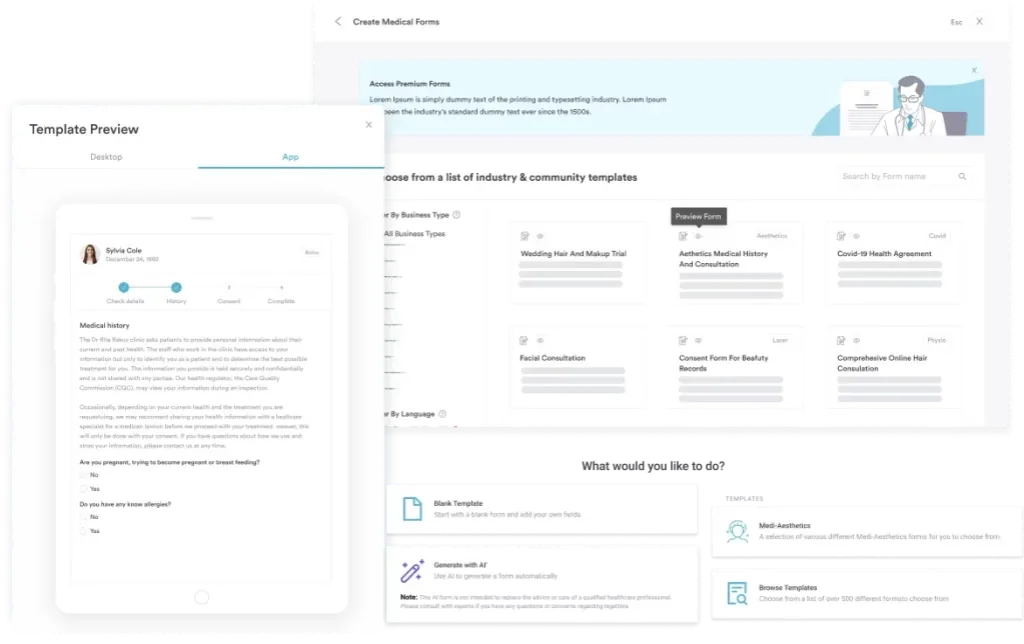
Practice management software like Pabau turns the same worksheet into a digital form your team completes on a tablet. Responses save straight to the client record, alongside treatment notes, consent forms, and appointment history.
Because every assessment is timestamped on that record, comparing a baseline against a 12-week re-test takes seconds. Pabau Scribe, our AI scribe, can capture observation notes while you administer, so you watch the student instead of writing.
The result is one searchable history per patient. Nothing goes missing between sessions, and the evidence you need for an IEP meeting is already in one place.

Pabau’s digital forms let your team administer standardized worksheets on a tablet. Scores save to the client record, so tracking progress between sessions takes seconds.

Screening earns its 40 minutes only when the results change what happens next. A completed worksheet sitting in a drawer has told the student nothing.
So treat the form as a measurement instrument. Score it the same way each time, re-run it on a schedule, and let the pattern of scores pick the structured literacy program. One caveat is worth keeping in view. A screening form supports a clinical hypothesis, and formal diagnosis still needs a qualified evaluator.
If your assessments still live on paper, that is the first thing to change. Book a demo to see how Pabau keeps worksheet scores, clinical notes, and progress on a single patient record.

Choosing an intervention approach? counseling theories chart sets out how different frameworks compare, which helps when you match a student to a program.
Supporting attention as well as reading? self-control worksheet gives students practical strategies for staying with a task they find hard.
Want to see how a scored rating form is built? clinical anger scale shows how items, scoring bands, and interpretation notes fit together on one page.
Need measurable goals for speech therapy too? Speech therapy goal bank collects measurable, IEP-compliant goals spanning articulation, language, fluency, and cognitive-communication for all ages.
A dyslexia worksheet is a standardized assessment tool used to identify and evaluate reading, writing, and language processing difficulties. Clinicians use it to screen for dyslexia, measure baseline skills, and inform evidence-based intervention planning under IDEA and Section 504.
No. It is a screening and assessment tool rather than a diagnostic test. It gathers standardized observations that support a clinical hypothesis. Formal diagnosis requires neuropsychological or psychoeducational testing by a qualified specialist, such as a psychologist or special education evaluator.
Screening can start as early as kindergarten, when phonological awareness is first taught. By Grades 1 and 2, screening is warranted if a child is not responding to phonics instruction at the expected rate. Early intervention produces the strongest outcomes.
The strongest forms are standardized, multisensory, and evidence-based. They assess all five reading components, which are phonemic awareness, phonics, fluency, vocabulary, and comprehension. They also use a consistent administration protocol and produce clear data that guides intervention planning.
Yes. Many undiagnosed adults pursue evaluation because of workplace reading or writing demands. Age-appropriate forms assess the same core difficulties, including decoding, fluency, and spelling, using adult-level texts and expectations.