Professional development record
A professional development record is a structured log of a healthcare practition...

5
Last Updated: Oct 8, 2026
Cliniko vs Nookal comes down to three things: Billing complexity, practice size, and location. Cliniko wins for smaller allied health practices that want a clean system and a fast start. Nookal wins for larger or multi-location practices that need native HICAPS claiming, DVA billing, and case management.
Both platforms serve allied health almost exclusively: Physiotherapists, occupational therapists, osteopaths, speech therapists, and similar practitioners. Neither one was designed for aesthetic or cosmetic practices. If you offer injectable treatments or skin services alongside allied health, you will hit the edges of both.
This guide covers pricing, scheduling, clinical notes, billing integrations, and the differences that matter to UK and Australian practices. Here is how the two compare on the features that decide the choice.

Cliniko wins on simplicity and onboarding, while Nookal wins on billing depth and multi-location management.
Nookal claims through HICAPS and bills DVA natively, which makes it the stronger pick for Australian practices.
UK practices submitting private medical insurance claims get native support from Nookal and manual workarounds from Cliniko.
Cliniko starts at $45 a month for one practitioner, and Nookal starts at around $65 per practitioner.
Pabau is worth a look if your practice also offers aesthetics, IV therapy, or skin health services.
Cliniko launched in 2011 and built its reputation on a clean, minimal interface aimed at solo practitioners and small allied health practices. Nookal took the opposite route, adding depth for practices that have outgrown simpler tools.
That depth matters most in Australia, where HICAPS and DVA claiming are daily operational work. If you want to weigh up a third option, start with our Pabau comparisons index.
Both platforms handle appointment scheduling well, but they diverge as practice complexity grows. Cliniko’s calendar is praised for its simplicity: It loads quickly, color-codes practitioners, and handles recurring appointments without fuss. For a practice running one or two practitioners from a single site, it does the job.
Nookal scales more naturally across multiple rooms, practitioners, and sites. Practices running case-based workflows, where a patient cycles through several practitioners, get a case management layer that links appointments across episodes of care. Continuity like that matters most in physical therapy practice management, where one injury can span months of treatment.
Cliniko’s clinical notes system is flexible and well-regarded, particularly for practitioners who want to build their own templates quickly. It handles SOAP notes, body charts, and treatment notes through a drag-and-drop template builder. Most users get comfortable with it in their first week. The interface stays out of the way, which matters when you are writing notes between appointments.
Nookal’s documentation layer goes deeper on case management: Notes attach to episodes of care rather than isolated appointments. A new practitioner picking up a patient’s file can trace the whole clinical history in one view.
Shared caseloads and long treatment programs are common in rehabilitation and occupational therapy. That structure keeps the record continuous from one clinician to the next. Cliniko’s per-appointment notes suit shorter episodes but strain under ongoing complex cases.
This is where Cliniko vs Nookal gets decisive for Australian practices. Nookal integrates natively with HICAPS, the health fund claiming system used by Medibank, Bupa, HCF, and most major Australian insurers. Practitioners can process health fund claims at the point of sale without leaving the platform.
Cliniko has no native HICAPS support, so Australian practices on Cliniko usually run a separate terminal and reconcile by hand.
Nookal also supports Department of Veterans’ Affairs (DVA) billing natively. That covers a meaningful patient population for physical therapy, occupational therapy, and podiatry practices.
The Australian Physiotherapy Association recognizes DVA as one of the main funding streams for outpatient allied health. For a practice with a veteran patient base, native DVA claiming often decides the shortlist on its own. Cliniko handles standard invoicing and payment collection well, but leaves the claiming to another system.
Cliniko integrates with Xero for accounting, Stripe for payments, Mailchimp for email marketing, and Physitrack for exercise prescription. Its API is open and well-documented, which has produced a healthy ecosystem of third-party tools. For most small practices, these integrations cover the essentials without any custom development.
Nookal also connects to Xero and Physitrack, and its integration story is strongest on the Australian health fund side. HICAPS, DVA, and Medicare-compatible workflows are built in rather than bolted on.
Both platforms offer API access, though Nookal’s developer documentation is less widely referenced. Practices running specialist tools, such as exercise physiology platforms or telehealth apps, should confirm current integration status with each vendor before committing.
Cliniko’s reporting covers the basics: Appointment volume, revenue by practitioner, cancellation rates, and outstanding invoices. For a single-site practice wanting a monthly financial summary, it is adequate. Customization is where it falls short. Most reviewers note that any non-standard report means exporting to Excel and building the analysis by hand.
Nookal’s reporting suite is more comprehensive, particularly for practices that need DVA or HICAPS reconciliation reports. Practices running several practitioners across sites can break revenue and appointment data down by location, which Cliniko handles less gracefully.
Neither platform offers the marketing analytics or staff performance dashboards that multi-specialty practices tend to want. If you need business intelligence beyond clinical throughput, plan on a second tool from the start.
UK private practices billing Bupa, AXA Health, Vitality, or other private medical insurers (PMI) submit claims electronically through a clearinghouse. Based on available comparison data, Nookal supports that submission natively, while Cliniko does not. Verify both platforms’ current status with their support teams before switching, because integration availability changes.
The practical implication is significant. Without a native connection, UK practices on Cliniko submit PMI claims through a separate portal, then reconcile the payments back into Cliniko by hand.
The Chartered Society of Physiotherapy treats private billing as one of the most time-sensitive administrative jobs for physiotherapists working outside the NHS. Native claim submission removes the most labor-intensive part of that workflow.
Cliniko works well up to a point with multiple locations: Practitioners can be assigned to specific sites, and the calendar filters by site. Practices with two or three locations running independent operations will find it manageable. The friction starts when you need centralized reporting, or want to track performance by location and practitioner at once.
Nookal is built with multi-location in mind. Centralized reporting, cross-site practitioner management, and case tracking regardless of which site a patient attends all come as standard. Running three sites is a different job from running one site three times. That is why multi-location practice management deserves its own line on the shortlist.
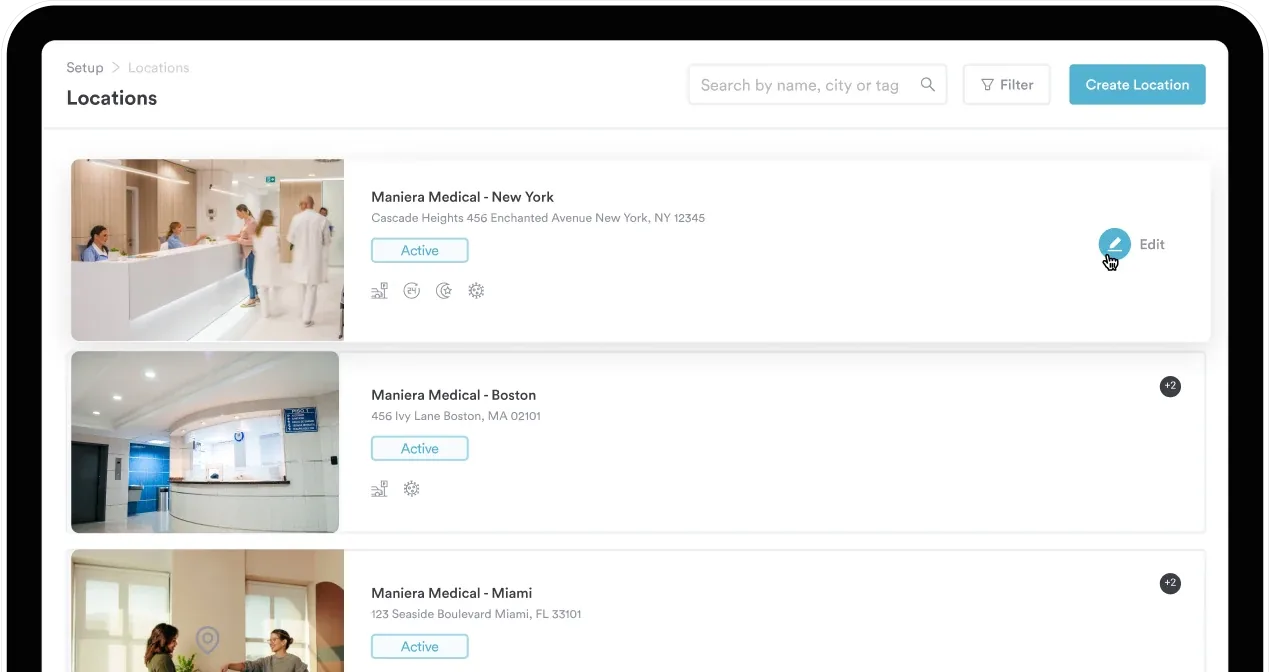
Cliniko earns the highest marks for user experience of any platform in the allied health space. Its interface is deliberately minimal: Most practitioners can run a full day of appointments, write notes, and send invoices after one training session. The onboarding documentation is thorough, and the support team has a strong reputation for responsiveness.
Nookal’s learning curve is steeper. The extra billing layers, case management structure, and reporting configuration all take longer to learn. Practices migrating from a simpler system often need two to four weeks before the team feels comfortable.
That investment pays off where the feature depth earns its keep. For a solo practitioner, it may be more complexity than the workflow justifies.
On Capterra, Cliniko holds 4.7 out of 5 from roughly 23 verified reviews. Ease of use and customer support come up most often as the platform’s strongest attributes.
On Capterra, Nookal holds 4.6 out of 5 from roughly 89 verified reviews. Reviewers praise the depth of HICAPS support and case management, and flag the steeper learning curve.
Both platforms price by practitioner, so the cost scales with headcount. The two structures differ, though. Cliniko sells banded tiers that cover a range of practitioners, while Nookal charges a rate per practitioner. Neither has a free tier, and both offer a 30-day trial. Check current pricing on each vendor’s own site, because rates change.
| Plan / Tier | Price | Details |
|---|---|---|
| Single Practitioner | $45/month | Per practitioner; annual pay = 1 month free/year; SMS add-on 10c/msg |
| 2-5 Practitioners | $95/month | Per tier (2-5 practitioners) |
| 6-8 Practitioners | $145/month | Per tier |
| 9-12 Practitioners | $195/month | Per tier |
| 13-25 Practitioners | $295/month | Per tier |
| 26-200 Practitioners | $395/month | Per tier |
Figures come from Nookal’s own published pricing at the time of writing, quoted in US dollars. Contact Nookal directly for a current quote, because rates change and Enterprise is priced case by case.
The review landscape reinforces the strengths each platform claims. Cliniko’s users point to ease of use as the deciding factor. Practitioners who switched from more complex systems report noticeably less administrative time in the first month. Complaints cluster around the limits of its billing workflows and reporting.
Nookal’s reviewers name HICAPS and case management as the reasons they chose it over simpler tools. The trade-off, which most positive reviewers acknowledge, is a longer setup and learning period. Support response times draw more mixed feedback than Cliniko’s, which is worth factoring in if your team needs hands-on help.
Both review counts are small for a software category this size. Treat the scores as directional, and weight what reviewers say about billing and support more heavily than the decimal place.
The choice maps cleanly to practice type and billing complexity. Cliniko suits practices where simplicity is the priority and billing stays straightforward. Nookal suits practices where billing depth, multi-location management, or specific fund integrations are non-negotiable. Four questions settle it faster than a feature list.
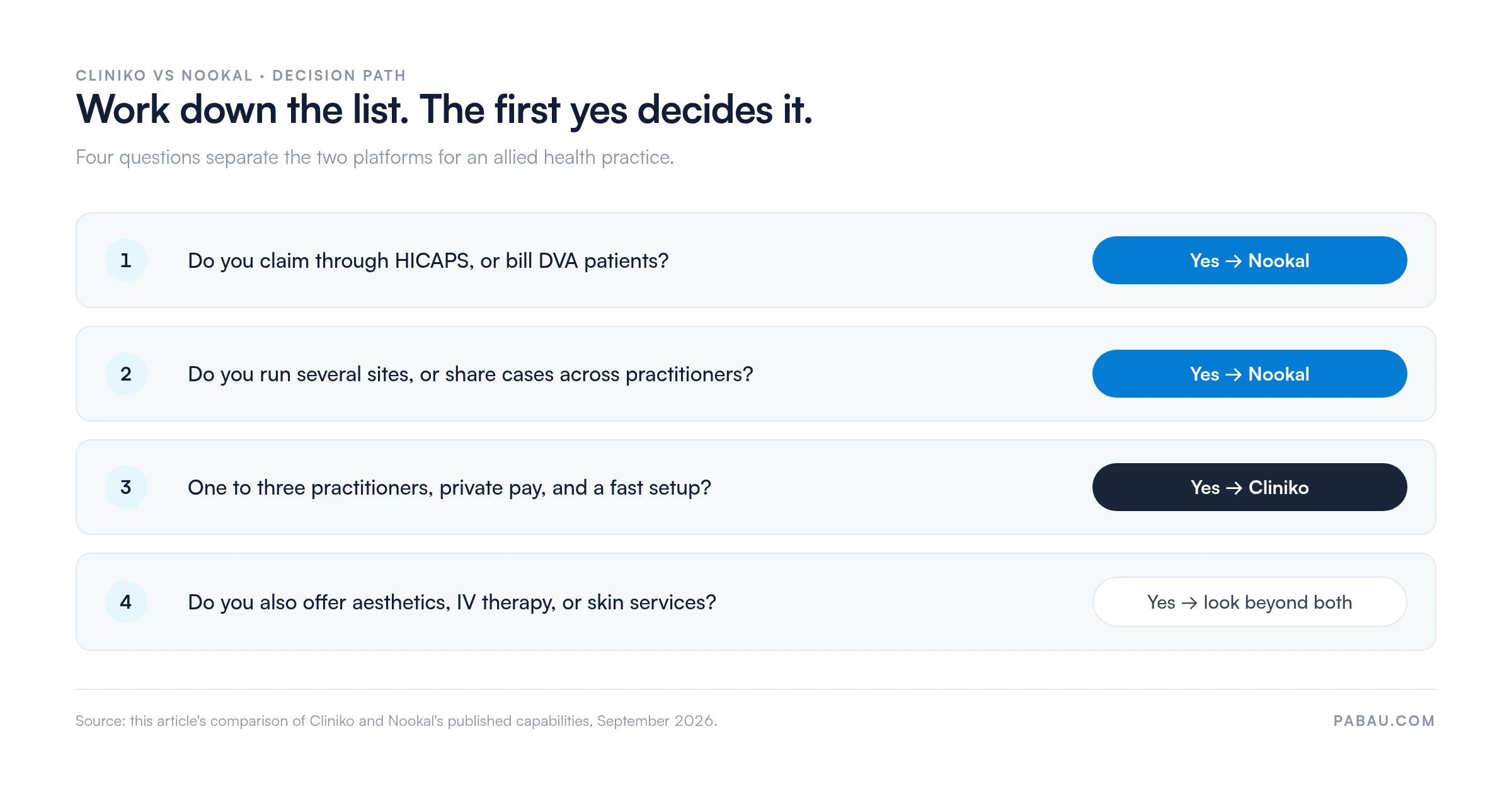
For practices offering treatments outside the core allied health scope, such as IV therapy, aesthetic injectables, or skin health services, neither platform is purpose-built. Our roundup of Cliniko alternatives covers systems that handle a wider service mix.
Cliniko and Nookal are purpose-built for allied health. If your practice also offers aesthetic treatments, medical-grade skincare, weight management, or IV therapy, you will hit the edges of both quickly.
Practice management software like Pabau was built for multi-specialty and aesthetics-adjacent practices. Clinical documentation, billing, marketing, and patient engagement sit in one system. Your front desk stops copying records between tools at the end of every day.
Pabau does not replace Nookal’s HICAPS and DVA claiming. For UK or international practices offering aesthetics alongside physical therapy or wellness services, it brings capabilities neither competitor has. Those include injection plotting, before-and-after photo management, built-in marketing campaigns, and a patient portal that goes past appointment booking. See how Pabau compares against the rest of the category.

Pabau runs scheduling, clinical notes, billing, and marketing for aesthetic practices, medical spas, physical therapy, and multi-specialty groups in one system. If Cliniko and Nookal both feel too narrow, see how Pabau handles your workflow.

Pick the platform that matches how you get paid. If health fund claiming or PMI submission runs through your practice every day, Nookal’s native billing justifies the steeper setup. If your billing is private pay, Cliniko’s speed to competence is worth more than features your team will never open.
The trade-off worth remembering is that depth costs time. Every hour a receptionist spends learning a configuration screen is an hour away from patients, so buy only the billing depth your workflow needs.
If your practice spans allied health and aesthetics, or you need marketing and patient engagement tools beyond what either platform offers, Pabau is worth evaluating. Book a demo to see how it handles a multi-specialty caseload in one system.

Want to see how Cliniko compares to another Australian favorite? Cliniko vs Power Diary weighs the two on scheduling, billing, and reporting depth.
Still not sold on either platform? Cliniko alternatives reviews the systems allied health practices move to most often, and what each one does better.
Is Jane App on your shortlist too? Jane App alternatives covers the systems multi-disciplinary practices switch to, and why.
Need the full cost picture before you commit? Cliniko pricing breaks down every tier and the add-ons that push the monthly bill higher.
Cliniko is a simpler, easier-to-learn platform suited to small allied health practices with straightforward billing needs. Nookal is a more feature-rich system built for larger or multi-location practices. It offers native HICAPS integration, DVA billing, and deeper case management. The core trade-off is simplicity versus billing depth.
Yes. Nookal integrates with HICAPS natively, so health fund claims can be processed at the point of sale. It also supports DVA billing for Department of Veterans’ Affairs patients. Cliniko does not currently offer native HICAPS or DVA support. Australian practices with significant claiming volume should treat this as the decisive factor.
No. Cliniko does not currently offer a native connection to the UK private medical insurance clearinghouse. Practices billing Bupa, AXA Health, or similar insurers submit claims through a separate portal, then reconcile the payments by hand. Nookal is reported to support this natively, though you should verify current availability with Nookal’s team.
Cliniko is the stronger choice for a small practice with one to three practitioners, straightforward billing, and no HICAPS or DVA requirement. Its interface is easier to learn, onboarding is faster, and its support reputation is better. Nookal earns its keep at five or more practitioners, or where claiming complexity justifies the setup investment.
Cliniko starts at $45 USD a month for a single practitioner and moves up in bands, reaching $395 a month for 26 to 200 practitioners. Nookal charges per practitioner, starting at roughly $65 USD a month on Essentials and $89 on Professional. Nookal prices Enterprise case by case.
Both Cliniko and Nookal offer 30-day free trials. Neither has a permanently free tier. The trial gives you the full feature set. Use it to judge whether the interface and the billing workflow suit your practice.
Both platforms integrate with Xero, Stripe, and Physitrack. Cliniko adds Mailchimp and has a well-documented open API with a broader third-party developer ecosystem. Nookal’s strengths lie in Australian health fund claiming, where HICAPS, DVA, and Medicare-compatible workflows are built in. For UK practices, Nookal offers claim submission that Cliniko currently lacks.