Head to toe assessment cheat sheet: Printable nursing guide
A head to toe assessment cheat sheet gives you one fixed order at the bedside, s...

2
Last Updated: Oct 23, 2026

An articulation test evaluates how accurately a client produces individual speech sounds across word positions — it is the primary tool SLPs use to identify and quantify articulation disorders.
The GFTA-3 is the most widely used standardized articulation test, normed from ages 2;0 to 21;11, and produces standard scores, percentile ranks, and severity classifications.
Four error types form the foundation of every articulation test analysis: substitution, omission, distortion, and addition — each requiring a different treatment focus.
Practice management software like Pabau helps speech therapy practices document articulation test results, schedule follow-ups, and keep HIPAA-compliant records without paper-based workflows.
A child’s third birthday passes and they still can’t produce /r/ or /s/ clearly. An adult recovering from a stroke loses the precise motor control needed for consonant clusters. In both cases, the clinician’s first structured step is the same: administer an articulation test.
This assessment is the cornerstone of speech sound evaluation. It gives speech-language pathologists (SLPs) the standardized data they need to diagnose disorders, set measurable goals, and justify services under speech therapy practice frameworks.
Written for SLPs, clinical educators, and practice managers, this guide pairs the clinical grounding with the workflow context that shapes day-to-day assessment decisions. It covers what an articulation test measures, the most widely used instruments, how to administer and score one, and how to interpret results across age groups.
It also covers the judgment calls that change outcomes: when a distortion needs a second listen, when to switch to a phonological analysis, and what changes when the client is an adult rather than a child.
An articulation test is a structured clinical assessment that measures a client’s accuracy in producing specific speech sounds across multiple word positions (initial, medial, and final) and linguistic contexts (isolation, syllables, single words, sentences, and connected speech). The goal is to identify which phonemes a client misarticulates, how consistently errors occur, and how performance compares to age-based developmental norms.
SLPs use an articulation test to answer three clinical questions: Which sounds are in error? How severe is the disorder? What is the appropriate treatment approach? Without this structured data, treatment planning relies on clinical impression alone, which weakens defensibility in insurance authorizations billed under G0153, IEP documentation, and IDEA-mandated eligibility decisions.
Not every evaluation requires a full articulation test. A screener takes five to ten minutes and flags whether a problem likely exists. A full diagnostic assessment takes 30 to 60 minutes and quantifies what that problem is. The decision between them depends on setting, purpose, and the referral question.
A school district running a kindergarten intake screen uses a brief articulation screener to flag children who need referral. The SLP who then evaluates those children administers a full articulation test to generate the eligibility data. Both tools are necessary; they answer different questions.
Standardized articulation tests compare a client’s performance to age-matched peers using published normative data. According to the American Speech-Language-Hearing Association (ASHA), norm-referenced instruments are the standard for eligibility and diagnosis decisions. The three instruments SLPs encounter most frequently are listed below.
The Goldman-Fristoe test of articulation remains the instrument most clinicians encounter first in graduate training and continue using throughout their careers. Its combination of standardized word-level elicitation and sentence-level probing makes it versatile across school, private practice, and early intervention settings.
The Arizona articulation test (Arizona-4) is the common alternative when you want a weighted intelligibility score and a shorter session, and the older Photo Articulation Test (PAT-3) still turns up in school assessment kits. Verify the age range against the current test manual before administration, as publishers update norms periodically.
Consistent administration is what makes an articulation test valid. Deviations from standardized procedures compromise the reliability of scores and can result in over- or under-identification of disorders. Follow these steps for every formal administration.
Most standardized articulation tests begin with single-word elicitation using picture stimuli. Show each picture and ask the client to name it. Record the response phoneme by phoneme, noting the position (initial, medial, final) and type of any error. Do not model the target word before elicitation; modeling contaminates the response.
After word-level testing, move to sentence or connected speech contexts if the instrument includes them (the GFTA-3 Sounds-in-Sentences subtest, for example). Connected speech samples reveal whether errors that appear in single words generalize across running speech, which has direct treatment planning implications.
For family-centered therapy contexts, recording a brief spontaneous language sample alongside the articulation test adds ecological validity to the assessment picture.
Record your administration session whenever possible. Reviewing the recording allows you to confirm transcription accuracy for ambiguous productions, especially for distortions that are difficult to classify in real time. Many SLPs find that 10-15% of distortion judgments change on re-listen. Flag ambiguous tokens on the scoring form with a question mark, then resolve them during playback.
Every error a client makes during an articulation test falls into one of four categories. Classifying errors correctly is essential because treatment targets and techniques differ across types. According to ASHA’s clinical practice guidelines, accurate error classification is a prerequisite to sound goal writing.
Distortions deserve particular attention in the articulation test scoring process. They are technically errors but often have lower intelligibility impact than substitutions or omissions. When a client’s errors are predominantly distortions (a lateral lisp, a dentalized /t/), motor-based approaches like traditional articulation therapy tend to outperform phonological approaches.
Misclassifying a distortion as a substitution can misdirect treatment for months. For practices that support clients with autism and speech delay, accurate error classification also informs whether the primary speech sound concern is phonemic or motor in nature.
Age-referenced norms are what transform a list of errors into a clinical finding. A five-year-old who cannot produce /r/ is developmentally typical. A seven-year-old with the same error pattern likely qualifies for services, often starting speech delay therapy targeted at that specific error pattern.
The table below draws from cross-linguistic acquisition norms published by McLeod and Crowe (2018) in the American Journal of Speech-Language Pathology, which synthesized data from 26,007 children across 27 languages. Note that norms vary across studies and should be interpreted alongside the specific articulation test instrument’s normative data rather than as universal cutoffs.
An articulation test for adults follows the same logic as a pediatric one but leans harder on clinical judgment, because far fewer norm-referenced instruments extend into adulthood. The GFTA-3 norms reach 21;11, so for most adult caseloads the standardized comparison runs out and you interpret errors against expected adult production rather than a percentile rank.
Adult referrals usually follow an acquired event, such as a stroke, traumatic brain injury, or a progressive neurological condition, where the concern is motor speech control rather than sound-system development.
That changes what you record: the consistency of each error across repeated productions, whether it breaks down under longer utterances, and whether the pattern points to apraxia or dysarthria rather than a phonemic substitution. A single-word articulation test still anchors the session, but a connected-speech sample carries more diagnostic weight with an adult than it does with a four-year-old.
Scoring converts raw error data into clinically meaningful numbers. Each articulation test has its own scoring procedure, so follow the manual exactly. The general process across most norm-referenced instruments follows a consistent sequence.
One nuance that trips up early-career clinicians: the “uncertain” confidence noted by researchers around universal severity cutoffs is clinically significant. A standard score of 70 may indicate severe impairment on one articulation test and moderate-severe on another. Always report severity using the specific instrument’s classification system, not a universal rubric.
This is a HIPAA-relevant documentation accuracy issue: misattributing severity can affect eligibility determinations and authorization for services. Practice management software like Pabau lets SLP practices build standardized scoring summaries into their digital intake forms and client records, so the standard score, percentile, and severity classification carry over cleanly instead of being re-keyed from a paper scoring form.
An articulation test and a phonological process analysis are not interchangeable, and getting the articulation vs phonological disorder distinction right at assessment is what keeps a treatment plan from targeting the wrong level. Using the wrong one means collecting the wrong data and writing the wrong goals. The distinction matters most when errors are systematic rather than isolated.
The practical rule: if a child substitutes one specific sound (say /w/ for /r/ only), start with an articulation test. If a child’s speech is broadly unintelligible with errors across many sounds, a phonological process analysis will reveal the patterns driving those errors more efficiently than a sound-by-sound count.
Many clinicians working with preschoolers administer an articulation test alongside the KLPA-3 to capture both dimensions in a single evaluation session. For practices managing mental health caseloads alongside speech-language services, having clear documentation of which assessment type was used, and why, is essential for defensible clinical records.
A well-administered articulation test generates data that is only useful if it is documented clearly, and many SLPs carry those findings into a SOAP notes template to connect assessment data with ongoing treatment tracking. Clinical reports based on test results are reviewed by parents, school teams, insurance reviewers, and referring physicians, so vague reporting undermines the value of careful assessment.
Every clinical report based on an articulation test should include, at minimum:
HIPAA requires that these records be stored securely and released only with appropriate authorization. SLP practices that manage assessment documentation in paper-based systems risk losing records, formatting inconsistently across clinicians, and struggling to retrieve historical assessment data for progress comparisons.
Practices using Pabau Scribe, our AI scribe, can generate structured clinical note templates from assessment sessions, cutting the time between finishing an assessment and delivering the report while keeping a consistent format across the whole caseload. For practices that manage safer clinical notes workflows, standardized articulation test reporting fields reduce variability and make quality audits more manageable.
Physiotherapists documenting orthopedic screens, such as Bragard’s test for sciatic tension, follow the same standardized-fields principle to keep findings comparable.
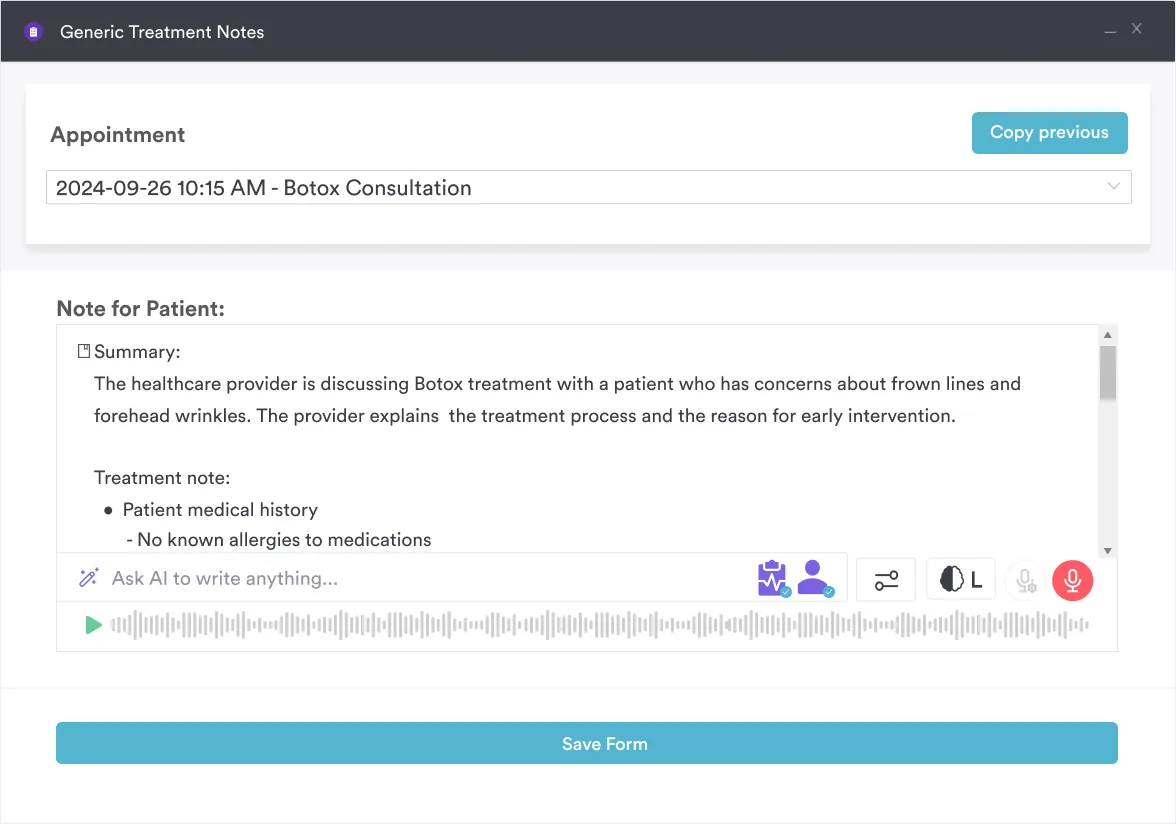
The administrative side of an articulation test, scheduling, consent, intake, scoring transfer, and report delivery, adds hours to a caseload that already stretches most SLP practices thin.
A practice seeing 30 children per week for articulation evaluations is managing 30 sets of scoring forms, 30 parent consent records, and 30 clinical reports, each with a slightly different turnaround expectation depending on the referral source.
Pabau supports speech therapy software workflows that consolidate these steps:
For practices offering both in-clinic and remote assessments, telehealth software integration means the screener-to-full-evaluation referral pathway can happen without scheduling delays.
None of this changes the clinical work. The articulation test is still administered by the SLP, scored against the normative tables, and interpreted with clinical judgment. What changes is the time spent on everything around the assessment, and for a practice managing 200 active clients, that time adds up to real clinical capacity.
If your speech therapy practice is looking to reduce assessment documentation overhead, book a demo with Pabau to see how structured workflows support evaluation-heavy caseloads.
The articulation test is the SLP’s primary instrument for converting clinical observation into defensible, norm-referenced data. Choosing the right instrument, administering it consistently, classifying errors accurately, and documenting results clearly are the four pillars of a sound articulation assessment.
Each one builds on the last: a well-administered articulation test yields better error data, which yields more targeted goals, which yields faster client progress.
For practices managing high-volume caseloads, Pabau’s client record management and automated workflows help turn assessment completion into structured clinical documentation without the administrative drag.
Book a demo with Pabau to see how structured workflows fit the way your speech therapy practice runs evaluations.

A positive test points to a speech sound disorder — what does treatment look like? Speech delay therapy walks through identification, therapy approaches, and the practice workflows that follow an assessment.
Need to document results consistently after testing? This SOAP notes for speech therapy template gives you a repeatable structure for recording articulation findings in the patient record.
Spending too much time on practice admin? Speech therapy practice management software compares six platforms that cut down on scheduling, SOAP notes, and insurance claims work.
An articulation test is a standardized clinical assessment that measures a client’s accuracy in producing specific speech sounds (phonemes) across word positions and linguistic contexts. It identifies which sounds are in error, classifies the error type (substitution, omission, distortion, or addition), and compares performance to age-based developmental norms to produce a standard score and severity rating.
An articulation screener takes five to ten minutes and produces a pass/refer decision to determine whether further evaluation is warranted. A full diagnostic articulation test takes 30 to 60 minutes and generates norm-referenced scores (standard score, percentile rank, severity classification) needed for eligibility decisions, IEP documentation, and insurance authorization. Only a licensed SLP can administer and interpret a full diagnostic articulation test.
The Goldman-Fristoe Test of Articulation, Third Edition (GFTA-3), published by Pearson Assessments, is the most widely used standardized articulation test. It is normed for ages 2;0 to 21;11 and includes the Sounds-in-Words and Sounds-in-Sentences subtests. It pairs with the Khan-Lewis Phonological Analysis, Third Edition (KLPA-3) for clinicians who need both sound-level and phonological pattern data from the same assessment session.
A formal articulation test can be administered as early as age two, though brief screeners are more typical for toddlers. Most referrals for a full articulation test occur between ages three and six, when speech sound errors become more clearly distinguishable from typical developmental variation. The referral decision should weigh the child’s error pattern, intelligibility, and how their production compares to the developmental norms for their age band.
Yes. The GFTA-3, for example, is normed through age 21;11. Adults who acquire speech sound errors following stroke, traumatic brain injury, or progressive neurological conditions can also be evaluated using articulation test procedures, though fewer norm-referenced instruments exist for older adults. Clinical judgment plays a larger role in adult articulation assessment, particularly when the primary concern is motor speech rather than phonemic accuracy.
An articulation test measures sound-by-sound production accuracy and is best suited to isolated or motor-based errors. A phonological assessment identifies systematic error patterns (processes like fronting, stopping, or cluster reduction) that affect entire sound classes. When errors are few and isolated, an articulation test is sufficient. When multiple sounds are affected in patterned ways, a phonological process analysis reveals the underlying rule more efficiently and guides a different treatment approach.
Free articulation screeners are easy to find online and are fine for an informal check of a child’s sounds, but they are not norm-referenced and cannot support an eligibility or diagnostic decision. The standardized diagnostic instruments (the GFTA-3, Arizona-4, and similar) are proprietary, purchased through their publishers, and administered and interpreted by a licensed SLP.