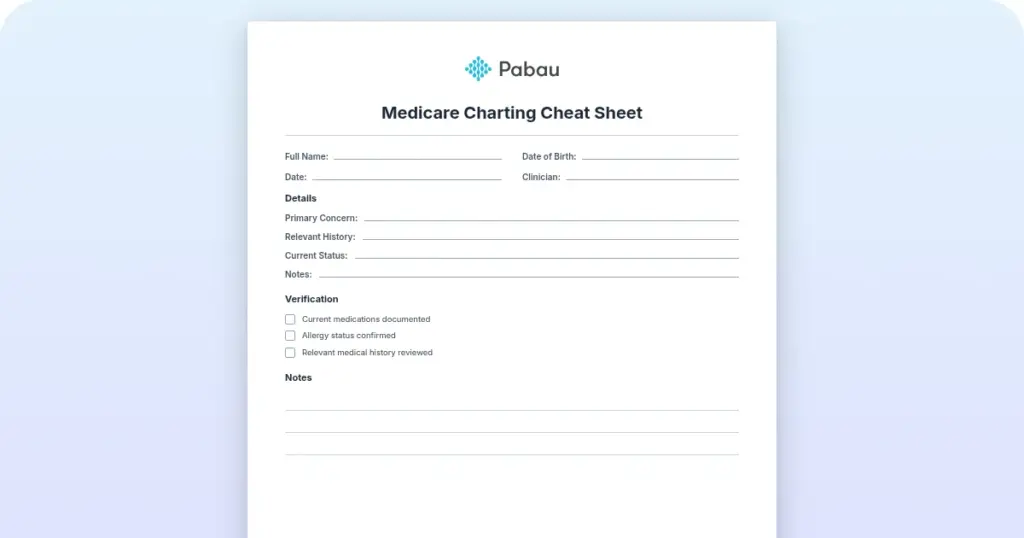
Medicare charting cheat sheet
A Medicare charting cheat sheet is a one-page reference that lists what Medicare...

4
Last Updated: Oct 21, 2026
Deciding between Pabau Scribe vs Heidi AI comes down to how much of your med spa admin the assistant should touch.
Pabau Scribe, our AI scribe inside practice management software Pabau, is the stronger pick for a practice already on the platform. It writes treatment notes, checks prescriptions, drafts patient letters and answers reviews inside the record you already keep.
Heidi AI wins in one situation. A practice on another system that only needs consultations transcribed gets that job done well, without paying for a platform it will not use.
The sections below compare what each assistant covers, what each one costs, and how both behave across a working med spa day.

Pabau Scribe is built into Pabau, so notes, prescriptions and letters land straight in the patient record.
Heidi AI is a standalone ambient scribe that transcribes consultations well but stops at documentation.
Pabau Scribe runs on pay-as-you-go credits, and the Care Plus add-on covers unlimited use.
Heidi AI publishes no prices for its paid plans, so a figure means a trial signup or a sales call.
Heidi AI only writes into an EHR from its Teams plan up, which adds cost and setup for a small med spa.
Pabau Scribe is an AI medical scribe built into Pabau’s practice management software, writing treatment notes straight into the patient record it already holds.
Pabau Scribe works as an ambient scribe, listening while the consultation happens. There is no second tool to log into, and no dictation session to start once the patient has left.
Because the scribe already sits beside the calendar and the patient record, no EHR integration has to be built, bought or maintained. Each agent takes one of the repetitive jobs that pile up across a treatment day:
Prefer a quick visual overview? Meet the Pabau Scribe agents in action. 👇
Every agent draws on live patient data held in your system, so the output matches what the record already says. Keep the patient card current and the note will reflect it.
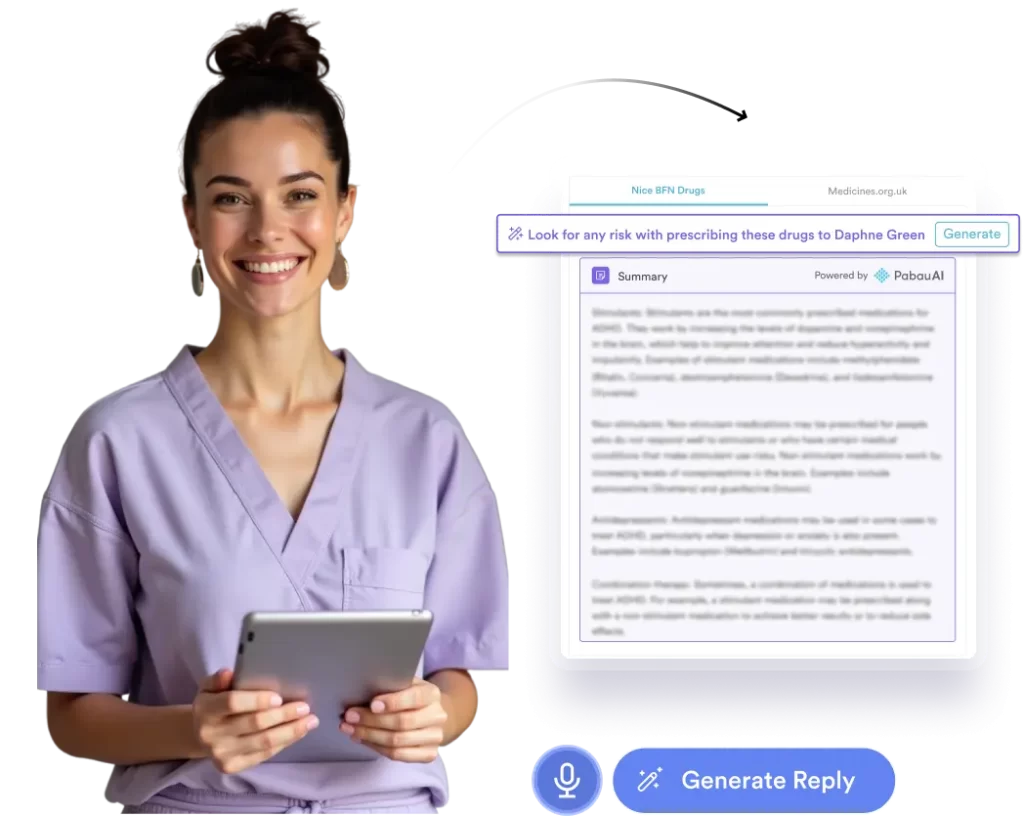
When something needs fixing, one support team owns it. Nobody has to chase a third-party vendor while a treatment day carries on around them.
Each Pabau Scribe agent is built for a specific task. Here is how they support your day:
On the move? With Pabau GO, our iOS app, you can dictate notes and open records straight from an iPhone or iPad.
Heidi AI is a standalone ambient scribe that transcribes a consultation in real time and drafts a structured clinical note for review.
As an ambient AI scribe, Heidi listens through the appointment and builds the note from what was said. That saves a lot of typing in a busy practice.
Heidi Health AI is pitched at every kind of clinician, from primary care to hospital specialties, rather than at aesthetics. Heidi handles documentation well and leaves the rest of the med spa workflow alone.
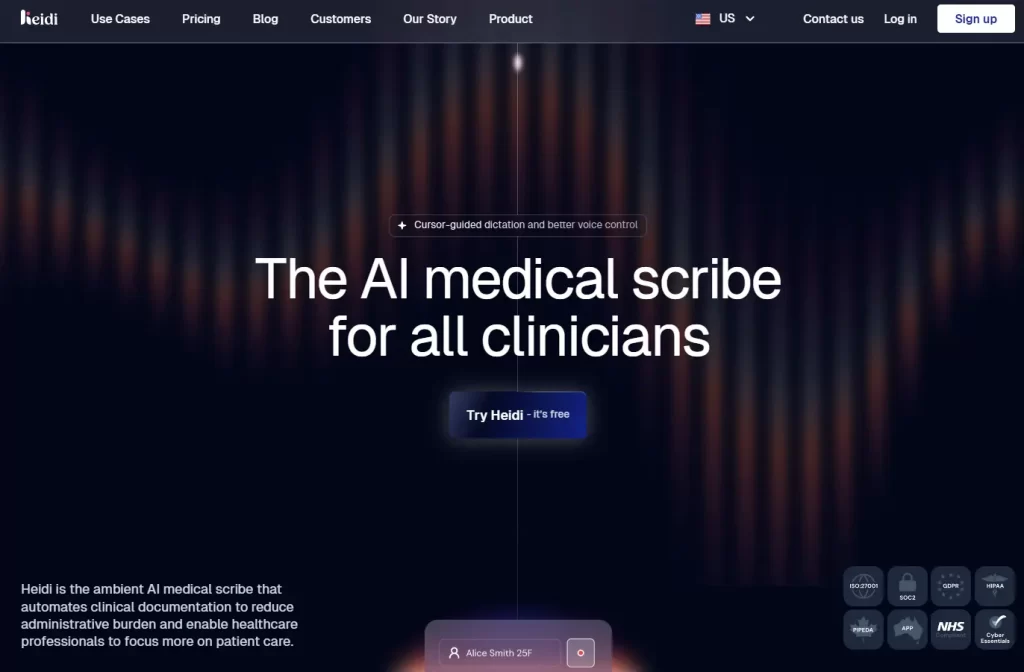
You will not find service description writing, prescription checks or review response tools, because those sit outside its core offering.
For practices that value team-based documentation and want a fast way to capture consults, Heidi still earns its place.
Heidi AI offers a tight set of documentation tools:
Pabau Scribe and Heidi AI both draft a structured note from a consultation, and only Pabau Scribe covers the prescriptions, letters and replies around it.
We mapped nine med spa documentation jobs against both tools.
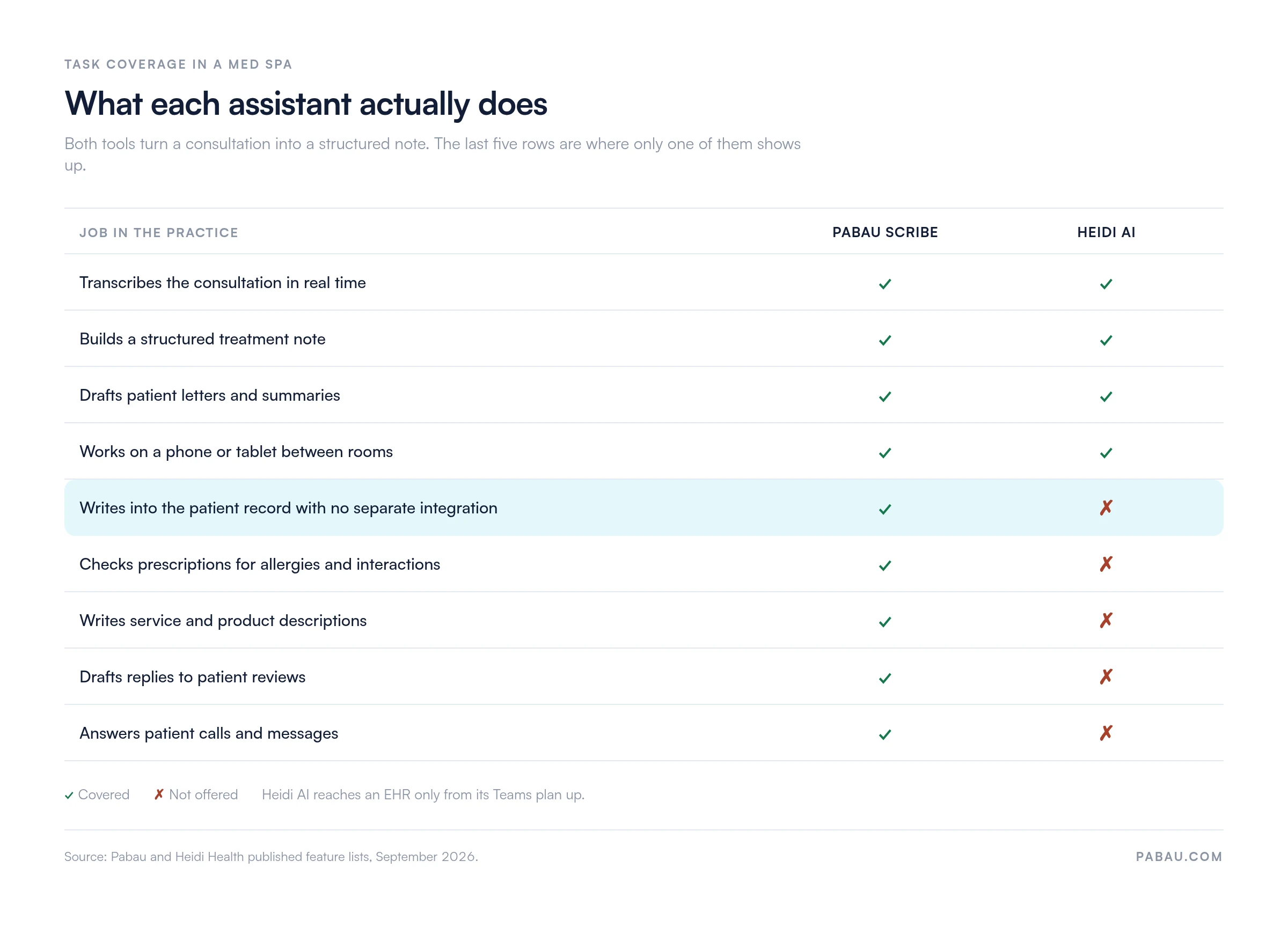
The table below covers setup, support and security, which is where the Heidi medical scribe and Pabau Scribe separate again.
| Feature | Pabau Scribe | Heidi AI |
|---|---|---|
| Integration | Fully built into Pabau, so there is no setup step | Requires a separate integration setup |
| Customization | Designed for med spa and aesthetic workflows | Built for general practice settings |
| Ease of use | Opens inside your consultation and notes section | External login or access usually required |
| EHR integration | Fully integrated with Pabau’s EHR, so it pulls patient data, treatment history and prescriptions | Native push-to-chart integration starts at the Teams plan; Free and Clinician have none |
| Speed and performance | Optimized for Pabau workflows | May respond slower due to external API connection |
| Support and maintenance | Handled by Pabau’s in-house support and development team | Requires coordination between Heidi support and Pabau support |
| Mobile access | Available in Pabau GO on iOS for dictation, notes and records | Mobile support available, but a less intuitive experience is reported |
| Data security | Native to Pabau, which follows HIPAA compliance, is GDPR registered and runs on ISO 27001-certified infrastructure | Heidi publishes HIPAA and GDPR compliance documentation, so a second vendor joins your security review |
| Cost | Pay-as-you-go credits, or unlimited use with the Care Plus add-on | Tiered subscriptions across Free, Clinician, Teams and Enterprise, with no published prices |
Pabau Scribe is charged in pay-as-you-go credits, while Heidi AI sells tiered subscriptions and publishes no price for any paid plan.
The charge follows the tasks you run, not the number of seats you bought.
Every AI task has a fixed credit cost. Run the same feature twice inside one treatment note and each run is charged separately.
Linda AI sits outside that system. It runs on its own subscription rather than on credits.
💡 Prefer not to watch a credit balance? Care Plus, our additional patient care add-on, includes unlimited Pabau Scribe use and is available today.
The Heidi AI medical scribe takes the subscription route instead. You pick a plan and get features according to the tier you sit on.
Heidi rebranded its plans in 2026 and no longer publishes a price for any paid tier. Its US pricing page routes you to a 14-day trial or to its sales team. Treat the tiers below as a feature ladder:
That model suits a general practice that wants one job done and can absorb a per-seat fee. For a med spa watching cost per treatment, Pabau Scribe leaves more control in your hands.
Med spas run on precision and speed. Appointments sit back to back, care has to feel personal, and admin stacks up before the first coffee.
AI assistants take the repetitive work off the team, keep records in order, and leave more of the day for treatment.
If AI in a med spa still feels like a maybe-later, the market disagrees. A recent report found that 73% of healthcare decision-makers expect it to be essential within five years.
Every minute spent retyping notes or hunting for a record is a minute away from the patient in front of you.
According to Mayo Clinic Proceedings: Digital Health, AI tools can cut documentation time by up to 70%.
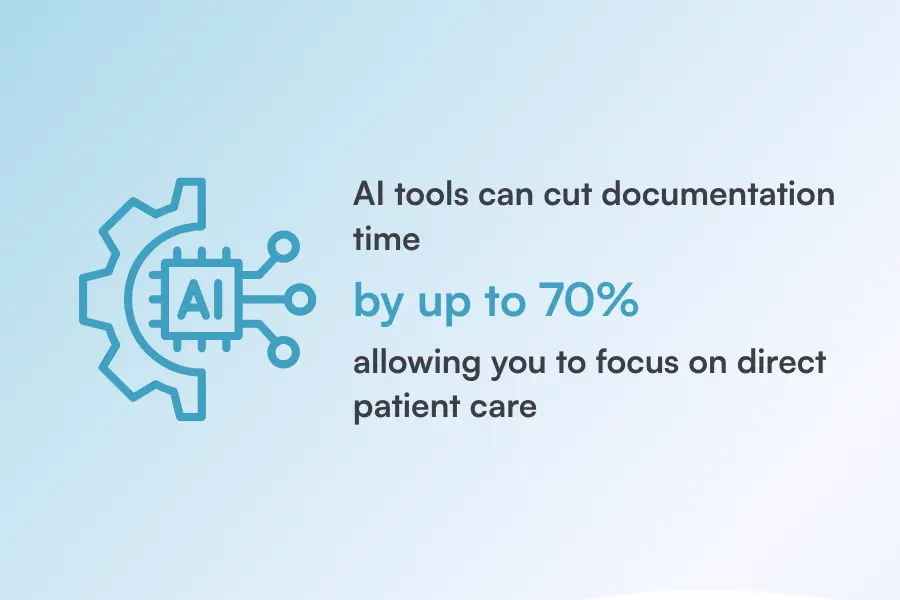
That hour buys extra bookings, follow-up calls, or a finish time that matches the one on the schedule.
An injectable treatment leaves four records behind, not one. A general clinical note covers only the last of them:
Those four belong on one patient timeline. Kept in four places, they turn a complaint 12 months later into an afternoon of searching.
A general ambient scribe writes the note and stops there, so the consent form and the photos stay wherever your team put them. Pabau Scribe writes into the record that already holds both, alongside the stock movement for the vial.
Structured notes written as the visit happens also mean fewer corrections when an audit lands. Pabau Scribe follows HIPAA compliance, and the record behind it is GDPR registered and hosted on ISO 27001-certified infrastructure.
There is a medicolegal argument for it too. A recorded consultation with an AI summary lets you show a complaining patient what was discussed, months later.
The biggest challenge for clinicians is obviously note-taking. The consultation is where you gain all the information.
Dr Harry Singh, founder and CEO of the Botulinum Toxin Club
What separates a decent visit from one that feels personal is having the right details at the right moment.
AI assistants pull up treatment history, preferences and key notes instantly, so your team can look at the patient instead of the paperwork. Those details are what move a visit from routine to individualized care.
Efficiency in a med spa should never cost you care quality. Precision treatments and patients who expect results leave no room for shortcuts.
AI assistants speed up the right part of the workflow, which is the admin that clutters the day and pulls focus. With less drag on the team, consistency holds even when the schedule is full.
Pabau Scribe is the better pick for a med spa, and Heidi AI only wins when transcription is the single job you need done.
Which one fits depends on the system you already run and the work you want covered.
If you are on Pabau, or heading there, Pabau Scribe is the clear choice. Pabau Scribe is already wired to your EHR, treatment history, prescribing and letters, so no tier unlocks a core feature.
You can pay as you go or move to Care Plus for unlimited use. Either way the cost tracks how much you use it, not how many seats you bought.
The Heidi AI scribe works well in general healthcare settings where note customization and shared documentation come first. In a med spa Heidi will feel like a workaround, because the aesthetic features and the built-in record are not there.
Still shortlisting platforms rather than scribes? You can compare med spa software head to head, and our guide to Pabau competitors and alternatives covers the wider field.
The same weigh-your-workflow logic drives matchups in other sectors, such as Cliniko vs Power Diary in allied health.
Still on the fence? Watch how Dr. Zainab Al Mukhtar, owner of Harrow on the Hill clinic, reacted when Pabau Scribe turned a recorded consultation into clean, structured notes. ⬇️
View this reel on Instagram
Pabau Scribe is the strongest Heidi alternative for a med spa, covering prescriptions, letters, service copy and review replies inside the patient record.
Most tools marketed as a Heidi alternative are other standalone scribes. Swapping one for another moves the same narrow job to a new vendor and leaves the rest of the documentation day where it was.
Three questions separate a scribe built for aesthetics from one built for a primary care practice:
In the med spas we onboard, the consultation note is rarely the slowest part of the day. The follow-up letter, the prescription check and the review reply are what push a team past closing time.
An alternative that answers only the first question fixes a quarter of that. For a practice staying on its current system and needing transcription alone, Heidi AI remains a fine choice.
In most med spas the note gets written twice. The practitioner scribbles during the consultation, then retypes it into the record between patients. The letter, the prescription check and the review reply each wait on a separate tool.
Pabau Scribe collapses that into one pass. Take a lip filler consultation on a Tuesday afternoon, documented as it happens:
Because the agents read the record rather than a copy of it, no one re-keys the note and the versions cannot drift apart. The practitioner reviews and approves, and the day moves on.

Pabau Scribe turns each recorded consultation into a structured treatment note on the patient card. It checks the prescription against that history and drafts the follow-up letter. Your team reviews and approves instead of retyping.

Heidi AI and Pabau Scribe are answering different questions. Heidi answers how to stop typing notes. Pabau Scribe answers how to stop the documentation work that surrounds the note.
If transcription is genuinely the only thing slowing your team down, Heidi will fix it, and a second vendor is the price you pay. If prescriptions, letters, service copy and reviews are eating the same hours, a bolt-on scribe leaves most of that untouched.
The trade-off worth remembering is where the note lands. A scribe that writes into the record you already keep costs nothing extra to integrate. One that does not will keep asking your team to move data by hand.
Book a demo to see how Pabau Scribe handles a full med spa consultation, from the recording to the filed note.

Weighing Pabau against another aesthetics platform? Pabau vs Aesthetic Record compares the two on charting, booking and payments for med spas.
Outgrowing Mindbody? Best Mindbody alternatives for med spas ranks the platforms that handle clinical records as well as scheduling.
Comparing two aesthetics-first systems? Aesthetic Record vs GlossGenius breaks down where each one fits a treatment-led practice.
Looking past AestheticsPro? AestheticsPro alternatives covers the options for practices that need deeper clinical workflows.
Running an allied health practice instead? Cliniko vs Power Diary compares two of the most common small-practice systems.
For a med spa already running on Pabau, yes. Pabau Scribe writes into the patient record you already keep, and it also handles prescriptions, letters, service descriptions and review replies. Heidi AI is the better choice only when transcription is the single job you need and you are not moving platforms.
No. Pabau Scribe is part of the platform, so every Pabau subscription can use it. You either top up credits as you go or add Care Plus for unlimited use.
Research in Mayo Clinic Proceedings: Digital Health found AI tools can cut documentation time by up to 70%. In a med spa that is roughly an hour back across a full treatment list. It is the difference between finishing on time and catching up after hours.
Most alternatives to the Heidi AI scribe are other standalone transcription tools, which move the same job to a new vendor. A med spa usually gets more from a scribe built into its practice management system. Pabau Scribe adds the prescription check, the follow-up letter and the review reply to the same record.
Heidi earns its cost when transcription is the only task slowing your team down. The company publishes no price for its paid tiers, so a trial signup or a sales call is the only way to compare figures. A med spa already paying for a platform with a built-in scribe is buying the same job twice.