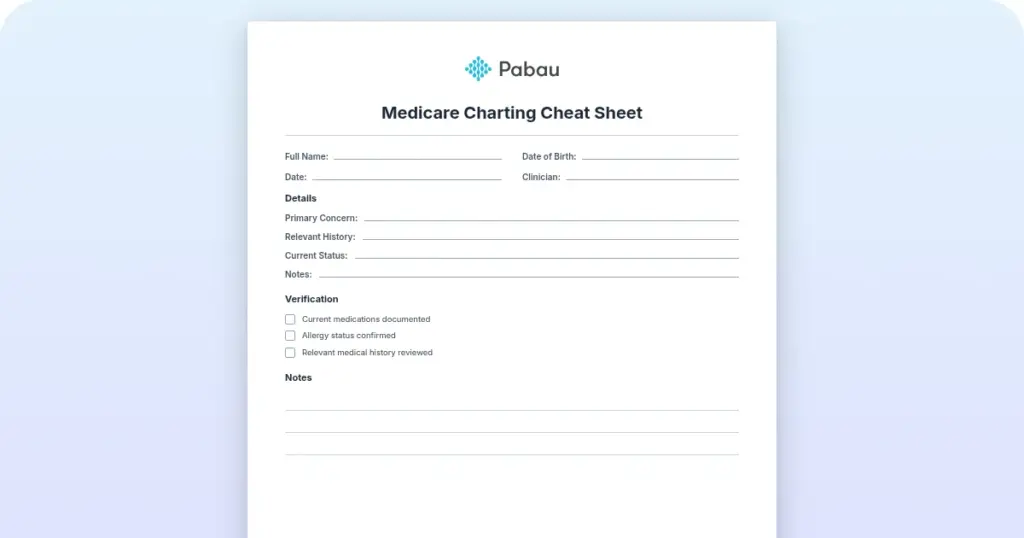
Medicare charting cheat sheet
A Medicare charting cheat sheet is a one-page reference that lists what Medicare...

2
Last Updated: Oct 21, 2026

The best physical therapy EMR software connects charting, scheduling, and insurance billing in one record, so documentation problems never reach the payer.
Run the billing-mix test first: your payer mix, your site count, and your service lines decide the shortlist.
WebPT and Prompt EMR lead for insurance-heavy US outpatient PT, because Medicare rules and denial analytics sit inside the workflow.
Pabau is the strongest pick for multi-specialty and multi-location PT practices that want one EMR, AI scribe, and patient engagement layer.
Solo PTs, cash-based practices, and allied health teams have lighter options in Jane App, SimplePractice, PtEverywhere, and Noterro.
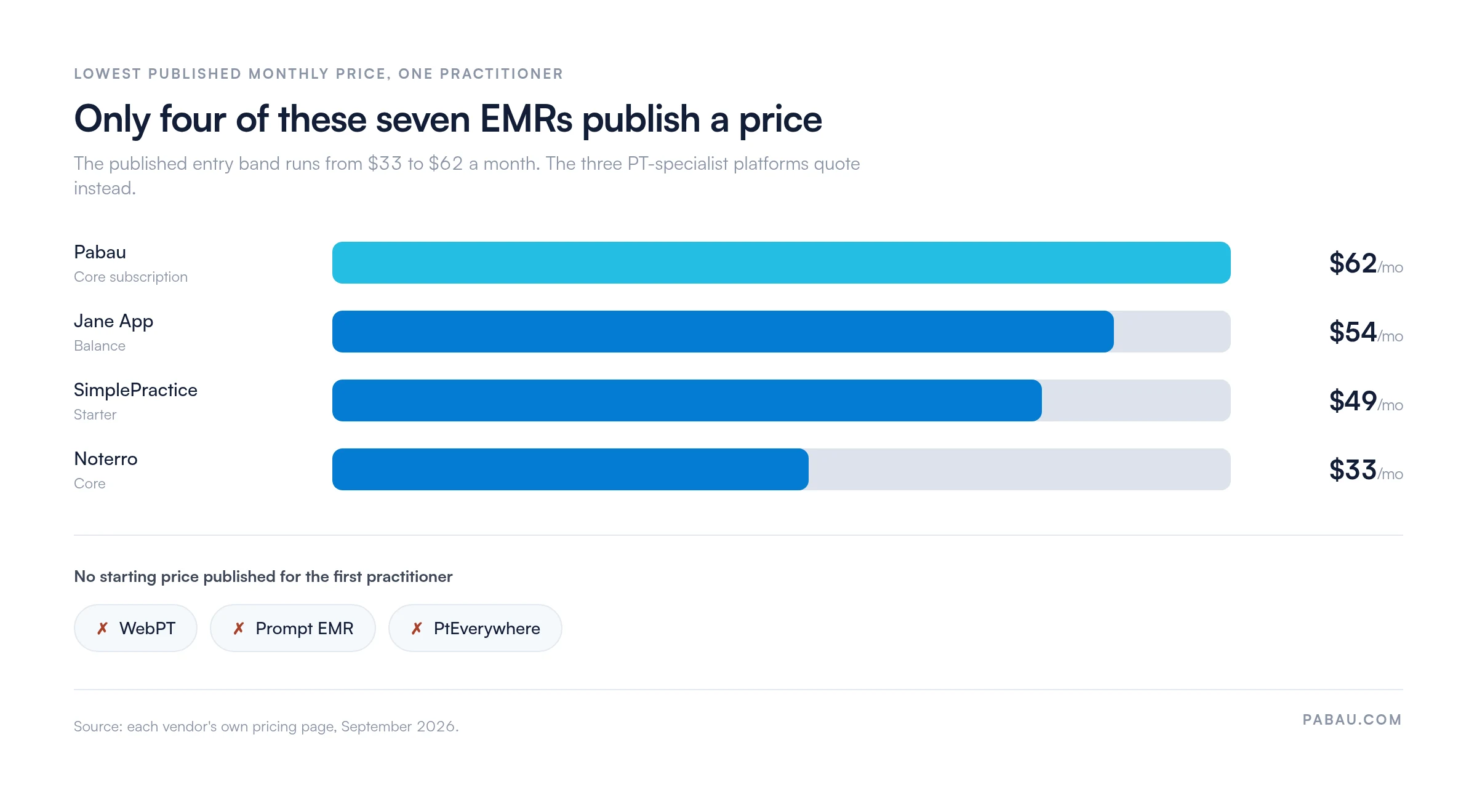
None of these seven platforms is free, and only four publish a starting price, in a band from $33 to $62 a month.
The best physical therapy EMR software for a practice is decided by how that practice gets paid, not by whose feature list is longest. WebPT and Prompt EMR win on Medicare documentation. Pabau wins when physical therapy is one service line among several. The other four sort by practice size and payer mix.
That routing rule is the billing-mix test, and it runs through this whole comparison. Payer mix comes first because denials are where the money leaks. According to Premier Inc., initial denial rates on claims submitted to private payers averaged nearly 15%. Rehab therapy denials come far more from thin documentation than from coverage disputes.
So this comparison ranks the seven platforms on documentation depth, Medicare and KX handling, outcome measures, home exercise programs, and billing. Every price below comes from the vendor’s own site, and three of the seven publish none. If you want the wider operational layer too, the guide to physiotherapy clinic management software covers it.
WebPT and Prompt EMR lead this comparison on Medicare depth, Pabau leads on multi-service-line breadth, and Noterro leads on price at $33 a month.
All seven handle PT charting and scheduling competently. They diverge on Medicare and KX depth, outcome measure support, home exercise program delivery, and whether they publish a price at all. The “Best for” column below states the routing, not a slogan.
On usage, WebPT has the widest adoption in US outpatient physical therapy, which is why new hires often arrive already trained on it. Prompt EMR is the fastest-rising challenger on the billing side. Jane App holds the equivalent position outside the US, particularly in Canada, the UK, and Australia. Those three plus SimplePractice are the names that dominate a PT software shortlist.
None of these seven platforms is free. Free EMRs do exist in the wider market, but they usually recover the subscription through advertising, per-claim fees, or a thinner clinical record. Among these seven, three will not name a price without a sales call.
WebPT bakes Medicare documentation rules into the note, so compliance stops depending on who is charting.
WebPT is the most recognized PT-only EMR in the United States. Built specifically for outpatient rehab, it has earned its position on documentation defensibility under Medicare. Its PT evaluation, daily note, and re-evaluation templates align with what payers expect to see. For US rehab groups billing high Medicare volumes, WebPT is the safest default. The documentation rules sit in the workflow rather than in the clinician’s memory.
The trade-off is rigidity. WebPT is opinionated about PT workflows, which is exactly what some groups want and exactly what holds others back. Multi-specialty practices, cash-based practices, and teams that want flexible chart templates often find the system harder to bend than its newer competitors.

WebPT averages 4.2/5 on Capterra across 484 reviews. Reviewers consistently praise its rehab-specific templates and Medicare compliance. The most cited concerns are pricing, the learning curve, and limited flexibility outside outpatient PT.
| Plan | Price | Who it’s for |
|---|---|---|
| All plans | Custom quote | US rehab practices and outpatient PT groups |
WebPT publishes no prices on its own site, so every figure comes out of a sales conversation. Budget a call before you budget a subscription.
Prompt puts a clearinghouse and denial analytics inside the EMR, which is where most PT practices lose margin.
Prompt EMR has built its reputation on the billing side of PT. Its clearinghouse, denial analytics, and RCM dashboards give billing teams live visibility into claim status, payer mix, and collection performance. Older PT EMRs struggle to match that. Clinical documentation is solid too, with structured PT templates, plan-of-care tracking, and KX modifier handling.
Prompt publishes the most specific numbers on this shortlist. Its own site claims 75% less documentation time, 92% of notes completed same day, and $32,000 in additional annual revenue per clinician. Treat those as vendor figures rather than independent benchmarks, but no competitor here publishes figures this specific.

Prompt holds a 4.8/5 on Capterra across 51 reviews. Reviewers most often highlight billing automation, denial reduction, and product responsiveness. The most consistent criticisms are the price point and the onboarding effort for billing teams moving off older systems.
| Plan | Price | Who it’s for |
|---|---|---|
| All plans | Custom quote | US outpatient PT practices with significant payer mix |
Prompt runs no pricing page at all, so the entry cost starts with a call. Most practices weigh the quote against what they already spend on a separate clearinghouse and billing service.
Before shortlisting any PT EMR, run a 30-day documentation audit. Count the average minutes per session spent charting, the number of claim denials per month, and the manual touchpoints between booking and discharge. Those three numbers tell you whether your bottleneck is documentation, billing, or workflow. Each one points at a different platform on this list.
Pabau runs PT charting, claims, and patient comms from one client record across every service line.
Pabau is practice management software built for healthcare practices running more than one service line. Its physical therapy EMR sits inside the same platform that handles scheduling, automated patient comms, and insurance billing. PT documentation, plan-of-care updates, and claim submission move through one record rather than three disconnected tools. Some practices combine PT with sports medicine, occupational therapy, or wellness. For them, this is the only platform here that does not lock you into a single discipline.

According to Capterra, Pabau holds a 4.7/5 rating across 600+ verified reviews. Reviewers consistently highlight the unified record, where one client card holds clinical notes, photos, prescriptions, payments, and communications. That is the reason teams pick it over PT-only EMRs. Where rehab-specialist platforms force workarounds when a practice expands beyond PT, Pabau adapts, because it was never built around a single specialty.
On Capterra, Pabau averages 4.7/5 from 600+ verified reviews. Recurring themes include consolidating several tools into one platform, strong appointment and scheduling features, and responsive support during onboarding. On G2, Pabau holds a similar 4.7/5 from 329 reviews. Reviewers in physical therapy and multi-specialty practices specifically call out the EMR flexibility.
| Plan | Price | Who it’s for |
|---|---|---|
| Core subscription | From $62 / month | Single-location practices, one user |
| Multi-user and multi-location | Scales with users and locations | Growing and multi-site PT groups |
Pricing scales with locations and user count, and every subscription includes every feature. There is no starter tier that locks a PT practice out of claims, telehealth, or reporting.
Jane App is the easiest of these to learn, and it assumes mixed cash and insurance work from the start.
Jane App is a Canadian-built EMR that has become the default option for international PT and allied health practices. The charting layer is approachable and the body-chart drawing tools are well integrated. Its scheduling and payment workflows assume mixed insurance and cash-pay work rather than a single Medicare-centric model. For PT practices outside the US, or cash-based US practices that do not need deep payer billing, Jane App is the strongest value pick.

Jane App holds a 4.8/5 on Capterra. Reviewers praise ease of use, scheduling, and the body-chart tools. The most common criticism is limited depth for US-style insurance billing.
| Plan | Price | Who it’s for |
|---|---|---|
| Balance | $54 / month | Solo practitioners |
| Practice | $79 / month | Practices adding insurance billing |
| Thrive | $99 / month | Larger multi-practitioner practices |
Jane App publishes all three plan prices, listed in Canadian dollars on its own site. AI scribe, group telehealth, and insurance billing are priced as add-ons on top of the plan.
SimplePractice has the most polished patient-facing experience here, with billing depth as the trade-off.
SimplePractice was originally built for mental health, then extended into physical therapy, occupational therapy, and speech. That heritage shows in the patient-facing experience. The client portal is one of the most polished in the category, the calendar is fast, and telehealth is built in. For solo PTs running mixed caseloads that include mental health, OT, or speech, SimplePractice removes friction from day-to-day operations without overwhelming new users.

SimplePractice holds a 4.5/5 on Capterra. Reviewers consistently praise the interface and telehealth. The most common criticisms are billing limitations and the total price for solo practices once add-ons are included.
| Plan | Price | Who it’s for |
|---|---|---|
| Starter | $49 / month | Solo clinicians with simpler billing |
| Essential | $79 / month | Solo practices wanting the full core set |
| Plus | $99 / month | Group practices, first practitioner |
SimplePractice publishes both solo and group pricing, and group plans add a per-practitioner charge above the first. AI note taking and ePrescribe are billed as separate monthly add-ons.
PtEverywhere keeps charting, scheduling, billing and messaging on one record, which is where double entry usually starts.
PtEverywhere is built around a single principle: One database. Charting, scheduling, billing, and patient communication all reference the same record. That removes the double entry that usually sits between separate EMR, scheduling, and billing tools. For independent PT practices that have outgrown spreadsheets and disconnected apps but do not need enterprise-grade RCM, that consolidation is the platform’s main draw.

PtEverywhere holds 4.8/5 on Capterra across 16 reviews. Reviewers most often praise the unified data model and the time saved on patient communications. Reporting depth and integrations draw the most criticism.
| Plan | Price | Who it’s for |
|---|---|---|
| Base plan, first therapist | Contact sales | Independent US PT practices |
| Additional therapist accounts | $50 to $75 / month each | Growing PT teams |
PtEverywhere publishes its per-seat rates but no starting price for the first therapist, so the entry cost still needs a call. The per-therapist rate falls as the team grows.
Noterro is the cheapest way onto a proper PT chart, as long as insurance billing stays light.
Noterro is the most accessible PT EMR on this list by price, and the product is not stripped down for it. The charting UI is clean, anatomy markers and pain mapping are well integrated, and online booking and SOAP notes work out of the box. It suits small massage, physical therapy, and rehab practices that want a clear workflow without enterprise overhead. For new or budget-conscious practices, Noterro is the strongest entry-level pick.

Noterro averages 4.8/5 on Capterra. Reviewers cite the value, ease of use, and responsive product team. The most common limits are billing depth and advanced reporting.
| Plan | Price | Who it’s for |
|---|---|---|
| Core | $33 / month | Independent practitioners |
| Plus | $55 / month | Small practices adding insurance features |
| Max | $77 / month | Practices wanting the full feature set |
Each Noterro plan includes one practitioner, with additional practitioners billed from $13.20 a month. That makes it the lowest published entry price in this comparison.
Pabau and WebPT suit multi-site PT groups best, because both keep one patient record, cross-site scheduling, and per-location reporting inside a single system.
A second site changes the question being asked. A single-site practice is buying charting. A group is buying one database that runs several schedules and a single billing operation without anyone re-keying a visit.
Five capabilities separate a platform that scales from one that merely copes:
So the best physical therapy software for multi-location clinics is the platform that treats a second site as a setting rather than a second subscription. Pabau does this natively, and every Pabau subscription includes every feature, so opening a site does not mean buying a different plan. WebPT and Prompt EMR both support multi-clinic groups on the insurance side.
Jane App runs multiple locations comfortably, though its US payer tooling stays lighter. SimplePractice, PtEverywhere, and Noterro are built around a single site, and groups tend to outgrow them at the reporting layer first.
Choosing physical therapy software for clinics managing patient schedules and billing across a team comes down to one test. Booking a visit should create the charge, and charting that visit should populate the claim. Where scheduling and billing sit in separate modules, someone re-keys the visit, and re-keying is where a group quietly loses margin.
Payer mix still shapes the answer. A multi-site cash-pay group has the easier problem, because there is no clearinghouse enrollment to consolidate across locations.
WebPT, Jane App, and Pabau collect validated outcome measures inside the note itself, rather than through a separate questionnaire tool bolted on beside it.
Outcome measures split into two kinds, and physical therapy documentation software treats them very differently. Patient-reported outcome measures, known as PROMs, are scored by the patient. The Lower Extremity Functional Scale and the Oswestry Disability Index are the familiar examples.
The other half is clinician-recorded. Manual muscle testing grades, range-of-motion readings, and gait or balance scores are captured by the therapist at the table. Both kinds have to live in the same chart entry as the treatment they justify.
Pain scoring sits on the clinician-recorded side whenever a patient cannot self-report, which happens on acute care and neuro caseloads. A CPOT pain scale form scores facial expression, body movement, and muscle tension in about two minutes.
What decides the purchase is whether the platform stores both longitudinally. A score earns its keep only when the note in week eight can be read against the note in week one. That comparison is what turns an outcome measure into evidence of continued medical necessity.
Here is where each of the seven actually sits, based on what each vendor publishes on its own site:
If your requirement is validated outcome measures and PROMs alongside manual muscle testing templates in one chart, the shortlist gets short fast. WebPT covers it out of the box. Pabau and Jane App reach it through configurable chart templates, which means more setup and more flexibility over what you record.
HEP delivery matters for the same reason outcome scores do. An exercise program the patient never opens is not adherence, and a program prescribed outside the chart is not documented. WebPT’s 5,500-exercise library is the benchmark the rest of this list gets measured against.
The billing-mix test routes a PT practice to a shortlist using three answers: payer mix, number of sites, and number of service lines.
It sorts by how a practice gets paid and how it is shaped, rather than by feature checklist. No page on this topic gives you a routing rule, so here is one. Work the three questions in order and five of the seven platforms fall away.
Two questions usually agree, and the third breaks the tie. A single-site, insurance-heavy, PT-only practice lands on WebPT or Prompt EMR without much argument. A two-site practice running PT and occupational therapy lands on Pabau just as cleanly.
Practices adding occupational therapy should weigh occupational therapy EMR features before committing one platform to both disciplines. The range of physical therapy specialties, from orthopedic to neurological to pediatric, also shapes which templates you need. Check the template library against your actual caseload, not against the demo.
A practice that adds chiropractic care bills spinal manipulation under its own code set, 98940 through 98943. Medicare pays those claims only on PART documentation, which is a separate standard from the KX therapy threshold. Compare chiropractic billing software before stretching one platform across both service lines.
If the bottleneck is charting time rather than claims, you are really shopping for physical therapy documentation software. In that case the AI scribe is the feature that moves the number. All seven platforms now ship one. Jane App and SimplePractice both price theirs as a monthly add-on.
Cash-based PT rewrites the first answer. The best EMR for cash-based physical therapy is the one with the strongest front desk, not the strongest billing engine. With no clearinghouse and no KX threshold to watch, denial analytics stop earning their price. Booking, deposits, packages, and rebooking earn it instead, because a cash practice lives on retention rather than claim throughput.
Jane App and Noterro are the value picks for a cash-based practice. Pabau suits a cash practice that runs several service lines and wants the marketing and recall layer built in.
Budget the switch, not just the subscription. In practices we onboard, a migration runs on two clocks. Data mapping and template rebuild are the fast one. Payer enrollment and EDI setup with the new clearinghouse are the slow one, and they are the reason a go-live slips.
Plan to run the old and new systems in parallel for at least one full billing cycle. Start payer re-enrollment before the go-live date rather than after it. A practice that skips this step usually discovers the problem in its cash flow, not in its software.
One name that comes up in PT software searches is missing from this list. TheraOffice now sits inside Netsmart’s enterprise portfolio rather than being sold as a standalone product, and it publishes no pricing. That puts it outside the shortlist this comparison is built for.
This guide to opening a physiotherapy clinic covers the wider operational picture. Read it if you are building the practice and choosing the system at the same time.
An EMR holds the clinical record, a practice management system runs scheduling, billing, and the front desk, and all seven platforms here sell both together.
The distinction that matters is not the label on the box. The real question is whether the two halves run on one database, or on two products stitched together with an integration.
A therapy PMS (practice management system) bolted onto a separate EMR means the patient exists twice. The two copies drift, a phone number gets updated in one and not the other, and the billing team works from a stale record.
So ask each vendor one question in the demo. Does billing read the therapist’s note directly, or does it receive an export? The answer tells you which product you are actually buying, whatever the marketing page calls it.
US compliance asks two things of a PT EMR: protect the record, and get the Medicare modifiers onto the claim before it leaves the building.
Three regulatory areas separate serious PT EMRs from generic charting tools, and the differences bite at the buy stage.
No round-up on this topic works a billing example through with real figures, so here is one Medicare visit end to end.
A therapist delivers 33 minutes of therapeutic exercise (CPT 97110) and 7 minutes of manual therapy (CPT 97140). Direct timed treatment totals 40 minutes.
Under the 8-Minute Rule, 40 minutes divided by 15 gives two full units with 10 minutes left over. Ten minutes clears the 8-minute floor, so a third unit is payable. CMS’s own example in the Medicare Claims Processing Manual bills this as two units of 97110 and one unit of 97140.
That unit of manual therapy pays even though 7 minutes alone would not support a unit. The first 30 minutes of 97110 take two units. The 3 leftover minutes of 97110 are then compared against the 7 minutes of 97140, and the larger remainder takes the third unit.
Untimed codes sit outside that arithmetic. A PT evaluation (97161 to 97163) bills one unit however long it takes, and its minutes never enter the timed total.
Now add the threshold. Say this patient’s PT and SLP allowed charges have already passed $2,480 for the year. Every line on this claim needs the KX modifier, alongside the GP modifier marking the service as delivered under a physical therapy plan of care.
Three things have to happen automatically for that claim to clear:
Miss the third one and the claim still pays, right up until a targeted medical review asks for the record. That is the difference between a compliant EMR and a charting tool with a modifier field.

WebPT and Prompt EMR carry the deepest US-payer scaffolding of the seven, with visit caps, KX triggers, and CPT feedback inside the charting screen. Pabau handles HIPAA, audit logging, role-based access, and KX through configurable billing rules, across US, UK, and EU markets. Jane App, SimplePractice, PtEverywhere, and Noterro all meet HIPAA, but their US-payer depth is lighter and KX tends to be tagged by hand.
In most PT practices the note lives in one system, the claim in another, and the recall reminder in a third. A therapist finishes a session, charts after hours, then a biller re-keys the visit into the claim. Every hand-off is somewhere a detail can go missing, and a missing detail is what a payer denies.
Pabau holds all of it in one client record. Pabau Scribe, our AI scribe, drafts the SOAP note from the session while the therapist is still with the patient. The plan of care, the outcome measures, and the claim all read from that same record. The biller works from the therapist’s own note, not a re-typed summary.
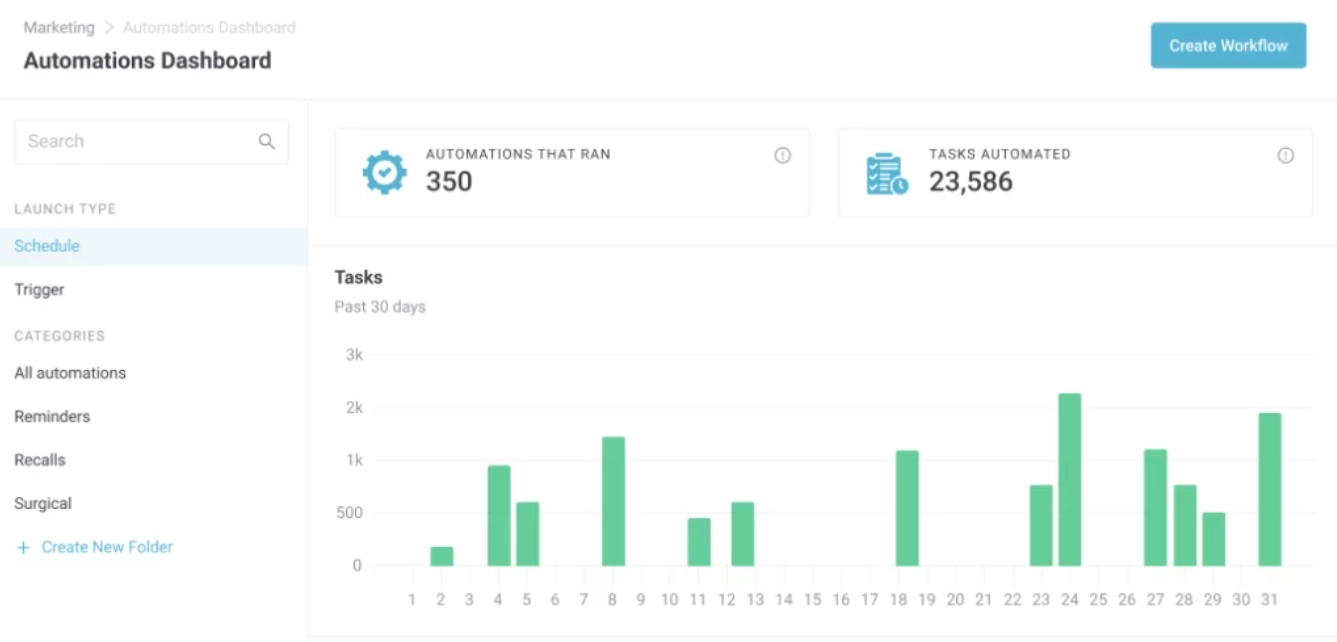
That leaves fewer hand-offs to chase. Appointment reminders, post-visit exercise instructions, and review requests fire off EMR events instead of a spreadsheet. Every subscription includes every feature, too. Adding a second location or a new service line does not mean a fresh quote and a second migration.
A practice that adds cupping to its PT service line puts the same demand on that record. Mark color and location sit in custom fields on the client record, so reading cupping marks compares one session against the next.

Pabau’s PT EMR drafts SOAP notes with Pabau Scribe, tracks the plan of care, and submits claims from the same client record. Your therapists finish charting in the session instead of after hours.

Run the billing-mix test before you book a single demo, and pick for the payer mix you have today. If most of your revenue arrives through Medicare and commercial plans, look at WebPT or Prompt EMR first. Both earn their keep in denials you never have to rework. Neither publishes a price, so budget a sales call before you budget a subscription.
Below them the choice splits by practice shape rather than by quality. Solo PTs and allied health hybrids get the cleanest day-to-day from SimplePractice or Noterro. International and cash-based practices fit Jane App. Independent US practices cutting double entry should look hard at PtEverywhere.
And if PT is one service line among several, or you are running more than one site, the calculation changes. A PT-only EMR will need a workaround the first time you add OT, sports medicine, or wellness. Pabau is the broadest option here for that case, with charting, AI documentation, scheduling, billing, and patient engagement on one record. Book a demo to see how a multi-specialty PT practice runs it end to end.

Comparing EMRs for an OT service line too? Best occupational therapy practice management software ranks seven platforms on documentation and billing depth.
Running chiropractic alongside PT? Best chiropractic EHR compares the charting and billing options built for spinal care.
Tracking a patient’s daily living skills too? ADL assessment tool gives a printable form covering basic and instrumental activities of daily living.
Screening for thoracic outlet syndrome too? Adson’s test template documents positioning, radial pulse findings, and vascular versus neurogenic TOS indicators.
Grading a spinal cord injury too? ASIA Impairment Scale scores sensory and motor function to determine AIS grades A through E.
For most US outpatient PT practices, WebPT and Prompt EMR lead, because Medicare documentation rules and denial analytics are built into the workflow. Pabau is the strongest pick for multi-specialty and multi-location practices that want one EMR across PT, sports medicine, wellness, OT, or aesthetics. Jane App, SimplePractice, PtEverywhere, and Noterro suit smaller and international practices with lighter billing needs.
At minimum: PT-specific SOAP and evaluation templates, functional outcome tracking, plan-of-care management, and KX modifier handling. Add insurance claim submission, HIPAA-compliant data handling, online booking, automated reminders, and patient communication tools. Growing PT practices should also expect telehealth, AI-assisted documentation, multi-location reporting, and a patient portal.
Four of the seven platforms here publish a starting price. Noterro’s Core plan starts at $33 a month, SimplePractice’s Starter at $49, Jane App’s Balance at $54, and Pabau at $62. WebPT, Prompt EMR, and PtEverywhere publish no starting price and quote instead. Budget for add-ons too, because AI note taking, insurance billing, and telehealth are often priced separately.
Not among the seven platforms compared here. Free EMRs do exist in the wider market, but they usually recover the subscription through advertising, per-claim fees, or a thinner clinical record. Four of these seven publish a starting price, running from $33 a month for Noterro’s Core plan up to $104 for Pabau. WebPT, Prompt EMR, and PtEverywhere quote instead of publishing. For a practice billing insurance, one avoidable denial usually costs more than a month of any of these subscriptions.
Cloud-based PT EMR is the industry standard in 2026. All seven platforms in this comparison are cloud-based, which means automatic updates, access from any device, lower IT overhead, and easier multi-location operation. The HHS HIPAA Security Rule applies to both deployment models. Reputable cloud vendors generally have stronger built-in security than on-premise installations maintained by smaller practices.
A PT EMR focuses on clinical documentation: SOAP notes, evaluation templates, plan of care, functional outcome measures, and discharge planning. PT practice management software covers operations: scheduling, billing, patient communication, reporting, and multi-location workflows. Modern platforms like Pabau, WebPT, and Prompt combine both into a single system, which removes the data duplication that comes with running them separately.
Yes. Dedicated US PT EMRs like WebPT and Prompt automate KX modifier tracking. They flag when a patient approaches the annual Medicare therapy threshold, then prompt the clinician to document medical necessity. Multi-specialty platforms like Pabau support KX through customizable billing rules. General-purpose allied health EMRs such as SimplePractice and Jane App handle it with manual tagging in most cases.