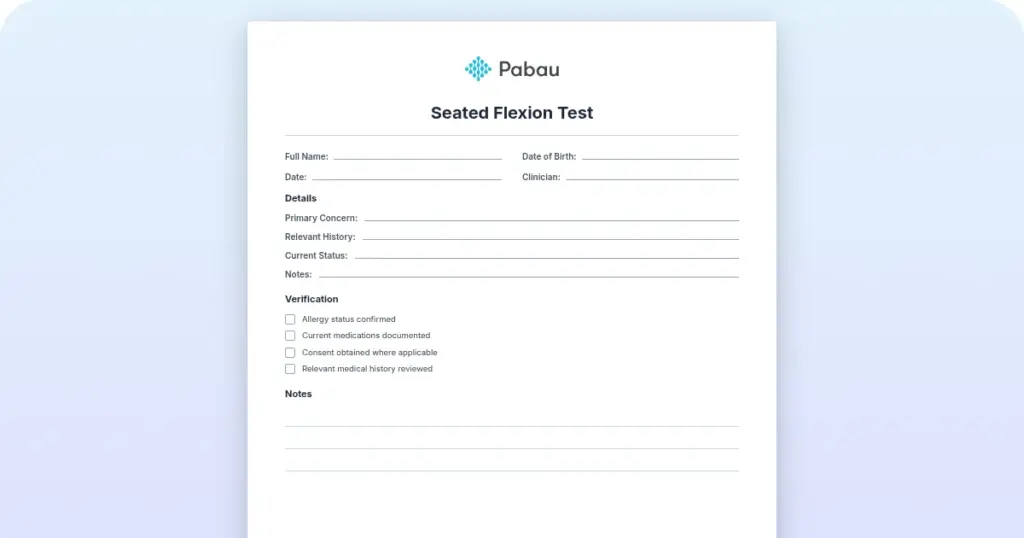
Seated flexion test
The seated flexion test is a palpation-based assessment of sacral motion at the ...

6
Last Updated: Oct 15, 2026

Chiropractic marketing works best as a system: Local SEO, reviews, referrals, and automation working together, not as isolated tactics.
Google Business Profile completeness directly improves local map pack rankings, according to Google Search Central documentation.
Patient reactivation campaigns targeting lapsed patients cost significantly less than new patient acquisition and often yield higher appointment volume.
Pabau’s automated workflows, online booking, and review tools let chiropractic clinics run marketing touchpoints without adding staff hours.
Most chiropractic practices spend money on marketing and get inconsistent results. The problem usually isn’t the tactic but the lack of a connected system, where every patient touchpoint, from the first Google search to the sixth appointment, reinforces the next. Effective marketing for chiropractors depends on that system more than most practitioners realize, and practice management software like Pabau is what holds it together. This guide covers the chiropractic marketing strategies that produce measurable growth: what to prioritize first, how to layer tactics together, and how automation removes the manual follow-up most practices can’t sustain. An EMR built for physical therapy keeps exercise prescriptions and outcome measures in the same record. An EMR built for physical therapy keeps exercise prescriptions and outcome measures in the same record.
The clinics growing fastest right now aren’t running more ads. They’re converting more of the demand that already exists. According to consumer review reports, 97% of people read online reviews for local businesses, and healthcare practices rank among the most review-sensitive categories. That stat sits at the intersection of every chiropractic marketing decision worth making.
Before choosing tactics, anchor the strategy to three questions: Where are new patients coming from right now? Which existing patients have lapsed? What does the post-treatment experience feel like? The answers determine where to put effort. For most established practices, the highest-return activities are internal: review generation, patient reactivation, and referral programs. For newer practices, visibility comes first: local SEO, Google Business Profile, and paid advertising when the schedule needs filling fast.
Here are the seven strategy areas that consistently produce results, in the order most practices should prioritize them. Treat them as a connected set of chiropractic marketing ideas rather than a menu to pick from at random.
When someone types “chiropractor near me,” the three practices appearing in the Google Map Pack capture the overwhelming majority of clicks. Getting there is about completeness, consistency, and activity, not about playing the algorithm.
Google states that businesses with complete and accurate information are more likely to show up in local search results; its documented local ranking factors are relevance, distance, and prominence. For a chiropractic clinic, that means:
Beyond Google Business Profile, local SEO for chiropractic clinics benefits from location-specific pages. A clinic serving three suburbs should have a dedicated page for each area, not a single generic “contact us” page. These pages rank for neighborhood-level searches that the homepage never captures.
Citations matter too. Consistent practice listings across Healthgrades, Yelp, Zocdoc, and Apple Maps strengthen the local authority signals Google uses to rank map results. Inconsistencies (a suite number missing here, a misspelled street name there) create ranking friction that’s easy to fix but often ignored.
Reviews are the single most leveraged asset in chiropractic marketing. A clinic with 200 reviews averaging 4.8 stars does not need to out-spend competitors on ads, because it already wins the consideration phase for most prospective patients.
The volume problem with reviews is structural, as most satisfied patients don’t leave reviews without being prompted. Practices relying on organic review accumulation typically grow their count by 10-15 reviews per year. Those with an automated post-appointment review request see 5 to 10 times that volume.
The timing of the request matters more than the channel. Sending a review request 2-4 hours after a positive appointment, when the experience is fresh, produces significantly higher conversion than next-day or week-later requests. Pabau’s patient review management tools automate this timing across SMS and email, so no appointment falls through without a follow-up.
Responding to reviews is equally important, and not just the negative ones. Thanking patients for positive reviews builds the kind of visible practice culture that converts readers into first-time patients.
One compliance note: The Federal Trade Commission (FTC) requires that any incentivized reviews (discounts, free visits) are clearly disclosed, however, state chiropractic licensing boards may impose additional restrictions. Never offer incentives for positive reviews specifically, only for leaving a review at all.
Social media works differently for chiropractic clinics than for most healthcare specialties. The visual nature of musculoskeletal care makes it naturally suited to short-form video. A 30-second demonstration of a lumbar adjustment, explained in plain language, consistently outperforms generic clinic photography on every platform.
Instagram and TikTok reward educational content that addresses real patient questions: “Why does my lower back hurt when I sit all day?” or “What happens during a first chiropractic visit?” These perform better than promotional posts because they match what patients are already searching for. The Pabau guide on social media marketing for clinics covers channel selection and content frameworks that apply directly to chiropractic practices.
Content consistency is the real barrier. Most clinics post for three weeks after deciding to “get serious about social media,” then go quiet for two months. A sustainable schedule is better than an ambitious one. Two to three posts per week, planned a month in advance, outperforms daily posting that burns out the person responsible.
For blog content, target long-tail search queries that patients actually type: “chiropractic care for headaches,” “how many sessions does chiropractic take,” “is chiropractic safe during pregnancy.” These posts drive organic traffic and convert readers into appointment-bookers at a higher rate than general practice pages.
HIPAA applies to digital content. Before posting patient success stories or case studies on social media, written authorization is required. For a clear breakdown of the rules, HIPAA and social media covers what chiropractic clinics can and cannot share online.
Plan your social media content in 30-day batches. Block two hours on the first Monday of each month to script, record, and schedule the following month’s posts. This single workflow change eliminates the day-to-day decision fatigue that causes most clinics to go silent online.
Most chiropractic practices are sitting on an underutilized asset: A list of patients who have visited before, trusted the clinic enough to book, and then simply stopped coming. The American Chiropractic Association (ACA) emphasizes that patient retention hinges on the quality of every patient interaction, not just the clinical treatment itself. In practice, patients also lapse for ordinary reasons — schedules change and life intervenes — which is exactly why a warm list of past patients is worth re-engaging.
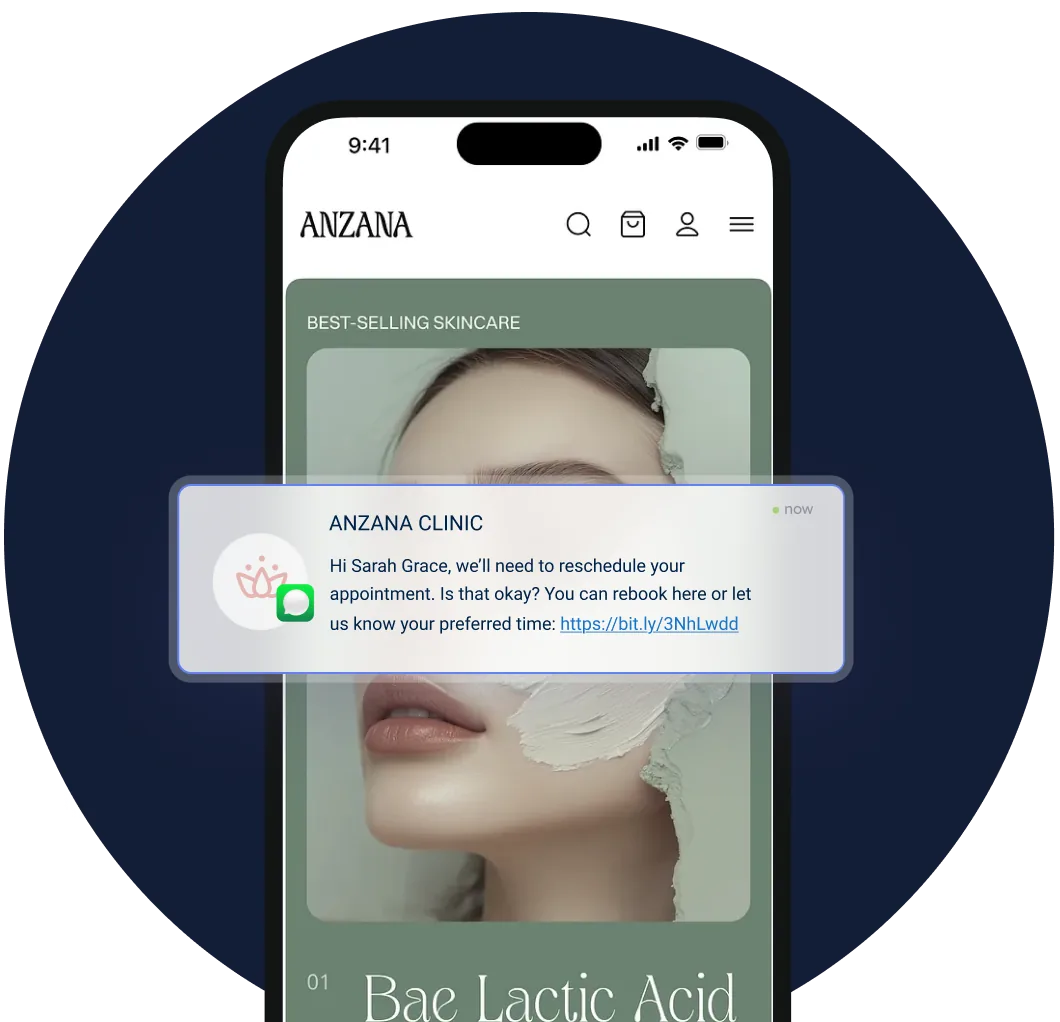
Reactivation campaigns targeting patients who haven’t visited in 90-180 days consistently produce some of the highest ROI in chiropractic marketing, because the trust barrier has already been cleared. A well-timed email or SMS saying “It’s been a while since your last visit, how is your back feeling?” costs almost nothing and regularly converts at 15-25% in practices with a warm list.
Pabau’s automated email and SMS campaigns let chiropractic clinics set up reactivation sequences once and run them continuously. The system identifies lapsed patients automatically based on appointment gap thresholds, sends the message, and tracks which patients rebook without any manual intervention from staff.
Beyond reactivation, email marketing serves three functions that most clinics underuse:
HIPAA compliance applies to all email and SMS marketing. Patients must have opted into communications, and messages must not disclose protected health information in ways that can be read by unintended recipients. Subject lines like “Your appointment for lumbar spine treatment” can constitute a HIPAA violation if the email is forwarded or viewed by a third party.

Pabau handles automated appointment reminders, patient reactivation campaigns, review requests, and online booking in one connected platform, so your front desk focuses on patients, not follow-up.

Word-of-mouth referrals remain the highest-trust acquisition channel in healthcare. A new patient referred by a friend or family member converts at a higher rate, stays longer, and refers others more often than a patient acquired through any paid channel. The challenge is that most referrals happen passively. Practices that build referral systems consistently outgrow those that rely on organic word-of-mouth alone.
Two referral channels are worth building deliberately: patient referrals and physician referrals. They require different approaches but both compound over time.
The simplest patient referral program is a structured ask at the right moment. After a positive outcome, when a patient says “my back feels so much better,” that’s the moment to say: “We’d love to help your friends or family too. If you know anyone dealing with back pain, please pass along our number.” Formalizing this with a referral card or a digital link that tracks who referred whom turns an occasional conversation into a measurable channel.
Loyalty programs amplify referral behavior. Practices with a structured rewards system, where patients earn points toward discounts or services, see 20-30% higher referral rates than those without one, according to general healthcare loyalty program benchmarks.
Primary care physicians, orthopedic surgeons, and physical therapists regularly refer patients who need chiropractic care, but only to practitioners they know personally. Building these relationships requires visibility: attending local medical association meetings, sending brief outcome reports when a shared patient completes treatment, and staying in contact through a quarterly newsletter directed at referring providers.
The key metric for physician referral programs is referral recency, not total count. A physician who referred three patients two years ago and zero patients since has effectively churned. Tracking referral source data in your practice management system surfaces these gaps before they become permanent losses.
Everything above compounds slowly. Done well, advertising for chiropractors buys the attention a new practice hasn’t earned organically yet, which is why paid ads belong in almost every marketing plan for a practice that’s just opened or launching a second location. But chiropractic advertising is also where practices waste the most money. Clicks that land on a slow website or ring an unanswered phone never become patients. Spend here only once the conversion layer behind it, online booking, review volume, and reactivation, is already working.
Two channels do most of the work. Google search ads, including Local Services Ads, put your practice at the top when someone nearby types “chiropractor near me,” and radius targeting keeps that spend inside a 5 to 10 mile drive of the office. The chiropractic ads that convert best skip generic terms and target a specific problem, such as sciatica, whiplash, or car-accident and personal-injury recovery, where the intent to book is immediate.
Facebook and Instagram ads work differently. They rarely convert cold viewers on the first click, so use them for awareness and retargeting. Pair a short adjustment video with a clear first-visit offer, like a discounted exam or posture assessment, that gives someone a reason to book today rather than later.
Most practices running ads budget somewhere between 5 and 10% of revenue, but the number matters less than knowing what each dollar returns. Tag every new patient with the source that sent them, so a campaign that looks busy but books no one gets cut. Pabau’s reporting ties booked appointments back to the channel that produced them, turning ad spend from a guess into a managed number.
The strategies above work in isolation. They work dramatically better when connected to the right systems. A chiropractor manually tracking lapsed patients in a spreadsheet, sending one-off reactivation texts, and chasing reviews after every appointment will burn out before seeing compounding results. The math changes when these touchpoints run automatically. Comparison guides like Boulevard vs Zenoti show how platforms differ on marketing automation.
Pabau’s automated patient workflows enable chiropractic clinics to build the entire patient communication sequence once: confirmation messages, pre-appointment reminders, post-care instructions, review requests, and reactivation triggers. Each fires automatically based on appointment status and time elapsed since the last visit.
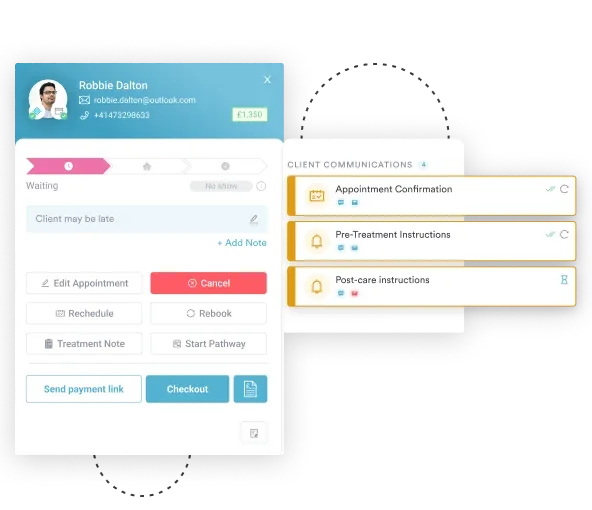
Online booking deserves specific mention as a marketing asset, not just a scheduling tool. A practice without online booking loses 30-40% of potential new patient bookings from patients who search in the evening or on weekends when the phone goes unanswered. Pabau’s booking widget embeds directly on the practice website and syncs in real time with the clinical calendar. Booking-first tools take a narrower approach, as these StyleSeat alternatives illustrate.
The reporting layer is where a chiropractic CRM creates genuine competitive advantage. Because every call, booking, review request, and campaign lives against the patient record, Pabau’s analytics can track which marketing sources are producing new patients, which patients are at risk of lapsing, and which practitioners are generating the highest referral rates. These data points turn chiropractic marketing from guesswork into a set of managed, improvable numbers.
| Marketing activity | Manual approach | Automated with Pabau |
|---|---|---|
| Appointment reminders | Staff calls or texts each patient | Sends automatically 24h and 2h before |
| Review requests | Remembered occasionally | Triggers 2-4h after appointment |
| Reactivation campaigns | Quarterly spreadsheet review | Fires at 90/180-day lapse threshold |
| Post-care instructions | Printed handout or verbal | Personalized email sent automatically |
| New patient onboarding | Front desk explains intake process | Digital forms sent before first visit |
Audit your last 90 days of appointment data and identify patients who visited once or twice and never returned. These are your highest-priority reactivation targets. A single campaign to this segment typically recovers 10-20% of lapsed patients within 30 days, often without any discounting.
Chiropractic marketing gets expensive when tactics operate in isolation. It becomes efficient when each touchpoint feeds the next: local SEO attracts the search, reviews close the decision, a smooth online booking experience converts the click, and automated follow-up keeps the patient coming back and referring others. The clinics growing fastest right now aren’t spending more but leaking less.
Pabau’s marketing tools bring these workflows together in one platform, built specifically for multi-disciplinary clinics including chiropractic practices. If you’re ready to see how automation can remove the manual effort from your marketing cycle, book a demo with the Pabau team.

Need a standardized neurodynamic assessment tool? Upper Limb Tension Tests template provides step-by-step procedures and documentation fields for all four ULTT variants.
Assessing pain and function in osteoarthritis patients? WOMAC Osteoarthritis Index template offers a validated 24-item questionnaire for measuring pain, stiffness, and physical function.
Need to understand what software your chiropractic clinic actually needs? Chiropractic software outlines the features that connect clinical workflows to patient communication and marketing automation.
Chiropractic marketing is the set of strategies and tactics a chiropractic practice uses to attract new patients, retain existing ones, and build visibility in its local area. It includes digital channels like local SEO, Google Business Profile, social media, and email campaigns, as well as offline approaches like physician referral programs, community events, and word-of-mouth systems.
The highest-ROI strategies for most chiropractic practices are local SEO and Google Business Profile optimization, automated patient review requests, email reactivation campaigns targeting lapsed patients, and physician referral programs. For newer practices, paid advertising on Google and Facebook can accelerate early visibility while organic channels build.
The most consistent path is to rank in the Google Map Pack for “chiropractor near me” searches through a complete, actively managed Google Business Profile, then convert those visitors with a streamlined online booking experience and strong review volume. Email reactivation campaigns targeting patients who haven’t visited in 90-180 days add a low-cost high-return layer on top.
Yes. Local SEO is the foundation of chiropractic digital marketing because most new patients begin with a location-based search. A practice appearing in the top three Google Map Pack results captures the majority of local search clicks without ongoing ad spend. This makes SEO one of the highest long-term ROI investments a chiropractic clinic can make.
The most effective method is an automated review request sent 2-4 hours after a positive appointment via SMS or email. This timing captures patients while the experience is fresh, producing significantly higher conversion than end-of-day or next-day requests. Practices using automated review workflows consistently accumulate 5-10 times more reviews than those relying on organic, unprompted submissions.
Start small and make it sustainable. Pick one internal tactic aimed at current patients, like an automated reactivation campaign, and one outreach tactic aimed at new ones, like local SEO or a paid search campaign. Assign each to a specific team member and put it on a recurring schedule, then layer in more channels only once those run smoothly. The practices that grow steadily treat marketing for chiropractors as a routine, automated system rather than a scramble whenever the schedule looks thin.
The cheapest wins target patients who already know you. Asking for a review 2-4 hours after a good visit, texting patients who haven’t booked in 90-180 days, and keeping your Google Business Profile active cost almost nothing and convert far better than cold ad spend. Once those run automatically, a referral card or a local community event brings in new faces without stretching the budget.