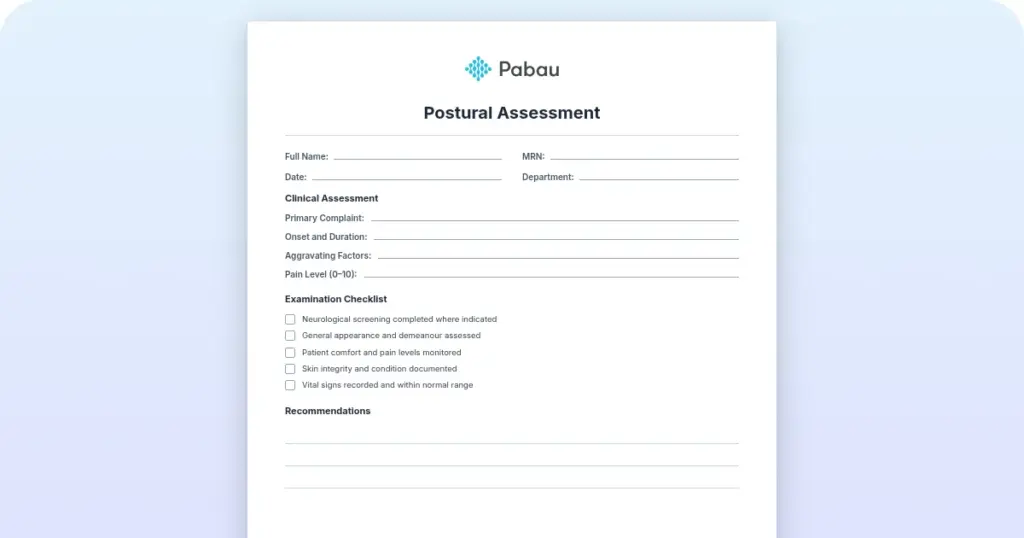
Postural assessment: Free template and step-by-step guide
A postural assessment is a structured clinical evaluation of how a patient’...

1
Last Updated: Oct 13, 2026

Chiropractic billing requires precise CPT code selection (98940-98943 for spinal manipulation), ICD-10 pairing by spinal region, and the mandatory Medicare AT modifier to avoid claim denials.
Medicare limits chiropractic coverage to active/corrective treatment with AT modifier; maintenance therapy requires an Advance Beneficiary Notice (ABN) to protect the practice from non-payment liability.
The most common chiropractic claim denials stem from missing AT modifiers, incorrect CPT-ICD pairing, inadequate subluxation documentation, and frequency limits. Documented fixes prevent rework and revenue loss.
Practice management software like Pabau automates CPT suggestions, modifier compliance checks, and claim scrubbing, reducing manual coding errors and denial rates for chiropractic practices.
A comprehensive reference guide combining CPT codes 98940-98943, ICD-10 diagnosis codes by spinal region, billing modifiers, Medicare rules, subluxation documentation requirements, and common claim denial fixes.
Download templateA chiropractic billing cheat sheet consolidates the CPT codes, ICD-10 pairings, and Medicare modifier rules chiropractors need for accurate claims into one quick-reference guide.
Billing staff and practice managers can use this reference to reduce claim rework, accelerate reimbursement, and stay compliant with payer-specific rules. Correct coding is one half of getting paid; claims management software handles submission through remittance.
A chiropractic billing cheat sheet is a structured reference guide that consolidates the codes, modifiers, and documentation rules chiropractors need for insurance billing. Unlike lengthy compliance manuals, a cheat sheet distills complex rules into quick-lookup tables and checklists.
The resource serves two purposes. First, it helps billing staff select the correct CPT code (procedure), ICD-10 code (diagnosis), and modifier (billing circumstance) for each patient claim.
Second, it flags the payer-specific rules that vary between Medicare, commercial insurers, and state regulations. Chiropractors who standardize on a cheat sheet catch coding and modifier errors before submission, which cuts down on the rework and delayed payments that come with denied claims.
Medicare Part B covers spinal manipulation but mandates the AT (active/corrective treatment) modifier — without it, claims are auto-denied. Commercial payers set their own coverage criteria.
Inadequate subluxation documentation — the clinical rationale for why manipulation is medically necessary — triggers denial and audit risk. A cheat sheet ensures the practice documents to payer standards.
These four CPT codes form the foundation of chiropractic billing. Medicare covers only 98940-98942; 98943 is billed only to commercial or Medicaid payers.
Actual payment for each covered code varies by locality under the Geographic Practice Cost Index (GPCI), so the ranges above are national averages before adjustment. Verify current rates against your payer contracts before submitting claims.
Software for chiropractic practices keeps exercise handouts and visit notes in the same record.
Pair each ICD-10 code to the anatomical region treated. A cervical manipulation (98940-98943) billed with M54.50 (low back pain) creates a geographic mismatch that triggers payer denial and audit scrutiny.
Common lumbar findings such as anterior pelvic tilt should show up in both the diagnosis and the treatment note. Use compliant clinical documentation to support the diagnosis-to-treatment link.
The AT modifier is non-negotiable for Medicare chiropractic billing. Medicare Part B covers only active/corrective treatment — maintenance visits without documented clinical improvement are non-covered.
Omitting the AT modifier results in automatic denial and forces rework.
Durable medical equipment runs on a different modifier logic. A capped-rental chair billed as HCPCS code K0884 carries KH in month 1, KI in months 2 and 3, then KJ through month 13.
Medicare and many commercial payers require SOAP notes documenting subluxation complex, following guidance such as the CMS documentation checklist. A compliant note includes:
These four denial reasons account for 70-80% of chiropractic claim rework.
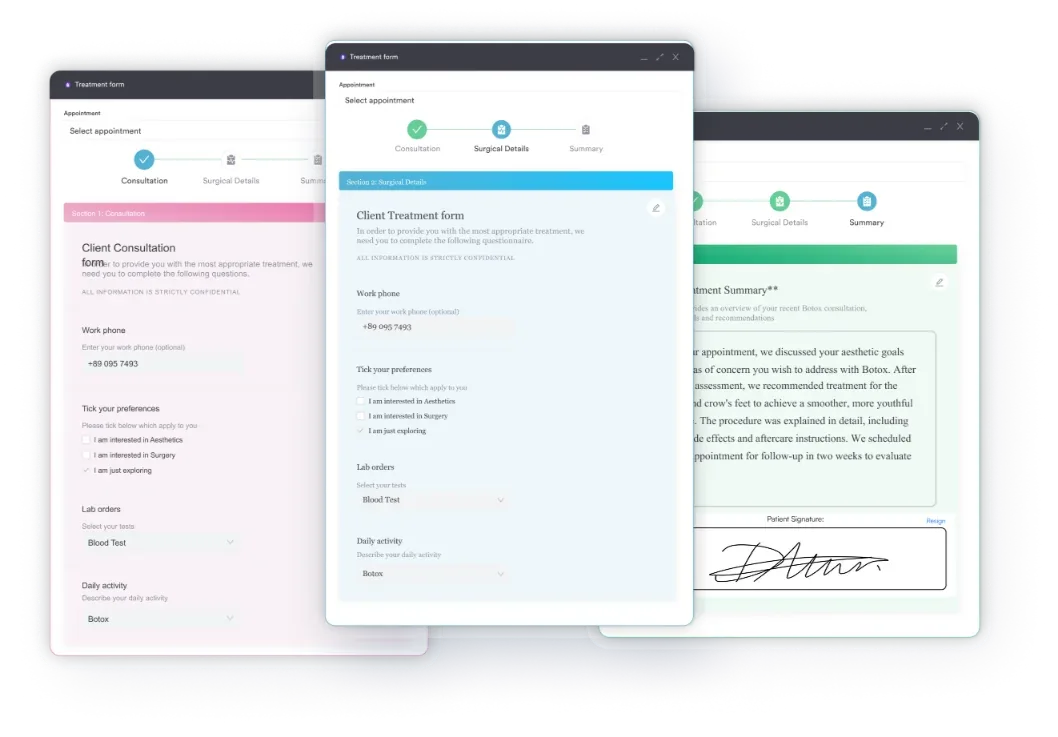
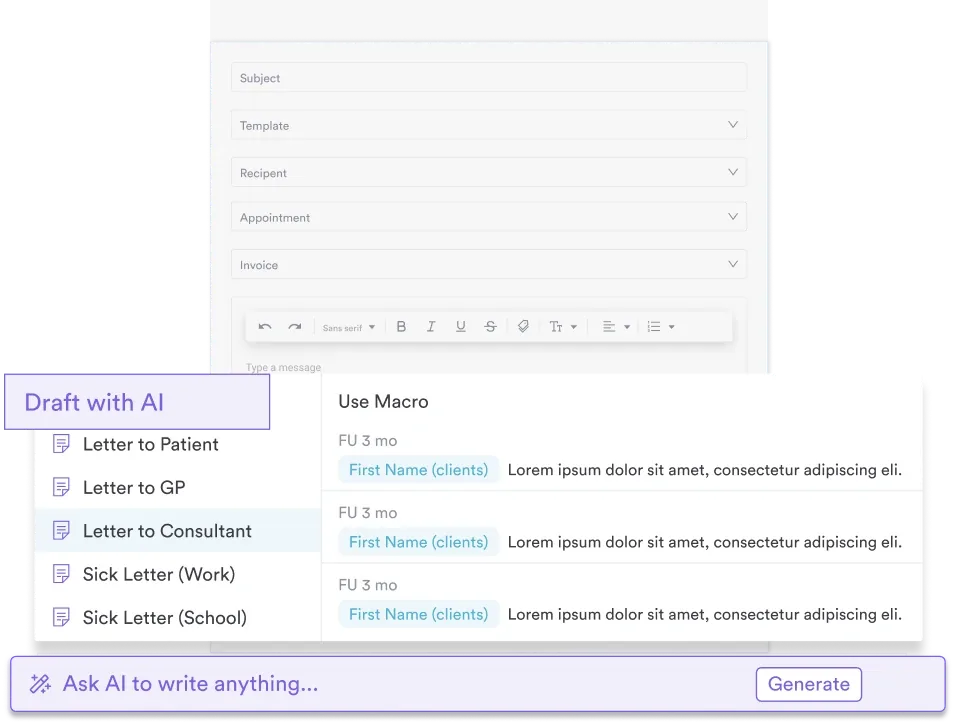
Modern practice management software integrates clinical documentation, billing codes, and compliance checks into one workflow.
When a clinician documents a chiropractic visit, the system auto-suggests the correct CPT code based on regions treated, prompts for the mandatory AT modifier on Medicare claims, and flags geographic mismatches between the ICD-10 diagnosis and treatment region.
This automation cuts claim denials by 30-40% and reduces recapture cycles from weeks to days.
Solo chiropractors managing their own billing, multi-clinician practices with shared billing staff.
Third-party billing services handling multiple chiropractic clients and practice managers overseeing compliance find it useful too, especially teams new to chiropractic billing or transitioning from paper records to digital systems.
Flag all Medicare patients for the AT modifier before submitting. Configure your billing software to auto-add AT to Medicare claims; many offices that do this see a 15-20% denial rate drop within the first month because the most common denial reason disappears.

Pabau’s integrated clinical notes and automated billing system catches coding errors before claims are submitted, reducing rework and keeping your practice compliant with Medicare rules.

Accurate chiropractic billing depends on three elements: CPT code selection (98940-98943), diagnosis-to-treatment alignment, and Medicare AT modifier compliance. This cheat sheet provides the reference tables and documentation checklists your practice needs.
Download the PDF, train your billing team, and start reducing claim denials this week. For practices looking to automate these checks, integrated practice management software helps ensure compliance and speeds up reimbursement.
Ready to see it in action? Book a demo and we will walk through how Pabau fits your practice’s chiropractic billing workflow.

Billing a larger facial wound repair? Facial wound repair billing code covers the CPT code for simple repair of facial wounds measuring 5.1 to 7.5 centimeters.
Billing an intermediate wound repair claim? Intermediate wound repair billing guide covers the CPT code for intermediate wound repair on the neck, hands, feet, or genitalia.
Billing a large intermediate wound repair? Large wound repair billing code covers the CPT code billed as one line item when repaired wound length exceeds 30 centimeters.
CPT codes 98940 (1-2 spinal regions), 98941 (3-4 regions), and 98942 (5 regions) are used for spinal manipulation. CPT 98943 is for extraspinal (non-spinal joint) manipulation. Code selection depends on how many spinal anatomical regions (cervical, thoracic, lumbar, sacral, pelvic) are treated in a single visit.
Yes. The AT (active/corrective treatment) modifier is mandatory for all Medicare chiropractic claims. Without it, claims are automatically denied. Commercial payers may have different modifier requirements; check each payer contract.
Missing AT modifier (40% of denials), incorrect CPT-ICD code pairing (20%), inadequate subluxation documentation (15%), and frequency limits exceeded (12%). Each is preventable with proper documentation and billing software checks. Mental health practices billing significant volume face similarly strict scrutiny on unspecified depression codes such as F33.9.
A compliant SOAP note must document: patient symptoms and onset (Subjective), physical exam findings and imaging (Objective), diagnosis and vertebral subluxation findings (Assessment), and treatment plan with expected outcome (Plan). Medicare auditors review these for medical necessity and subluxation substantiation.
Yes, if the evaluation and management service is separately identifiable from the manipulation. Use modifier 25 on the E/M code to indicate a distinct service. Without modifier 25, payers may bundle the E/M into the manipulation code and pay only once.
CPT 98940-98942 are for spinal manipulation (cervical, thoracic, lumbar, sacral, pelvic regions). CPT 98943 is for extraspinal manipulation of non-spinal joints (shoulder, knee, ankle). Code selection depends on the anatomical location treated, not the patient’s condition.