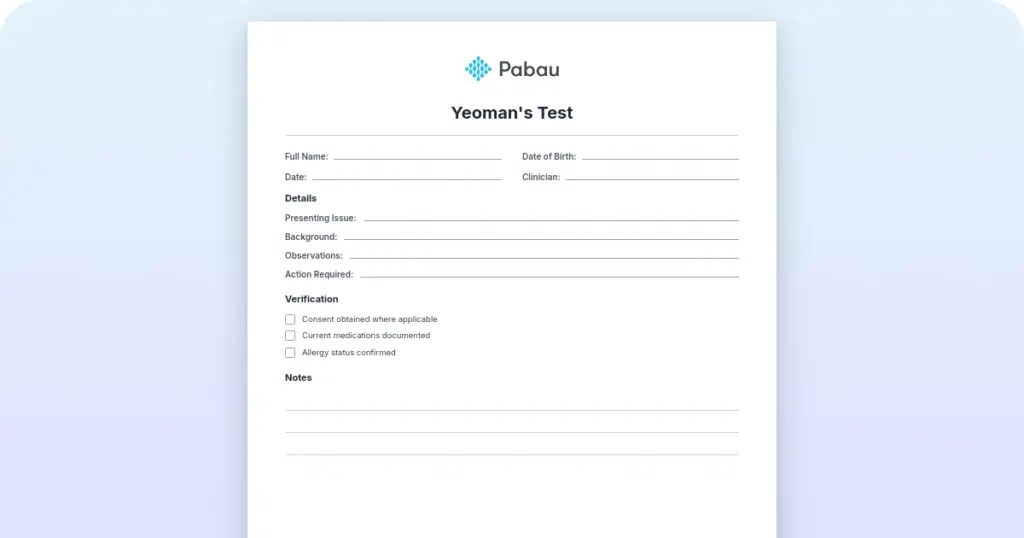
Yeoman’s Test Template
Yeoman’s test is a prone provocation test for sacroiliac joint (SIJ) pain....

1
Last Updated: Sep 28, 2026

Kemp’s test combines extension, side bending, and rotation to load the lumbar facet joints and narrow the intervertebral foramina.
A positive result reproduces the patient’s familiar pain, which points toward facet irritation, foraminal narrowing, or nerve root involvement.
Diagnostic accuracy is poor and varies widely between studies, so treat the finding as one input among several.
Useful documentation names the movement, the exact level, the pain quality, and any radiation, never just positive or negative.
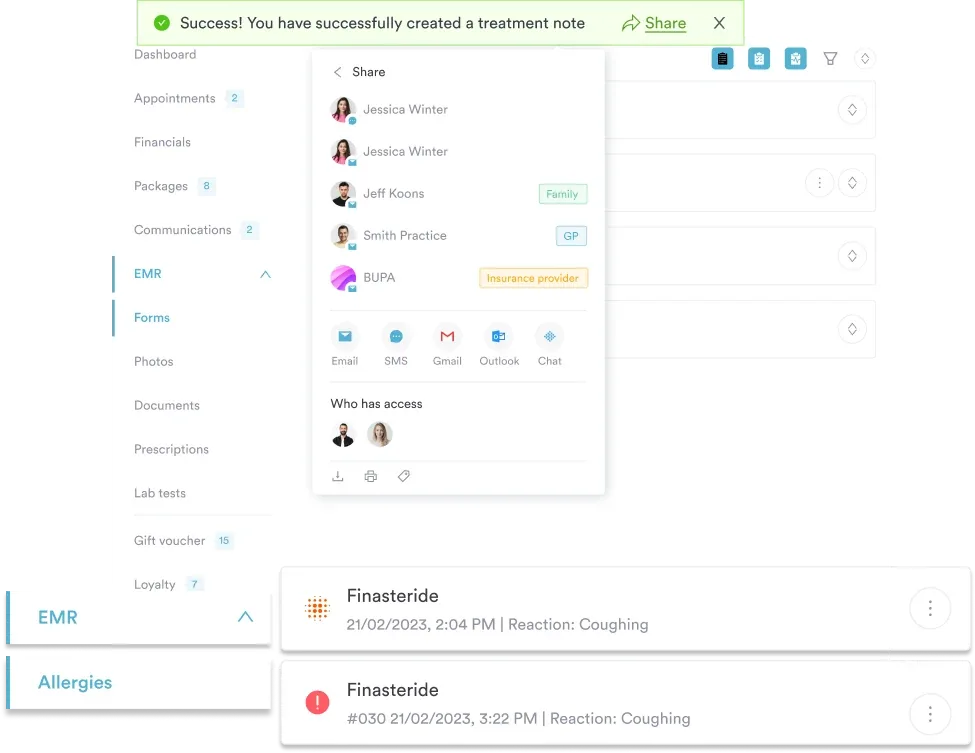
Practice management software like Pabau stores the finding in structured fields, so every clinician records the test the same way.
A print-ready sheet for recording the lumbar test in standing and seated positions. Fields cover patient positioning, movement findings, symptom pattern, and a SOAP-ready interpretation for lumbar spine assessment.
Download templateTwo chiropractors can run the same Kemp’s test on the same patient and produce notes that look nothing alike. One records the level, the direction, and the pain quality. The other writes “Kemp’s positive” and moves on.
Only one of those notes survives an insurance review or a records request. The test itself takes seconds. Turning what you felt into a defensible record takes more thought, and that’s where notes usually fall apart.
Kemp’s test loads the posterior elements of the lumbar spine, mainly the facet joints and the intervertebral foramina. Three movements stack up in sequence. The patient extends, then bends to one side, then rotates. Each layer squeezes those structures a little harder, so a sensitive joint or a narrowed foramen starts to complain.
The name comes from the clinician who first described the maneuver. You’ll also see it called the lumbar quadrant test or the extension quadrant test, depending on where the examiner trained.
Treat the result as one line of evidence. A positive finding needs to sit alongside the history, the neurological screen, and any imaging before it changes your working diagnosis.
Setup does most of the work here. Stabilize the pelvis, guide the movement slowly, and watch the patient’s response at every stage.
Stop the moment the patient reports severe radiating pain, numbness that spreads, or weakness that wasn’t there a minute ago.
Don’t start at all if imaging or history points to fracture, severe stenosis, an acute disc herniation, or unstable spondylolisthesis.
A positive result means the movement reproduced the pain the patient came in with. New pain doesn’t count, and neither does general stiffness at end range. The pattern of what came back is the part that guides treatment.
Foot symptoms deserve a local check too. Never read one provocation test on its own. A Kemp’s finding that matches the history, the imaging, and two other tests carries far more weight than an isolated result.
Clinical form capture tools let staff complete assessments like this on a tablet during the session itself.
Write the objective section so another clinician could repeat your test and compare results. Two words won’t do that. Name the position, the direction, the level, and what the patient felt. A structured SOAP progress note keeps that detail in the same place every visit, which makes comparison quick.
Strong entry: “Kemp’s test, lumbar spine, standing. Extension, left side bend, left rotation. Sharp left-sided pain at L4 to L5 at end range, no radiation. Stopped at moderate discomfort on patient request. Consistent with left facet irritation.”
Weak entry: “Kemp’s positive.” It records that you did something, and nothing about what you found.
Fixed fields for test name, direction, level, quality, and radiation mean the same information appears in every record. Practices using a different note structure get the same benefit from a DAP note.
Run through this list before you sign the entry.
Common mistakes cluster in two places. Clinicians forget to record the side, and they write “positive” without the pain pattern that makes the word useful.

Kemp’s test tells you about the posterior elements. The other common lumbar tests probe different structures, which is why clinicians run them as a group.
The cluster matters more than any single result. If Kemp’s reproduces local pain while the slump test and straight leg raise stay negative, facet irritation is the better bet. When two or three neurodynamic tests light up together, nerve root involvement moves up the list.
The cluster then sits in the record as a whole, rather than as scattered lines you have to reassemble later.
The movement pattern is the same, but almost everything around it changes. Cervical range is smaller, the force is lighter, and the risk profile is different.
Upper limb symptoms can also come from outside the neck. On the cervical side, endurance matters as much as provocation.
A patient portal lets people read their own results afterward. That cuts down the follow-up phone calls and makes shared decisions easier.
Kemp’s test shows up wherever someone assesses a spine and has to write down what they found.
Precise notes pay off at three moments. You plan treatment, you defend a claim, and you hand the patient to someone else.
Plenty of practices still capture special test findings twice. Someone writes on a paper exam sheet during the visit, then types a shorter version into the record that evening. Detail leaks at every step.
Practice management software like Pabau removes the second step. You build the Kemp’s test fields once, either as a digital form or a note template. Every clinician then records the direction, the level, the pain quality, and any radiation the same way.
The record then does more work for you. Serial results sit on one timeline, so you can see a symptom moving from the calf to the thigh across three visits. Pabau Scribe, our AI scribe, drafts the narrative from the consultation, which keeps the exam detail in the note instead of in your head.
Every subscription includes the forms, the note templates, and the reporting, so nothing here sits behind a higher tier.

Pabau’s digital forms and note templates hold the movement, level, and pain pattern in fixed fields. Every Kemp’s test result lands in the patient record the same way, ready for the next visit.

The test is easy. The note is where clinicians lose value, and it’s the only part a reviewer ever sees.
So set the standard once. Decide what a Kemp’s test entry must contain, put those fields in front of every clinician, and stop relying on individual habits. Accuracy data says the test can’t carry a diagnosis on its own, which makes the surrounding detail the thing that gives it weight.
Download the template above to standardize your entries today. Then book a demo to see how Pabau turns those fields into a permanent part of the patient record.

Chasing lateral hip pain instead? Ober’s test shows how to separate iliotibial band tightness from a lumbar referral.
Tracking functional independence over time? Barthel Index template is a standardised tool for tracking functional independence in rehab and long-term care.
Documenting a chiropractic visit consistently? SOAP notes for chiropractic template records what you observe, assess, and plan at each visit.
Setting a functional baseline? Star excursion balance test gives you a repeatable measure to track alongside your provocation findings.
Assessing an older patient with stenosis? Fall risk assessment adds the safety screen these patients often need.
Poor, and highly variable. A systematic review reported sensitivity ranging from 23% to 100% across individual studies, with pooled estimates near 34% to 46%. Specificity sat around 47%. Treat the result as one input, never as a rule-in or rule-out test.
Yes. Seat the patient with feet flat and stabilize the pelvis, then guide the same extension, side bend, and rotation. The seated version suits patients who can’t balance in standing. Record which position you used, because results aren’t interchangeable.
No. Orthopedic special tests have no code of their own. Kemp’s test forms part of the examination you already bill, whether that’s an evaluation or a chiropractic exam. The findings still matter for medical necessity, so document them properly.
Bilateral reproduction points away from a single irritated joint. Central canal narrowing and widespread facet arthropathy both provoke symptoms in either direction. Note both sides in the record, then let imaging and the neurological screen settle it.
Retest at the visit where you expect change, usually after a course of treatment rather than every session. Compare against the level and pain quality you recorded first. Repeating it daily adds little and irritates a sensitive spine.