How to Start Private Practice in California as a LCSW (Step-by-Step)
Pabau helps new LCSW practices stay organized and compliant with integrated clie...

April 6, 2026


Buy now, pay later is now available in Pabau

Demand for medical weight loss is rising: 40.3% of U.S. adults have obesity, and the global weight management market is on track to double from $176 billion by 2035.
Your clinic model shapes your launch: Standalone, add-on, and virtual clinics each come with different costs, licensing requirements, and timelines.
Structured programs drive retention and revenue: Successful weight loss clinics focus on recurring care plans rather than one-off consultations.
Start lean or go big: You can launch a weight loss clinic for as little as $5,000 or invest $300K+ for a full standalone setup.
Learning how to start a weight loss clinic begins with understanding the market.
The global weight management industry is worth $176 billion and projected to reach $392 billion by 2035, according to Towards Healthcare. That’s a massive window of opportunity for new clinics.
Below, we break down everything from licensing and startup costs to services, tech, and marketing. By the end, you’ll have a clear roadmap to get your clinic up and running.
A weight loss clinic isn’t a one-and-done treatment business. It’s a recurring-care model built around long-term weight management programs and ongoing patient relationships.
Before you learn how to open a weight loss clinic, you need to understand a few foundational realities.
If you already run a private practice, you can skip most of the legal setup and tap into your existing patient base. Many practitioners launch weight loss services as an add-on in under 60 days.
Here’s an overview of the key milestones you’ll need to hit when launching your weight loss clinic.
| Step | What It Covers | Key Outcome |
|---|---|---|
| 1. Pick your clinic model | Standalone, add-on, virtual, or hybrid | Clear business direction |
| 2. Handle legal & licensing | Business entity, medical licenses, compliance | Legally operational clinic |
| 3. Write a business plan | Financial projections, services, target market | Funding and strategic clarity |
| 4. Define your services | Program structure, pricing, service categories | Revenue model in place |
| 5. Estimate startup costs | Equipment, rent, staffing, tech | Realistic budget |
| 6. Build your team | Licensed clinicians, admin staff, specialists | Qualified care team |
| 7. Set up operations & tech | EHR, scheduling, billing, patient tracking | Operational infrastructure |
| 8. Attract your first patients | Marketing strategies, local SEO, referrals | Booked appointments |
Your clinic model determines everything from your startup costs to your daily operations. There are three main options.
Virtual clinics that prescribe controlled substances must comply with the Ryan Haight Act. This typically requires at least one in-person evaluation before prescribing. Check both federal and state telehealth prescribing rules.
Every medical weight loss clinic needs a solid legal foundation. Here’s what to get in place.
Need help choosing a platform that ticks the compliance boxes? See our guide on HIPAA compliance for clinic software.
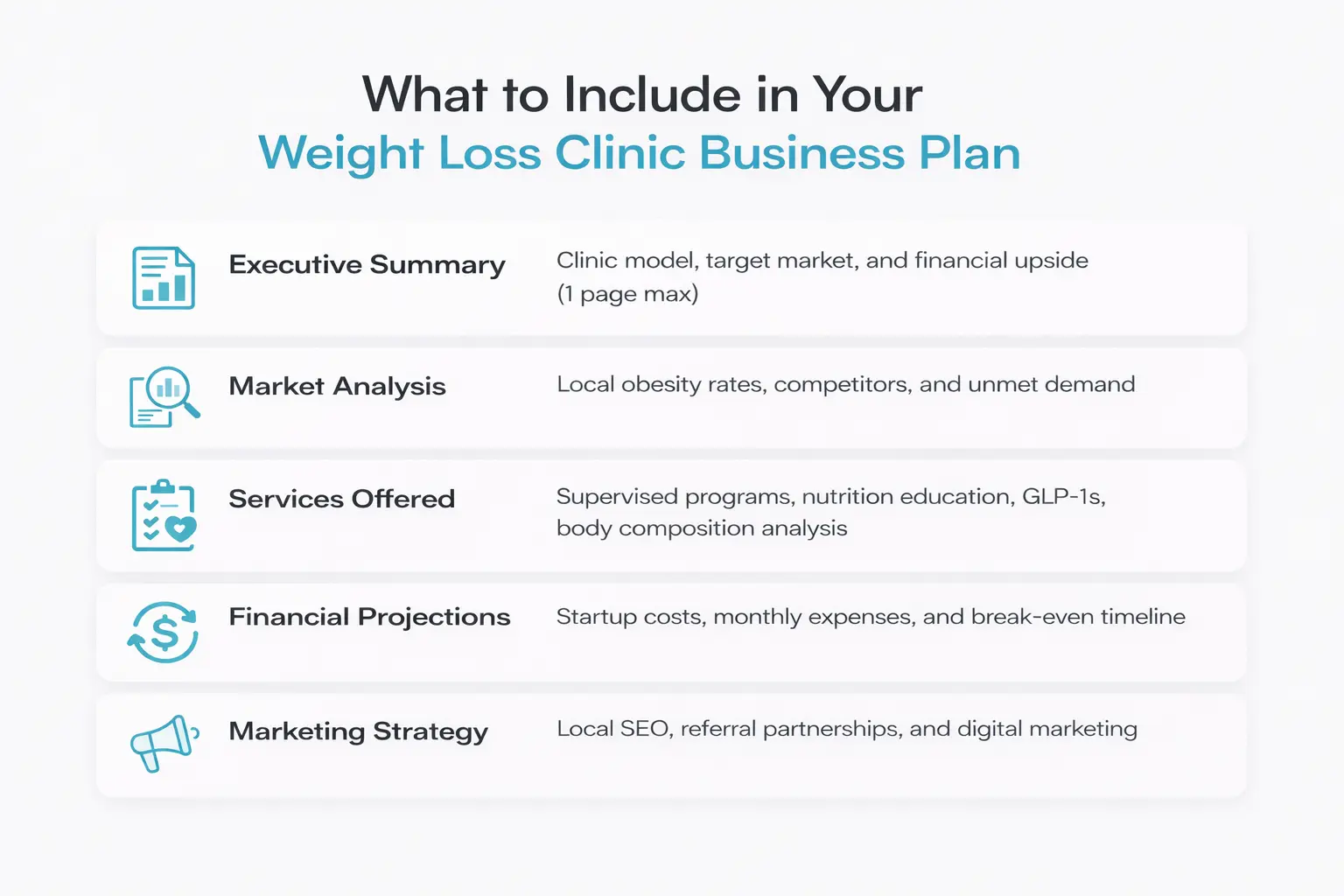
A solid business plan is your roadmap for funding, hiring, and scaling. It’s also the document that lenders and investors will ask for.
Your weight loss clinic business plan should include:
Build two versions of your financial projections: a best-case and a worst-case. If the worst-case still works, you’re in a strong position to move forward.
Your service structure drives your revenue model and patient retention. Here are the three main formats to choose from:
Many successful clinics use a hybrid approach. They combine a membership plan with add-on packages for specific services. Price each based on your local market and cost of delivery.
Weight loss clinic startup costs vary widely based on your model, location, and scope of services.
Here’s a general breakdown:
| Clinic model | Estimated startup cost |
|---|---|
| Lean/virtual (add-on to existing practice) | $5,000–$30,000 |
| Mid-size standalone clinic | $50,000–$100,000 |
| Full standalone with equipment and staff | $100,000–$300,000+ |
| Franchise (e.g., Medi-Weightloss) | $251,000–$494,000 |
Estimates based on data from Elite Nurse Practitioner, BusinessPlan-templates, Starter Story, and Medi-Weightloss FDD.
For a deeper look at the costs of starting an aesthetics or medical business, check out our detailed guide.
Your team determines the quality of care you deliver and the range of services you can offer.
These are the key roles to plan for:
Invest in training programs for your team. Organizations like Empire Medical Training offer weight management certification and aesthetic medicine training. These help practitioners stay current on the latest protocols.
Operational efficiency makes or breaks a clinic. You need the right systems from day one.
At minimum, you need tools for scheduling, EHR, billing, and patient communication. Running these on separate platforms creates data gaps and extra admin work.
An all-in-one practice management platform (like Pabau) keeps everything in one system and gives you full visibility into your operations and revenue.
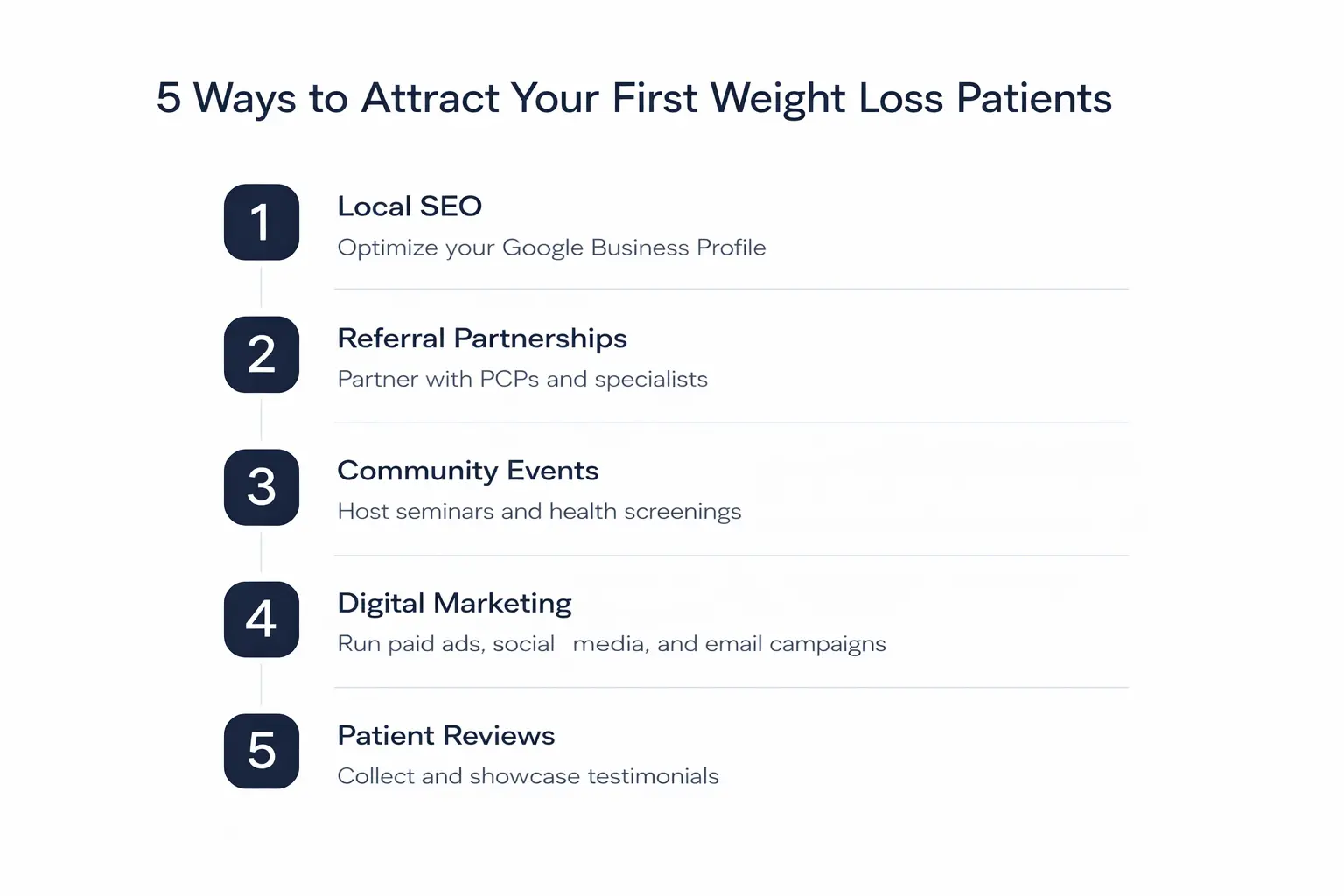
You can have the best programs and the best team. But without patients, your clinic doesn’t survive.
Here’s what works:
Make it easy for happy patients to leave a Google review after every visit. Clinics that do this consistently outperform competitors in local search.
Ready to streamline your clinic launch? Book a demo with Pabau and see how one platform handles scheduling, records, billing, and marketing.
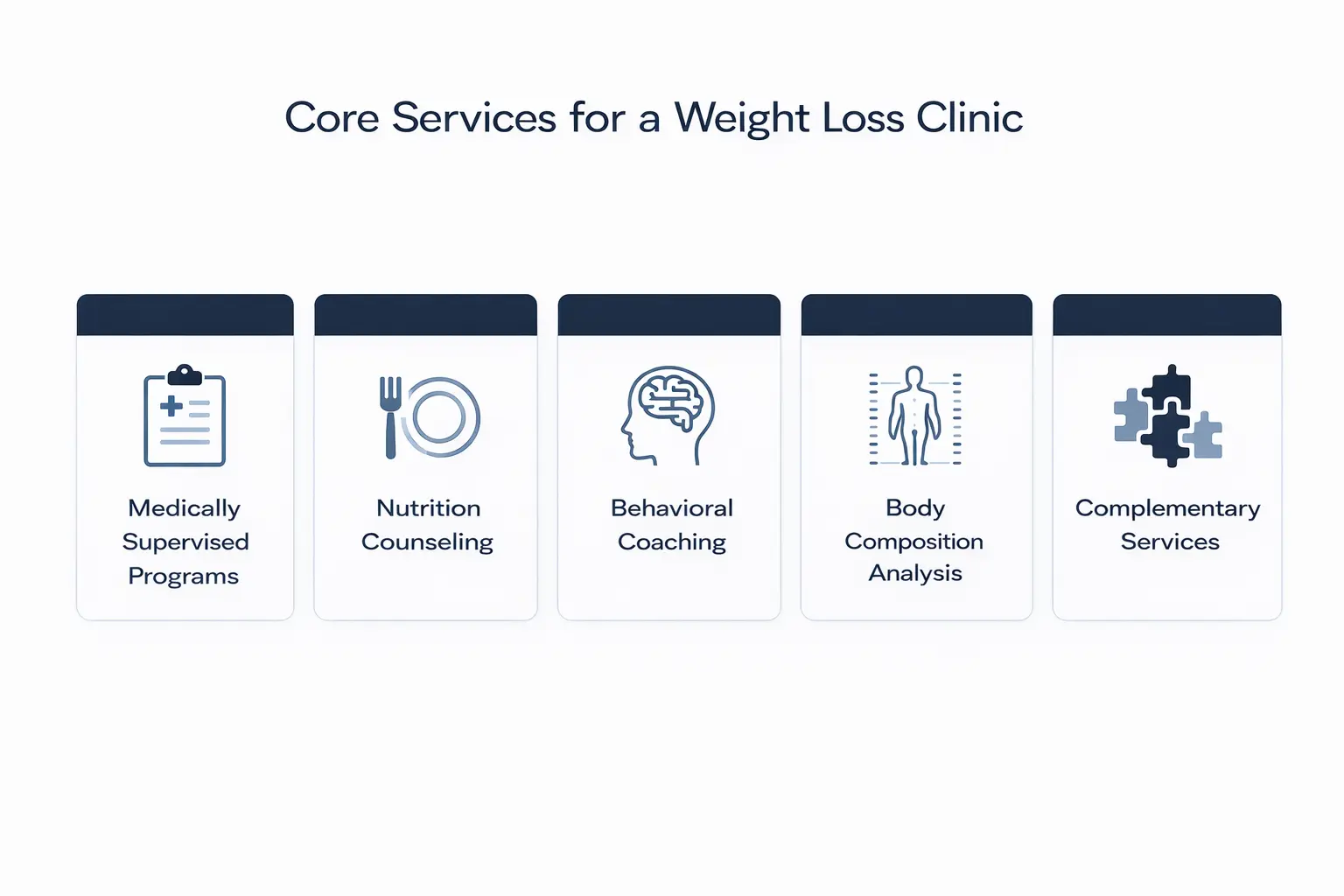
Your service mix determines how much revenue you generate and how long patients stay. It also affects how scalable your clinic becomes.
Focus on services that create a comprehensive care experience.
Medically supervised programs combine medical history review, lab work, and personalized action plans with regular check-ins.
GLP-1 medications like Wegovy and Zepbound have shown average weight loss of up to 20% of body weight in clinical trials. Pairing prescriptions with lifestyle counseling improves outcomes and keeps patients coming back.
Most patients know what to eat. The hard part is sticking to it.
Personalized meal plans, food diary tracking, and nutrition education help bridge that gap.
Registered dietitians are ideal for delivering these services and they naturally create a recurring-visit model.
Weight management isn’t just physical. It’s behavioral.
Clinics that include cognitive behavioral therapy and stress management see better long-term results. They also see lower weight regain rates.
Expert coaching and consultations that convert are critical for building trust and patient commitment.
A body composition analyzer and metabolic rate testing give patients (and providers) objective data to track progress beyond the scale.
Tools like measurement tracking software help you record and visualize patient progress over time. This keeps patients motivated and provides clear evidence of results.
Depending on your clinic model, consider adding:
These add-ons increase revenue per patient and differentiate your clinic from competitors.
Clinical expertise gets patients in the door. But it’s your operational systems that keep things running.
These are the capabilities your tech stack needs to cover.
Patients expect to book appointments online. A good scheduling system reduces no-shows, automates reminders, and keeps your calendar full.
Look for automated SMS and email reminders, online self-booking, and waitlist management. These are essential for improving your patient no-show rate.
Pabau’s scheduling system handles all of this in one platform, integrated directly with patient records and billing.
Electronic health records are non-negotiable. You need a system that stores patient medical history, treatment notes, and lab results securely.
HIPAA-compliant EHR software ensures your paperless practice stays secure. It also saves time on documentation by making patient information instantly accessible during consultations.
Weight loss clinics deal with a mix of self-pay options, insurance billing, and membership payments. Your billing system needs to handle all three.
Integrated payment processing (connected to your scheduling and records) eliminates double data entry and speeds up revenue collection.
Two-way communication keeps patients engaged between visits. Automated reminders, follow-up messages, and educational content all contribute to better patient compliance.
The more touchpoints you create between appointments, the less likely patients are to drop off.
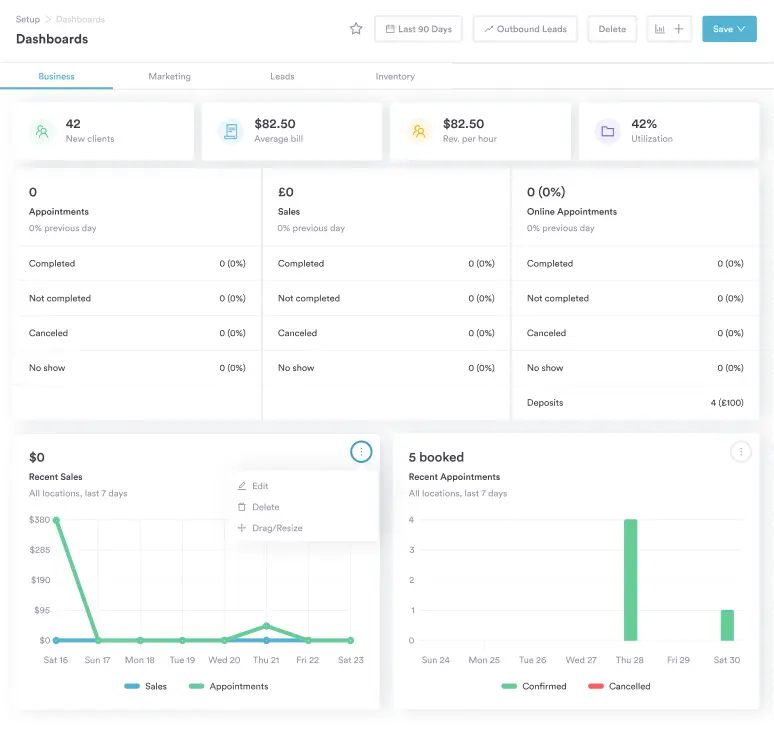
Real-time dashboards let you track revenue, appointment volume, patient retention, and program performance in one view.
This is where an all-in-one platform like Pabau makes a real difference. Instead of pulling data from separate tools, you get full visibility into your clinic’s performance from a single dashboard.
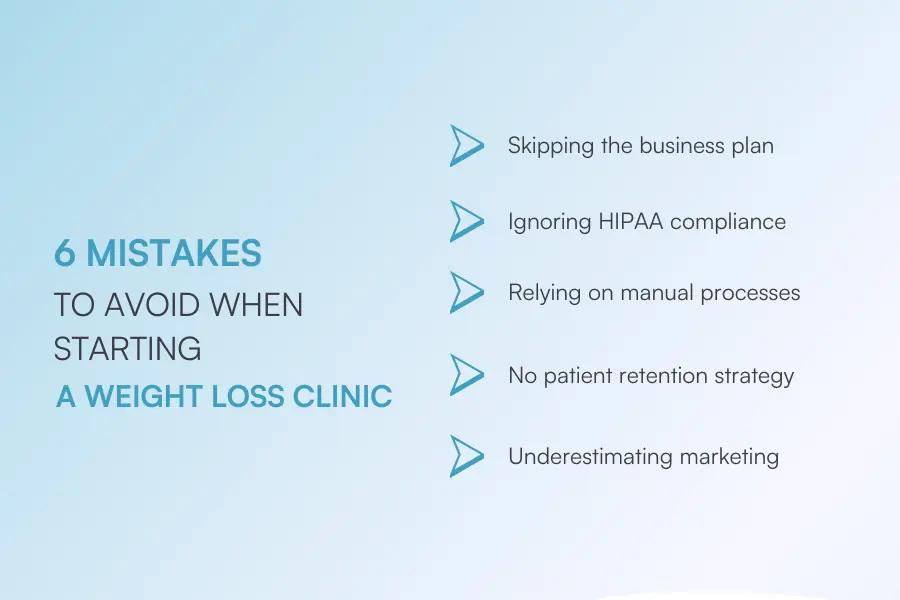
Weight loss clinics rarely struggle because of bad clinical care. It’s the operational mistakes that hold them back. Here are five to steer clear of.
It’s tempting to jump straight into operations. But without a documented plan, cash flow problems and unclear growth targets follow fast.
How to avoid it: Write a detailed weight loss clinic business plan before you sign a lease or hire anyone. Include realistic financial projections and a 12-month operating budget.
Compliance often gets treated as an afterthought. That’s a costly gamble. HIPAA fines range from $100 to $50,000 per violation, depending on severity.
How to avoid it: Invest in HIPAA-compliant software and train every staff member. Document your data protection best practices before seeing your first patient.
Paper forms and spreadsheets might work at first. But as patient volume grows, they become the bottleneck.
How to avoid it: Automate from the start. Use clinic automations for appointment reminders, patient intake, and billing. This frees your team to focus on patient care.
Acquiring new patients is expensive. Losing them after one or two visits because of poor follow-up is even more costly.
How to avoid it: Build structured weight loss programs with clear milestones. Use patient feedback loops and automated check-ins to keep people on track. Membership models also create financial and psychological commitment.
“If you build it, they will come” doesn’t work in healthcare. Many new clinics open with no marketing plan and wonder why the phone isn’t ringing.
How to avoid it: Allocate at least 5–10% of your projected revenue to marketing in year one. Prioritize local SEO and Google Business Profile optimization. A consistent patient review strategy also goes a long way.
Weight loss clinics can be highly profitable when structured correctly.
With 40.3% of U.S. adults classified as obese according to CDC data, the demand side isn’t the problem. How much you earn depends on your clinic model, pricing, and the services you offer.
The numbers speak for themselves:
The key to profitability is recurring revenue. Clinics that rely on one-off consultations struggle. The ones that succeed build a structured weight loss business with predictable pricing.
Note: Avoid making specific income guarantees. Profitability varies based on location, competition, and operational efficiency. The numbers above are industry benchmarks, not promises.
Now you know how to start a weight loss clinic. The next step is choosing a platform that ties it all together.
Pabau is an all-in-one practice management software that covers:
Whether you’re launching your first location or scaling to several, Pabau grows with you.
Ready to put your weight loss clinic on the right foundation? Book a free demo and see Pabau in action.
Yes, in most states. Clinics that prescribe medications or provide medically supervised programs need a licensed physician (MD or DO) to oversee operations. Some states allow nurse practitioners to run clinics independently. Always check your state’s scope-of-practice regulations.
It depends on your model. A lean virtual or add-on practice can start under $50,000. A full standalone clinic with dedicated space and staff runs significantly more. See Step 5 above for a detailed cost breakdown by category.
Licensed clinicians (MDs, DOs, NPs, PAs, RDs) need active state licenses. Providers prescribing GLP-1 medications must have a DEA registration. Optional certifications like ABOM or aesthetic medicine training add credibility and expand your offerings.
Yes, when structured correctly. GLP-1 demand is accelerating and the broader market is growing fast. Clinics that focus on recurring revenue through memberships and multi-week programs see the strongest margins. See the profitability section above for detailed benchmarks.