Patient financing: How to offer it and stay compliant
Patient financing lets patients spread the cost of treatment over weeks or month...

Last Updated: Oct 7, 2026
How to hire a medical director for a med spa starts with a legal question, because most states require one once you offer medical treatments. Injectables, lasers, and IV therapy are medical services, so they need licensed physician oversight. Medical-director-led practices get a dedicated pick in our med spa management software comparison.
From there the job is procedural. You pick an engagement model, vet the physician on license, board certification, malpractice history, and aesthetic experience, then put a compliant agreement in writing.
What you pay depends almost entirely on which model you choose. An off-site retainer can cost $500 a month, while a full-time on-site physician can pass $20,000.
Disclaimer: This article is for informational purposes only and should not be considered legal advice. Always consult a healthcare attorney or malpractice insurance provider for federal and state-specific regulations.

Most states require a med spa to operate under a licensed physician medical director once the menu includes injectables, lasers, or other medical treatments.
In strict corporate-practice-of-medicine states like California, Texas, and New York, the physician usually has to own or majority-own the practice.
A medical director runs clinical operations day to day, while a collaborating physician signs off on an NP’s or PA’s work.
Cost tracks the engagement model, from a $500 monthly retainer for off-site oversight to $250,000 a year for a full-time physician.
Vet every candidate on state license, board certification, malpractice history, malpractice insurance, and hands-on aesthetic experience before you sign.
Tying a medical director’s pay to revenue or referrals can trigger federal Anti-Kickback Statute and Stark Law exposure.
A med spa medical director is the licensed physician who oversees medical treatments, keeps the practice compliant with state law, and answers for patient safety.
Job listings write the title several ways. Medical director for medspa, med spa medical director, and supervising physician usually describe the same job.
Most states enforce a corporate practice of medicine doctrine. That doctrine is why a med spa needs a medical director before it can legally offer Botox, fillers, or lasers.
Depending on the state, the medical director may need to own the med spa, or hold a majority stake. California, Texas, and New York all work this way.
Other states let registered nurses, physician assistants, and nurse practitioners own a med spa outright. A medical director still has to oversee the medical services.
In that setup the med spa is split into medical and business operations. The physician oversees the medical side, while non-physicians handle the business side through a management service organization (MSO). That split is what lets non-physician owners operate legally in states that bar them from owning a medical practice.
A medical director sets treatment protocols, supervises and trains the clinical team, reviews charts, and carries final responsibility for patient safety and compliance.
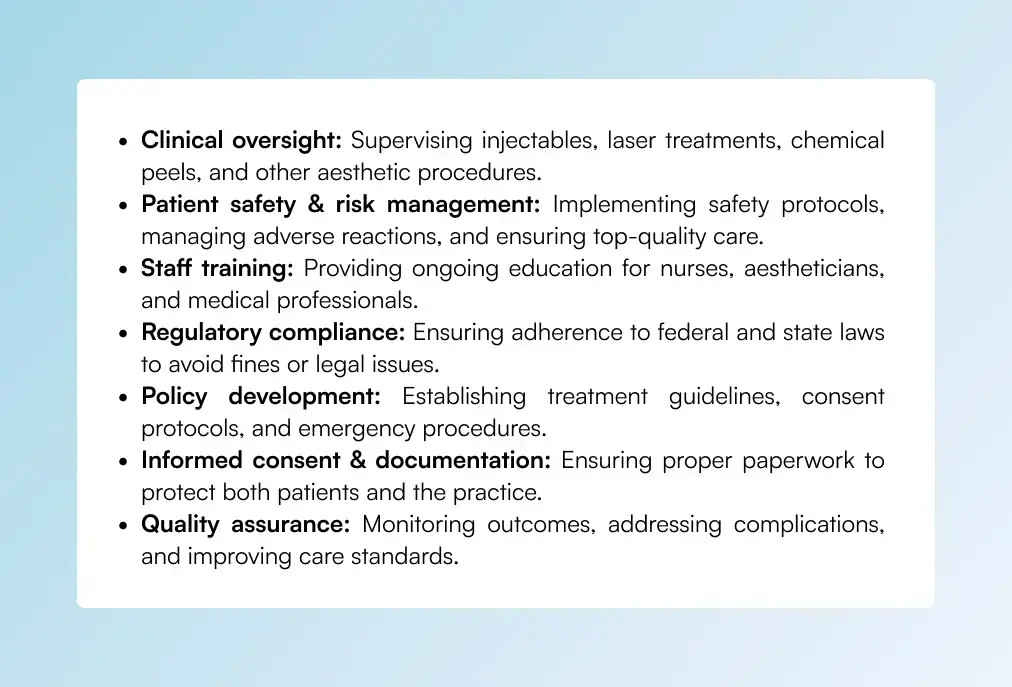
Most medical director agreements spell out these duties:
A medical director runs the med spa’s clinical operations, while a collaborating physician only supervises an NP or PA where state law demands it. Most med spas hire one or the other, not both.
A collaborating physician partners with a nurse practitioner (NP) or physician assistant (PA) to provide the oversight state law requires. They review treatment plans, sign off on procedures, and give guidance, but they are rarely involved in daily operations.
The medical director is hands-on. They set protocols, train staff, review charts, and own compliance for the whole practice.
From a compliance point of view, a medical director is required for med spas offering medical treatments. A collaborating physician is only required where NPs or PAs need physician oversight to treat.
| Factor | Medical director | Collaborating physician |
|---|---|---|
| Core role | Runs clinical operations and takes ultimate responsibility for medical care | Supervises an NP or PA where state law requires physician oversight |
| Day-to-day involvement | Hands-on. Sets protocols, trains staff, reviews charts, owns compliance | Lighter touch. Reviews treatment plans and signs off on procedures |
| When it is required | For most med spas offering medical treatments | In states where NPs or PAs need physician oversight to treat |
| Typical arrangement | Employed or partner, and sometimes the owner in strict physician-ownership states | Contracted through a collaborative practice agreement |
Yes, in nearly every state, once your menu includes injectables, lasers, or other medical treatments a licensed physician must oversee that care. What changes from state to state is who may own the practice, and how hands-on the physician has to be. No UK law requires a medical director for aesthetics, so UK practices appoint one by choice.
California, Texas, and New York run strict corporate practice of medicine rules, so the practice is physician-owned and the business side runs through an MSO. Florida allows physician ownership as the norm and layers on medical director and treatment-registration requirements.
Arizona, Colorado, Oregon, and Washington let nurse practitioners own a med spa, under full practice authority or with a physician providing oversight. State rules change, so confirm yours with your medical board or a healthcare attorney before you set up the structure.
Our breakdown of med spa laws covers ownership and supervision state by state. Licensing and ownership are only part of what it takes to start a med spa from scratch.
Texas has its own guide, because a medical director in Texas oversees all medical care under strict physician-ownership rules.
An esthetician-led med spa needs a medical director, or a collaborating physician, because an esthetician cannot administer injectables or prescription treatments.
A medical director for nurse injector teams works the same way. The registered nurse administers, and the physician sets the protocol, reviews the charts, and stands behind the care.
So can a nurse open a med spa? In many states, yes. A registered nurse or nurse practitioner can own a med spa, as long as a medical director oversees the medical services.
In full-practice-authority states, a nurse practitioner may be able to provide that oversight directly. The exact rules depend on your state and each provider’s license. Texas is stricter. A nurse there can own only the MSO, and Texas delegation rules set what each nursing license may do.
A med spa medical director needs an MD or DO degree, an active state license, aesthetic experience, and working knowledge of your state’s supervision rules. Five of these qualifications matter most, and the first two are non-negotiable.
A medical director must hold a Doctor of Medicine (MD) or Doctor of Osteopathic Medicine (DO) degree from an accredited medical school.
While both MDs and DOs are fully licensed physicians, DOs receive additional training in osteopathic manipulative treatment (OMT), which emphasizes a holistic approach.
Whichever degree they hold, the medical director needs a working understanding of aesthetic medicine to lead a med spa.
A medical director must hold an active and unrestricted medical license in the state where the med spa operates. That license is what legally authorizes them to practice medicine and oversee medical procedures.
Verify it with the state medical board before you make an offer, and check the same board for disciplinary actions.
Check malpractice coverage at the same time. Confirm the candidate carries current malpractice insurance, and ask whether their policy extends to supervising your staff’s treatments.
Board certification in a relevant specialty is not always required, but it is worth insisting on. Dermatology, plastic surgery, and internal medicine are the usual ones.
It gives you a verifiable standard of training to point at when a patient, an insurer, or an inspector asks who supervises care.
The medical director should have hands-on experience with the treatments you offer today.
They need working knowledge of your menu, from standard injectables to laser services to newer techniques such as polynucleotides.
A director who has never supervised a laser is not much use the day a patient burns.
A medical director must understand the state laws that govern med spas, because the rules vary widely.
They should be well-versed in:
Beyond state law, they keep the practice compliant with federal rules like HIPAA and OSHA, which protect patient privacy and workplace safety.
The qualities that matter most are leadership, clear communication, genuine interest in aesthetics, business awareness, and a willingness to mentor non-physician staff. Beyond credentials, the right director also fits your culture. Weigh these qualities in the interview:
Most med spa owners find a medical director through professional networking, healthcare job boards, or a matching company that pre-screens physicians for a fee.
Those three channels, in the order they tend to work:
Networking surfaces candidates who already know your market and your treatment menu.
Join aesthetic medicine associations like the American Med Spa Association (AmSpa) or The Aesthetic Society. Both run events and boot camps where you can meet physicians face to face.
Spread the word in your own network too. Tell former colleagues and ask your current staff to pass it on.
Many AmSpa members report finding their medical director through a previous job.
Specialized job boards put your listing in front of physicians who are already looking.
Health eCareers reaches a broad pool of physicians, and the AMA’s Find a Doctor directory and Honest Doctor are worth checking too.
The American Med Spa Association job board is narrower, and the candidates on it already understand med spa operations.
A matching company runs the search for owners who are short on time. It pre-screens physicians and pairs them with practices that fit.
These firms keep networks of qualified physicians and check credentials before they introduce anyone. Guardian MD, AMN Healthcare, and The Medicus Firm all operate in this space.
None of them publishes a standard fee, so treat any quote as a starting point for the model you need. The Medical Director Fit Matrix further down compares what each engagement model costs, and what each one exposes you to.
Once you have a shortlist, hiring takes three steps: interview for judgment, verify the license and insurance, then put a compliant offer in writing.
The interview is where you learn how a candidate thinks, which a resume will never tell you. Prepare questions that go past technical experience and qualifications.
Questions worth asking medical director candidates:
Then give them a scenario from your own practice and ask how they would handle it. A candidate who has managed a filler occlusion will answer very differently from one who has not.
Verification means four checks: the state license, board certification, malpractice history, and current malpractice insurance that covers supervising your team.
You have both the right and the duty to run these checks before anyone signs.
Put the offer in writing, and spell out scope, time commitment, compensation, malpractice coverage, and termination terms before anyone signs.
How you structure the pay matters as much as the number. Compensation tied to revenue, or to the volume of referrals, can create exposure under the federal Anti-Kickback Statute and the Stark Law.
A revenue share or an equity partnership is common in physician-ownership states, and it is the structure a healthcare attorney should draft. A flat monthly retainer avoids that question entirely, which is one reason most off-site arrangements use one.
Walk away from a candidate who shows any of these:
In the med spas we onboard, the director agreement is usually signed before the first injectable appointment goes in the calendar. Leaving it until after you open is how practices end up accepting whatever terms are available.
A med spa medical director costs from about $500 a month for off-site oversight to $250,000 a year for a full-time on-site physician.
What you pay depends on the engagement model, your state, your service mix, and whether the director is on-site. Most new med spas do not need a physician on payroll. Oversight at the level your state requires is enough.
The Medical Director Fit Matrix below crosses all five engagement models against cost, the state rules they suit, and the compliance risk each one carries.
| Engagement model | Typical cost | State-requirement fit | Compliance consideration | Best suited to |
|---|---|---|---|---|
| Monthly retainer (off-site, part-time) | $500 to $4,000+ per month | Works where non-physicians may own | Low risk when the fee is flat and set at fair market value | Nurse- or esthetician-led spas that need oversight without a full-time hire |
| Hourly consulting | Varies by market, billed per hour | Works where non-physicians may own | Low risk when the hourly rate is fair market value | Occasional chart review, protocol updates, or audits |
| Part-time salary | $19,000 to $60,000 per year | Works where non-physicians may own | Low risk on a fixed salary | Regular, scheduled on-site involvement |
| Full-time, on-site physician | $120,000 to $250,000+ per year | Works in any state, physician-ownership states included | Low risk on a fixed salary | Larger or physician-led practices |
| Revenue share or equity partner | A percentage of revenue, or an ownership stake | Required in strict physician-ownership states like California, Texas, and New York | Anti-Kickback Statute and Stark Law exposure. Have a healthcare attorney structure it | Practices that must be physician-owned to operate |
Put on one monthly scale, the three models that carry a published figure are further apart than the table suggests.
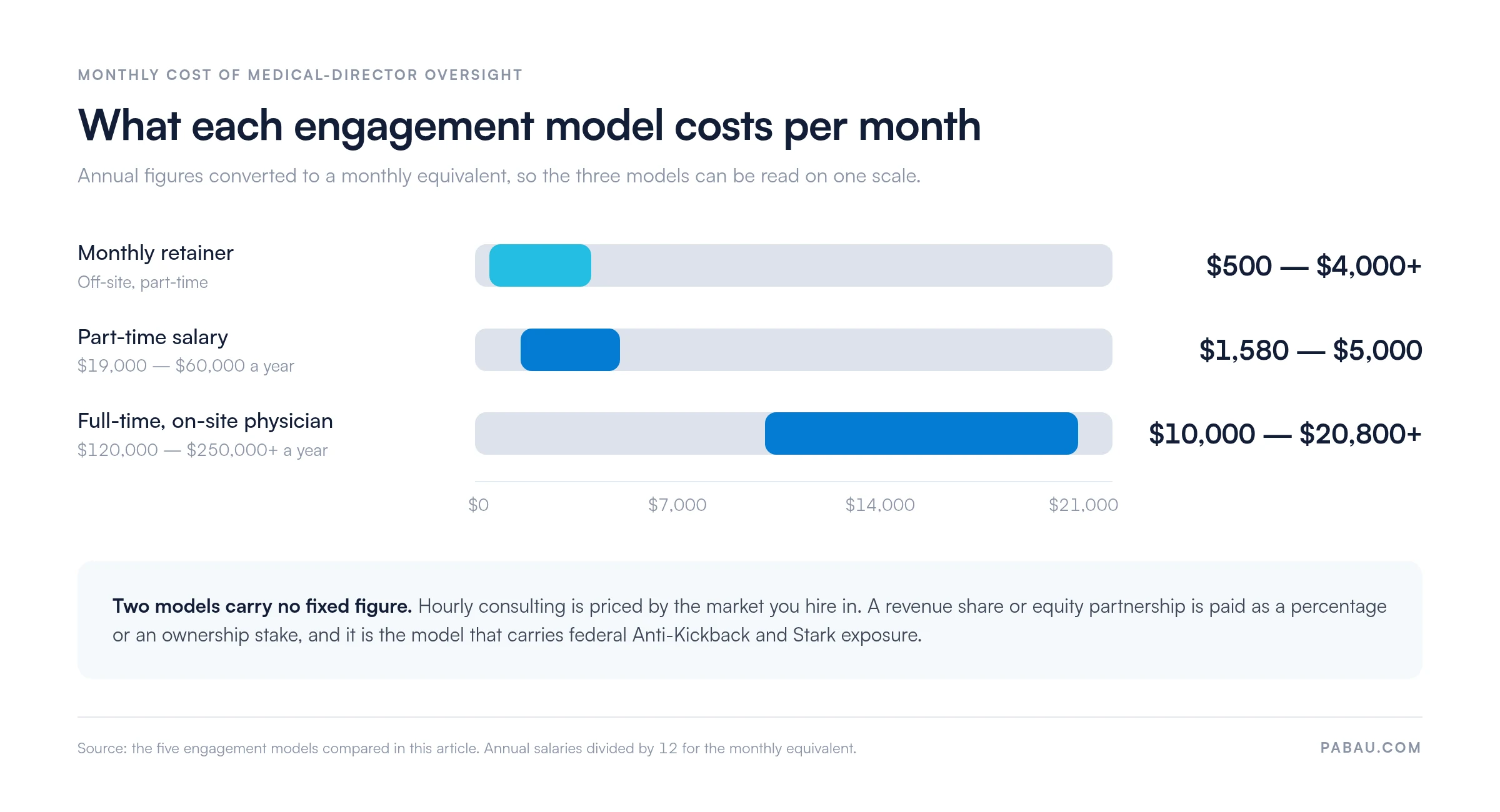
Ranges here come from commonly reported salary data such as Glassdoor. Your cost will depend on your state and service mix. Tracking that retainer alongside payroll and product costs is the job medical spa accounting software does.
The cheapest arrangement is not always the safest one. A rock-bottom retainer that buys a name on paper and little oversight leaves you exposed when something goes wrong.
Pay for a director who is genuinely available to review charts, set protocols, and step in when needed. Whatever you agree, the oversight has to be documented.
Chart reviews, protocol sign-offs, and supervision records all belong in your medical spa software, not in an email thread.
A medical director’s oversight only counts if you can show it. Protocols, chart reviews, consent, and supervision sign-offs all have to be findable when a board or an insurer asks.
Practice management software like Pabau keeps that evidence attached to the patient it belongs to. Treatment notes, digital consent forms, before-and-after photos, and the practitioner who performed the treatment sit in one record.
Your medical director can review charts from anywhere instead of driving in for a filing cabinet. Pabau’s reporting shows who treated whom, so an off-site retainer still produces a documented trail.
That matters most in the arrangement most new med spas choose. Off-site oversight is the cheapest option, and it is also the one that needs the clearest paper trail.

Pabau keeps treatment notes, consent forms, and supervision records in one patient file. Your medical director can review charts from anywhere, and your compliance evidence is ready when an inspector asks.

Hire on licensure, availability, and a compliant structure, not on the monthly figure. The cheapest retainer on your shortlist is usually the one that buys the least oversight.
The trade-off worth remembering is between cost and involvement. An off-site retainer keeps your overhead low, but it puts the burden of documentation on your own systems.
Get a healthcare attorney to draft the agreement, especially if the pay is tied to revenue. Book a demo to see how Pabau keeps oversight, consent, and treatment records audit-ready for your med spa.

Operating in California? A complete guide to California med spa licensing laws sets out who can own, supervise, and inject in the state.
Building out the rest of your clinical team? How to hire LPNs at your med spa covers scope limits state by state.
Taking before-and-after photos? Before and after photo consent form requirements explains what HIPAA needs on the form.
Choosing the system that records all of it? 8 best medical spa software and systems compares the platforms built for aesthetics.
Worried about claims and complaints? How practice management software reduces claims in aesthetics shows where documentation prevents disputes.
Most med spa owners find a medical director through networking and referrals, healthcare job boards, or a matching company. Those companies vet and pair candidates for a fee. Whichever route you take, screen each medical spa director on state license, aesthetic experience, and malpractice history before signing.
It depends on the engagement model. An off-site, part-time director for a med spa is usually a monthly retainer of $500 to $4,000. A full-time on-site physician commands a full salary, commonly $120,000 to $250,000 a year. Your state and service mix drive the final number.
In many states, yes. A registered nurse or nurse practitioner can own a med spa, as long as a medical director oversees the medical services. In full-practice-authority states, a nurse practitioner may provide that oversight directly. Always confirm your state’s rules first.
A medical director oversees clinical care and takes ultimate responsibility for the medical side of the practice. That includes setting treatment protocols, supervising and training staff, reviewing charts, and keeping the med spa compliant with state and federal law.
Start with the same three channels any owner uses: networking, healthcare job boards, and matching companies. A medical director for esthetician-led practices oversees the medical services your license does not cover, so make your treatment menu clear in the first conversation.
In most states, no. Dental boards limit a dentist’s scope to the oral and maxillofacial area. That license does not usually extend to supervising facial injectables or laser treatments. Check your state dental and medical boards before you rely on one.