CRM for chiropractors: how to manage patients, bookings and marketing
A CRM for chiropractors is a patient relationship management system built around...

Last Updated: Oct 13, 2026
A med spa service menu that retains patients groups treatments by category, prices them transparently, and links straight to online booking. Get those three right and someone browsing at 11PM can book without calling your front desk. Behind those booking links sits a scheduling system, one of the tools compared in our guide to med spa management software.
The design is rarely the hard part. The hard part is deciding how many services to carry, what each one should cost, and when to retire the ones nobody books.
Below you will find a sourced price comparison for the core treatments and a worked margin example. You will also get the Core–Complementary–Signature framework, our method for sizing a menu and growing it.

A med spa service menu converts when treatments are grouped by category, priced transparently, and linked straight to online booking.
Menus fail on length more often than on design, so start at 8 to 12 core services across three or four categories.
The Core–Complementary–Signature framework decides what earns a place on the menu each quarter, and what comes off it.
Price from your cost to deliver rather than from the practice down the road, so a promotion never quietly erases the margin.
Practice management software like Pabau connects the menu to online booking, so a price change reaches patients without a reprint.
Your medical spa service menu matters because it is where a patient decides whether to book, usually before anyone at the practice speaks to them.
Someone might be scrolling your booking page or flipping through a brochure at reception. Either way, how your services are presented shapes what they think of the practice. A smart, modern menu helps you:
It is also one of the cheapest ways to differentiate, alongside broader med spa branding choices. If a competitor’s menu is jumbled and outdated while yours is clear and easy to book from, you have already won round one.
Patients read a menu for trust signals as much as for prices, so clarity, transparency and organization decide whether they book.
That gives the menu three jobs:
A patient might want an injectable treatment without knowing the difference between Botox, Xeomin and Dysport. A short blurb under each service covering the benefit, how long it lasts and the price per unit makes that decision easier.
A structured aesthetic consultation template then keeps the conversation consistent once they book.
The three mistakes that cost the most bookings are listing too many services, hiding prices behind “consult for price”, and leaving treatments uncategorized.
Here is what a med spa service menu looks like when all three go wrong:
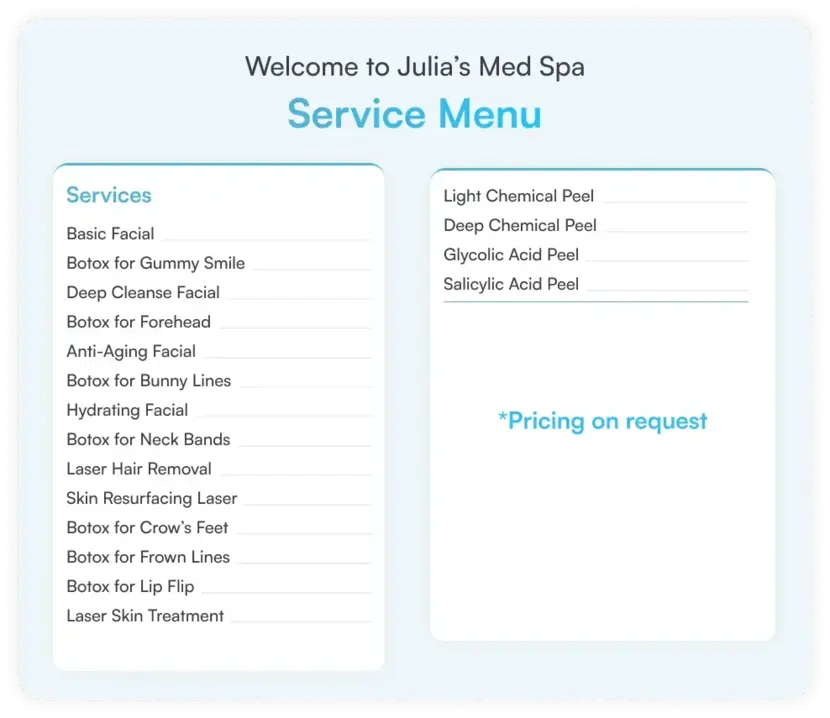
A menu like that gives nobody a reason to book. Your menu should make it effortless to go from “I’m curious” to “I’m booking”.
Practice management software like Pabau keeps the menu clean, categorized and current, and connects it directly to your online booking page. One price change updates what every patient sees.
A medical spa services menu needs four elements: a scannable layout, grouped categories, transparent pricing, and a benefit-led description under every treatment.
Nail those four and the menu does the heavy lifting for you. The sections below cover each one, starting with structure.
Group services into three or four named categories, lead each category with your top seller, and keep every description to two lines.
A medical spa menu works best at 8 to 12 services across three or four categories, then grows in two deliberate tiers.
In the practices we onboard, the longest menus are rarely the busiest ones. A 40-line list reads as indecision, and it buries the six treatments that pay for the room.
The framework has three tiers, and a service only moves up a tier when your own booking data says so.
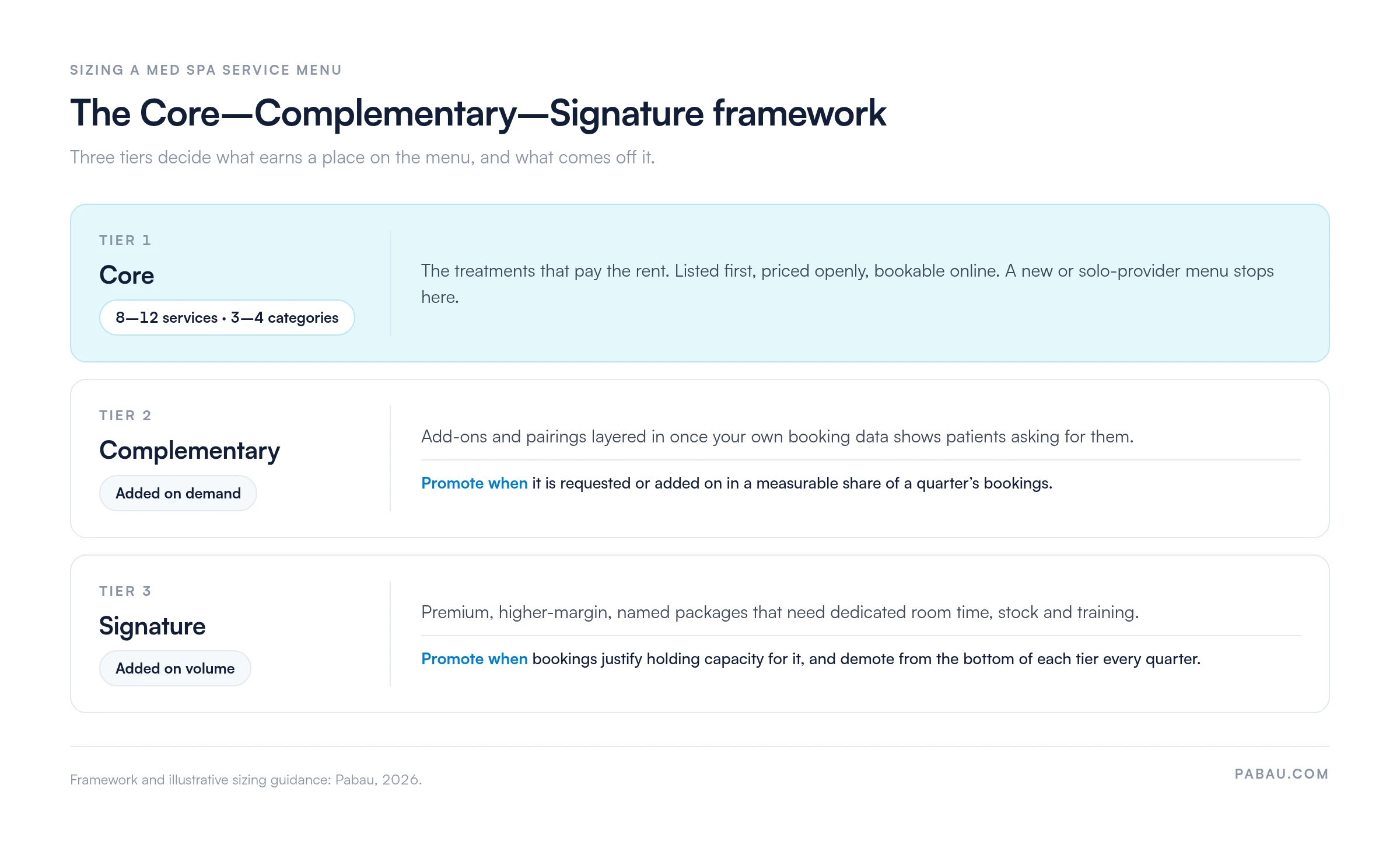
Demotion is the step that keeps the framework honest. Review the list each quarter and cut from the bottom of each tier. The menu stays roughly the same length while the mix improves.
Write each description as a result the patient can picture, then attach the price, rather than naming the treatment and the cost alone.
Here is the same treatment written both ways:
❌ Botox – $14/unit. Great for wrinkles and fine lines.
✅ Botox – Smooth out forehead lines and crow’s feet in minutes. Our FDA-approved Botox treatments relax wrinkles for a natural, refreshed look that lasts 3-4 months. Price = $14/unit.
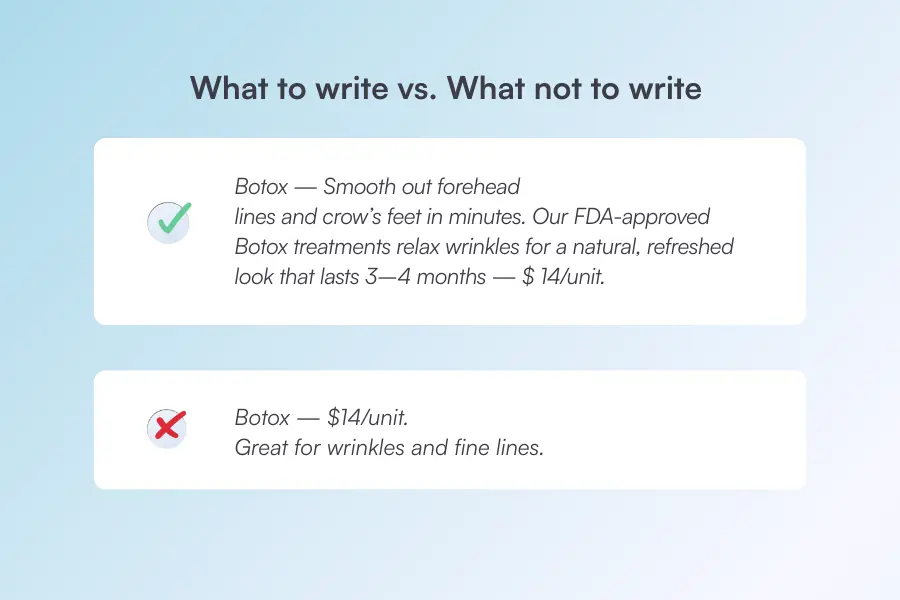
One version lists a price and a purpose. The other speaks to a result, builds trust, and makes it easy for the patient to say yes.
Set medical spa prices from your cost to deliver plus a target margin, then check the result against what practices near you charge.
That order matters. Pricing off the competition first is how a service ends up busy and unprofitable. Five strategies do the rest of the work:
A worked example. Say a microneedling session lists at $300. The consumables cost $45, your provider is paid $60 for the hour, and room time, laundry and card fees add $25. Cost to deliver is $130, so you keep $170, a 57% margin.
Now run a $199 spring promotion on the same session. Cost to deliver has not moved, so you keep $69, a 35% margin. You need two and a half promotional bookings to earn what one full-price booking earned.
Those numbers are illustrative, so substitute your own. The habit worth keeping is running the margin before you publish a discount, not after the quarter closes.
💡 Good to try: the charm pricing strategy prices some services at $99 instead of $100, which reads as better value for a dollar of margin.
The medical spa procedures below are the ones that earn their place on most menus. Each is profitable, in demand, and straightforward to describe on a spa services menu.
The table sets out what each category typically costs per session, how that compares to the national average, and how often patients come back. Treat it as a starting list of services rather than a shopping list.
| Service category | Typical price per session | ASPS national average | Typical course | Best suited to |
|---|---|---|---|---|
| Injectables (botulinum toxin) | $10–$20 per unit | $435 per treatment | Repeat every 3–4 months | Predictable, high-frequency rebooking |
| Dermal fillers | $500–$1,500 per syringe | $715 per treatment | One to two syringes, then top-ups | Higher-ticket, consultation-led slots |
| Chemical peels | $100–$500 | $1,829 (all skin resurfacing) | Courses of three to six | Memberships and prepaid plans |
| Microneedling | $200–$700 | No published ASPS average | Courses of three to six | Pairing with peels and facials |
| Laser hair removal | $100–$400 | $697 (all laser skin treatments) | Four to six sessions | Prepaid packages |
| Body contouring | $600–$2,000 | $1,157 (nonsurgical fat reduction) | Two or more cycles per area | High-value, low-volume slots |
| IV therapy and vitamin shots | $30–$300 | No published ASPS average | Weekly to monthly | Wellness memberships and walk-ins |
Per-session ranges are the figures listed in the sections below. National averages and the laser hair removal course length come from the American Society of Plastic Surgeons. ASPS publishes one average per procedure category rather than a range.
Those averages sit above most med spa list prices, because a category average pools work that not every med spa offers. Use them to sanity-check a price, not to set one.
A menu of services this size is already enough for most single-location practices. Adding more to the spa menu tends to dilute it rather than broaden it.
Botox, dermal fillers and lip enhancements are still the top earners, thanks to quick results and minimal downtime. Patients book them on a lunch break and leave looking refreshed.
For patients asking about lighter, preventative dosing, a baby Botox consent template keeps the documentation consistent.
Price range:
Microneedling, chemical peels and acne-focused facials stay in high demand because the results show up fast. They are also the easiest category to sell as a course.
Price range per session:
💡 Tip: skin treatments pair well with memberships and loyalty programs, because they usually need several sessions. A simple med spa membership program rewards those repeat visits and gives patients a reason to rebook.
Non-invasive options like CoolSculpting, radiofrequency and ultrasound attract patients who want sculpted results without surgery. Body contouring is a big-ticket category with minimal downtime, which makes it a strong draw for high-value bookings.
Price range per session:
IV hydration therapy, vitamin shots and lymphatic drainage massage are growing because they sit on the wellness side of aesthetics. They bring patients in between aesthetic appointments, which lifts lifetime value.
Price range:
Laser hair removal, photofacials, tattoo removal and resurfacing are staples in most med spas, largely because they are sold as courses rather than single visits. That repeat structure is what makes them worth the equipment.
Price range per session:
If you are still in the planning stages, our guide to starting a laser hair removal business covers the equipment and licensing side in detail.
Medspa menu optimization means tracking what books, retiring what doesn’t, and moving the winners to the top of each category.
Your menu is not set in stone. It should move with performance, seasonality and what your patients keep asking for.
Watch your best-performing services every month. If microneedling books out and facials sit empty, the menu has already told you what to promote.
Three figures are worth tracking, and a med spa waitlist helps you capture demand for whatever spikes:
That booking history is what promotes a service from Complementary to Signature in the framework above. A medical spa CRM keeps booking and patient history in one place, so those patterns surface without a spreadsheet.
Digital should be your primary menu and print the in-room supplement, because only the digital version can be corrected the day a price changes.
Digital menus win on four counts:
Here is what a digital service menu looks like on a live booking page:
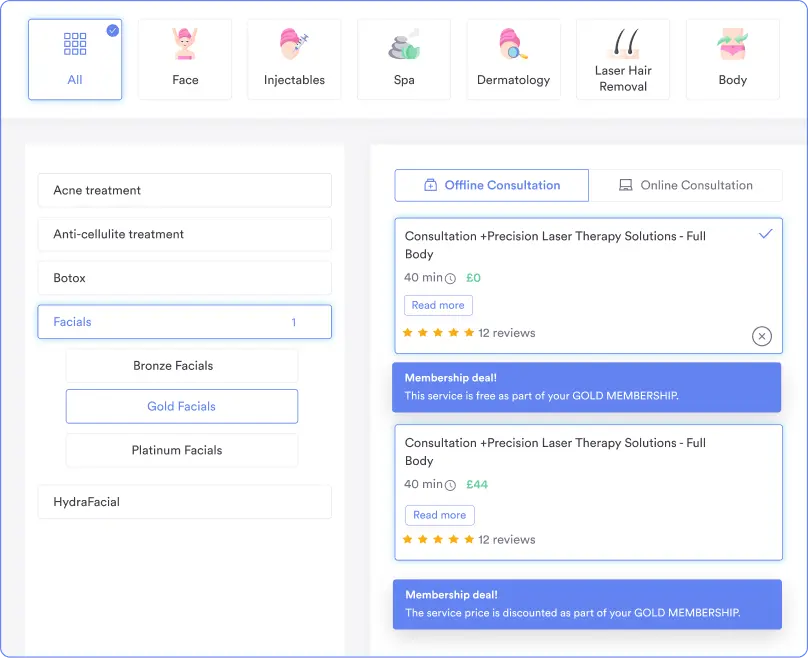
Printed menus still earn their place:
Searches for a med spa menu template or a downloadable PDF usually come from practices maintaining two versions of the truth. A live digital menu removes the second one. Export or print from the same record your booking page reads, and the paper copy can never quote a retired price.
Upselling and cross-selling lift your average ticket without lifting your prices. They work best when the add-on genuinely suits the treatment already booked.
These offers sit alongside your wider med spa marketing strategies. Three shapes that work:
Done well, these read as a treat rather than a sales pitch, and that is what brings patients back.
The menu is often a separate artifact. The price list lives in a design file, the booking page lists something slightly different, and the brochure at reception is a year old. Reconciling the three is a job nobody owns.
Pabau is an all-in-one practice management system, and your service menu is the same record that drives the booking page, the calendar and the invoice. Change a price once and all three follow.
Defining your offerings is a vital step when you start a med spa, and Pabau handles the parts around it:
Updating a price, retiring a service or launching a package takes a few clicks. You can add reviews against a service too, so the social proof sits where the booking decision happens.
No design file to reopen, no brochure to reprint, and no technical skill required.
Offer enough treatments and a menu gets cluttered fast. Clutter causes decision fatigue, and a patient with decision fatigue books nothing at all.
Pabau lets you categorize services the way patients think about them. Someone after a peel never has to scroll past 20 injectables to find it.
Pabau connects your service menu directly to the booking calendar, so patients book at 11PM without phoning anyone. Your front desk stops fielding “have I been booked in?” calls during treatment hours.
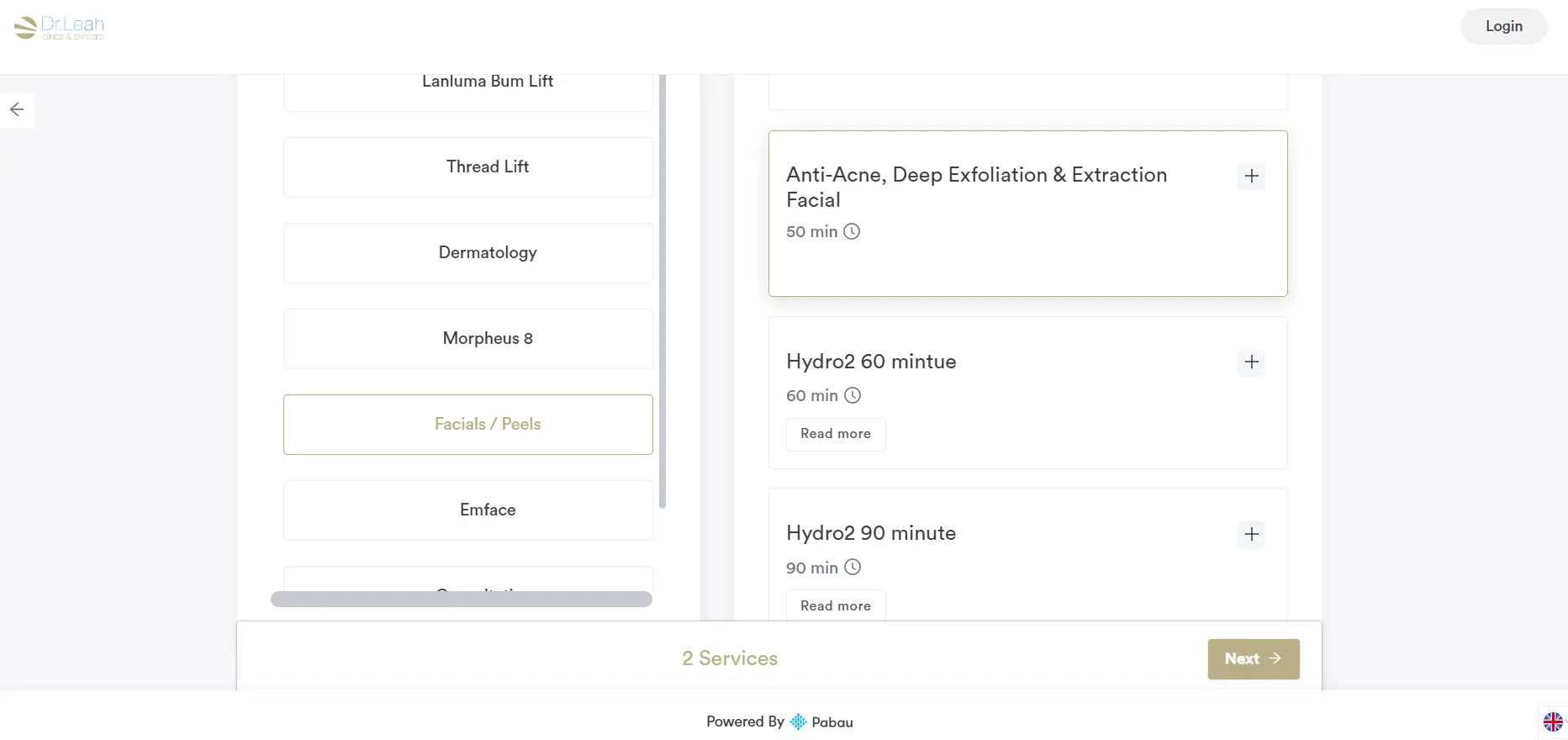
Image credits: Dr Leah Skin Clinics
Someone may open your booking page intending to buy one session. Pabau can show them what a course of three would save at the same moment, before they reach checkout.
You can also surface a membership package, which trades a monthly fee for perks and member pricing.
Pabau’s reporting shows which services book, which stall, and when demand spikes. Those three readings are exactly the evidence the Complementary and Signature tiers ask for before you promote a treatment.
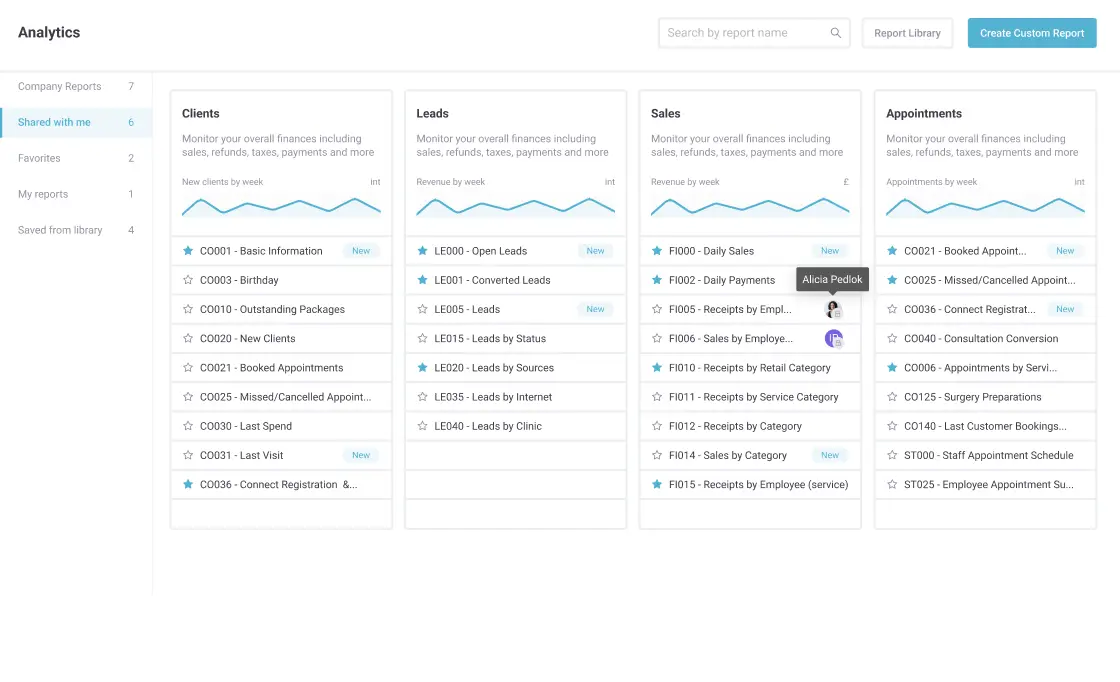

Pabau connects your service menu to online booking, so a price change, a new package or a retired treatment reaches patients the same day. Categories, descriptions and prices live in one record instead of three.

The menu you publish is a decision about what your practice is for. Eight to 12 services you deliver well will out-earn 40 you deliver occasionally. The short menu is the one patients can read and your team can staff.
The trade-off is worth naming. A tight menu means saying no to a treatment somebody asked for, and that is uncomfortable for the first few quarters. The framework turns it into a scheduled review rather than an argument.
Start with the price audit. Work out the cost to deliver on your five best sellers, compare it to what you list, and fix whichever one has quietly stopped paying. Book a demo to see how Pabau keeps your service menu, your prices and your booking page in step.

Ready to turn single treatments into packages? Med spa package ideas shows which bundles patients buy and how to price them.
Deciding what to add to the injectables tier? Trending Botox and filler treatments covers what patients are asking for right now.
Want retail earning its shelf space? How to sell more retail at med spas explains how product sits alongside the treatment menu.
Need patients to see the new menu? Med spa marketing ideas covers the promotion side once the menu itself is right.
Unsure what you can legally list? Med spa compliance sets out the supervision and advertising rules behind your service list.
Medical spas offer injectables, skin rejuvenation, body contouring, laser treatments, and wellness add-ons such as IV therapy. The exact medical spa procedures on a menu depend on the practice’s equipment and its licensed providers.
A med spa menu of services lists every treatment by category, with a price and a short description of what each one delivers. Patients can then compare options and book without calling the front desk.
A typical med spa services list covers injectables, skin treatments like microneedling and peels, body contouring, laser hair removal, and IV therapy. Each entry carries a price and a one-line description, so patients can compare options without calling.
Price each service from its cost to deliver, meaning consumables, provider time and room time, then add your target margin. Check the result against local medical spa prices and against the national averages published by the American Society of Plastic Surgeons.