How to start a TRT clinic: A step-by-step guide for 2026
Learning how to start a TRT clinic comes down to nine steps, from choosing a del...

Last Updated: Oct 21, 2026

Demand for medical weight loss is rising: 40.3% of U.S. adults have obesity. The global weight management market is projected to grow from $176 billion to $392 billion by 2035.
Your clinic model shapes your launch: Standalone, add-on, and virtual clinics each carry different costs, licensing requirements, and timelines.
Structured programs drive retention and revenue: Successful weight loss clinics sell recurring care plans rather than one-off consultations.
Start lean or go big: An add-on to an existing practice can launch for around $5,000. A full standalone build runs to $300,000.
You can open a weight loss clinic as an add-on to an existing practice for about $5,000. A standalone site with equipment and staff runs to $300,000 or more.
The demand is there. 40.3% of U.S. adults have obesity, according to CDC data. The global weight management market is projected to reach $392 billion by 2035, per Towards Healthcare.
Below you’ll find the licensing rules, what a launch costs by model, which services generate recurring revenue, and how to win your first patients.
A weight loss clinic is a recurring-care business. Patients come back for months, and your programs, billing, and staffing all have to assume that.
Four realities shape almost every decision that follows.
If you already run a private practice, you can skip most of the legal setup and tap into your existing patient base. Many practitioners launch weight loss services as an add-on in under 60 days.
Here are the eight milestones you’ll hit between the decision and your first booked patient.
| Step | What it covers | Key outcome |
|---|---|---|
| 1. Pick your clinic model | Standalone, add-on, virtual, or hybrid | Clear business direction |
| 2. Handle legal and licensing | Business entity, medical licenses, compliance | Legally operational clinic |
| 3. Write a business plan | Financial projections, services, target market | Funding and strategic clarity |
| 4. Define your services | Program structure, pricing, service categories | Revenue model in place |
| 5. Estimate startup costs | Equipment, rent, staffing, tech | Realistic budget |
| 6. Build your team | Licensed clinicians, admin staff, specialists | Qualified care team |
| 7. Set up operations and tech | EHR, scheduling, billing, patient tracking | Operational infrastructure |
| 8. Attract your first patients | Marketing strategies, local SEO, referrals | Booked appointments |
Your clinic model sets your startup costs, your licensing burden, and your daily operations. There are three main options.
Virtual clinics that prescribe controlled substances must comply with the Ryan Haight Act. That usually means at least one in-person evaluation before you prescribe. Check both federal and state telehealth prescribing rules.
Every medical weight loss clinic needs a solid legal foundation. Here’s what to get in place.
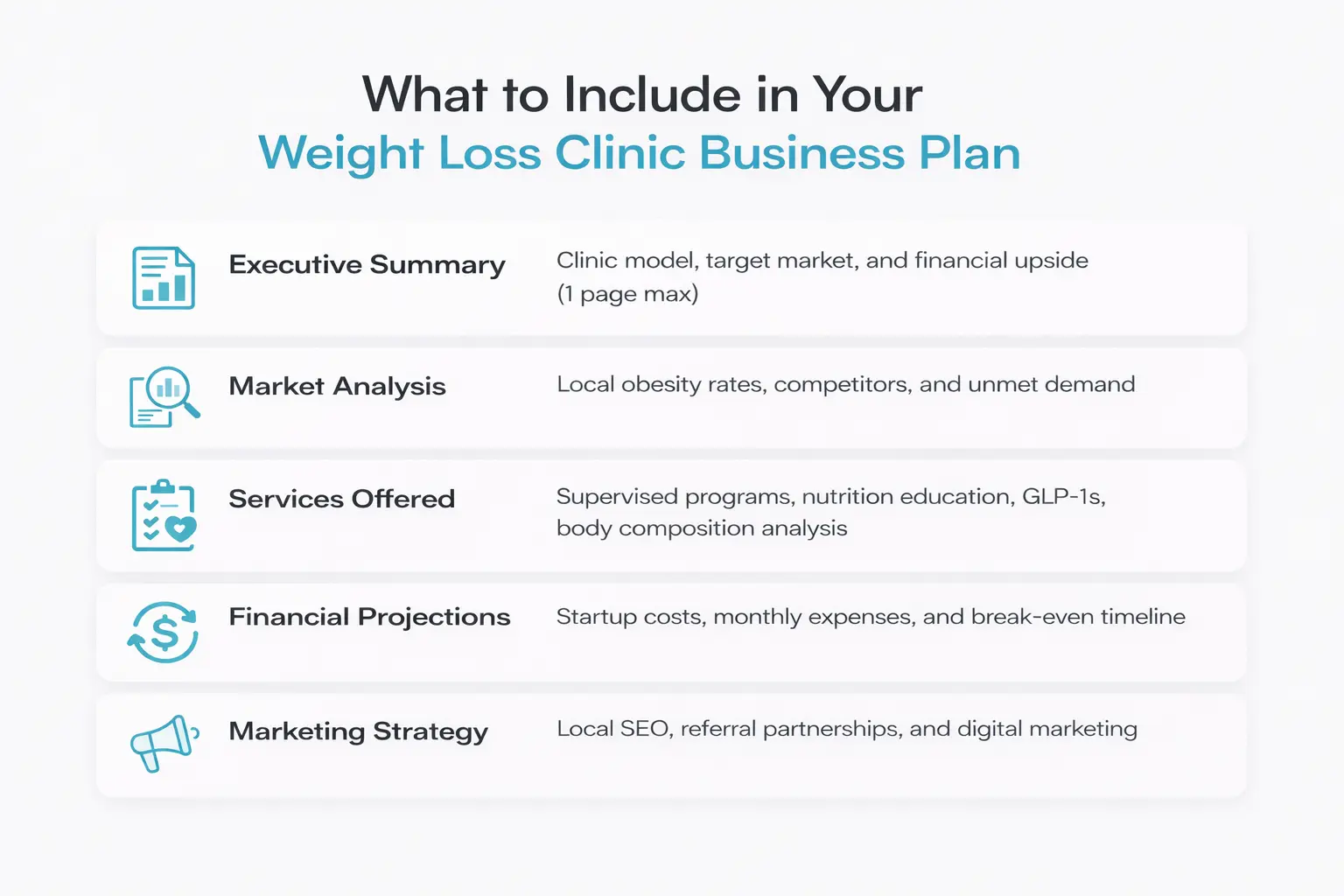
A solid business plan is your roadmap for funding, hiring, and scaling. Lenders and investors will ask for it first.
Your weight loss clinic business plan should include:
Build two versions of your financial projections: a best case and a worst case. If the worst case still works, you’re in a strong position to move forward.
Your service menu drives your revenue model and your patient retention. There are three main formats to choose from.
Many successful clinics use a hybrid approach. They combine a membership plan with add-on packages for specific services. Price each one against your local market and your cost of delivery.
Weight loss clinic startup costs vary widely with your model, your location, and the services you plan to sell.
Here’s a general breakdown:
| Clinic model | Estimated startup cost |
|---|---|
| Lean/virtual (add-on to existing practice) | $5,000–$30,000 |
| Mid-size standalone clinic | $50,000–$100,000 |
| Full standalone with equipment and staff | $100,000–$300,000+ |
| Franchise (e.g., Medi-Weightloss) | $251,000–$494,000 |
Plotted on one axis, those ranges overlap less than you would expect. A franchise license costs more than building your own standalone site.

These estimates draw on published startup-cost data from Elite Nurse Practitioner, BusinessPlan-templates, and the Medi-Weightloss franchise disclosure document.
Your team decides the quality of care you deliver and the range of services you can sell.
These are the key roles to plan for:
Budget for training from year one. Weight-management certification and aesthetic medicine courses keep your practitioners current on prescribing protocols and patient safety.
Operational efficiency makes or breaks a new practice. You need the right systems from day one.
At minimum, you need scheduling, EHR, billing, and patient communication. Running those on separate platforms means duplicate data entry and extra admin work.
An all-in-one platform built for weight loss practices keeps records, calendar, and payments in one system. Practice management software like Pabau then gives you a single view of operations and revenue.
If you’re still comparing systems, our guide to weight loss clinic EMR covers what to check before you commit.
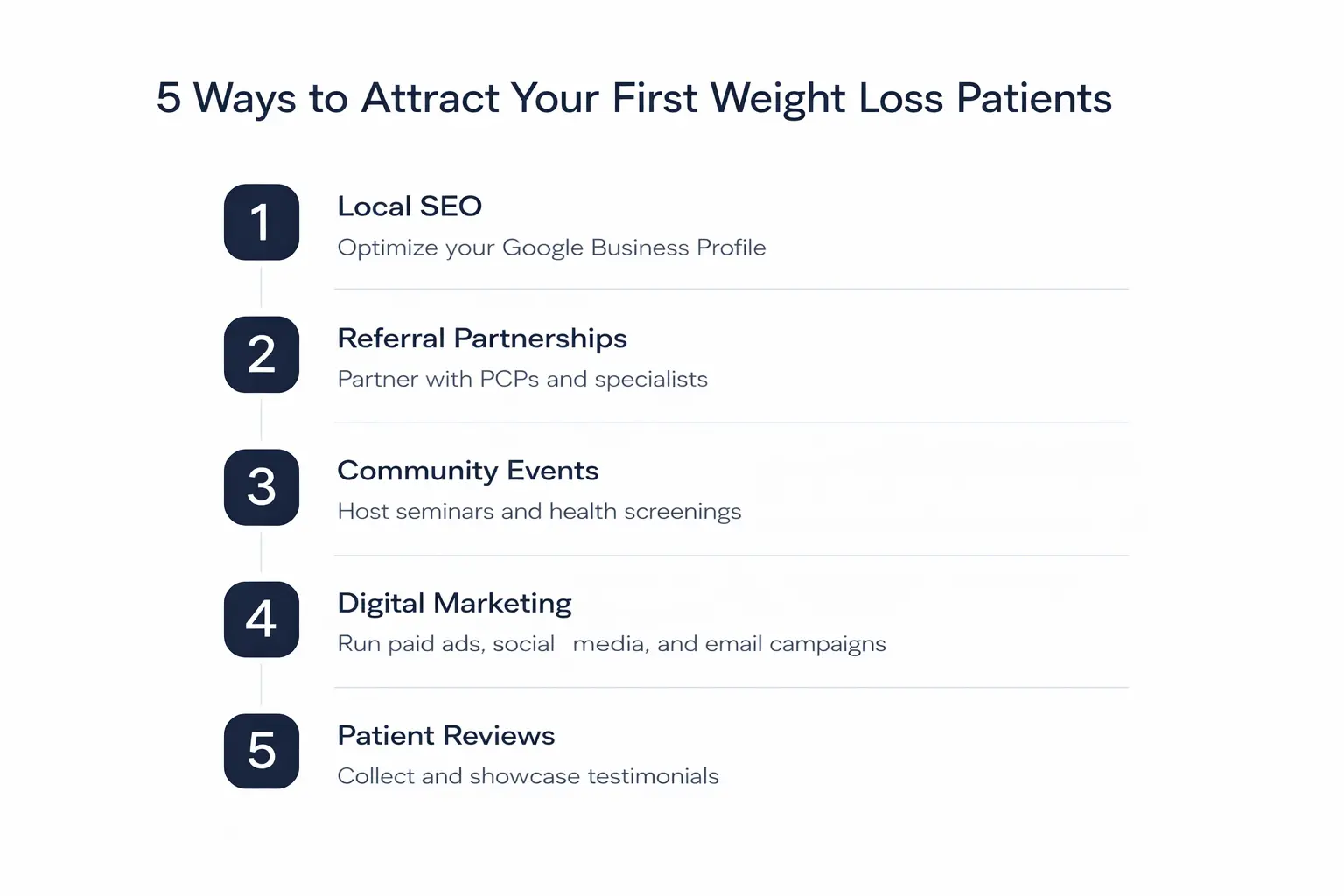
You can have the best programs and the best team. Without patients, your clinic doesn’t survive.
Here’s what works:
Make it easy for happy patients to leave a Google review after every visit. Clinics that ask consistently outperform competitors in local search.
Ready to streamline your clinic launch? Book a demo with Pabau and see how one platform handles scheduling, records, billing, and marketing.
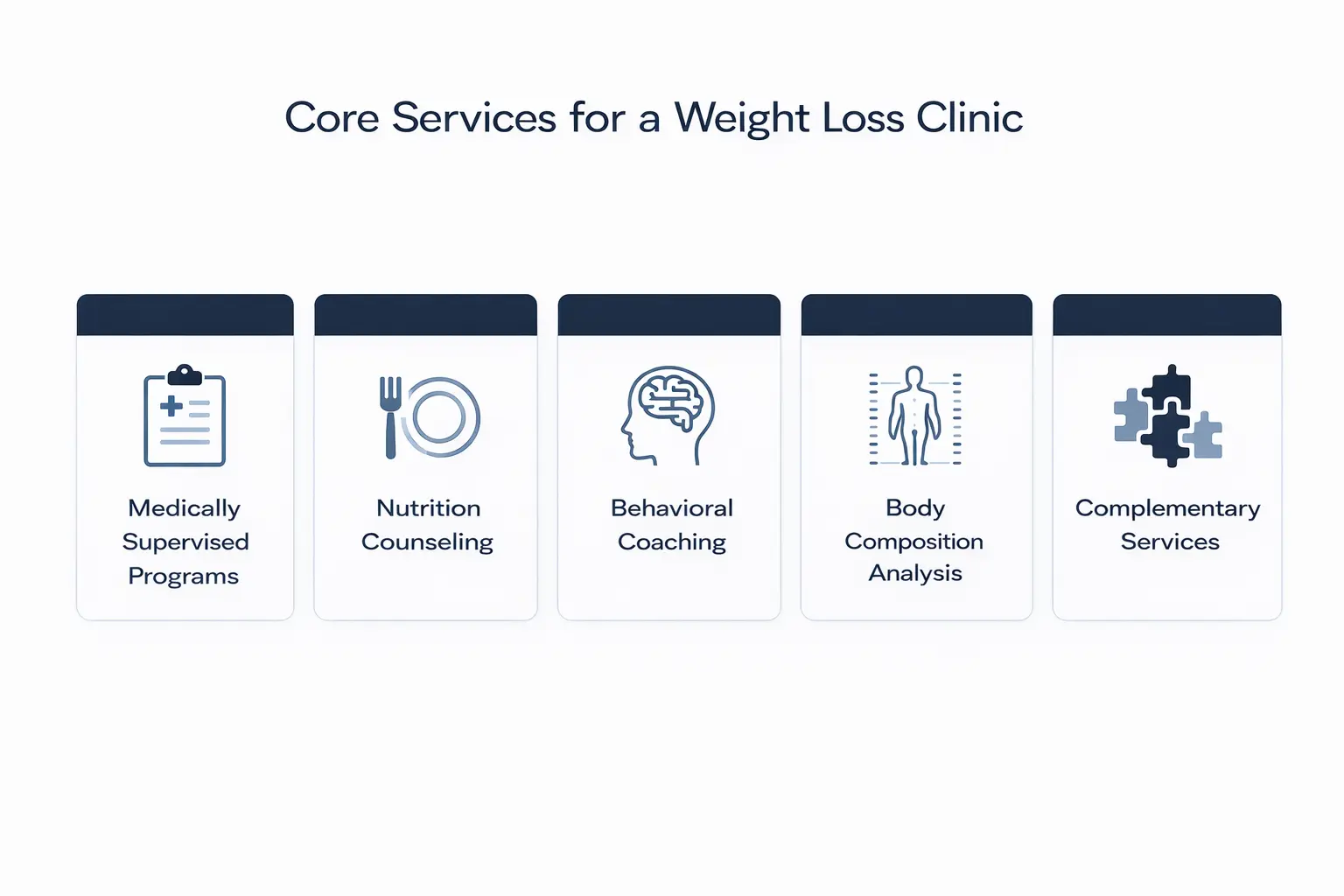
Your service mix determines how much revenue you generate and how long patients stay. It also decides how easily the clinic scales.
Focus on services that build one complete care experience.
Medically supervised programs combine medical history review, lab work, and personalized action plans with regular check-ins.
GLP-1 medications are what most patients come for, and the two leading drugs do not perform alike. In the head-to-head SURMOUNT-5 trial, Zepbound produced 20.2% average weight loss over 72 weeks against Wegovy’s 13.7%. Pairing either prescription with lifestyle counseling improves outcomes and keeps patients booking follow-ups.
Many patients start the program with existing conditions. A cholesterol medication list and a written diabetes management plan help the prescribing provider check for interactions before adding a GLP-1 drug.
Most patients know what to eat. The hard part is sticking to it.
Personalized meal plans, food diary tracking, and nutrition education give patients structure between visits.
A blood-type diet chart or a diabetic grocery list gives dietitians a ready starting point instead of building a meal plan from scratch each visit.
Registered dietitians deliver these services well, and they naturally create a recurring-visit model.
Behavior drives most of the long-term result. Clinics that add cognitive behavioral therapy and stress management see better outcomes and lower regain rates.
Simple, repeatable techniques carry the work between appointments. A 5-5-5-5-5 mindful eating exercise gives patients a structured way to read hunger and fullness cues at home.
A body composition analyzer and metabolic rate testing give patients and providers objective data beyond the scale.
Patients focused on recomposition rather than the number on the scale need a different resource. A fat-loss diet plan pairs a protein target with a calorie deficit instead of a flat calorie cut.
Recording those measurements over time keeps patients motivated. It also gives you evidence of progress when the scale stalls and someone wants to quit.
Practices managing metabolic-associated fatty liver disease alongside weight loss sometimes add an elastography test to track liver stiffness between visits.
Depending on your clinic model, consider adding:
For the aerobic track, a structured Body-for-Life exercise plan gives patients a defined 12-week progression to follow between visits.
These add-ons raise revenue per patient and set your clinic apart from the practice down the road.
Clinical expertise gets patients in the door. Your operational systems are what keep them coming back.
These are the capabilities your tech stack has to cover.
Patients expect to book online. A good scheduling system cuts no-shows, automates reminders, and keeps your calendar full.
Look for automated SMS and email reminders, online self-booking, and waitlist management. Those three features do most of the work on your no-show rate.
Pabau’s scheduling handles all three in one platform, wired directly to patient records and billing.
Electronic health records are non-negotiable. You need a system that stores patient medical history, treatment notes, and lab results securely.
HIPAA-compliant EHR software keeps that record defensible. It also cuts documentation time, because patient information is in front of you during the consultation.
Weight loss clinics juggle self-pay, insurance billing, and membership payments. Your billing system needs to handle all three.
Payment processing connected to your scheduling and records removes double data entry and speeds up collection.
Two-way communication keeps patients engaged between visits. Automated reminders, follow-up messages, and educational content all improve program compliance.
The more touchpoints you create between appointments, the less likely patients are to drop off.
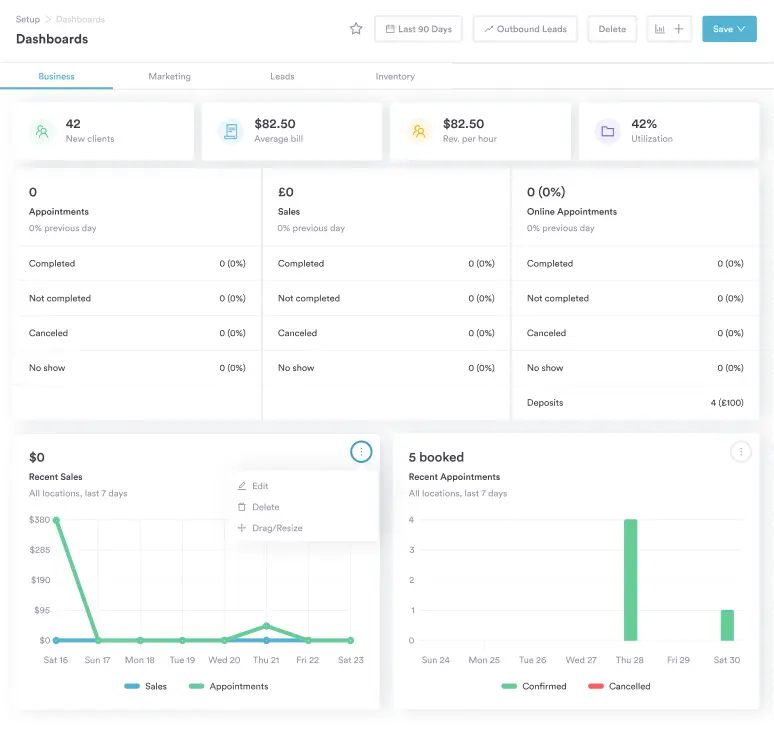
Real-time dashboards track revenue, appointment volume, patient retention, and program performance in one view.
An all-in-one platform matters most here. Instead of pulling numbers out of separate tools, you see the whole clinic from a single dashboard.
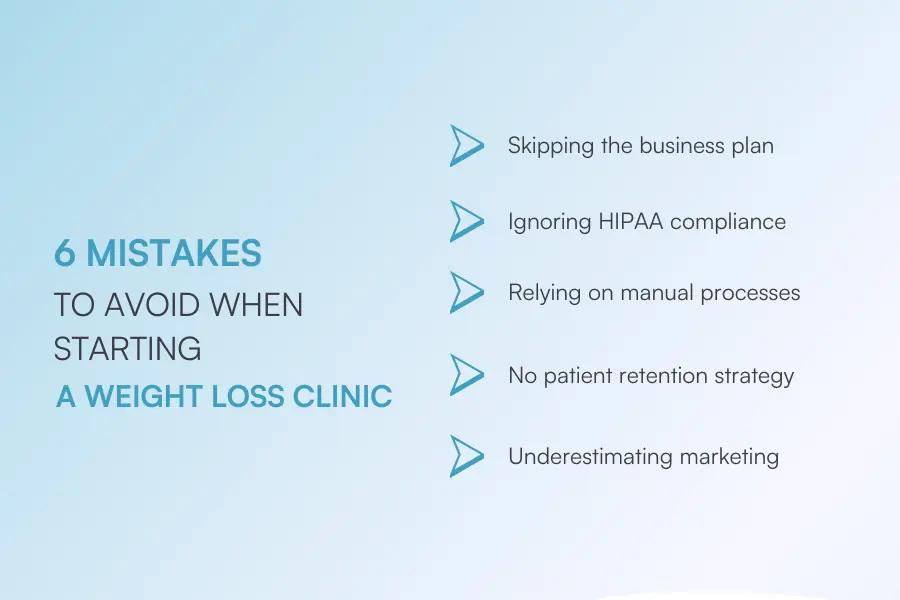
Operational mistakes sink more new weight loss clinics than clinical ones. Here are five to avoid.
It’s tempting to jump straight into operations. Without a documented plan, cash flow problems and unclear growth targets follow fast.
How to avoid it: Write the business plan before you sign a lease or hire anyone. Include realistic financial projections and a 12-month operating budget.
Compliance often gets treated as an afterthought. That’s an expensive gamble. Under the current inflation-adjusted schedule, HIPAA penalties run from $145 to $73,011 per violation, depending on culpability.
How to avoid it: Invest in HIPAA-compliant software and train every staff member. Document your privacy and security policies before you see your first patient.
Paper forms and spreadsheets work at first. As patient volume grows, they become the bottleneck.
How to avoid it: Automate from the start. Appointment reminders, patient intake, and billing all run without staff time once they’re configured. That frees your team for patient care.
Acquiring new patients is expensive. Losing them after one or two visits to poor follow-up costs even more.
How to avoid it: Build structured weight loss programs with clear milestones. Use feedback loops and automated check-ins to keep people on track. Membership plans create financial and psychological commitment.
“If you build it, they will come” doesn’t work in healthcare. Plenty of new clinics open with no marketing plan and wonder why the phone stays quiet.
How to avoid it: Allocate 5–10% of your projected revenue to marketing in year one. Prioritize local SEO and your Google Business Profile. A consistent review strategy compounds over time.
Yes, when the model is built around recurring revenue rather than single visits. Demand is not the constraint.
Margins come down to your model, your pricing, and how long patients stay enrolled. Our guide to weight loss clinic revenue works through the per-patient math.
Three figures worth knowing:
Recurring revenue is what makes those margins work. Clinics built on one-off consultations struggle to cover their fixed costs.
Note: Avoid making specific income guarantees. Profitability varies with location, competition, and operational efficiency. The numbers above are industry benchmarks, not promises.
Most new weight loss clinics run their calendar in one tool, their notes in another, and their payments in a third. Every 12-week program then needs someone to reconcile the three.
Pabau holds the whole program in one record. Consent forms, lab results, weight and measurement history, GLP-1 prescribing notes, and invoices all sit against the same patient.
Recurring billing runs your membership and package plans, so a 12-week program invoices itself on schedule. Automated check-ins go out between visits, which is where weight loss retention is won or lost.
The outcome is fewer dropped follow-ups, and a clear view of which programs earn their keep.

Pabau keeps consent forms, measurements, prescribing notes, and recurring payments against a single patient record. Your team stops reconciling three systems and spends that time on follow-ups instead.

The model you pick in week one decides most of what follows. An add-on to an existing practice can be seeing patients within 60 days on a $5,000 budget. A standalone build takes longer and costs twenty times more.
Neither model earns anything without repeat visits. The clinics that hold their margins sell 12-week programs and memberships, then work the follow-ups that keep patients enrolled.
Get your systems in before the patients arrive. Retrofitting scheduling, records, and billing at 200 patients costs far more than setting them up at 20. Book a demo to see how Pabau runs a weight loss program end to end.

Wondering what a program earns? How weight loss clinics make money breaks the revenue down by program and by patient.
Comparing platforms before you buy? Top 7 weight loss clinic software in the US ranks the options on scheduling, records, and billing.
Need the GLP-1 market numbers? GLP-1 statistics collects prescribing, cost, and outcome data in one place.
Deciding between medication and lifestyle change? Lifestyle vs pharmacologic interventions is a clinical guide to managing metabolic health.
Building your intake assessment? Body mass index assessment covers how to measure and record BMI at the first visit.
Yes, in most states. Clinics that prescribe medications or provide medically supervised programs need a licensed physician (MD or DO) to oversee operations. Some states allow nurse practitioners to run clinics independently. Always check your state’s scope-of-practice regulations.
It depends on your model. A lean virtual or add-on practice can start under $50,000. A full standalone clinic with dedicated space and staff runs significantly more. See Step 5 above for a detailed cost breakdown by category.
Licensed clinicians (MDs, DOs, NPs, PAs, RDs) need active state licenses. Providers prescribing GLP-1 medications must have a DEA registration. Optional certifications like ABOM or aesthetic medicine training add credibility and expand your offerings.
Yes, when structured correctly. GLP-1 demand is accelerating and the broader market is growing fast. Clinics that focus on recurring revenue through memberships and multi-week programs see the strongest margins. See the profitability section above for detailed benchmarks.