Anja Dodevska

Self-harm worksheet: Free PDF with a safety plan
Download your free self-harm worksheet A two-page worksheet in four parts, writt...

1
Last Updated: Nov 6, 2026
Free PDF 2 pages, print-ready Clinician-reviewed
A values exploration worksheet is a clinical tool that helps patients put what matters most to them into their own words. Therapists and counselors use it to open values-based conversations, especially in Acceptance and Commitment Therapy (ACT). This free two-page PDF starts with patient information and a short medical history. It then asks nine open-ended questions about core values, proud moments, moral dilemmas, admired people and caregiver influences. A 1-to-10 alignment scale rates how well the patient's current lifestyle fits their values. Print it for in-session work or send it home as homework.
A two-page printable form that opens with patient information and a short medical history. It then asks nine open-ended questions about the patient's core values and adds a 1-to-10 alignment scale.
Start from scratch, or upload this PDF or any form you already use, and Pabau's AI Form rebuilds it with tick boxes, text fields and a signature. Attach it to the treatment once, and every patient gets it on time.
AI Form rebuilds the consent, history and aftercare forms you already use. You review each one, then publish.
Patients complete forms on their phone before they arrive, so the front desk stops retyping paper.
Every signed form is versioned and attached to the treatment record, ready when you need it.
Set how long a consent stays valid. Returning patients skip forms they have already signed.
Supports HIPAA and GDPR compliance AES-256 encryption 4.8 on G2 4.7 on Capterra Trusted by 4,000+ practices worldwide

A values exploration worksheet helps patients put what matters to them into their own words.
This free PDF pairs a patient information and medical history section with nine open-ended values questions and a 1-to-10 alignment scale.
It is a print-and-write form with no fillable fields, so patients answer by hand in session or as homework.
The PDF stops at reflection, so linking values to committed action is work you do with the patient afterward.
The worksheet is a clinical aid and does not replace professional assessment.
A values exploration worksheet is a guided written tool that asks a patient to reflect on what they care about most. It uses open questions about past choices, admired people and personal history in place of a fixed checklist. The worksheet supports self-reflection in therapy and carries no diagnostic weight.
Clinicians use it to move from abstract ideas about values into specific, personally meaningful language. The answers give you material for later goal-setting work, which happens in session rather than on the page.
In Acceptance and Commitment Therapy (ACT), values clarification is one of the core processes that supports psychological flexibility. Values are treated as chosen directions that a person keeps moving toward without ever finishing.
So the questions ask what matters to the patient and leave achievements aside. The ACT bullseye worksheet builds on the same idea by plotting how closely a patient lives by each value.
Facilitators typically follow a simple sequence in session:
Clinicians working in other frameworks, including CBT and integrative approaches, may also use the worksheet to orient therapy around values. The ACT research behind values-based work is collected by the Association for Contextual Behavioral Science, a useful starting point for practitioners.
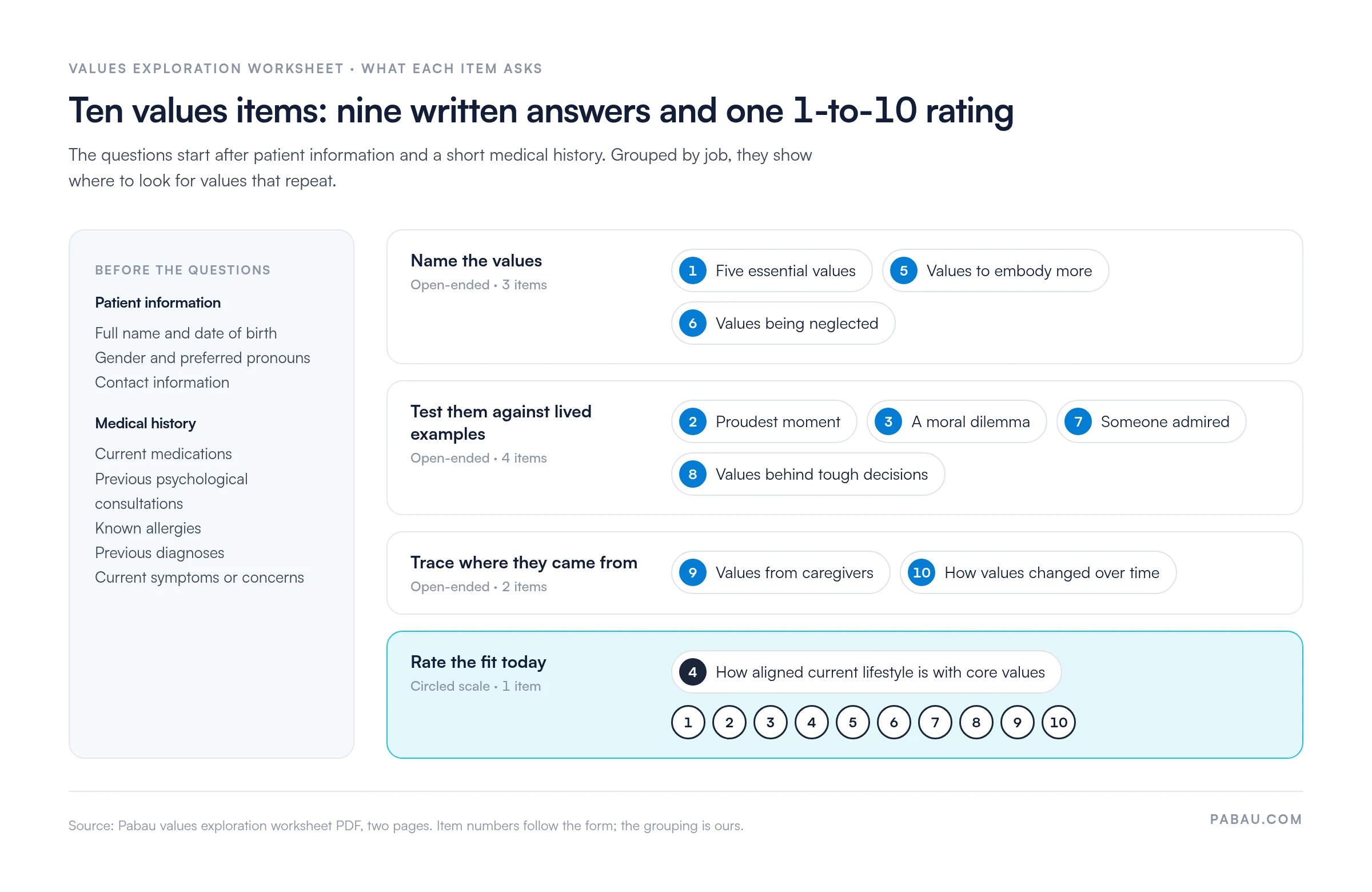
The PDF is a two-page clinical form in three parts. The first two capture background details, and the third holds the values questions.
Nine of the ten items are open-ended questions with blank space for a written answer. Item four is a 1-to-10 alignment scale that the patient circles. The PDF has no fillable fields, so print it and have the patient complete it by hand.
Sorted by what each one asks the patient to do, the ten items fall into four groups.
Identifying core values works best when the patient starts broad and narrows gradually. Rushing to a final list usually produces socially expected answers rather than personally meaningful ones.
This sequence keeps the work patient-led while giving you a clear structure to follow. Patients often find the question shifts from “what should I value” to “what do I care about”.
The alignment item is a single self-rating. For a fuller check of the same idea, the valued living questionnaire rates importance and consistency across ten life domains.
Values on their own do not change behavior. The PDF has no goal-setting or action section, so committed action is the step you take with the patient once the worksheet is done. Questions five and six make a natural bridge, since they ask which values the patient wants to embody more and which they have neglected.
The table below is an example of how you might build that link in session. It is not part of the PDF.
Agree on one small action per value and record it in your session notes. Reviewing it at the start of the next appointment keeps the value visible between sessions. When a patient keeps drifting from an agreed action, a choice point worksheet maps the moment they moved away from it.
Values and boundaries are closely linked. A boundary often becomes clearer once a patient knows which value it protects.
The moral-dilemma and neglected-values answers often show where current commitments clash with what the patient cares about most. From there, the conversation can move into practical boundary-setting, such as which requests to decline and which to renegotiate. A healthy boundaries worksheet gives that conversation a written structure.
Re-ask the 1-to-10 alignment question at a later session and compare it with the first answer. The scale is an unvalidated self-rating, so use any change to open a conversation.
Read through the questions yourself first, so you can explain each one with confidence. Where a patient needs simpler language, adapt the wording aloud and keep the question order intact.
The first page asks for medications, allergies, diagnoses and previous psychological consultations. A completed worksheet therefore belongs in the clinical record. Store it in the patient’s file under the same confidentiality rules as your session notes. If you already hold those details from intake, the patient can skip that section.
Paper worksheets tend to end up in a folder, away from the session notes they belong to. That makes it hard to set a patient’s first answers beside the ones they give months later.
Pabau, the therapy practice management software we build, lets you rebuild a form like this as a digital one. Its digital forms send the questions before a session and keep the completed answers on the patient record.
Patients fill it in on their own device, and you review their answers alongside your notes. The committed actions you agree on sit in the same record, so the next session starts from what the patient said last time.

Pabau’s digital forms send values worksheets before a session and store completed answers on the patient record, next to your session notes.

This worksheet does one job well: it gets a patient talking about their values through stories from their own life. It does not rank values or set goals for you. Plan to spend the session after it turning two or three of the answers into small, specific actions.
Treat the completed form as part of the clinical record, because its first page holds medical history. Book a demo to see how Pabau keeps values worksheets and session notes together on one patient record.

Want a hands-on sorting exercise? Printable values cards let patients sort and rank values physically in session.
Need a word list to prompt the first question? The personal values list gives patients vocabulary when they struggle to name five values.
Looking for a structured ranking tool? The Rokeach values survey asks patients to rank 18 end-state and 18 behavioral values in order of importance.
Ready to turn values into goals? Goal setting worksheets help patients set specific, measurable goals after values work.
Documenting the session afterward? Progress notes for psychotherapy shows how to record values work in your clinical notes.
A values exploration worksheet helps patients name and reflect on what matters most to them. It supports values clarification in ACT and similar approaches, and the answers can inform later goal-setting.
No. This worksheet is a separate resource with its own wording. It pairs a short patient information and medical history section with nine open-ended values questions and a 1-to-10 alignment scale. Choose the version whose layout suits your session style.
Values clarification is discovery-oriented and explores what matters to a patient. A values assessment is evaluative and measures or ranks values against a standard. This worksheet is built for exploration, and its 1-to-10 alignment scale is a self-rating with no scoring system.
This worksheet is written for adults, and its medical history section assumes an adult patient. Values work with children needs different wording and framing, so check suitability with your clinical supervisor before adapting it.
No. The PDF has no fillable fields, so print it and have the patient write their answers by hand. If you want patients to complete it on a device, rebuild the questions as a digital form in your practice software.