Obagi Blue Peel Radiance: Consent form and aftercare guide
An Obagi Blue Peel Radiance consent form records that your patient understood a ...

1
Last Updated: Sep 29, 2026

Personal values are the beliefs that guide your decisions and define your sense of identity.
Clarifying them gives a client a stable reference point when a difficult choice comes up.
Scanning a ready-made list is far faster than naming your values from a blank page.
Grouping values by life domain keeps the exercise scannable for a client working through it in session.
Storing the finished assessment in the client record lets you return to it throughout care.
A printable assessment tool carrying 100+ personal values, grouped by life domain. It includes reflection prompts, a five-step process for narrowing down to your core values, and space to define each one in your own words.
Download templateA personal values list is a reference set of the beliefs people use to steer their decisions. Reading one is far faster than naming your values from a blank page. That is why therapists and coaches hand the list to a client instead of asking the question cold.
This page carries 100+ values grouped by life domain, plus a five-step process for cutting them down to a core set. The sections below cover how to run the exercise on yourself, and how to use it in a session.
Personal values are the core beliefs and principles that guide how you live, make decisions, and relate to others. Goals are specific outcomes you want to reach. Values are the ongoing directions you want your life to move in. They name what matters most to you, from authenticity and family through to health, growth, creativity, and integrity.
Values shape behavior in ways people feel long before they can explain them. When you act in line with your values, you experience authenticity and purpose. When your actions drift away from them, you feel disconnected, anxious, or unfulfilled. Closing that distance is what values clarification is for.
Values are one of the most practical tools for navigating a life choice. Facing a career change, a relationship decision, or a major transition, they act as a decision filter. Someone who values family and health weighs a high-paying job differently than someone who prioritizes independence and adventure. Knowing your values is what makes either answer authentic.
Research from positive psychology and Acceptance and Commitment Therapy (ACT) links values-aligned living to lower anxiety, greater resilience, and better well-being. When therapy practice management builds values clarification into the care plan, clients report stronger engagement and better outcomes.
Below is the full list, covering the major life domains. Each entry is short and actionable. Use it as a reference when you complete your own assessment, or when you facilitate a client’s values exploration session.
The table covers the core categories. Other common values include adventure, balance, beauty, compassion, discipline, faith, and financial security. The list also runs to gratitude, harmony, humility, independence, influence, innovation, and kindness. Learning, love, patience, peace, respect, and security belong on it too. So do self-expression, solitude, stability, tolerance, tradition, and wisdom. Clinicians and coaches often add values specific to a client’s own situation.
Identifying your core values is a reflective exercise, best done somewhere calm and free of distraction. The sequence below works whether you run it on yourself or facilitate it in a therapy or coaching session. Two of the five steps do the cutting, and the rest test what survives.
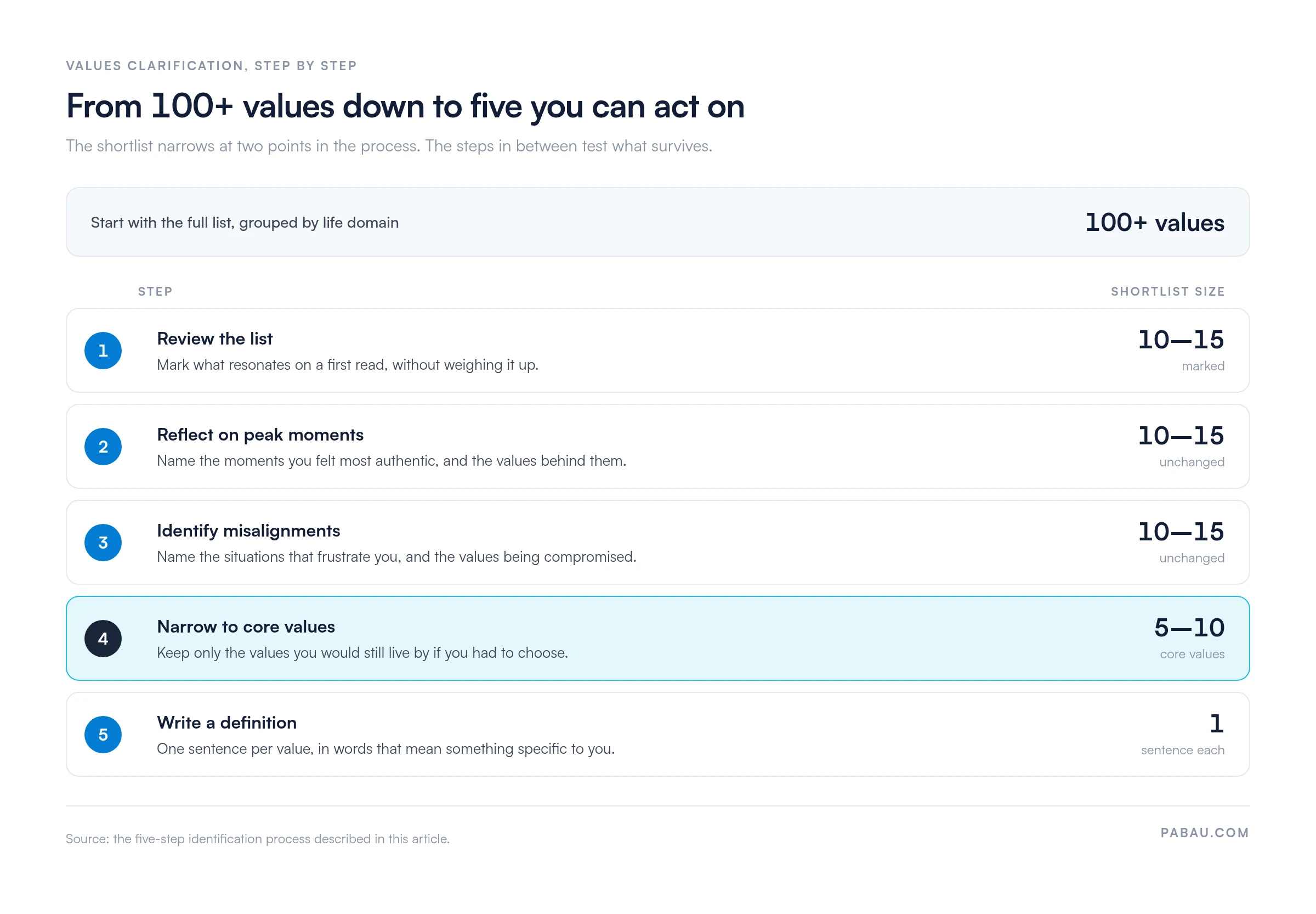
Many therapists treat this as an ongoing tool rather than a one-off exercise. In coaching, revisiting the core set each quarter helps clients stay aligned as their circumstances change.
Values clarification is a cornerstone intervention in ACT. Therapists use it to help clients picture what a meaningful life looks like, then build behavior change around that picture. Motivational interviewing draws on the same exploration to strengthen intrinsic motivation when a client is ambivalent about change.
In session, the sequence is simple. You introduce the list, the client marks what resonates, and you discuss the top five to ten in depth. The question shifts from “What do I want to achieve?” to “Who do I want to be?” That reframe is usually where deeper motivation surfaces.
An ACT bullseye worksheet makes a natural follow-on, because it plots each chosen value against how the client is living right now. Coaches reach for the same tool when a client is stuck on a career move.
To fold this into your workflow, collect the assessment through digital intake forms at the start of care. Store the completed version in the client record next to your clinical notes. When someone stalls mid-treatment, you can reconnect them to the values they named and the life they said they were building.
Naming your core values is the first step. Living by them is the harder part, and it is where behavior change happens. Start by auditing your week. How much of your time and energy actually goes to the values you just chose?
If family sits at the top of your list but you work 60-hour weeks, the audit will show it. This is where therapy or coaching earns its place, by supporting the changes that close the distance.
Practical steps:
A change plan worksheet gives clients somewhere to record that loop between appointments. It also keeps the commitment out of your notes alone, where the client never sees it.

People who live in line with their personal values report higher life satisfaction, better mental health, and more resilience through hard periods. Values work as a buffer against depression, anxiety, and burnout. Clarifying them gives a sense of direction that external achievement alone does not provide.
That matters most in the helping professions, where burnout is common. A therapist, coach, or clinician who revisits their own core values reconnects with why they chose the work. Building that reflection into your own care plan is part of sustainable, ethical practice.
On paper, the values exercise ends where the session ends. The client marks a printed list, you talk it through, and the sheet goes into a folder. Six sessions later, the five values they chose are hard to quote from memory.
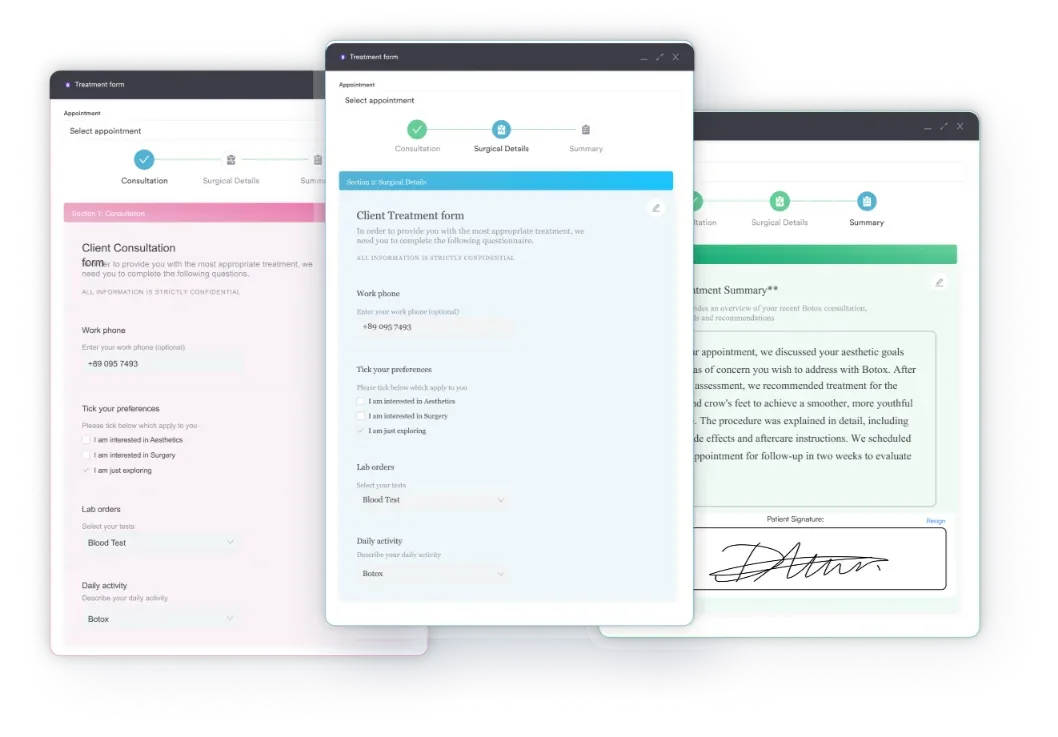
Practice management software like Pabau keeps the assessment where the care happens. You send the values list as a digital form before the appointment. The answers land in digital client records, beside the notes and the treatment plan. There is no rekeying, and no filing cabinet to search.
From there the values stay usable. Pull them up mid-treatment when a client stalls, or revisit them at a quarterly review. Reporting will also show how a person’s stated priorities shift across a year of care. Every subscription includes the forms, the records, and the reporting, so none of that sits behind an upgrade.


Pabau’s digital forms and client records capture a values assessment before the first session and keep it beside your notes. You can return to it at any point in a client’s care.

The exercise pays off after the marking, in what someone does with the five to ten values that survive the cut. A list left in a drawer will not change how anyone spends their week.
So decide now when you will reuse it. Bring the values back when a client stalls, when a decision looms, or at a scheduled review. Values also shift with circumstance. An assessment from two years ago describes who someone was, not who they are today.
Whether you run this on yourself or with clients, the tool only works while it stays within reach. Book a demo to see how Pabau keeps a client’s values assessment beside their notes, from intake through every review that follows.

Need the language that opens a values conversation? The motivational interviewing cheat sheet carries the prompts that surface a client’s own reasons for change.
Want to map values across a client’s whole life? The 7 areas of life worksheet splits the review into domains you can work through one at a time.
Ready to turn a core value into a target? These goal setting worksheets convert a stated value into actions a client can schedule and track.
Documenting the plan that follows the session? The psychology treatment plan template gives you a structure for goals, interventions, and review dates.
Personal values are deeply held beliefs and principles that guide how you live, make decisions, and interact with others. Goals are specific outcomes. Values are ongoing directions, such as family, integrity, health, or growth. They represent what matters most to you and shape your daily choices.
Most people find that five to ten core values are manageable and meaningful. Having 20 or more dilutes clarity, while one or two can feel restrictive. The right number is personal. What matters is that the values feel authentic and guide your decisions.
Beliefs are convictions you hold as true, such as “hard work pays off”. Values are principles that guide behavior and direction, such as “achievement matters to me”. You can believe something without valuing it, and value something without believing it will always succeed. In therapy, clarifying both often helps clients understand their motivations.
Yes. Major life transitions such as parenthood, a career shift, loss, or illness often move values around. That is healthy and natural. Revisiting your values every one to two years keeps them aligned with who you are and who you want to be.
Living in alignment with your personal values is linked to better mental health outcomes, including lower anxiety and depression rates. Values-based therapies such as ACT use values clarification as a core treatment tool. It helps clients build a meaningful life despite ongoing challenges.
Yes, it is designed for clinical use. Present it during intake or when a client is exploring life direction, and have them mark what resonates. Then facilitate a conversation about their top five to ten. Store the completed assessment in your client records for later reference.