Trauma response test: Free template for clinicians
A trauma response test is a structured screening questionnaire that helps clinic...

3
Last Updated: Oct 15, 2026

The Rokeach Values Survey asks people to rank 18 terminal values and 18 instrumental values from most to least important.
Terminal values name desired end-states like happiness. Instrumental values name preferred conduct, such as being honest or courageous.
The ranking takes 15 to 20 minutes, and the top five in each list become the reference point for later sessions.
Re-ranking every 6 to 12 months turns a one-off worksheet into a record of how a client’s priorities move.
Practice management software like Pabau can carry the survey inside intake and file the scored result to the client record.
A one-page ranking worksheet with fields for the client’s name and date. Blank boxes follow for their top five terminal values and top five instrumental values. The full lists of all 36 values are further down this page.
Download templateThe Rokeach Values Survey is a values-ranking instrument used in therapy, coaching, and organizational development. Social psychologist Milton Rokeach published it in 1973. Clients rank 36 values in about 15 to 20 minutes, and the ranking itself does most of the work.
What comes back is a picture of what the client is actually optimizing for. That makes it a useful opening move before goal-setting, behavior-change work, or a team conversation about shared values. Pair it with a broader tool such as our psychiatric evaluation template when you need a fuller clinical baseline.
The Rokeach Values Survey is a values-classification instrument that maps a person’s value system across two categories. Terminal values are desirable end-states of existence. Instrumental values are preferable modes of behavior. Respondents rank each list separately, from most to least important.
Rokeach’s 1973 framework is still in use across psychology, leadership development, and healthcare ethics training. It rests on decades of psychological research, and it produces interpretable results across very different populations.
The ranking is where the work happens. Ordering 18 items forces conscious trade-offs between what matters and what only feels obligatory. A therapist, coach, or team lead can then use the finished hierarchy to open a conversation about alignment, ethics, or behavior change.
Plenty of clients arrive in therapy or coaching without much clarity about their values. They report feeling stuck, unmotivated, or conflicted. Often their week sits at odds with what they say matters most, and the ranking makes that mismatch visible.
Where ranking 36 fixed values asks too much, blank values cards let someone name five to ten of their own and rate each one. The ratings run from very important down to not as important, instead of a forced 1-to-18 order.
Once values are explicit, behavior change lines up with what the client already wants rather than with pressure from outside. That shift is usually what makes the second and third sessions easier.
The survey also appears in organizational psychology research on team dynamics, leadership styles, and cross-cultural value systems. Healthcare teams can run it during onboarding or a team day to surface shared values and head off conflict.
Administering the survey is simple, but the ranking needs uninterrupted attention. Clients work through five steps.
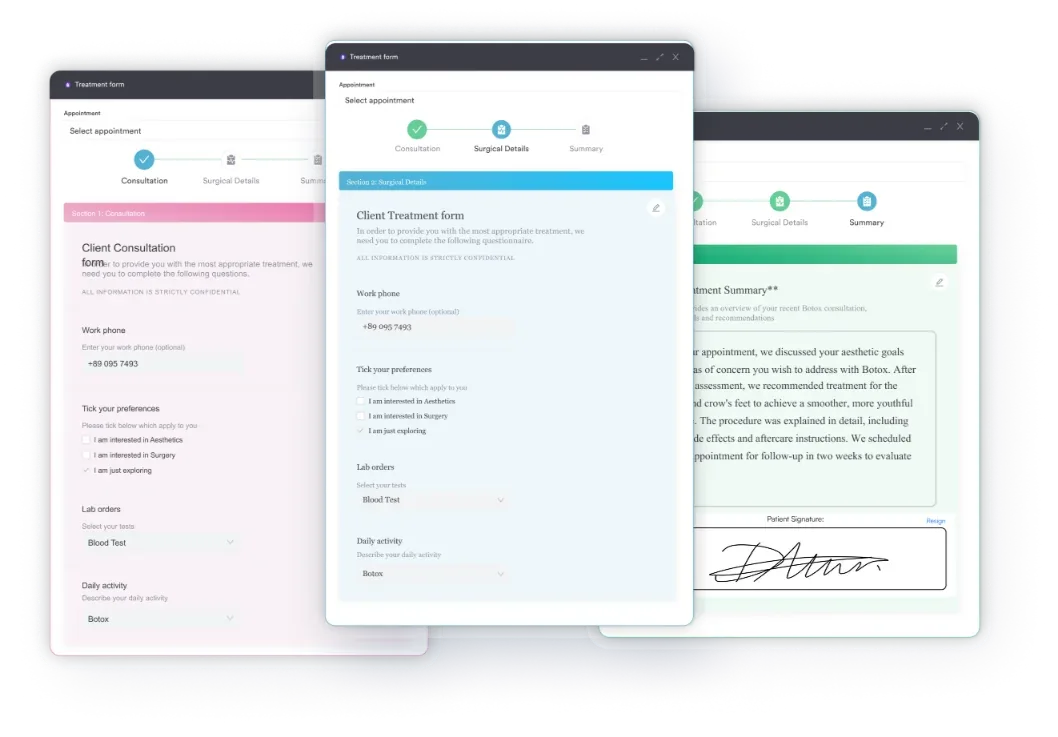
Running the survey through digital intake forms puts the ranking in front of the client before the first appointment. The result lands in their record automatically, so you start the session with a baseline instead of a paper form to type up.
The two categories do different jobs. One asks where the client wants to end up. The other asks how they want to get there.
These are the end-states clients rank first, listed here alphabetically rather than in any order of importance.
These are the modes of conduct, ranked second and again listed alphabetically.
The two lists interact, which is where the clinical material sits. A client who puts a sense of accomplishment near the top of the terminal list but ranks ambitious near the bottom is carrying a conflict. They want to achieve, and they doubt they should push for it. Naming that out loud is often the first useful moment of the session.
The survey suits therapists, counselors, coaches, and healthcare teams working with mixed client populations. Five settings get the most out of it:
It gives therapy a fixed reference point. Map values early and every later conversation has something to return to. When motivation dips or a client relapses, you have a specific line to point at. “You put being honest in your top five. Where does that sit in the choice you just made?”
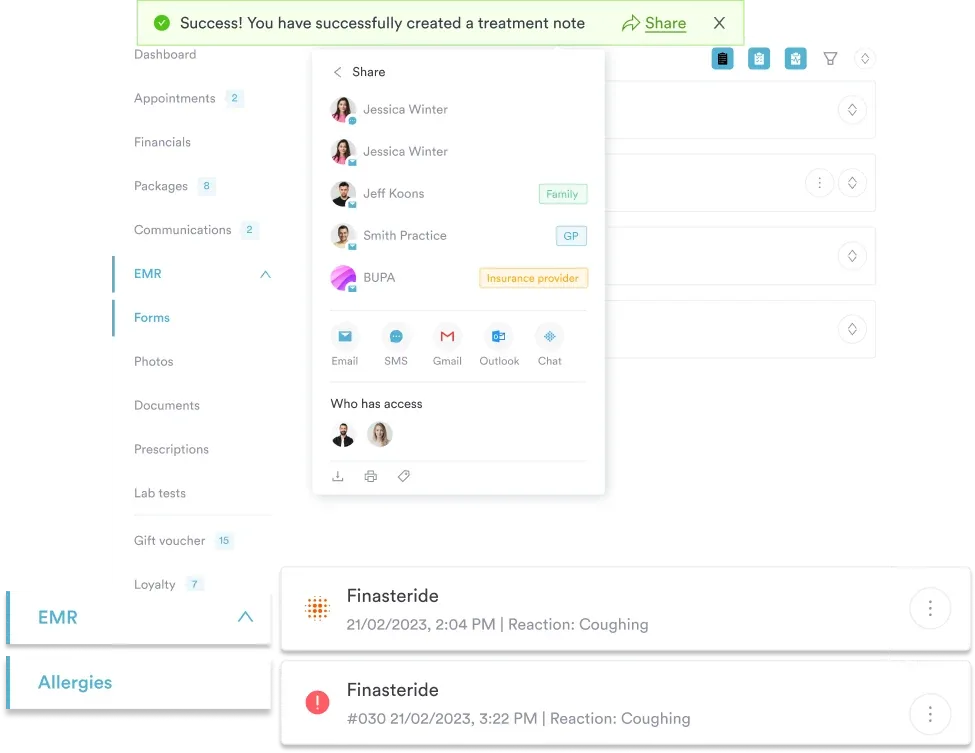
It cuts down the writing. A ranked list is a compact artifact you can file in client record management, instead of three paragraphs of narrative about motivation. The next clinician reads the hierarchy in seconds.
It is grounded in published research. The instrument has been in use since 1973, with more than five decades of peer-reviewed study behind it. That makes it easy to defend in supervision or an audit.
It surfaces team culture. Run the ranking with your clinical and administrative staff and the disagreements come out in the open. Naming shared values as a group also makes later decisions easier to settle, because the criteria are already on the table.
The ranking earns its keep when it lives in the workflow rather than in a one-off exercise. The sequence below is what smoother therapy practice management looks like once a values ranking sits in the intake.
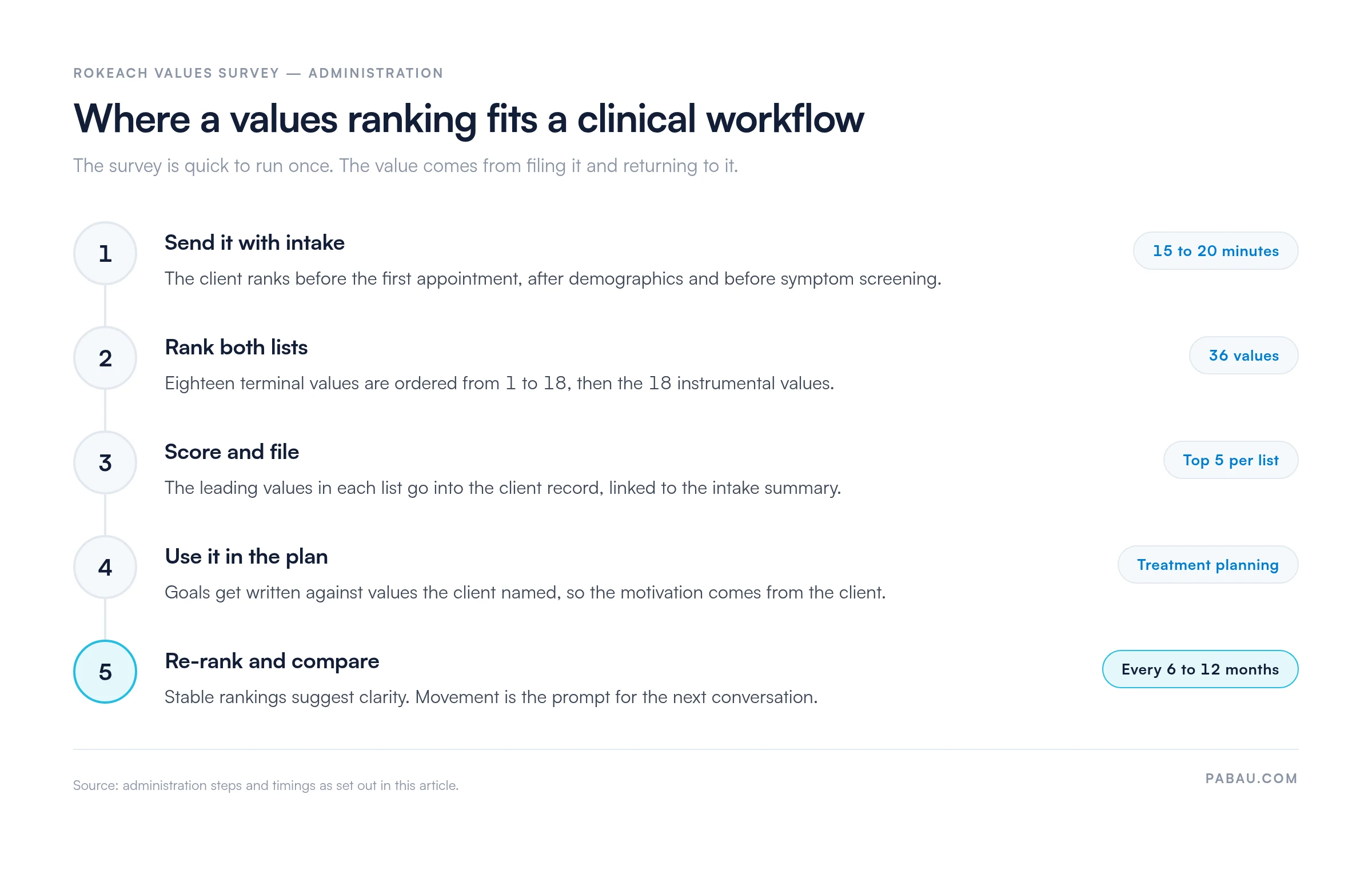
1. Put it in intake. Include the ranking form in your standard intake battery, after demographics and before symptom screening. It sets a values-centered tone from the first contact.
2. Score it and file it. Pull the top five in each list, then store the sheet in the client’s clinical file. Link it to the intake summary so it does not get buried.
3. Reference it in treatment planning. Ask which of the top values the client wants to honor more fully through therapy. Goals written that way tend to hold, because the client set the criteria.
4. Re-rank every 6 to 12 months. Compare the two rankings side by side. Stability suggests values clarity, and movement suggests the client has changed. Both are worth a conversation.
5. Run it with the team. Administer the survey to your clinical and administrative staff, then talk through where you agree and where you do not.
Interpretation is qualitative. The survey produces no pathology score and no clinical cut-off. What it hands you is a hierarchy and a short set of questions worth asking.
Look at the clusters. Do the top terminal values lean toward inner life, such as happiness, self-respect, and inner harmony? Or toward outward standing, such as social recognition and a comfortable life? The balance suggests where the client’s motivation comes from.
Read the instrumental list against it. If honest ranks high and ambitious ranks low, the client may suspect that pursuing goals costs integrity. That belief is a common source of procrastination, and it is worth asking about directly.
Check the alignment. Ask how much of the client’s current week reflects their top five. A wide mismatch between the two often travels with low mood and a sense of meaninglessness. It also gives you somewhere concrete to start.
Write your reading into the clinical note while the session is fresh. A short paragraph naming the top five and the one tension you noticed is enough for the next clinician to pick up.
Strengths. The survey is short, easy to score, and adaptable across cultures. It works across age groups, education levels, and clinical populations. Five decades of published research sit behind it.
Limitations. It measures conscious, self-reported values, not the unconscious drivers of behavior. Clients sometimes rank the values they think they should hold. It diagnoses nothing and predicts no treatment response. Cross-cultural validity also varies, since the categories were developed with Western populations.
Most practices run the survey on paper. Someone prints the form, the client fills it in during the waiting-room minutes, and the sheet goes into a folder. Six months later, nobody can find it to compare.
Practice management software like Pabau handles the same job differently. You build the ranking once as a digital form, and it goes out with the booking confirmation. The client completes it before they arrive, and the scored result lands in their record.
When the re-rank comes around a year later, both versions sit in the same file, next to the notes from the sessions in between. Pabau Scribe, our AI scribe, drafts the session note itself, so writing up what moved takes minutes rather than an evening.

Build the ranking once as a digital form and send it with the booking confirmation. Every completed version stays in the client record, ready for the next review.

The survey is worth its 15 to 20 minutes mainly because of what happens afterward. Download the form, run it at intake, and file the scored result where the next clinician will see it. Then put a reminder in the calendar for the re-rank.
The trade-off worth remembering is that the survey reports what clients believe they value, not what drives them without their noticing. That is still the most useful starting point 20 minutes can buy you. Book a demo to see how Pabau sends the ranking with intake and keeps every version in the client record.

Need the rest of the intake pack? Mental health intake form covers history, risk, and presenting concerns, which a values ranking deliberately leaves out.
Building a full baseline assessment? Psychiatric evaluation template gives you the clinical structure to pair with the values ranking.
Ready to turn values into action? Change plan worksheet takes the one or two neglected values and turns them into concrete steps.
Working mostly with adults? Adult counseling intake form collects the background you need before the first values conversation.
The Rokeach Values Survey is a psychological assessment that measures personal values by ranking. Clients order 18 terminal values, meaning desired end-states, then 18 instrumental values, meaning preferred modes of conduct. It takes 15 to 20 minutes.
Terminal values describe the end-states a person wants from life. The first six alphabetically are a comfortable life, an exciting life, a sense of accomplishment, a world at peace, a world of beauty, and equality. Next come family security, freedom, happiness, inner harmony, mature love, and national security. The last six are pleasure, salvation, self-respect, social recognition, true friendship, and wisdom.
Instrumental values describe how a person prefers to behave. Six of them are ambitious, broad-minded, capable, cheerful, clean, and courageous. Another six are forgiving, helpful, honest, imaginative, independent, and intellectual. The final six are logical, loving, obedient, polite, responsible, and self-controlled.
Read the hierarchy, not a score. Identify the top five in each list, then ask how much of the client’s current week reflects them. A wide mismatch often points to low mood, stalled motivation, or a sense of meaninglessness.
Yes. Therapists and counselors use it to clarify client values before treatment begins. Clinical teams also run it internally to align on shared ethics, and coaches use it in leadership and behavior-change work.
Use the download card near the top of this page. The PDF is a one-page ranking worksheet with fields for the client’s name and date. Blank boxes follow for their top five terminal and instrumental values. The full lists of all 36 values are on this page.