Printable values cards: What they are and how to use them in therapy
Printable values cards are a reflection tool that helps a patient work out which...

14
Last Updated: Sep 30, 2026

The Valued Living Questionnaire measures how important each of 10 life areas is to a client, and how consistently they act on it.
Clients rate importance and consistency from 1 to 10, and each domain’s composite score is the two ratings multiplied together.
The overall score is the mean of the 10 composites, so it runs from about 10 to 100.
A low composite is ambiguous, so check whether the domain matters little to the client or whether behavior has drifted from it.
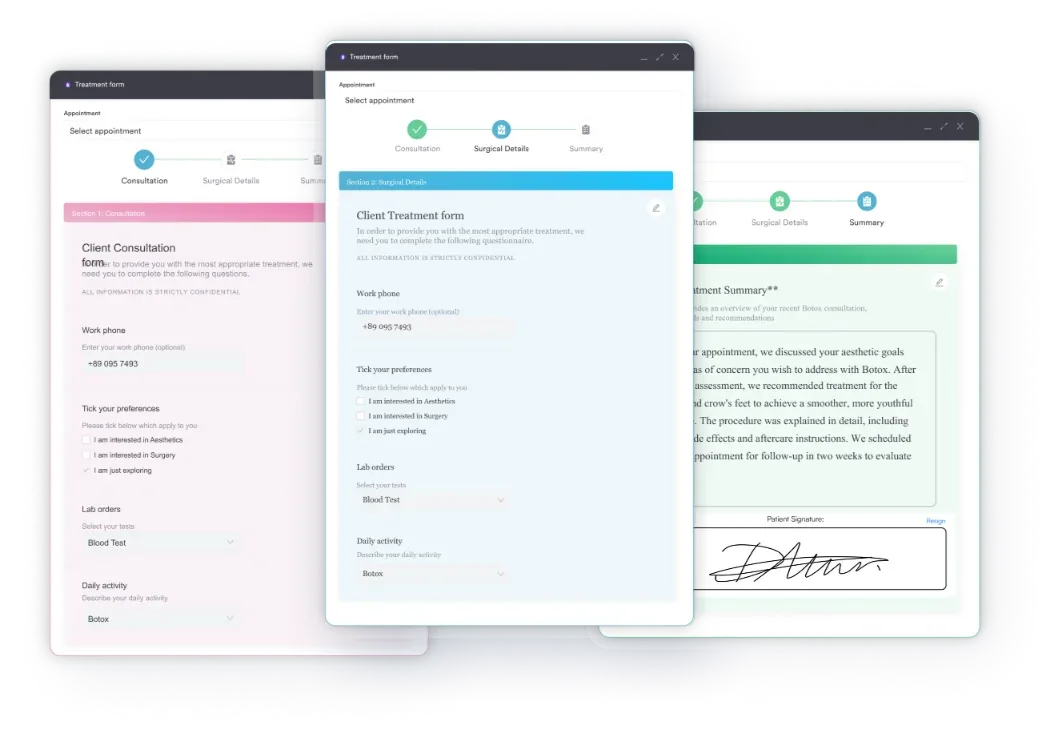
Pabau’s digital intake forms let you send the questionnaire before the visit, score it automatically, and store results in the client record.
A ready-to-use rating sheet covering all 10 life domains, from family and marriage to work, education, spirituality, and self-care. Print it for the treatment room or attach it to a digital intake packet.
Download templateThe Valued Living Questionnaire (VLQ) asks clients to rate 10 life domains twice. The first rating is how important that domain is to them. The second is how consistently they have acted on it over the past week.
Multiply the two ratings and you get a composite score for that domain. Those composites are what a clinician reads, because they show where a client’s stated values and daily behavior have drifted apart.
The questionnaire comes out of Acceptance and Commitment Therapy (ACT), and it usually sits at the front of values clarification work. You can hand it out on paper or send it ahead of the appointment through digital intake forms.
The VLQ is a brief, psychometrically validated measure developed by Wilson, Sandoz, Kitchens, and Roberts. It asks how much a person values each of 10 life domains, and how closely their recent behavior has matched that value. Every domain carries both ratings, so a completed form holds 20 responses.
It belongs to Acceptance and Commitment Therapy, a transdiagnostic approach built around psychological flexibility and values-driven action. Measuring valued living shows a clinician where a client’s priorities and behavior have separated. That reading feeds straight into treatment priorities across psychology practices, counseling centers, and behavioral health teams.
The form covers these 10 areas of life. Each one is somewhere a client can either act on what they value or drift away from it:
The pattern is usually visible before you score the form. Domains rated 9 or 10 for importance and 3 or 4 for consistency stand out on the page. Those are the ones worth opening the session with.
Scoring takes three steps. For each of the 10 domains, the client gives two ratings on a scale of 1 to 10.
The overall VLQ score is the mean of the 10 domain composites, not their sum. That puts the standard range at roughly 10 to 100. A higher figure means the client is living closer to what they say matters to them.
Most clinicians record every domain composite rather than the overall mean alone. The domain detail is what shapes the next session, and it is what you compare against at the next administration.
Interpretation starts with the distance between the two ratings. A domain rated 10 for importance and 3 for consistency is usually where treatment begins.
A single composite figure cannot tell you which of those two situations you are looking at. The grid below splits the two ratings apart, so you can read the clinical action off the pair rather than off the product.
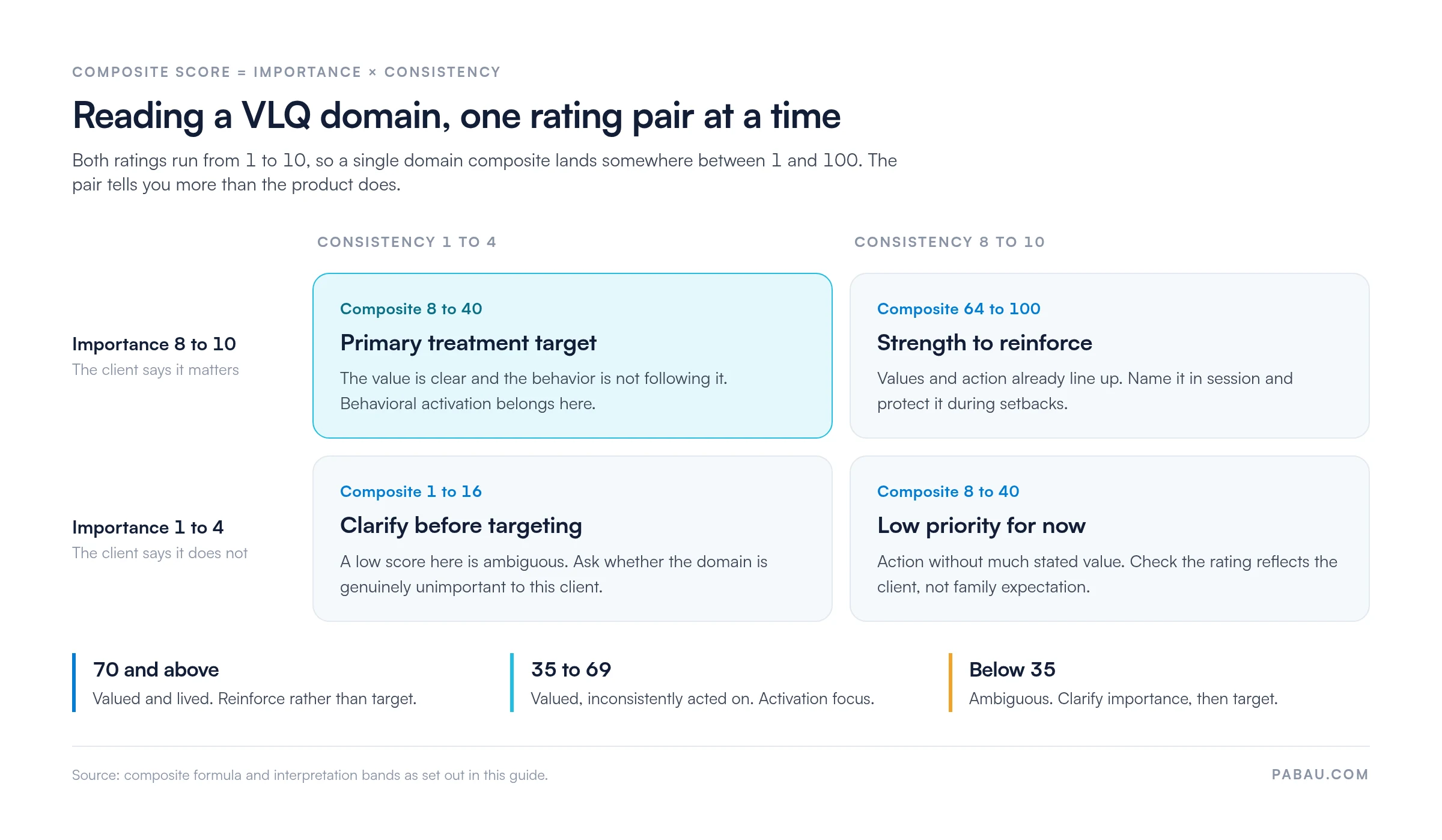
Once the picture is clear, the work turns behavioral. The ACT Bullseye worksheet is a common follow-on, because it turns a low-consistency domain into a specific action the client can commit to this week.
The questionnaire supports treatment across several settings. Its main job is values clarification, which helps a client say what matters to them rather than what they think should matter.
Readminister every 4 to 12 weeks and the composites become outcome data you can put in a progress note. Pair the results with a behavioral activation worksheet when a client values a domain but cannot get moving in it.
The original questionnaire has solid psychometric support. Studies report good internal consistency, with Cronbach’s alpha usually between 0.70 and 0.85 across domain composites, plus acceptable test-retest reliability. Scores correlate with psychological flexibility measures and with clinical outcomes in ACT research.
Validation evidence spans community samples, mental health caseloads, chronic pain, substance use disorders, and non-clinical coaching. Work published in Behaviour Research and Therapy and the Journal of Contextual Behavioral Science supports it as a reliable values measure.
There is no second edition, despite what some summaries online suggest. What does exist is a small set of named adaptations for particular groups. One is the comprehension-support version, the VLQ-CS, written for readers who need simpler wording. Use the original unless a study protocol or a funder asks for an adaptation by name.
For current studies, search PubMed for “Valued Living Questionnaire” or “VLQ Wilson”.
The PDF above is free to download and free to use with clients. Getting it into a routine takes seven short steps.
Store completed forms wherever your client records already live. Scoring history is far more useful sitting beside the session notes than in a separate folder.
Three resources make implementation easier:
Paper administration works, and plenty of practices will keep using it. The cost shows up afterwards. Someone has to type 20 ratings into a note, work out 10 composites, and then find last quarter’s form to compare against.
Practice management software like Pabau turns the questionnaire into a form you send before the appointment. The client completes it at home, the responses land in their record, and the scoring history is waiting when you open the note.
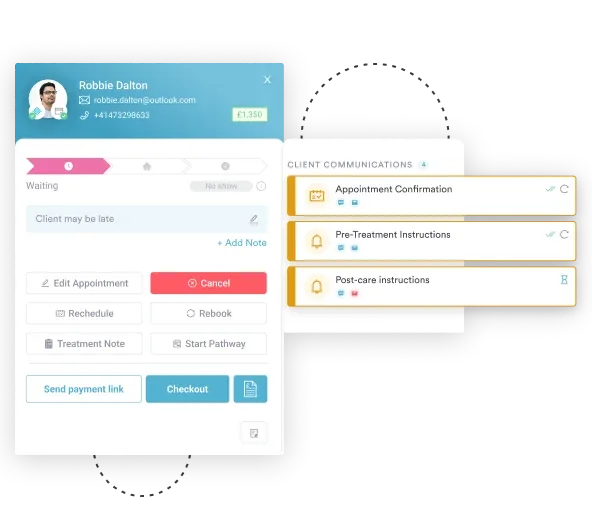
That matters most for repeat administration. Comparing week 1 against week 12 stops being a hunt through paperwork, so the session can go on what the change means. The same setup handles consent forms, screening tools, and other outcome measures, which is most of what software for therapy practices gets bought for.

Pabau turns the Valued Living Questionnaire into a digital form that clients complete before the visit. Scores post straight to the client record, so progress is visible without a spreadsheet.

The questionnaire is worth running because it changes what the session is about. A client who says they should exercise more is guessing. A client who rates self-care 9 for importance and 2 for consistency has handed you a target.
The one thing to hold onto is that a low composite is a question, not an answer. Ask whether the domain genuinely matters before you build a plan around it. Otherwise you spend six weeks activating behavior the client never wanted.
Download the PDF above and run it at your next intake. Book a demo to see how Pabau sends, scores, and files it for you.

Need the action step after values clarification? The ACT Bullseye worksheet turns a low-consistency domain into one committed action the client can rate again next week.
Want a second view of the same 10 domains? The life values inventory sorts values by priority rather than scoring importance against behavior.
Teaching the ACT model to a client? The ACT hexaflex template maps the six processes behind psychological flexibility, with valued action as one of them.
Turning scores into a documented plan? The psychology treatment plan template gives you goals, interventions, and review dates in one place.
Writing up the session afterwards? Progress notes for psychotherapy show how to record an outcome measure so the next clinician can read the trend.
Yes. It works well as a digital form sent through a client portal or an intake system. Online administration saves session time, removes the retyping step, and lets scores post straight into the client record.
A high overall score, near 100, means the client rates several domains as important and is acting on them. Read the domain composites too, since one very high domain can lift an otherwise flat profile.
No. The original remains the standard instrument, and no published second edition exists. Named adaptations do exist for particular groups, such as the comprehension-support version, but they are variants rather than replacements.
Run it at intake for a baseline, then every 4 to 12 weeks depending on how intensive the treatment is. Repeat administration is what turns the form from a conversation starter into outcome data.
It suits adolescents and adults in mental health, chronic pain, substance use, and coaching settings. The client needs to read and understand a 1 to 10 rating scale. Young children, or clients with significant cognitive impairment, usually need an adapted measure.
Psychological flexibility is the ACT process of staying present with difficult thoughts while still acting on values. This questionnaire measures the result of that process. Used together, the two give you the mechanism and the outcome.