Despina Petrushevska

ASAM treatment plan template: Free PDF, updated for 4th edition
An ASAM treatment plan is a written, individualized care plan for a person with ...

1
Last Updated: Nov 17, 2026
Free PDF 2 pages, print-ready Clinician-reviewed
A managing expectations worksheet is a printable that helps people identify, assess and adjust the expectations they hold in relationships, work, health and personal growth. It asks where each expectation comes from, whether it matches personal values and what evidence supports it, then turns the answers into an action plan. Therapists and practitioners can use it as a discussion prompt before or between sessions, but it is not a consent form. This article explains each section of the free PDF and how to put it to work.
A ready-to-use PDF worksheet that helps you identify your expectations and assess where they come from and whether they are realistic. It then walks you through adjusting them and building an action plan.
Start from scratch, or upload this PDF or any form you already use, and Pabau's AI Form rebuilds it with tick boxes, text fields and a signature. Attach it to the treatment once, and every patient gets it on time.
AI Form rebuilds the consent, history and aftercare forms you already use. You review each one, then publish.
Patients complete forms on their phone before they arrive, so the front desk stops retyping paper.
Every signed form is versioned and attached to the treatment record, ready when you need it.
Set how long a consent stays valid. Returning patients skip forms they have already signed.
Supports HIPAA and GDPR compliance AES-256 encryption 4.8 on G2 4.7 on Capterra Trusted by 4,000+ practices worldwide

A managing expectations worksheet helps people identify the expectations they hold across relationships, work, health, finances and personal growth.
Its assessing section asks who holds each expectation, whether it fits personal values and what evidence supports or challenges it.
The worksheet closes with reframing prompts, an action plan for when unrealistic expectations resurface and space for additional notes.
Pabau, the practice software we build, lets teams send the worksheet as a digital form and keep the completed copy in the patient record.
A managing expectations worksheet is a reflective self-help tool for examining what a person expects of themselves and what others expect of them. Its core test is whether each expectation is realistic, and a study of 1,601 British adults shows why that matters. People whose financial expectations were too optimistic or too pessimistic reported lower long-run well-being than realists.
The form is written for the person completing it and covers any area of life, from relationships and work to health, money and personal growth. Its two pages carry Name and Date fields, then four sections of prompts and free-text space. Practitioners use it as a discussion prompt, but it is not a consent form or a signed agreement.
Expectations shape how people judge success, relationships and their own progress. When they are unclear or set by outside pressure, they tend to produce frustration, disappointment and stress.
In a practice, the same pattern shows up when a patient arrives with hopes about treatment or therapy that nobody has said out loud. The worksheet helps the patient think those hopes through first, which makes the consultation conversation easier.
The worksheet opens with a short explanation of why expectations matter, then works through four numbered sections and a notes box. Each section uses checkboxes and open prompts, so it can be completed in one sitting or returned to later. The sections build on each other, from naming an expectation to planning for setbacks.
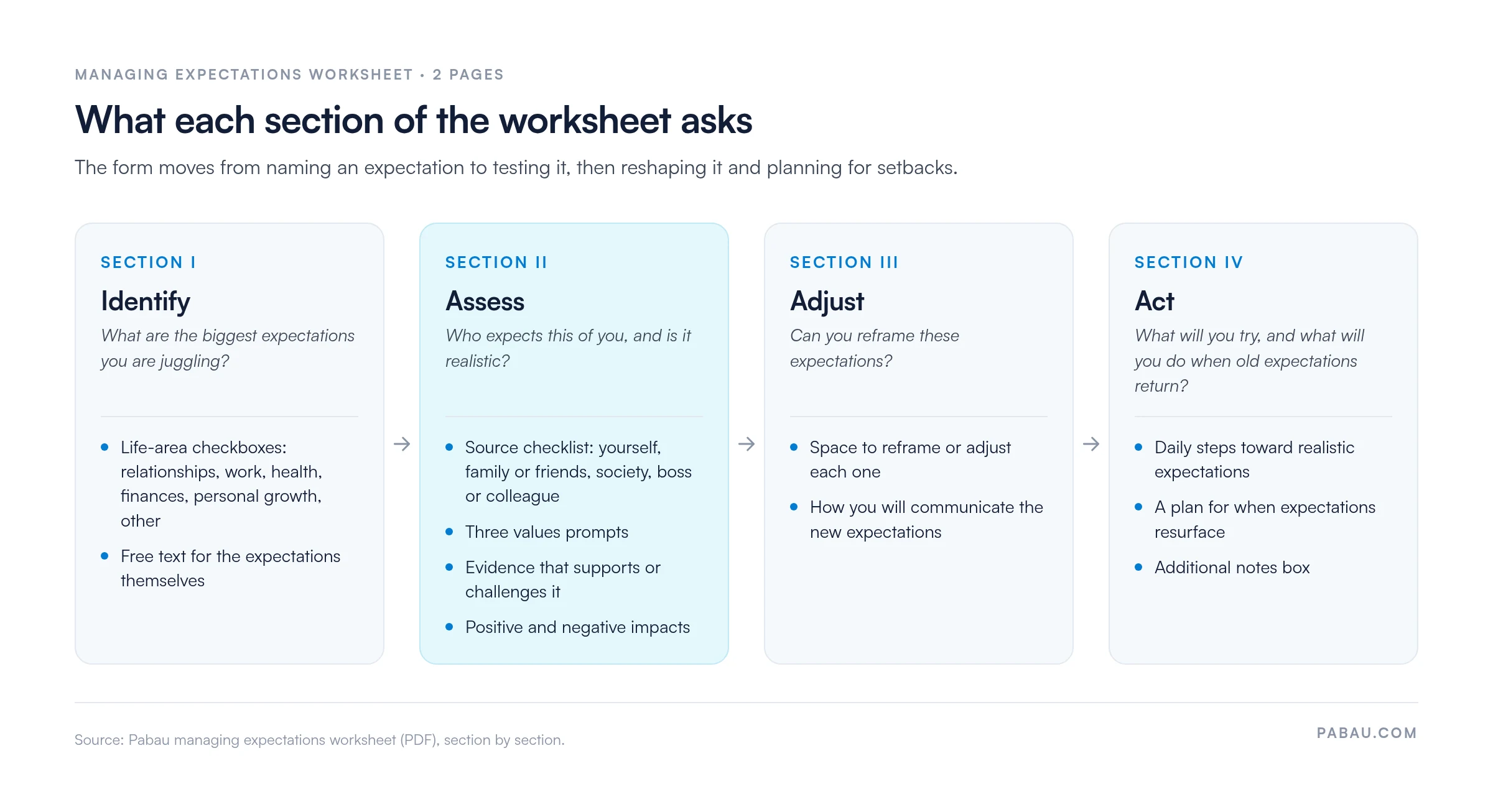
The first section asks which area of life the person is focusing on. Checkboxes cover relationships, work or career, health and wellness, financial goals, personal growth and other. It then asks them to describe the biggest expectations they are juggling at the moment.
This is the longest section. A checklist asks who is expecting this of the person: themselves, family or friends, society, a boss or colleague, or someone else.
Three reflection prompts follow. They ask whether the expectation aligns with the person’s values and whether it is genuinely theirs or shaped by outside influences. The third asks how it supports the life they want to create. A patient who struggles to name their values can work through a values exploration worksheet first.
The section then asks whether the expectation is realistic, with separate boxes for evidence that supports it and evidence that challenges it. Two final boxes record its positive and negative impacts on the person’s life.
Section III asks whether the person can reframe or adjust the expectations they have just assessed. It also asks how they will communicate the new expectations to themselves or to others.
The action plan asks for specific steps to practice realistic expectations in daily life. Its examples include breaking goals into smaller steps, setting reminders to reassess expectations and practicing self-compassion during setbacks.
A second prompt plans for the moments when old or unrealistic expectations resurface. Its ideas range from pausing to take a breath to seeking support from a trusted person or therapist. An Additional notes box closes the form.
The worksheet is designed to be completed by the person themselves. A practitioner can hand it out before a consultation or between sessions, then use the answers to guide the conversation.
The form has no treatment-specific fields, so in cosmetic work it suits the patient’s wider expectations rather than one procedure. Sections I and II help a patient name what they hope treatment will change and who that expectation comes from.
Use the answers as a starting point for your own consultation. Treatment outcomes, timelines and risks still belong in your consultation notes and consent forms, not on this worksheet.
Therapists can use the worksheet to surface the expectations a patient brings into therapy, including assumptions about how quickly progress should come. It works as a discussion prompt rather than a diagnostic instrument, and it should sit alongside existing clinical assessment.
The action plan in Section IV suits work between sessions. Its prompt about resurfacing expectations gives the patient a plan for setbacks, which you can review together. When therapy is ending, a mental health maintenance plan sets out longer-term relapse prevention in more detail.
Relationships are the first area listed in Section I, so the form fits couples work well. Each partner can complete their own copy separately, then compare answers in session. The Section II checklist shows whether an expectation comes from the person, from family and friends or from society. For expectations inside one partnership, a relationship expectations worksheet covers communication, conflict and future plans.
Realistic expectations are easier to agree on when the clinician leads with the evidence. Open with what the treatment is designed to do before discussing what it cannot do.
Send the worksheet a few days before the consultation rather than handing it over in the room. The patient has time to reflect, and you arrive knowing which expectations to discuss first.
Paper worksheets are easy to hand out and easy to lose. A completed form often ends up in a folder nobody opens at the next session, so the action plan never gets reviewed.
In Pabau, the worksheet sits with the rest of the patient history. Pabau’s digital forms let teams send it before the appointment and file the completed copy in the patient record. It sits next to the consultation and treatment notes.
At the follow-up, the action plan is already in front of you, and nobody has to search a filing cabinet for it. Therapy teams can keep session notes and reminders on that same record with easier therapy practice management.

Book a demo to see how Pabau stores completed forms, consent and treatment notes in one patient record.

A managing expectations worksheet earns its place when you treat it as what it is, a reflective tool the patient completes for themselves. Used that way, it brings unspoken expectations into the conversation before they turn into disappointment.
Keep it separate from consent. The worksheet records the patient’s own thinking, so treatment outcomes, risks and timelines still belong in your consultation notes and consent forms.
Hand the PDF out before your next consultation and review the action plan at follow-up. Book a demo to see how Pabau sends forms ahead of appointments and keeps completed worksheets in the patient record.

Helping a patient separate what they can and cannot control? Circle of influence worksheet maps concerns into what a person can act on and what they need to let go.
Working on decisions and their outcomes? Choices and consequences worksheet walks a patient through the likely results of each option before they act.
Need a tool for the moments when expectations fall apart? Distress tolerance skills worksheet gives patients practical skills for getting through difficult emotions.
A managing expectations worksheet is a structured printable that helps a person identify the expectations they hold and assess whether they are realistic. It then guides them to adjust those expectations and build an action plan.
Yes, the worksheet is available as a free two-page PDF from the download section at the top of this page. Practitioners can share it with patients as a self-reflection resource.
Use it as a discussion prompt, with the patient completing the worksheet in their own words before or between sessions. Review their answers together, and keep it alongside existing clinical assessment.
They are most useful one-to-one or in couples work, where each person can complete the form privately. Group use needs careful adaptation to protect individual privacy.