Reflection questions: 14 examples and a free template
Reflection questions are open-ended prompts that guide a person through structur...

6
Last Updated: Oct 16, 2026
Printable values cards are a reflection tool that helps a patient work out which personal values matter most to them.
This free one-page PDF explains the exercise briefly and gives the patient a blank space to write their own values. They then rate each value as very important, important, or not as important.
The format grows out of the Personal Values Card Sort, a public-domain exercise used in motivational interviewing, Acceptance and Commitment Therapy (ACT), counseling, and coaching. Because the patient writes each value in their own words, the sheet works as a warm-up or a stand-alone exercise. It takes 20 to 30 minutes in one-on-one sessions, groups, and coaching.
A one-page PDF with a short introduction to values work and a blank space for personalized values. Patients rate each value as very important, important, or not as important. Print it for in-session use, or save it as a PDF or screenshot so the patient can return to it between sessions.
Download template
Printable values cards help a patient identify the personal values that matter most, then rate each as very important, important, or not as important.
The free template is a one-page PDF with a blank space for personalized values, so the patient writes every value in their own words.
The exercise adapts the Personal Values Card Sort, developed in 2001 at the University of New Mexico’s CASAA and released into the public domain.
A session takes 20 to 30 minutes and works in ACT, motivational interviewing, counseling, coaching, and group settings.
Pabau, the practice management platform we build, stores each completed values sheet with session notes, ready to revisit in later sessions.
Values cards are a structured exercise in which a patient names their personal values and sorts them by how much each one matters. The exercise surfaces what the patient cares about. It often shows a mismatch between stated goals and daily life, which is a useful starting point for change.
Therapists, counselors, life coaches, and psychologists use values cards to help patients clarify direction without prescribing it. Asking “What do you want to achieve?” often triggers a rehearsed answer. Writing and rating values gives the conversation something concrete to work with. A patient might find that independence ranks above security, or that family connection matters more than career advancement. That discovery shapes treatment planning, goal-setting, and session direction.
Values cards work best in early-stage therapy, at intake or in the first few sessions. They also suit motivational interviewing when ambivalence is high, and group therapy where shared values can be explored together. Later on, they anchor decision-making conversations. When a patient is stuck between two paths, revisiting their rated values often shows which option fits.
The free template is a single page with four parts:
The template does not include a pre-printed list of values. The patient names each value in their own words rather than choosing from a deck someone else wrote. If a patient struggles to start, the example prompts later in this article give them somewhere to begin.
Running the exercise takes 20 to 30 minutes and needs little setup. The flow below shows the five steps at a glance, and the list after it covers what to say and do at each one.
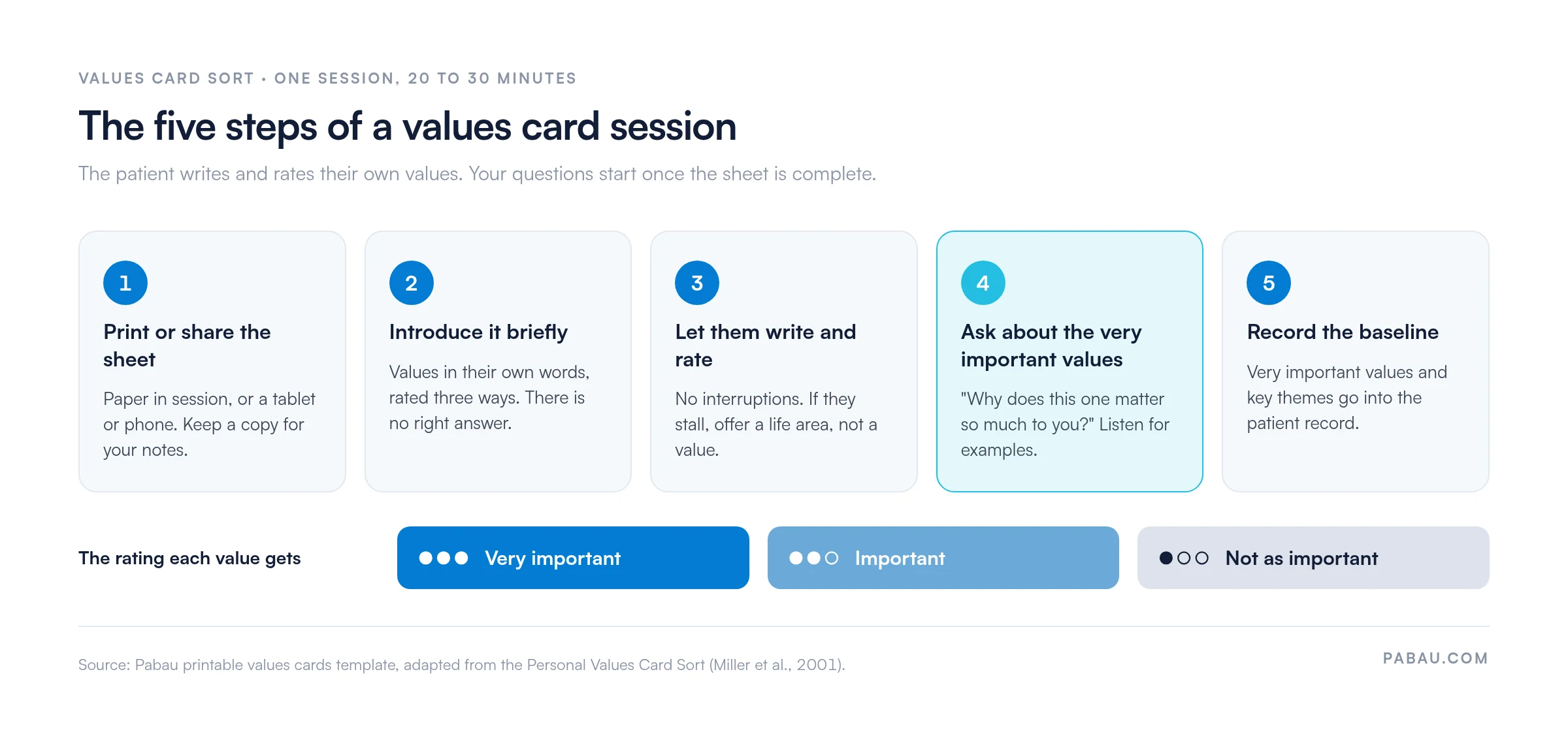
In ACT, values clarification is a foundational intervention. ACT therapists use values cards to move patients beyond symptom-relief goals (“I want the anxiety to go away”). The aim is values-aligned living (“I want to be a present parent, even when anxious”). Naming and rating values makes them concrete and actionable rather than abstract.
ACT values work usually follows three steps. The patient first names and rates what matters. They then explore lived examples of that value (“Tell me about a time you felt connected to family”). Finally, they commit to one small, values-aligned action. The values exercise is the first step, turning a general talk about priorities into the patient’s own written list.
Once the values are on paper, an ACT bullseye worksheet lets the patient mark how closely daily life matches each one.
The values card sort comes from the motivational interviewing (MI) tradition. W.R. Miller, J. C’de Baca, D.B. Matthews, and P.L. Wilbourne developed the Personal Values Card Sort in 2001. They worked at the University of New Mexico’s Center on Alcoholism, Substance Abuse, and Addictions (CASAA). The exercise is in the public domain, and the Motivational Interviewing Network of Trainers (MINT) hosts a copy.
In MI, values cards help resolve ambivalence. A patient might say they should cut back on drinking but also want to have fun. Naming and rating their values clarifies the tension underneath. Health, family, or responsibility may land as very important, which carries more weight than the stated ambivalence suggests. That insight belongs to the patient, and it becomes the lever for change.
The free template leaves the values blank, so the patient decides what goes on the sheet. Some patients need a prompt to get started. The life areas below are examples you can read aloud or show them, and none of them are printed in the template.
Offer a life area rather than a specific word where you can. A patient who writes “being there for my kids” has told you more than one who picks “family” from a list. The blank space captures that nuance, which closed-ended questions tend to miss.
Values cards also work well outside one-on-one therapy. In therapy groups, coaching circles, and team-building workshops, they start shared conversations without putting individuals on the spot.
Give each group member their own copy of the sheet. Ask everyone to write and rate their values silently for 10 minutes. Then go around the circle: “What’s one value you rated very important, and why does it matter?” This structure ensures everyone participates without forced disclosure.
Members often find unexpected common ground, which builds cohesion and reduces isolation. In coaching groups, shared values become a base for accountability. A group that values growth, for example, can support each other through the quarter’s learning goals.
The blank format already adapts to most populations, since each patient writes their own values. Small changes make the exercise more accessible and relevant:
Older adults who want to carry that reflection further can pair the sheet with a life story journal at home.
Because the template is a printable PDF, you can print as many copies as you need for individual and group sessions.
A paper values sheet often ends up in a folder and never comes out again. Pabau’s therapy practice management software keeps the completed sheet in the patient record alongside your session notes. When a patient is stuck on a decision mid-therapy, you can pull up their rated values without repeating the exercise.

You can also send the sheet as a digital form before an appointment, so the patient arrives with their values already written. Between sessions, automated reminders can prompt values-aligned homework, such as scheduling one family meal without devices.

For group work, keep the master template on file and share a fresh copy with each cohort. Pabau’s automated workflows can add the sheet to the forms a patient completes before a group session.

Pabau’s digital forms and patient records store each completed values sheet with your session notes. You can revisit a patient’s priorities whenever a decision comes up.

Printable values cards work because the patient names what matters in their own words, then says how much each value counts. This free template gives you the simplest version of that exercise: a blank space and a three-level rating. It suits a first session, a stuck decision, or a group warm-up.
Start with the blank sheet, and bring in example prompts only when a patient stalls. Keep the completed sheet with your notes so you can return to it when goals shift. Book a demo to see how Pabau keeps values work and session notes together in one patient record.

Need a ready-made set of value words? Personal values list gives patients a list to browse before they write their own values on the sheet.
Want a longer values exercise? Personal values worksheet walks patients from a broad list down to five core values.
Prefer a structured rating format? Life values inventory offers an 18-value worksheet for a more formal values assessment.
Looking for another values format? Values worksheet gives you a second printable option for exploring values in session.
Working with an ambivalent patient? Motivational interviewing script provides sample dialogue for drawing out the patient’s own reasons for change.
Values cards help patients identify their core personal values and rate how much each one matters. The exercise shows what a patient cares about, often revealing a mismatch between stated goals and daily life. Therapists use that insight for treatment planning, motivation, and values-aligned action steps.
Give the patient the printed sheet and ask them to write the values that matter to them in the blank space. They then rate each one as very important, important, or not as important. The exercise usually takes 20 to 30 minutes. Afterward, ask open-ended questions about the very important values and record the results in the patient record.
Yes. In groups, each member writes and rates their values silently for 10 minutes. Each person then shares one value they rated very important and why it matters. This builds cohesion without forced disclosure, and groups often discover shared values that support peer accountability.
Both use the same values exercise, and often the same values. The difference is clinical context. ACT uses values to orient patients toward psychological flexibility and values-aligned action despite anxiety or avoidance. MI uses values to surface intrinsic motivation and resolve ambivalence about change.
Yes. The template on this page is a free one-page PDF you can download and print. It gives patients a blank space to write their own values and a three-level importance rating. It adapts the Personal Values Card Sort, a public-domain exercise developed at the University of New Mexico’s CASAA in 2001.
The template sets no fixed number, because the patient writes their own values. Asking for five to ten gives enough to compare without overwhelming the patient. For adolescents or patients facing decision fatigue, three to five is often enough.