Questions about gender roles
Questions about gender roles are structured prompts that help clinicians, counse...

1
Last Updated: Oct 20, 2026
A personal value assessment is a structured self-reflection exercise that helps you identify, rate and rank the values that matter most to you. Our free template walks you through four steps (identify, rate, rank and reflect) in 30 to 45 minutes. You finish with a written list of priorities that makes decisions at work and at home easier to weigh.
Healthcare professionals and practice teams use it because the same pressures keep coming back: long shifts, competing demands and limited time with each patient. Below, you’ll find what the PDF contains, how to complete it, and how to turn your ranking into a month of specific actions.
A two-page reflection form that asks for your three core values, a moment when you felt fulfilled, and a 1-to-5 ranking of five value areas. It closes with prompts on decisions, relationships, change and your daily routine.
Download template
A personal value assessment is a reflective tool for identifying the values that guide your choices.
Completing it takes about 30 to 45 minutes and needs no special training or clinical knowledge.
Ranking values forces trade-offs, which is where most of the insight comes from.
Results work best when turned into specific actions for your role or practice.
A personal value assessment is a reflective self-assessment that asks you to name your values and judge how much each one matters. You then decide which ones sit at the top of your list.
It draws on values clarification, a practice used in coaching and in Acceptance and Commitment Therapy (ACT). In ACT, values are one of the six core processes mapped on the ACT hexaflex.
The template has no scoring norms and no diagnostic cut-offs. What it gives you is structure: a vague sense of what matters becomes a written record you can review, compare and act on. If you need a scored ACT measure instead, the valued living questionnaire rates importance and consistency across 10 life domains.
You’ll also see the name used for the Barrett Values Centre’s Personal Values Assessment. That’s a paid online survey ($19.95) that takes a few minutes and returns a personalized report. This free template trades that speed for depth, because you write every answer yourself and keep the working.
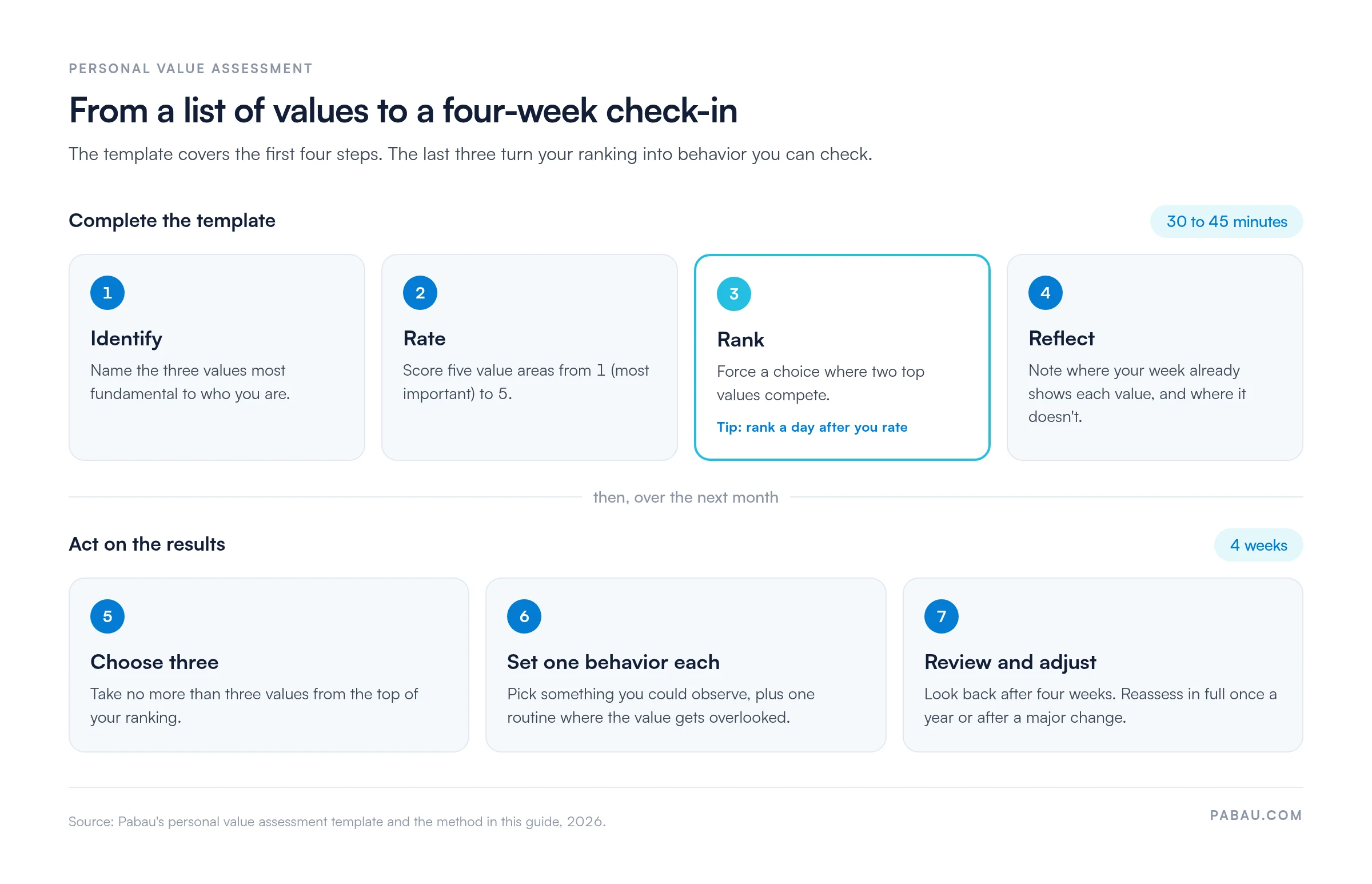
Set aside 30 to 45 minutes somewhere quiet, and work through the template in order. Rushing the ranking stage is the most common mistake, because that’s where you have to choose between values you care about.
If a value you rated highly never shows up in your week, write that down in the reflection step. One mismatch is enough to work on for now.
Complete the rating step first, then return after a day to rank. Values that felt urgent in the moment often drop down the list once you have some distance. That reordering is useful information in its own right.
Most people find their values fall into a handful of recognizable groups. Use the table below as a starting reference, and add any value it doesn’t cover. Our personal values list has a longer set to choose from.
Clinicians often find that compassion and accountability both score highly, which makes ranking harder. The ranking step exists to settle exactly that tension.
The template combines three approaches that are common in values clarification work. Each one asks you to make the same judgment from a slightly different angle.
These methods organize your thinking without measuring a personality trait or predicting behavior. For a published instrument built on ranking, the Rokeach values survey asks you to order 18 terminal and 18 instrumental values.
The PDF runs to two pages and can be printed or filled in on screen. It opens with space for your name and the date, so you can compare versions over time. No clinical background is needed to complete it.
Results only help if they change something. Pick no more than three values to act on in the next month, and make each one specific enough to check.
Values also shape decisions: which patients you prioritize for follow-up, how you handle a difficult conversation, or which projects you take on. Use the results to weigh those choices, and revisit them when your circumstances change. The full cycle, from first list to four-week review, is mapped below.
Practice managers sometimes use a values exercise during onboarding, so new staff can share what matters to them before they join a team. Each person completes the template individually and shares only what they’re comfortable discussing.
Practitioners can also use the same structure in a consultation when a patient is weighing a treatment decision. The aim is to help the patient describe what matters to them, with no push toward a particular outcome.
A decisional balance worksheet pairs well here, because it lays out the pros and cons of each choice in four quadrants.
Most practices hand out a values exercise on paper, then file it in a drawer or scan it into a shared folder. By the time the four-week review comes around, the original is hard to find.
Pabau, the practice management platform we build, lets you send the template as a digital form before a consultation. Each completed form saves to the patient’s file in Client records, so the next review starts from the last version instead of a blank page.
For therapists and coaches, the form sits in the same system as scheduling, treatment notes and online booking. That’s simpler therapy practice management, with no paperwork to chase between sessions.

Send the assessment as a digital form before a consultation, and keep each completed version on the patient’s record in Pabau for the next review.

A values assessment earns its 45 minutes only when the ranking leads to a change you can see within a month. Pick three values, set one behavior for each, and put the four-week review in your calendar before you close the PDF.
Expect the ranking to feel uncomfortable, because compassion, accountability and rest rarely fit into one shift. That discomfort shows you where your week needs to change. Book a demo to see how Pabau keeps each completed assessment on the patient record, ready for the next review.

Want more prompts for the reflection step? Reflection questions gives you 14 open-ended prompts and a free template for structured self-examination.
Working with values inside ACT? Psychological flexibility worksheet helps patients practice the six core ACT processes between sessions.
Need a scored view of self-awareness? Self-awareness test covers emotional recognition, values clarity, strengths and interpersonal impact, with a scoring guide.
Want to see which life areas need attention? Wheel of life assessment rates 10 life domains from 1 to 10 on a single page.
Turning your top values into goals? SMART goals worksheet walks you through each SMART criterion with reflective prompts.
A personal value assessment is a structured self-reflection exercise for identifying, rating and ranking the values that guide your choices. It is a reflective tool rather than a diagnostic or validated psychometric test.
Most people complete it in 30 to 45 minutes. Allow extra time for the ranking step, which is usually where the most thought is needed.
Revisiting the assessment once a year, or after a major life or career change, is a sensible rhythm. Values rarely change quickly, so frequent repetition adds little.
The terms are often used interchangeably. Core values usually refers to the few values at the center of your decisions. Personal values can cover a wider set that matters to you across different areas of life.