All about me worksheet for adults
An all about me worksheet for adults is a guided self-reflection form that maps ...

5
Last Updated: Oct 14, 2026
Reflection questions are open-ended prompts that guide a person through structured self-examination of their thoughts, emotions, relationships, and life direction. Therapists, counselors, and coaches use them in sessions and as homework between sessions to build self-awareness, clarify values, and turn insight into action.
Below you’ll find example questions for five areas of life and a five-step method for using them with patients. There’s also a free weekly reflection template to download.
A one-page weekly reflection form that asks what you learned this week and which challenges you faced. It adds a 1 to 5 career-confidence rating and one goal for next week. Ready to print or share via digital patient portals.
Download template
Reflection questions are structured prompts that guide self-examination across identity, values, relationships, and goals, which sets them apart from journaling prompts or general advice.
Research on structured self-reflection suggests benefits for emotional clarity and goal pursuit when it is practiced consistently.
Practitioners use reflection questions in therapy, coaching, and wellness settings to help patients move from insight to concrete behavioral change.
In Pabau’s practice management software, digital forms let practitioners send reflection questions through the patient portal and keep responses in the client record.
Reflection questions are open-ended prompts designed to start deep thinking about a specific area of life. Closed questions get a yes or a no. Reflection questions invite the person to explore their beliefs, patterns, and goals at length.
The distinction matters for practitioners. A closed question (“Do you feel anxious?”) identifies a symptom. A reflection question (“What situations trigger your anxiety, and what pattern do you notice in how you respond?”) lets the patient map their own story and find their own solutions.
Reflection questions serve three clinical functions. They surface blind spots, crystallize values, and translate insight into intention. They work across mental health, coaching, wellness, and even occupational health settings.
Research on structured self-reflection suggests benefits for emotional clarity and goal pursuit. Those benefits depend on practice, which is why a set of written questions works better than an occasional chat about how things are going.
For practitioners, the benefit runs two ways. Patients arrive having already done some of the thinking, and you get a written record of how their answers change. That leaves less session time for open-ended exploration and more for the work itself.
Reflection questions yield insight only when the setting supports honest thinking. Here’s how practitioners can use them:
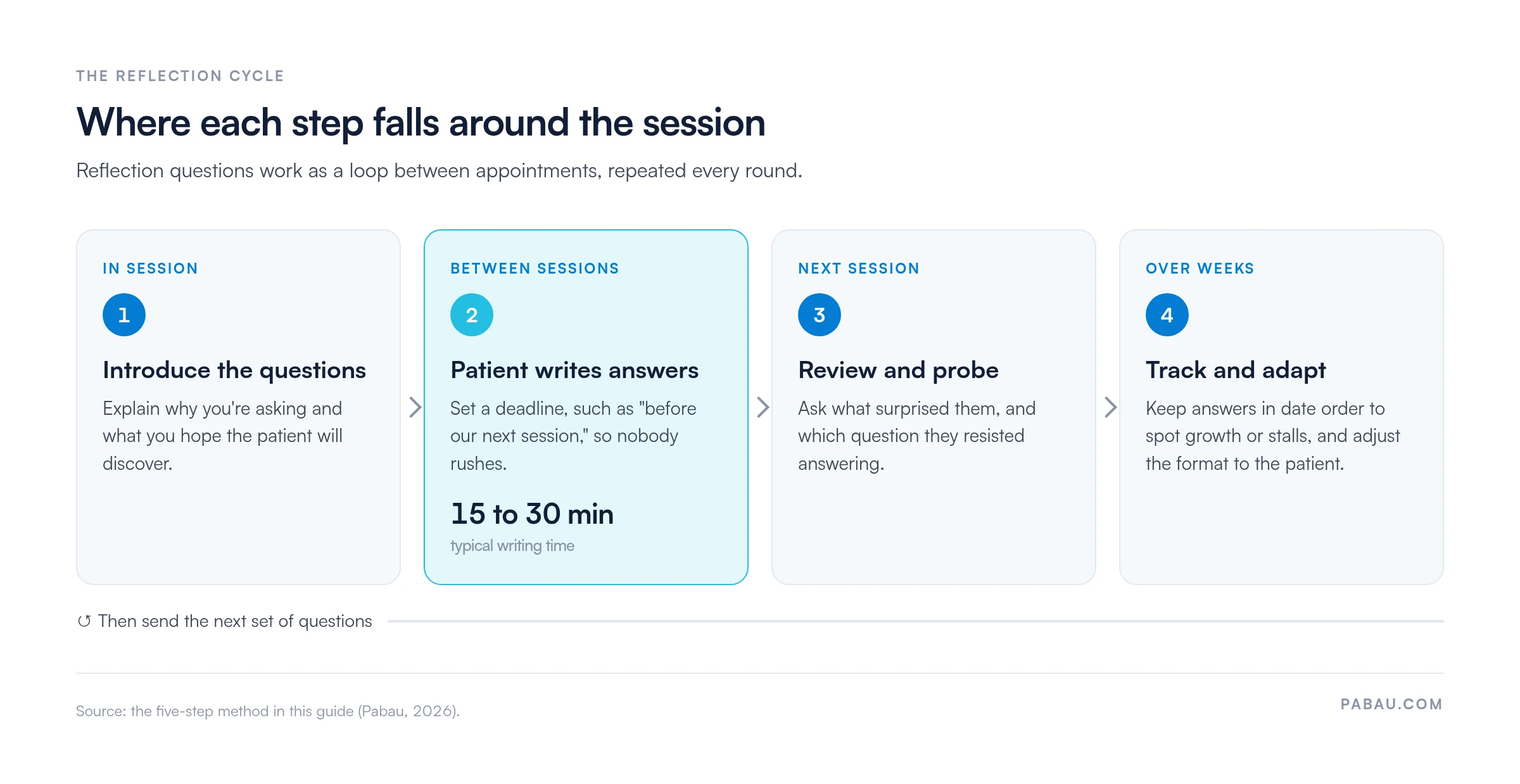
The steps fall into a loop around each appointment, as the cycle below shows.
Core-values questions help patients separate inherited beliefs from chosen principles. These anchor major life decisions. If a patient struggles to name their values at all, a printable values test gives them a list to react to first.
Interpersonal reflection prompts deepen emotional intelligence and strengthen connection.
Forward-focused reflection questions help patients move from aspiration to concrete steps.
Reflection questions work across learning and life-stage contexts. International Baccalaureate (IB) programs use structured reflection in the CAS (Creativity, Activity, Service) component, asking students to examine their impact and growth.
For students, keep the questions on learning and contribution:
End-of-year questions help professionals and individuals assess what worked and what to prioritize next. Balance gratitude for progress with an honest look at what stalled:
For a fuller personal or professional appraisal, a self-reflection worksheet covers achievements, strengths, self-care, and an action plan on one page.
Therapists, counselors, life coaches, and wellness practitioners build reflection questions into their session workflows. Many set them as a between-session assignment that feeds directly into the next appointment.
Ask for written answers a day or two before the session, so you can read them in advance and plan where to probe. Note the themes you follow up on in your psychotherapy progress notes, so the thread carries from one session to the next.
The approach also scales to group coaching and multi-week programs. A shared set of questions lets you compare how each participant moves across the course.
In team supervision, the same questions help practitioners examine their own clinical assumptions, burnout triggers, and growth edges. It also models the reflective habit you ask of patients.
Paper worksheets go missing between sessions, and answers emailed back as attachments end up outside the patient’s file. You then spend the start of an appointment hunting for last month’s responses.
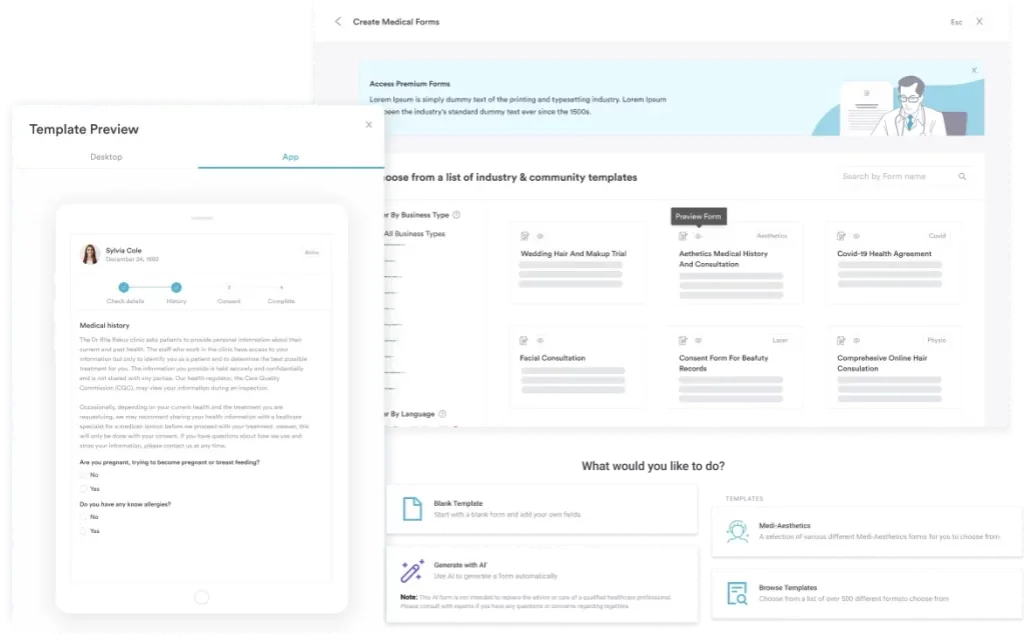
With digital forms in Pabau, you send reflection questions to patients through the patient portal. Completed responses are saved to the patient’s file in Client records, so you can read them before the next session.
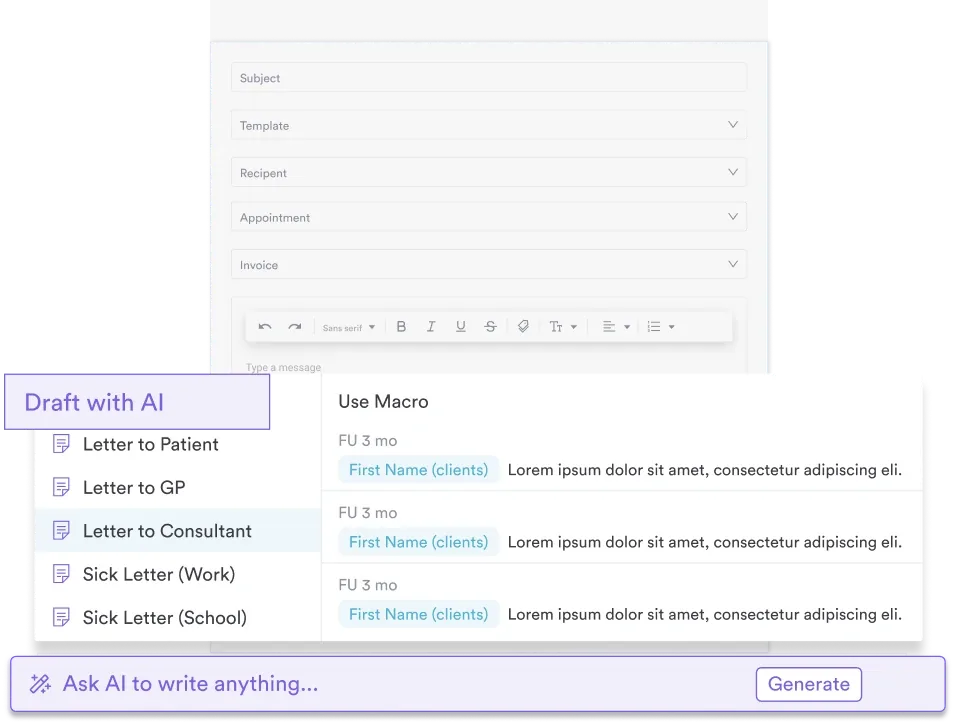
Pabau Scribe, our AI scribe, can draft consultation notes so you can capture what comes up in sessions. Forms, notes, and appointments then sit in one system, for simpler therapy practice management.
The result is a reflection process you can run for a whole caseload without chasing paper. See it in a demo set up for a therapy, coaching, or wellness workflow.

Pabau’s digital forms send reflection questions through the patient portal and save each response to the client record. You review answers before the session instead of chasing paper.

Start small. Pick three questions from the area your patient is working on and send them a few days before the next session. Then read the answers before you meet.
The value builds over repeated rounds. Answers kept side by side show which beliefs shift and which keep returning, and that pattern tells you where to focus. The trade-off is time, so set fewer questions rather than rushing a long list.
Download the free template above, whether you hand it out on paper or send it through a patient portal. Book a demo to see how Pabau sends reflection forms and keeps each response in the patient’s record.

Looking to streamline patient intake and follow-up? Psychology practice management covers how to structure your workflows so reflection becomes a documented part of every patient journey.
Working on identity with a patient? Who am I worksheet adds prompts on identity statements, character strengths, life roles, and core beliefs.
Prefer a regular habit to a one-off exercise? Self reflection journal gives patients a guided template for gratitude, emotions, lessons learned, and goals.
Need a starting point for self-awareness work? Self-awareness worksheet walks patients through their values, strengths, emotions, and behavioral patterns in 20 to 30 minutes.
Reflection questions are open-ended prompts that guide meaningful self-examination across identity, values, relationships, and goals. Unlike yes/no questions, they invite sustained exploration and help patients discover their own insights rather than receive advice.
Journaling prompts typically inspire creative expression or narrative flow (“Write about a time you felt proud”). Reflection questions target specific internal patterns or decisions (“What belief limits you, and where did it come from?”). Both have value, but they serve different purposes.
Yes. Therapists, counselors, coaches, and practitioners across mental health, wellness, and occupational health use structured reflection questions as a between-session intervention. They help patients reach insight sooner, leave a written record of progress, and free up session time.
Most people need 15–30 minutes depending on question depth and personal style. Provide a deadline (e.g., “complete before our next session”) so patients don’t rush. Rushed reflection yields surface-level answers.
Student reflection questions focus on learning, contribution, and growth. Examples: “What challenge did you face, and how did you respond?”, “How did this experience change your perspective?”, “What would you do differently next time?” These work across academic, CAS, and extracurricular contexts.
Annual reflection typically covers what went well, lessons learned, relationships strengthened, and intentions for the year ahead. Example: “What are you most proud of this year, and what taught you the most?” These support both individual and team review cycles.