Journal prompts for mental health
Journal prompts for mental health are guided questions that help people process ...

2
Last Updated: Oct 13, 2026

A self-awareness test measures how well someone understands their emotions, values, strengths, and impact on others.
The assessment scores four dimensions: emotional recognition, values clarity, strengths and limitations, and interpersonal impact.
Most people overestimate their own insight. Research shows only 10-15% are truly self-aware overall.
Score each dimension separately, because a low subscale points to a different piece of follow-up work.
Practice management software like Pabau lets practitioners administer and track these assessments during intake and ongoing care.
An assessment template covering emotional recognition, values clarity, strengths and limitations, and interpersonal impact, with a scoring guide for each. Use it in session, or hand it over as reflective homework.
Download templateMost clients arrive at a first session confident that they know themselves well. Research puts the share who actually do at 10 to 15 percent. A structured self-awareness test gives you a way to test that assumption rather than work around it.
The template above scores four dimensions: emotional recognition, values clarity, strengths and limitations, and interpersonal impact. A client completes it in 10 to 15 minutes, on paper or as a digital form.
This guide covers what the test measures, and how to administer and score it. It also covers what to do with the results in session. You get the follow-up step each low subscale calls for, plus how to store the responses safely.
A self-awareness test is a structured assessment of how well someone understands their own thoughts, emotions, behaviors, and motivations. It is not a diagnostic instrument. It prompts a person to examine how they see themselves, then to consider how their actions land with the people around them.
Therapists, coaches, and wellness professionals use it as a foundation for deeper clinical work. Administer it at intake, or as a checkpoint during ongoing sessions. The assessment does not diagnose. It shows where a person’s self-perception and the perception of others diverge. Harvard Business Review research by Tasha Eurich puts the share of people who are truly self-aware at 10 to 15 percent.
Scored responses belong in the client file rather than a drawer, alongside the rest of your mental health records. A baseline you cannot find again is a baseline you cannot compare against.
Each dimension behaves differently in session, so read the subscales separately rather than as one total. That separation is what makes the results usable.
The ability to identify and name emotional states as they arise. Many people feel an emotion but cannot distinguish anxiety from frustration, or disappointment from sadness. Building that vocabulary with a client is usually the first piece of work a low score points to.
Self-aware people can articulate their core values and spot where daily behavior drifts from them. Someone might value authenticity and still avoid every difficult conversation. That contradiction is where the therapeutic work happens.
An honest read on what someone does well and where they struggle. Low self-awareness often shows up as either excessive self-criticism or unrealistic confidence. A balanced score is what makes realistic goal-setting possible.
The hardest dimension to score honestly. It covers how a client’s presence, communication style, and emotional state land with other people. Someone might intend to be helpful and come across as controlling. This one needs outside feedback, not more introspection.
The assessment works best inside a structured clinical workflow. Administer it during intake, or as a checkpoint assessment during ongoing care.
Structured self-awareness scoring earns its place in several practitioner contexts.
Scoring insight on a scale buys you things a conversation cannot.
Administer the test digitally through your practice management system’s intake module. This removes paper scoring errors, stores a baseline for future comparison, and cuts clinician admin time. Digital administration also flags the highest and lowest scoring dimensions straight away, so you walk into the session already knowing where to look.
Self-awareness is the foundation of emotional intelligence, known as EI. Daniel Goleman’s framework treats it as the first pillar. Self-regulation, empathy, social skills, and motivation all rest on it. You cannot manage an emotion you do not recognize, and you cannot read someone else’s if you have no insight into your own.
The American Psychological Association notes that emotional awareness predicts better mental health outcomes, stronger relationships, and clearer decisions. Pairing self-awareness work with emotional regulation skills compounds the clinical effect.
Tasha Eurich, an organizational psychologist and author of Insight (2017), ran the most comprehensive modern research on self-awareness. Her headline finding: only 10-15% of people are truly self-aware. She also identified two types that often do not overlap.
Eurich found that conflict, misunderstanding, and missed opportunities pile up where self-perception and outside perception diverge. Her work supports pairing a structured assessment with a feedback mechanism. That combination moves people toward the integrated self-awareness that improves relationships and outcomes.
A completed test is a starting point. The insight comes from what the client practices in the weeks afterward. Each of the six steps below targets a specific dimension the test scores.
Assign one or two after scoring rather than handing over the whole list. Clients who leave a session with six new habits usually keep none of them.
Steps one, two, and five build internal self-awareness. Steps three and four build the external side, which Eurich identified as the dimension most people never develop. The map below pairs each subscale with the step that moves it.
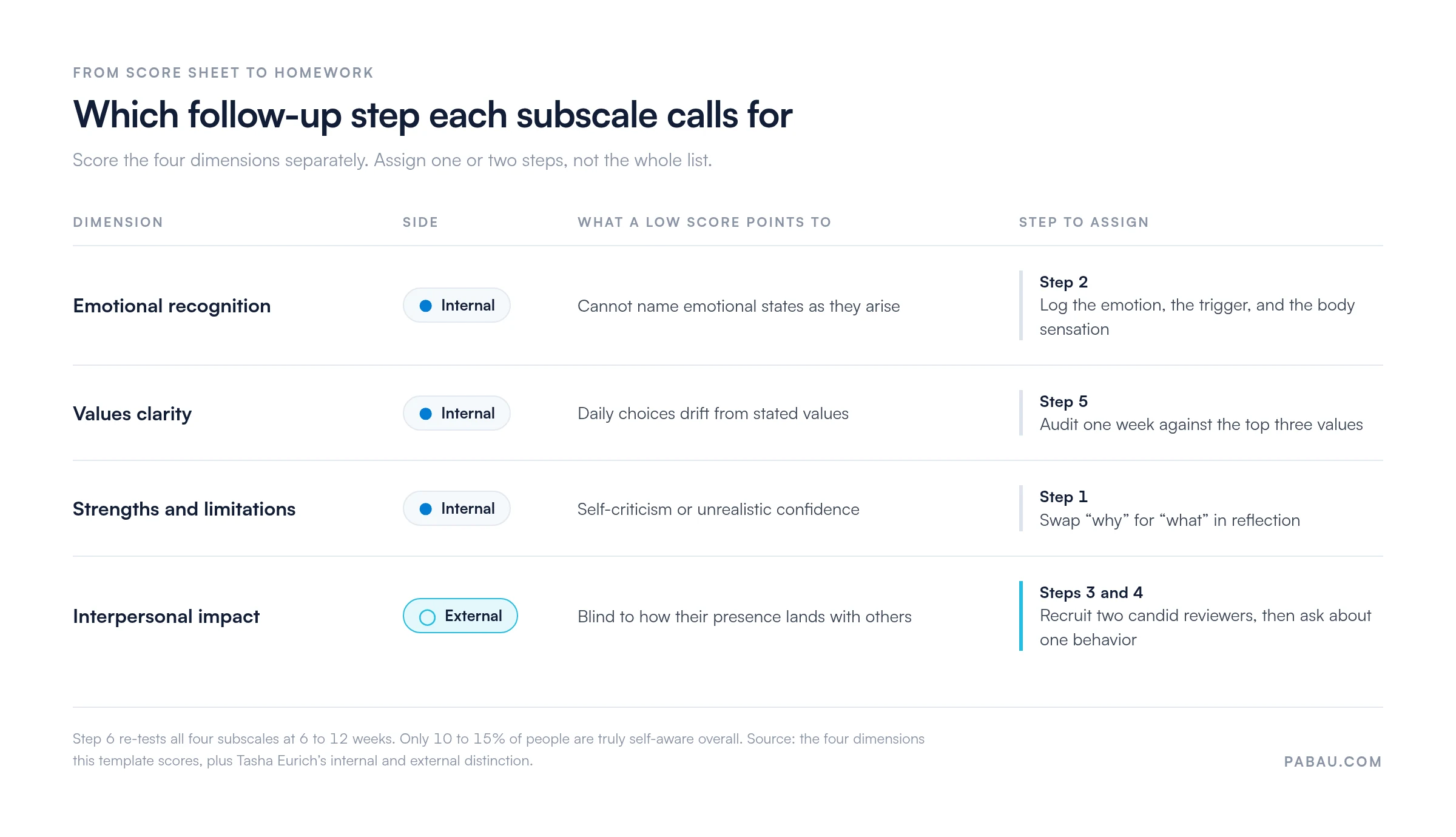
Where the test sits in your workflow matters as much as the questions on it. Embed it into intake, progress reviews, and discharge. Handled that way it becomes one of the routines behind a calmer therapy practice, rather than another form to chase.
Administer the test during the first session, or set it as pre-session homework. Score the results before the second session, then use the output to co-create treatment goals.
You might open with something like this: “Emotional awareness looks like a strength for you. You also flagged some uncertainty about how your withdrawal affects your relationships. Would that be a useful area to explore?”
Re-administer at milestones: 6 weeks, 12 weeks, and end of treatment. Track the shifts dimension by dimension. Improved interpersonal impact scores often predict better relational outcomes and higher treatment satisfaction.
Store the results in your client portal so clients can follow their own progress narrative. Watching the movement themselves reinforces engagement and autonomy.
Pre- and post-assessment quantifies what a group intervention achieved. The results also point to the themes worth discussing. If 80% of a group scores low on values clarity, make that the session focus.
Group-level data shared openly builds psychological safety, because it describes the room rather than singling anyone out.
Store completed assessments securely and timestamp them. That documentation supports supervision, consultation, and your own clinical reasoning. It also shows that assessment, rather than assumption, drove your treatment approach.
Data security note: If you store responses digitally, check that your practice management system complies with UK GDPR or HIPAA, depending on where you practice. Assessment responses are sensitive personal data. They need encryption at rest and in transit.
Keep a simple tracking sheet: date administered, dimension scores, next review date. Share a visual summary with the client, since a bar chart by dimension lands harder than four numbers read aloud. That accountability loop drives engagement and shows progress the client can see for themselves.
Most practices run this kind of assessment on paper. Someone prints the form, the client fills it in, and the sheet gets scanned into a file or left in a drawer. Scoring happens by hand. Comparing a 12-week retest against the baseline means locating both sheets first.
Practice management software like Pabau moves that loop into the client record. You build the test once as a digital form. Send it out before the first session, or hand it over on a tablet in the waiting room. Responses land in the client file, timestamped and encrypted.
Because the baseline is already stored, a retest sits next to it and the comparison takes seconds. Clients can view their own completed assessments through the client portal, which keeps them involved in their progress. Scores, notes, and treatment goals stay in one record, so you spend less time on paperwork and more time in the room.

Pabau’s digital forms let you send a self-awareness test out before the first session. Scored responses store in the client file, so every retest compares against the baseline. Practitioners spend less time scoring paper and more time on clinical work.

Self-awareness develops through structured practice and feedback, rather than arriving on its own. A scored test gives you and the client a starting point you can both measure against later.
The judgment worth keeping is the one about the two sides. A client can lift their internal scores for months and still land badly on the people around them. So assign external work early, and re-test by subscale so you can see which side actually moved.
The template above is ready to use today. Book a demo to see how Pabau stores scored assessments in the client record and lines every retest up against the baseline.

Measuring emotional intelligence next? Emotional intelligence test scores the competencies that sit on top of self-awareness in Goleman’s framework.
Building the intake pack around it? Mental health intake covers the history, risk, and consent sections this assessment deliberately leaves out.
Turning a low subscale into a plan? Change plan worksheet converts one score into concrete steps, a target date, and a way to track follow-through.
Screening the practitioner too? Compassion fatigue test applies the same self-assessment approach to a clinician’s own workload and emotional reserve.
A self-awareness test is a structured assessment of how well someone understands their emotions, values, strengths, limitations, and impact on others. It works as a reflective tool for personal insight, not as a diagnostic instrument.
This assessment uses standardized Likert-scale items and a scoring framework, so you get subscale numbers you can compare over time. Self-reflection questionnaires are usually open-ended and less standardized. They support narrative exploration rather than measurement.
Administer at intake, then every 6 to 12 weeks depending on treatment intensity. Every 3 to 4 weeks suits short-term coaching or intensive group programs. Annual administration works for wellness and organizational contexts.
No. The Self-Monitoring Scale measures behavioral flexibility and social sensitivity, meaning how much someone adjusts their behavior across social contexts. This assessment measures emotional, values, strengths, and relational insight. The two constructs are related but distinct.
It works with adolescents and adults, roughly age 14 and up. Simplify the language for younger teens. For clients with significant cognitive or developmental delays, the Likert format may need adapting. Check reading level and comprehension before you administer it.
Low scores across the board can mean genuine low self-awareness. They can also mean depression, dissociation, or test-taking fatigue. Explore it conversationally: “These answers suggest you’re uncertain about your emotions and strengths right now. Does that match how you feel?” Treat it as a starting point for the conversation, not a verdict.