Antipsychotic medication list
An antipsychotic medication list is a structured reference that organizes psychi...

2
Last Updated: Oct 13, 2026

The decisional balance worksheet is a four-quadrant tool that weighs the pros and cons of changing against those of staying the same.
The exercise puts competing motivations on a single page, which is what makes a client’s ambivalence manageable in session.
Clinicians using Pabau can store completed worksheets in the client record for progress tracking and clinical documentation.
The worksheet works across addiction counseling, weight management, smoking cessation, eating disorders, and mental health treatment adherence.
A ready-to-use four-quadrant template with the clinician prompt printed inside each cell, plus a blank client-facing page for in-session or take-home use. Includes a worked example you can show a client who is stuck.
Download templateThe decisional balance worksheet is a structured therapeutic tool that helps clients explore both sides of a difficult decision. Clients weigh the pros and cons of changing against the pros and cons of staying put. That clarity is what moves an ambivalent client toward a decision they can own.
This guide covers how therapists, counselors, and coaches use the worksheet in session. It also traces where the four-quadrant method came from. Along the way it shows how software for therapy practices keeps a completed worksheet in the client record, not in a filing cabinet.
A decisional balance worksheet is a four-cell matrix. It asks clients to list the benefits and drawbacks of two scenarios: Changing their behavior, or staying the same. Ambivalence means feeling pulled in opposite directions, and resolving client ambivalence starts with treating that as normal rather than as a barrier. Putting competing motivations on the page creates room for honest reflection.
Clinicians reach for this tool when a client expresses mixed feelings about change: “I want to quit drinking, but alcohol helps me sleep.” The worksheet does not push the client toward one answer. It asks them to map the trade-offs they are facing. The result is a franker conversation and better buy-in when the client does decide.
The format comes from the decisional balance sheet that Irving Janis and Leon Mann described in 1977. Prochaska and DiClemente later folded that idea into the Transtheoretical Model of behavior change. Their model sorts change into five stages, running from precontemplation through contemplation, preparation, action, and maintenance.
The decisional balance exercise belongs in the contemplation stage, where ambivalence peaks. A stages of change worksheet helps you confirm the client is there before you hand over the four quadrants.
Motivational interviewing (MI) was developed separately, by William Miller and Stephen Rollnick. It grew up alongside the Transtheoretical Model and is often paired with it. Miller and Rollnick are clear, though, that MI does not depend on the model’s stages.
MI practitioners adopted the worksheet as a way to explore ambivalence without judgment. Support for MI techniques and frameworks is strongest in substance use and other behavior change work. Our motivational interviewing cheat sheet covers the wider skill set the worksheet sits inside.
Knowing where the method came from helps clinicians explain it to a client. Describe it as a structured way to organize thinking during an ambivalent moment. It does not score the client, and it is not a device for persuasion.
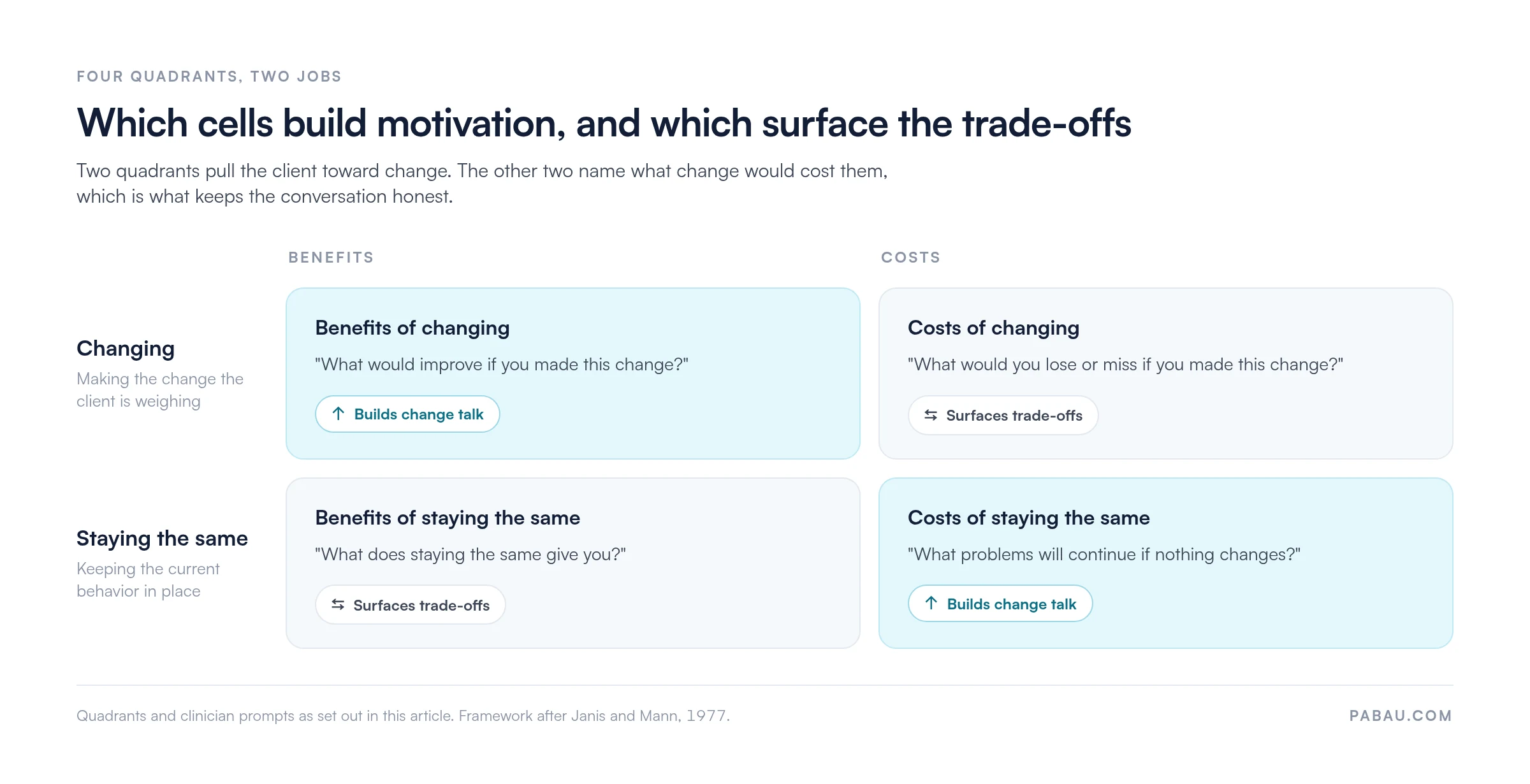
The worksheet divides into four cells, each addressing a different side of the decision:
Each quadrant does a different job. The benefits of changing and the costs of staying the same tend to raise motivation. The costs of changing and the benefits of staying the same name what the client would give up. A skilled facilitator works all four without judgment, so the client’s own reasoning can surface. The map below shows which pair does which job, with the prompt that opens each cell.
Facilitation is what makes the tool work. Here is how clinicians typically guide a client through it:
Once the matrix is full, review the four cells together. Two openers that work: “What stands out to you now?” and “What surprises you about what we wrote?”
When the balance tips toward change, the session has somewhere to go next. A change plan worksheet turns the reasons the client just listed into concrete steps, a timeline, and a way to measure follow-through.
A completed sheet makes the pattern easier to see. Below is one from a client considering cutting back on daily drinking:
The client’s own responses build the argument for change, with no push from the therapist. The completed matrix also exposes a tension the clinician can explore. “You wrote ‘better sleep’ as a benefit of cutting back. You also wrote that alcohol helps you sleep. Let’s talk about that.”
The exercise is not addiction-specific. It fits anywhere a client faces ambivalence, including behavior change coaching approaches:
The method works because it honors the client’s autonomy. It asks clients to consult their own values and experience, rather than accept the clinician’s view of the right decision.
The worksheet is powerful but not universal. Four situations call for something else:
The worksheet also works best when the client is genuinely ambivalent. Someone who has already decided, or who is still in denial, may need motivational enhancement or psychoeducation first.
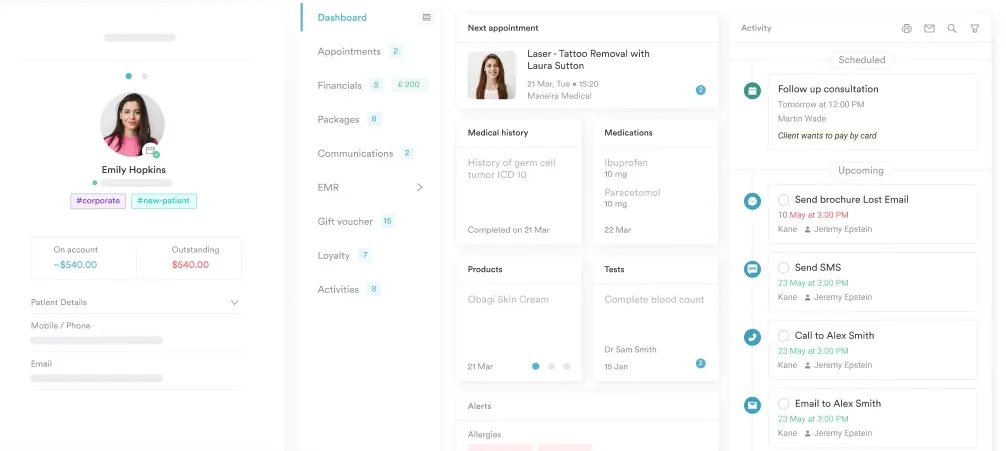
Most practices still run this exercise on paper. The completed sheet goes into a folder, or gets scanned into a general documents tab where nobody opens it again. Practice management software like Pabau puts it where the clinician will see it at the next session.
You can send the four quadrants ahead of the appointment as a digital form, so the client arrives having already thought about the decision. Their answers land in the client record instead of on a clipboard.
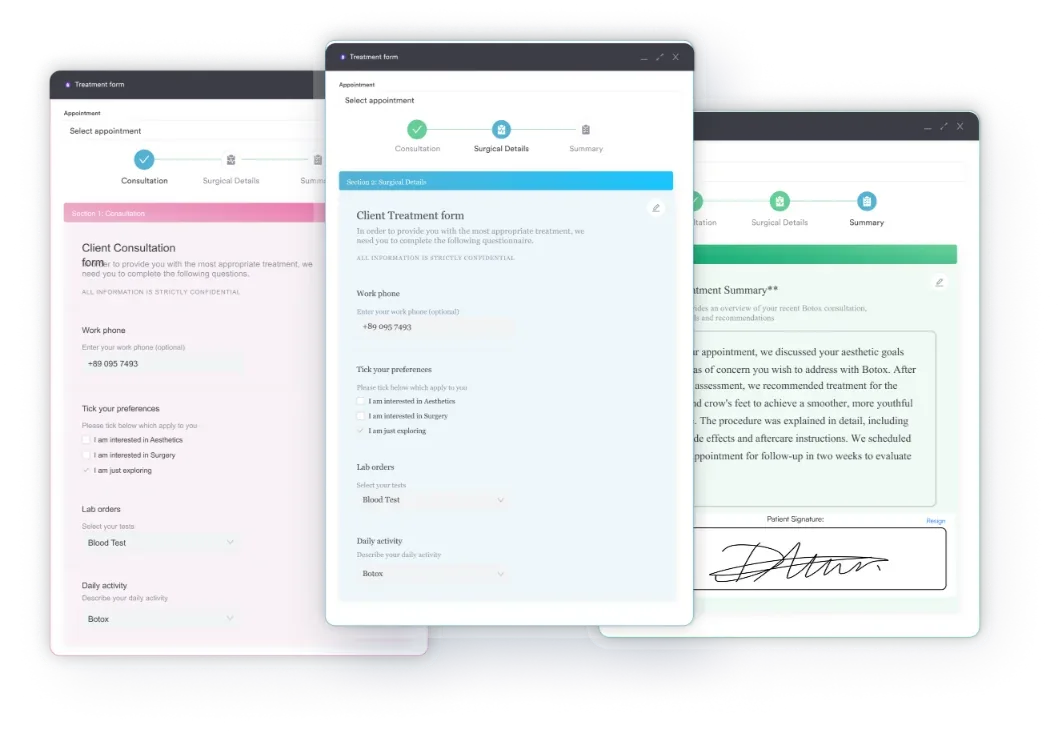
Completed worksheets then sit alongside progress notes in the same record. When a client revisits the decision months later, you can open the original and set it against what they say now. That comparison is often the clearest evidence of progress either of you has.
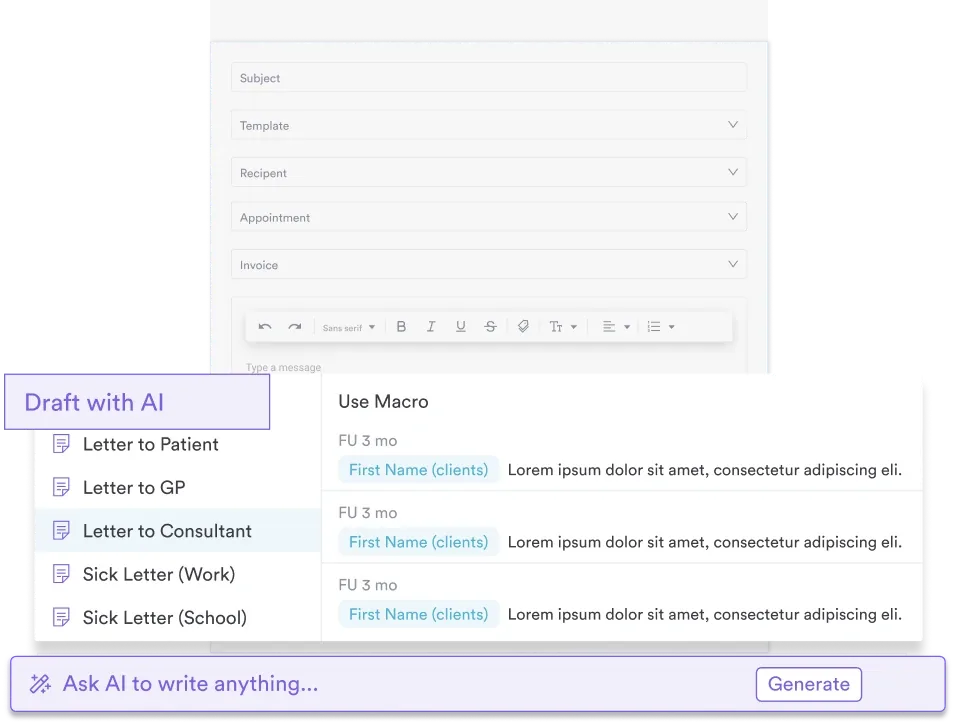
Writing the conversation up afterward is its own tax on the day. Pabau Scribe, our AI scribe, drafts the note from the session. The reasoning behind each quadrant gets captured while it is still fresh, so you can finish on time.

Pabau stores completed worksheets beside progress notes and treatment plans, so behavior change work stays visible from one session to the next. You can send the form ahead of the appointment and compare versions months later.

The worksheet earns its place because it hands the argument back to the client. Your job is to ask all four questions and then resist filling in the answers.
The trade-off worth remembering is timing. Run it too early and you get a compliance exercise. Run it in genuine ambivalence and the client produces change talk you never had to manufacture.
Print it, send it through a client portal, or store completed versions in your practice management system. Book a demo to see how Pabau keeps worksheet-based work visible across a client’s whole course of therapy.

Not sure the client is ready for the four quadrants? Readiness to Change Questionnaire gives you a scored way to place someone before the exercise begins.
What happens once the client commits? Relapse prevention plan worksheet maps the triggers and coping steps that keep the decision intact.
Need a fuller picture before the first session? Adult counseling intake form covers the history and presenting concerns that tell you which decision to work on.
Running this in a group instead? 8-week group counseling plan shows where a shared worksheet fits across a full program.
A decisional balance worksheet is a four-quadrant tool. It sets the pros and cons of changing against the pros and cons of staying the same. The format comes from Janis and Mann’s 1977 decisional balance sheet, and motivational interviewing uses it widely.
Yes. The method was later incorporated into the Transtheoretical Model developed by Prochaska and DiClemente, and it is supported by peer-reviewed research on motivational interviewing. Studies report benefits in addiction treatment, smoking cessation, weight management, and treatment adherence.
Use it during the contemplation stage of change, when a client is genuinely ambivalent about a decision. It works best where the client has already expressed conflicting motivations. Skip it in a crisis, or when someone has firmly decided.
A pros and cons list usually covers one option. The worksheet uses four quadrants, so the client weighs changing and staying the same side by side. That is more therapeutic, because it names the benefits of the current behavior and the costs of change.
Yes. Decisional balance is one of the core techniques in motivational interviewing for substance use treatment. It is most useful in early recovery, when a client is weighing recovery against continued use and needs to explore that conflict without judgment.
Motivation rises when the reasons for change come from the client rather than from clinician persuasion. Work all four quadrants, then review the finished sheet together. Clients often see the weight of their own arguments, which lifts intrinsic motivation.