ICD-10 Code Y76.0: Diagnostic obstetric and gynecological devices
ICD-10 Code Y76.0: Definition and billable status ICD-10 Code Y76.0 is a valid, ...

Last Updated: Oct 23, 2026
Billable Code Specific Code
M81.6 is the billable ICD-10-CM code for localized osteoporosis [Lequesne].
Let Pabau's smart automation suggest the right codes, reduce claim denials, and keep your practice compliant—effortlessly.
Automate repetitive tasks and focus on what matters most—your patients.
Reduce coding errors and ensure compliance with the latest regulations.
Clean claims, fewer denials, and faster reimbursements.
Powerful insights and reporting to help your practice thrive.
HIPAA compliant SOC 2 certified GDPR-compliant Trusted by 4,000+ clinics worldwide

ICD-10 code M81.6 describes localized osteoporosis [Lequesne]: site-specific bone density loss without a current pathological fracture.
M81.6 is billable and valid for HIPAA-covered transactions. It must not be coded when Sudeck’s atrophy (M89.0) is present (Type 1 Excludes).
M81.6 differs from M81.0 (age-related systemic osteoporosis): documentation must specify the affected anatomic site to justify the localized code.
Practice management software like Pabau helps practices attach the correct diagnosis code to every claim, reducing M81.6 denials caused by missing site documentation.
ICD-10 code M81.6 is the ICD-10-CM diagnosis code for localized osteoporosis [Lequesne]. It is a billable, specific code, valid for HIPAA-covered transactions. The code sits within the M81 category, “Osteoporosis without current pathological fracture,” which in turn falls under the broader M80-M85 range covering disorders of bone density and structure.
The bracket notation [Lequesne] refers to the classification system introduced by French rheumatologist Michel Lequesne, who described regional or localized forms of osteoporosis affecting a discrete anatomic area rather than the entire skeleton. This distinguishes M81.6 from systemic presentations coded elsewhere in the M81 family.
Practices using physical therapy EMR software or musculoskeletal-focused systems should ensure M81.6 is available in their diagnosis code libraries for accurate claim submission.
The CMS ICD-10 codes page confirms M81.6 as a valid code within this hierarchy. It has remained billable continuously from FY2016 through FY2026, with no planned retirement or code split as of the current update cycle.
Localized osteoporosis describes reduced bone mineral density confined to a specific anatomic region, as opposed to the diffuse skeletal involvement seen in age-related or postmenopausal osteoporosis.
The Lequesne classification captures presentations such as regional migratory osteoporosis, transient osteoporosis of a joint (most commonly the hip), and documented site-specific bone density loss following immobilization, disuse, or localized inflammatory processes.
Clinically, localized presentations differ from systemic ones in important ways. A patient with M81.6 may have normal DEXA T-scores at the spine and contralateral hip but show focal bone loss at a single joint or bone segment.
Providers should note that the WHO ICD-10 browser classifies this condition under M81.6 at the international level, though ICD-10-CM is the US-specific clinical modification maintained by NCHS and CMS.
Each of these presentations requires explicit anatomic documentation in the chart. Providers who rely on structured patient records within their practice management system are better positioned to capture the site-specific language payers look for during claim review.
ICD-10 code M81.6 carries a Type 1 Excludes note for Sudeck’s atrophy, coded as M89.0. This is one of the most consequential coding restrictions attached to localized osteoporosis, and mishandling it is a common claim error.
A Type 1 Excludes note means the two conditions are mutually exclusive. When Sudeck’s atrophy (also known as complex regional pain syndrome Type I, or CRPS-I) is the clinical diagnosis, the coder must use M89.0, not M81.6. The two codes cannot appear together on the same claim for the same episode of care.
Sudeck’s atrophy produces localized bone changes that can appear similar to Lequesne osteoporosis on imaging, but the underlying pathophysiology and treatment pathway are distinct. Clinicians in chiropractic software-supported practices treating musculoskeletal conditions should flag this distinction during chart review to avoid claim-level errors.
Musculoskeletal caseloads demand solid charting, and several Jane App competitors handle it with billing built in.
Selecting between M81.0 and ICD-10 code M81.6 is the most common decision point for coders working with osteoporosis diagnoses. The two codes are not interchangeable, and payers increasingly use automated edits to flag claims where the code selected does not match the clinical documentation on file.
M81.0 (age-related osteoporosis without current pathological fracture) is the appropriate code when the provider documents osteoporosis in the context of systemic skeletal aging, typically confirmed by a DEXA scan showing a T-score of -2.5 or below at the spine, hip, or wrist.
This is the most common M81 code in clinical practice. The provider’s note does not need to name a specific anatomic site because the disease is diffuse by definition.
M81.6 (localized osteoporosis [Lequesne]) applies when osteoporosis is documented as confined to a specific anatomic region. The provider’s note must name the affected site, whether that is the hip, jaw, tibia, or another area.
Without site documentation, the claim lacks the specificity the code demands and may be returned for additional information or denied outright. The AAPC Codify ICD-10-CM lookup confirms this distinction in the code’s official description and guidelines.
When providers see patients whose osteoporosis is documented as both systemic and locally severe, M81.0 is generally selected, because M81.6 implies localization as the primary clinical feature rather than a superimposed severity. Coders working in practices that also reference M47.9 or other musculoskeletal codes should apply the same documentation-first principle here: code what the chart supports.
Document the anatomic site explicitly in the clinical note before selecting M81.6. Phrases like ‘localized osteoporosis of the right hip’ or ‘site-specific bone density loss at the mandible’ give coders the specificity needed to justify the code and reduce payer denials at claim review.
Insufficient documentation is the primary reason M81.6 claims are denied or returned. Payers reviewing a claim with this code expect the clinical record to support four elements.
Practices using digital intake forms and structured clinical note templates can build these four documentation elements into musculoskeletal assessment workflows, reducing the back-and-forth with payers that occurs when records are pulled for review.
The CDC/NCHS ICD-10-CM web tool provides the official tabular list for M81.6 and its associated notes, which coders can reference to confirm documentation requirements align with the published guidelines.
Local Coverage Determinations (LCDs) for osteoporosis-related treatments, including DEXA scans (billed under CPT 77080 or 77081) and pharmacological agents like bisphosphonates or denosumab, often specify which ICD-10 diagnosis codes qualify for coverage.
M81.6 may or may not appear on a specific LCD’s covered diagnoses list depending on the Medicare Administrative Contractor (MAC) jurisdiction. Billers should verify that M81.6 is included in the applicable LCD before submitting claims for related services.
Practices relying on manual biller review for this step can benefit from claims management software that surfaces LCD restrictions at the point of claim creation.
Understanding ICD-10 code M81.6 in isolation is useful, but coders working in bone health, rheumatology, and musculoskeletal settings need to navigate the full M80-M85 range to select codes precisely. The ICD List lookup tool provides a fast reference for checking hierarchy and excludes notes across this range.
The distinction between M80 and M81 is especially important. M80 codes apply when a pathological fracture is present. M81 codes apply when it is not. Selecting M81.6 on a claim for a patient who has sustained a pathological fracture will trigger an edit, because the fracture changes the code family entirely.
Providers treating patients with comorbid diagnoses such as M31.6 should confirm each code’s fracture-status requirement before finalizing a claim.
Practices that see high volumes of musculoskeletal diagnoses may also benefit from reviewing related code guides. Maintaining compliance management tools in your practice workflow supports consistent application of these distinctions across your billing team.


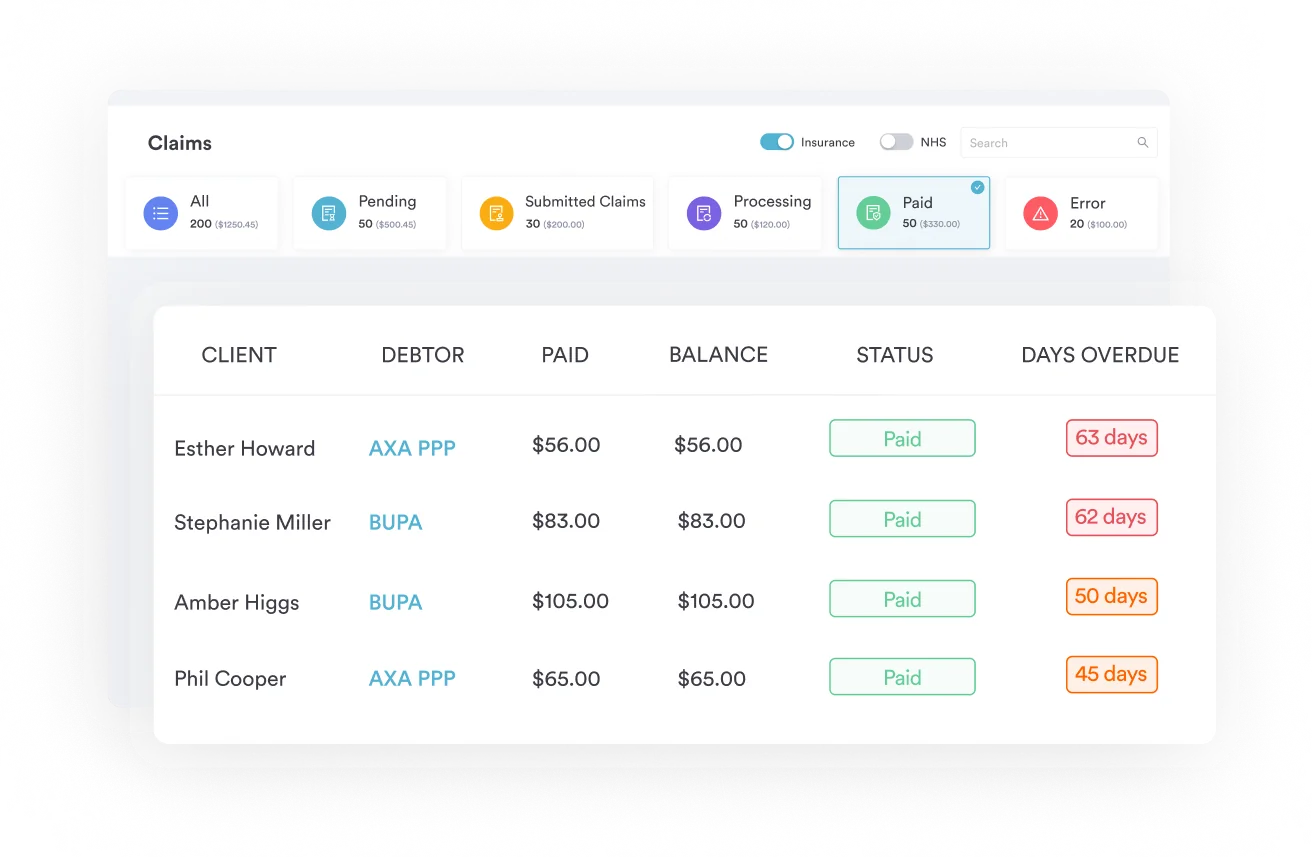
Pabau’s claims management tools help musculoskeletal and bone health practices attach the right ICD-10 diagnosis code to every claim, flag LCD restrictions, and submit clean claims the first time.

Practices that maintain historical patient records or work with payers who still reference legacy data may encounter ICD-9-CM codes during retrospective audits or older claims reviews. ICD-9-CM 733.09 (Other osteoporosis, not elsewhere classified) forward-maps to ICD-10-CM M81.8, not M81.6.
ICD-9-CM had no dedicated code at the level of specificity M81.6 requires, so localized, Lequesne-type osteoporosis had no direct ICD-9 equivalent. The transition to ICD-10-CM in October 2015 introduced that specificity for the first time.
Coders performing retroactive record reviews should not back-map M81.6 claims to 733.09 for periods prior to October 2015 without confirming the payer’s crosswalk policy. Some MAC jurisdictions maintain their own crosswalk guidance that differs from the general GEMS (General Equivalence Mappings) files.
Reviewing practices should consult the published NCHS GEMS files or a certified coder for complex retrospective cases.
When performing retrospective audits of claims originally filed under ICD-9-CM code 733.09, do not assume it maps to M81.6. GEMS forward-maps 733.09 to M81.8. Review the original clinical note to confirm whether M81.0, M81.6, or M81.8 is the most accurate ICD-10-CM code before amending any record.
Clean M81.6 claim submissions depend on three operational elements: Documentation completeness, code selection accuracy, and payer-specific policy verification. Most M81.6 denials are preventable with a structured pre-submission review.
Practices managing high volumes of bone health claims benefit from systematic pre-submission workflows. Pabau’s claims management software supports musculoskeletal practices in structuring diagnosis code attachment and pre-submission review steps, reducing the manual error rate that drives M81.6 denials.
For practices looking at broader billing patterns across their patient population.
Localized osteoporosis claims fail most often for one reason: Missing site documentation. ICD-10 code M81.6 is billable and valid, but its specificity is also its requirement. When the clinical note does not name an anatomic location, the code becomes indefensible at payer review.
Pabau helps musculoskeletal and bone health practices build documentation structure into every patient encounter, so the right diagnosis code is always supported by the right clinical note. To see how Pabau’s structured patient records and claims tools work in practice, book a demo with the team.

Coding follow-up wound care for a thumb? thumb laceration follow-up care S61.122D covers a follow-up visit for a left thumb laceration with a foreign body and nail damage.
Coding a puncture wound on another finger? finger puncture wound coding S61.238A covers a puncture wound of a finger other than the index, middle, ring, or little finger.
Coding a healed index finger laceration? index finger laceration sequela S61.311S applies once a left index finger laceration with nail damage has finished active wound care.
ICD-10 code M81.6 is used to diagnose localized osteoporosis [Lequesne], a condition where reduced bone mineral density is confined to a specific anatomic site rather than affecting the skeleton systemically. It is appropriate when the provider documents site-specific bone loss without a current pathological fracture, such as transient osteoporosis of the hip, regional migratory osteoporosis, or disuse-related bone density reduction in a single limb.
Localized osteoporosis [Lequesne] refers to the classification of site-specific osteoporosis described by French rheumatologist Michel Lequesne. It encompasses regional bone density reduction, including transient osteoporosis of a joint and regional migratory osteoporosis, where loss is concentrated in one anatomic area. The Lequesne bracket notation in ICD-10-CM M81.6 signals this regional, non-systemic nature of the condition.
M81.0 covers age-related osteoporosis affecting the skeleton systemically, with no fracture present. No specific anatomic site needs to be documented. M81.6 applies when osteoporosis is limited to a named anatomic region, meaning the clinical note must identify the affected site. Selecting M81.6 without site documentation in the chart is a common billing error that leads to claim denial or request for additional information.
Yes, M81.6 is a billable ICD-10-CM diagnosis code, valid for HIPAA-covered transactions. It has been active and billable continuously from FY2016 through FY2026. As a specific leaf-level code in the M81 category, it can be submitted on claims without requiring a more detailed sub-code. Providers should verify annually that it remains active in the current CMS tabular list update.
The M81 category covers osteoporosis without current pathological fracture. The three billable codes within it are M81.0 (age-related), M81.6 (localized [Lequesne]), and M81.8 (other). When fracture is present, use the M80 family instead. Selecting M81.6 for a patient with an active pathological fracture will generate a claim edit because the fracture changes the correct code family entirely.