Anja Dodevska

Values exploration worksheet
Download your free values exploration worksheet A two-page printable form that o...

2
Last Updated: Nov 6, 2026
Free PDF 3 pages, print-ready Clinician-reviewed
A nurse assessment sheet is a structured clinical form that records a patient’s health status across each body system. It runs from vital signs through to pain and mobility. Used consistently, it gives nursing teams a shared, repeatable picture of the patient at admission, at handover, and after any change in condition.
Most nurses already run a head-to-toe check in their heads. The hard part is writing it down, handing it over, and having it stand up to an audit. A sheet that prompts each system in the same order keeps findings from slipping through and makes handovers clearer.
This guide gives you a free, downloadable nurse assessment sheet and explains what a complete assessment should cover. It also shows how to use the form day to day. The same sheet works on a hospital ward, in the community, or in a practice that employs nurses.
A head-to-toe template with sections for vital signs, neurological status, respiratory, cardiovascular, skin integrity, abdominal, musculoskeletal and pain findings. Each section leaves room for observations, and the form closes with an assessor sign-off.
Start from scratch, or upload this PDF or any form you already use, and Pabau's AI Form rebuilds it with tick boxes, text fields and a signature. Attach it to the treatment once, and every patient gets it on time.
AI Form rebuilds the consent, history and aftercare forms you already use. You review each one, then publish.
Patients complete forms on their phone before they arrive, so the front desk stops retyping paper.
Every signed form is versioned and attached to the treatment record, ready when you need it.
Set how long a consent stays valid. Returning patients skip forms they have already signed.
Supports HIPAA and GDPR compliance AES-256 encryption 4.8 on G2 4.7 on Capterra Trusted by 4,000+ practices worldwide

A nurse assessment sheet standardizes the head-to-toe check so no body system is missed.
A complete sheet covers vital signs, neurological, respiratory, cardiovascular, skin, abdominal, musculoskeletal and pain findings.
The vital signs and neurological sections supply the physiological inputs to the NEWS2 early warning score, so neither should be left blank.
Record the time, the assessor, and the reason for the assessment on every sheet.
Digital intake and records software can keep assessment data structured, searchable and access-controlled.
A nurse assessment sheet is a clinical documentation form that structures a nursing assessment by body system. It captures what the nurse observed and measured so that the next clinician can see the same picture without repeating the check.
Nurses typically complete a sheet at admission, at shift handover, and after a clinical deterioration event. Each of these points carries a different risk, so the sheet has to be quick to complete and clear to read. At handover, it pairs well with an SBAR nursing handoff, which structures the verbal report that goes with the written findings.
The sheet also supports the legal record. Standards bodies such as the American Nurses Association and the Nursing and Midwifery Council expect nursing assessments to be recorded accurately and contemporaneously. A template helps teams meet that expectation consistently, though it does not replace local policy or professional judgment.
The sheet works best as a fixed sequence. Work through the same systems in the same order every time, then record only what you found.
Where the sheet is used in a practice that also offers aesthetic or elective procedures, keep a separate record for each treatment episode. That way, pre-procedure findings don’t get mixed with later observations.
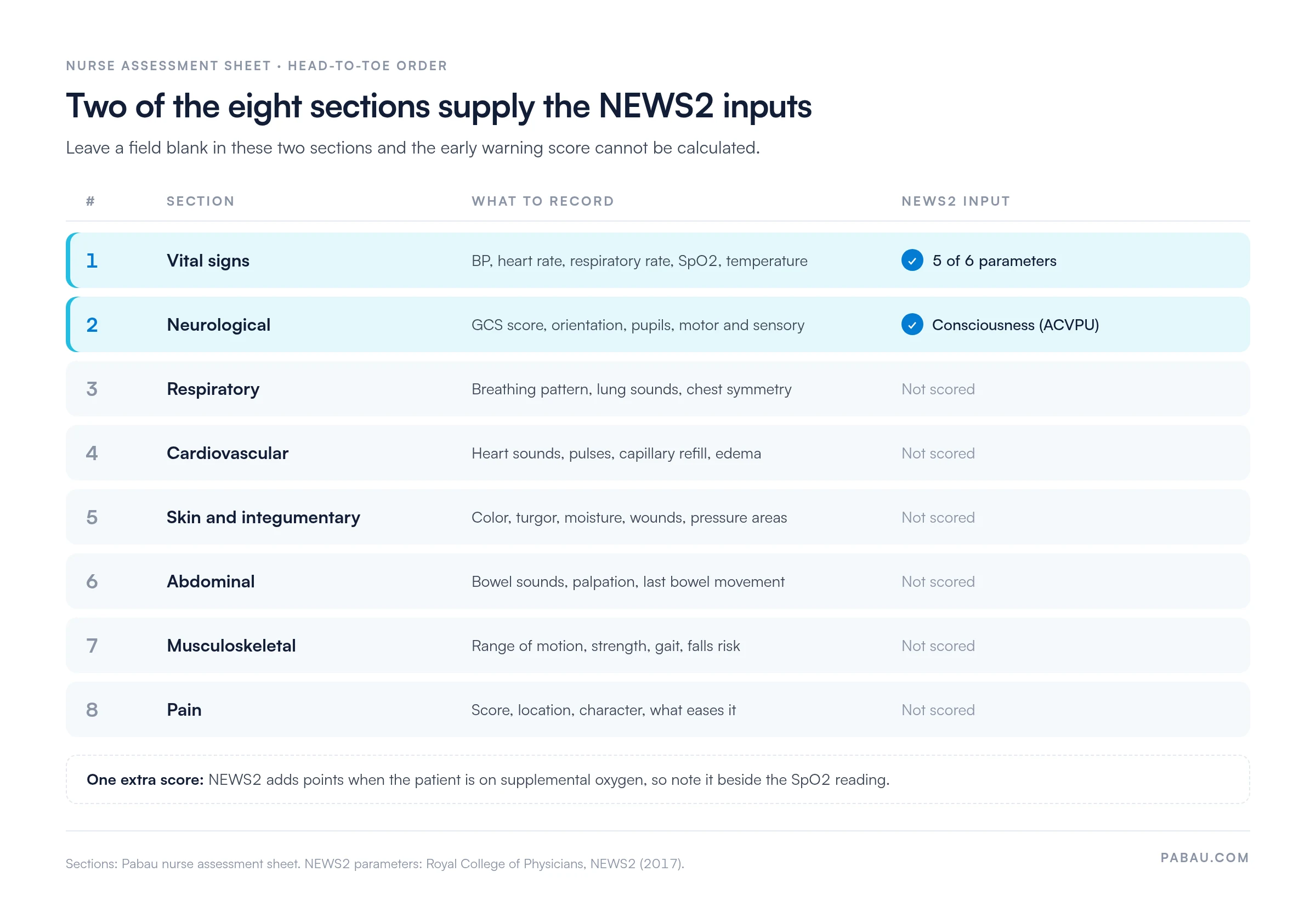
A complete sheet covers every system in a head-to-toe assessment. The table below lists what to record in each section.
Vital signs and neurological status usually carry the most weight in a deterioration review. NEWS2, the early warning score used across NHS England, draws on the same observations, so recording them accurately on the sheet matters.
NEWS2 scores six physiological parameters: respiratory rate, oxygen saturation, systolic blood pressure, pulse rate, level of consciousness and temperature. Five of them sit in the vital signs section of this sheet.
Consciousness comes from the neurological section, and NEWS2 records it on the ACVPU scale rather than the Glasgow Coma Scale. Where the neurological findings need more detail, a dedicated level of consciousness assessment takes the check further.
NEWS2 also adds points when the patient is on supplemental oxygen, so note it beside the oxygen saturation reading. The chart below maps each section of the sheet against the score.
The skin section works the same way for pressure injuries. Where it flags a pressure area, a Braden Scale score adds a structured risk rating to the finding. Poor turgor logged beside vomiting in the abdominal section points to fluid loss. A dehydration care plan turns those findings into a PES statement, measurable goals and interventions.
A head-to-toe nursing assessment is a systematic physical check that moves through each body system in a fixed order. The sheet mirrors that order so no section is skipped under time pressure.
Start with the observations that take least time and give the most information, then move to hands-on examination. Keep the patient informed and check for consent at each stage.
Thoroughness should never delay escalation. If a finding changes the clinical picture, escalate first and complete the remaining sections afterward. A neurological finding that triggers escalation is usually rechecked at set intervals. A neuro check form records each round in the same structure, so a change in GCS, pupils or motor function stands out.
Good documentation records what was observed, when, and by whom. It avoids vague phrases such as “looks well” and replaces them with specific findings.
For data protection, the Health Insurance Portability and Accountability Act (HIPAA) governs patient records in the United States. In the UK, the UK General Data Protection Regulation (UK GDPR) applies to digital assessment records. Confirm the requirements that apply in your setting before storing assessment data electronically.
Paper sheets are easy to start with but hard to search, audit and share. A scanned form sits in a folder, and comparing today’s findings with last week’s means pulling out both pages.
Pabau, the all-in-one practice system we build, lets you rebuild this sheet as a digital form in its patient intake software. Each completed assessment then saves against the correct patient instead of a loose file.
Pabau’s medical records software keeps every completed assessment in date order, so clinicians can compare findings over time. Pabau Scribe, our AI scribe, can help draft clinical notes from a consultation. Every note still needs clinician review before it is signed.

Pabau’s digital forms save each nursing assessment to the patient record in date order. Your team can compare findings at every handover without pulling paper files.

A nurse assessment sheet earns its place when every nurse on the team fills it in the same way. Fix the order, treat the vital signs and neurological sections as mandatory, and write “not assessed” instead of leaving blanks. Then a handover or an audit can rely on the sheet alone.
The trade-off is time. A full head-to-toe check takes longer than a quick look, so save it for admission, handover and deterioration. When a finding demands action, escalate before you finish the form.
If your sheets still live on paper, moving them into the patient record is the next step. Book a demo to see how Pabau keeps each nursing assessment where your whole team can find it.

Assessing patients in the emergency department? Emergency nursing assessment template adapts the head-to-toe check to triage and the ABCDE approach.
Need a quick reference while you chart? Nurse charting cheat sheet gives you a quick reference for consistent nursing notes.
Handing over at the end of a shift? Nursing handoff report gives the next nurse a structured summary of each patient.
Neurological section flagging a change? Cranial nerve nursing assessment walks through each of the 12 nerves with a printable checklist.
Admitting a new patient? Intake assessment and evaluation template captures history and baseline findings at the first visit.
A nursing assessment sheet includes vital signs, neurological, respiratory, cardiovascular, skin, abdominal, musculoskeletal and pain sections, plus patient identifiers and assessor sign-off.
A complete sheet has one section per body system, in a fixed head-to-toe order. Local policy may add specialty-specific sections, such as wound or continence assessment.
Nurses usually complete a full assessment at admission and at handover, then repeat it when the patient’s condition changes. Your organization’s policy sets the exact frequency.
Yes, digital forms in practice management software can capture the same structured sections and store them in the patient record. Check that the platform meets the data protection rules that apply to your setting.