Anemia nursing care plan
An anemia nursing care plan is a structured document that guides a nurse from as...

1
Last Updated: Oct 9, 2026
Braden Scale nursing assessment is a six-part scoring tool that predicts a patient’s risk of pressure injury before any skin damage develops. Nurses score sensory perception, moisture, activity, mobility, nutrition, and friction and shear. Five subscales run from 1 to 4 and friction and shear runs from 1 to 3, so totals fall between 6 and 23.
A total of 18 or below means the patient is at risk, and each lower band calls for more intensive prevention. Complete the scale on admission, reassess on a set schedule, and repeat it whenever the patient’s condition changes. This guide covers each subscale, the five risk bands, the low subscale that hides inside a safe total, and how to document every score.
A printable Braden Scale form with a scoring row for each of the six subscales, a total score box, and the five risk bands. It also leaves space to record the interventions each score triggers.
Download template
The Braden Scale scores pressure injury risk across six domains: sensory perception, moisture, activity, mobility, nutrition, and friction and shear.
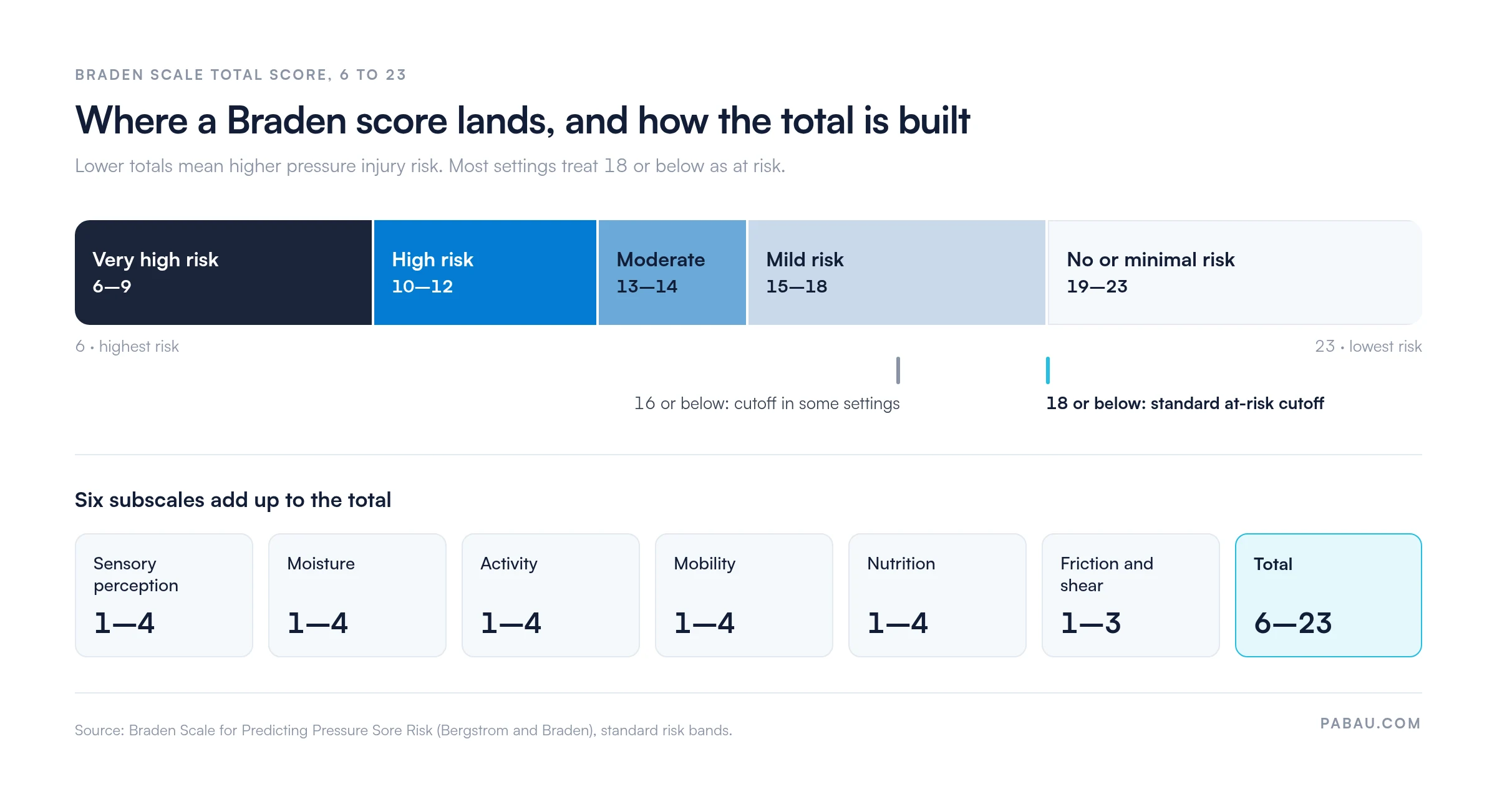
Total scores range from 6 to 23, and a score of 18 or below indicates some level of risk that needs preventive intervention.
A single subscale scored 1 or 2 can hide inside a safe total, so treat it as a trigger in its own right.
Reassessment frequency varies by setting: daily in acute care, weekly or per policy in long-term care, and after any significant change in condition.
Pabau, the practice management platform we build, lets nurses complete the assessment in the patient record, with historical scores visible for trend analysis.
The Braden Scale for Predicting Pressure Sore Risk is a validated assessment tool developed by Barbara Braden and Nancy Bergstrom. They first published the scale in Nursing Research in 1987.
It quantifies a patient’s risk of developing pressure injuries, also called pressure ulcers, pressure sores, or decubitus ulcers. The scale takes about five minutes and needs no special equipment, only clinical observation and a short patient interview.
Pressure injuries develop when sustained pressure cuts blood flow to the skin and underlying tissue. They form most often over bony prominences such as the sacrum, heels, and hips.
The scale exists because clinical judgment alone misjudges risk. Nurses may underestimate vulnerability in immobile patients or overestimate it in patients with minor risk factors. A standard score points prevention at the right patients at the right time.
In practice, the score works as a trigger. When a patient scores 18 or below, the care team starts specific preventive measures and records them in the care plan. Typical measures include repositioning schedules, skin protection, nutritional support, and pressure-redistributing surfaces.
The scale combines two kinds of factors. Sensory perception, mobility, activity, and nutrition reflect how well the patient can respond to pressure. Moisture and friction and shear describe how the environment adds to tissue damage. Each subscale is scored on its own, then the six scores are added together.
This subscale reflects the patient’s ability to sense and respond to pressure-related discomfort. A score of 4 (no impairment) means the patient can shift position or call for help when uncomfortable.
Lower scores, down to 1 (completely limited), apply to patients with altered mental status, sedation, or neurological impairment. For those patients, a level of consciousness assessment helps explain the score.
This subscale measures skin exposure to moisture from sweat, incontinence, wound drainage, or respiratory secretions. A score of 4 (rarely moist) means the skin is usually dry. A score of 1 (constantly moist) means urine, perspiration, or drainage keeps the skin damp almost all the time. Moisture softens the skin and raises the risk of friction and shear injury.
This subscale describes the patient’s usual level of physical activity. A score of 4 (walks frequently) applies to ambulatory patients, and a score of 1 (bedfast) applies to patients confined to bed. Activity shortens the time any one area spends under pressure.
This subscale assesses whether the patient can change and control body position independently. A score of 4 (no limitation) means the patient makes major and frequent position changes without help. A score of 1 (completely immobile) means the patient relies on caregivers for every position change.
This subscale evaluates the patient’s usual food intake and protein adequacy. A score of 4 (excellent) means the patient eats most of every meal and has a stable weight. A score of 1 (very poor) points to inadequate intake, weight loss, or meals mostly left uneaten. A low score here often warrants an imbalanced nutrition care plan, because nutrition drives skin integrity and tissue repair.
This subscale measures the risk of skin trauma from sliding or rubbing during repositioning and transfers. A score of 3 (no apparent problem) applies to patients who move independently. A score of 1 (problem) applies to patients who slide down in bed or chair and need moderate to maximum help to move.
Total scores range from 6 to 23, and lower scores mean higher risk. The chart below shows how the six subscales add up to that range and where each risk band starts.
The standard interpretation thresholds are:
Thresholds vary by institution. Some settings use 16 as the risk cutoff and others use 18, so always follow your facility’s pressure injury prevention protocol.
Two patients can share a total and need very different care. Picture a patient who scores 4 for sensory perception, activity, and mobility, then 3 for nutrition and for friction and shear. If moisture scores 1, the total is 19. That sits in the no-risk band, yet constant moisture is already softening their skin.
So treat any subscale scored 1 or 2 as a trigger in its own right, whatever the total says. Match the response to the domain:
Record each subscale score beside the total. That way the next nurse sees which domain drives the risk, not just how high it is.
On admission: Complete the Braden Scale within 24 hours of arrival, as part of the initial nursing assessment. This sets the baseline risk and starts preventive measures from day one.
Regularly during the stay: Reassess at least daily in acute care settings, or per your facility’s policy. Long-term care facilities typically reassess every three to seven days. Record the date and time of each assessment in the patient’s medical record or EHR.
After a significant change: Reassess immediately if the patient’s condition changes. Declining mobility, reduced food intake, new incontinence, and a change in mental status can all shift the risk band and require updated prevention.
The total score sets the baseline intensity of prevention. Use this mapping to link the assessment outcome to action:
Document each intervention in the care plan alongside the Braden score that triggered it. That creates an audit trail linking assessment to action.
Paper forms: Complete all six subscales legibly, enter the total score, and date, time, and sign the form. File it in the patient’s chart, and have it countersigned if your facility requires that.
EHR documentation: Many facilities now build the Braden Scale into their EHR. Nurses enter each subscale score in its own field, and the system calculates the total. Linking the score to the care plan can prompt the nurse to select the matching interventions.
Every entry should carry the date, the time, and the assessing nurse’s name. Storing historical scores also makes trends visible during patient rounds.
Common pitfalls: Avoid scoring by rote, such as defaulting to 3 on every subscale because the patient “seems moderate.” Reassess clinically each time, and note the finding behind each score (for example, “Sensory: 2 – patient sedated, does not respond to verbal stimuli”). Auditors look for this detail, and it follows the same principles as wider nursing documentation.
Other validated risk scales exist, and the Norton Scale and Waterlow Score are the most common. The Braden Scale is predominant in US acute care and many other settings, thanks to its research base and quick administration.
The Norton Scale covers similar domains with slightly different scoring weights. The Waterlow Score, widely used in UK nursing, is more complex and adds factors such as BMI and existing wounds. Most settings choose one scale and standardize on it for consistency and staff familiarity.
The Braden Scale was validated mainly in adult acute care, and its reliability varies across patient populations. It may underestimate risk in ICU patients on sedation and mechanical ventilation. Their immobility is extreme, but the subscales don’t fully capture it.
The scale was not developed for children, whose physiology and pressure distribution differ. Pediatric patients are assessed with a separate tool, the Braden Q scale.
The tool identifies risk, but it does not replace clinical judgment. Pair every Braden score with a head-to-toe check on a skin assessment form, the patient’s history, and your facility’s protocol.
On paper, a Braden form gets filed in the chart and the trend lives in someone’s memory. Comparing today’s score with last week’s means pulling old sheets, and a missed reassessment often surfaces only at audit.
With Pabau’s patient intake software, the Braden Scale becomes a digital form completed directly in the patient record. Each completed assessment is stored against that patient, and historical scores stay visible for trend analysis.
So the nurse on the next round can see whether risk is rising before the skin shows it. And when an auditor asks for the history, it is already in one place.

Pabau’s digital forms let nurses complete the Braden Scale in the patient record, with past scores on hand for trend analysis. That means fewer paper sheets to chase and a clear history at audit.

The Braden Scale earns its place when it becomes a habit rather than an admission task. Score it on admission, rescore on schedule and after every change, and act on the lowest subscale as well as the total.
The trade-off is time. Five minutes per patient adds up across a unit. Even so, prevention at the risk stage costs far less than treating a stage 3 or 4 injury.
Start with the template, set the cutoff your facility uses, and audit a week of scores to check your team rates subscales consistently. Book a demo to see how Pabau keeps each Braden score and its history in one patient record.

Admitting a patient through the ED? Emergency nursing assessment template covers the initial assessment where the first Braden score usually starts.
Want faster charting on every shift? Nurse charting cheat sheet lists the phrasing and structure that keep entries complete.
Writing notes that hold up at audit? Focus charting (F-DAR) shows how to document a pressure injury concern as data, action, and response.
Caring for sedated or ventilated patients? ICU note template gives you a systems-based note for the patients the Braden Scale underscores.
Scores of 19 to 23 indicate no or minimal pressure injury risk and need only standard preventive skin care. Scores of 18 or below indicate some level of risk, with interventions matched to the score band.
Scores of 12 or below indicate high or very high risk. These patients need intensive prevention, including repositioning every 1–2 hours, a pressure-redistribution mattress, nutritional support, and often a wound care specialist.
The Braden Scale was validated for adult populations. Pediatric patients are assessed with the Braden Q scale, which adjusts the subscale descriptions and scoring for children’s physiology and development.
A score of 18 sits at the top of the mild-risk band. Some facilities use 16 as the cutoff instead, so check your protocol. Apply mild-risk prevention, such as repositioning every 2 hours and a daily skin check, and reassess regularly.
Reassess at least weekly, and many facilities do it every three to seven days as part of routine care plan review. Reassess immediately after any significant change in mobility, continence, nutrition, or consciousness.
No. A low score signals elevated risk and the need for prevention, and consistent prevention can stop an injury from forming. A high score does not guarantee safety either, so clinical assessment still matters for low-risk patients.