Head to toe assessment cheat sheet: Printable nursing guide
A head to toe assessment cheat sheet gives you one fixed order at the bedside, s...

Last Updated: Oct 23, 2026

SBAR stands for Situation, Background, Assessment, Recommendation. It is the handoff structure AHRQ teaches as part of its TeamSTEPPS program.
Each section answers one question: what is happening, why, what it means, and what you need from the person listening.
Nurses use SBAR at shift change, on escalation calls to a provider, during patient transfers, and in rapid response situations.
A complete handoff runs two to three minutes. Going longer usually means Background is carrying detail the listener does not need.
Practice management software like Pabau can hold the same four sections inside the patient record, so every handoff is documented the same way.
A ready-to-use form with guided prompts for all four SBAR sections. Fields cover patient identifiers, allergies, current status, and the specific action you are requesting. Use it at shift change, on provider calls, and during transfers.
Download templateCommunication failures are the most common root cause of serious adverse events in healthcare.
The Joint Commission attributes roughly 70% to 80% of sentinel events to them. Handoffs are where those failures concentrate, because patients move between shifts, departments, and care settings on inconsistent language.
The SBAR nursing handoff framework reduces that variability by fixing what gets communicated, and in what order. SBAR stands for Situation, Background, Assessment, and Recommendation. AHRQ teaches it as part of the TeamSTEPPS program, and it is now standard in hospitals, practices, and care coordination teams.
This guide walks through the five-step process, explains what belongs in each section, and gives you two worked scripts. The free template above is yours to print or rebuild inside your own records system.
The SBAR nursing handoff is a standardized communication technique that moves critical patient information safely between clinicians. Michael Leonard’s team at Kaiser Permanente formalized it for healthcare, adapting it from U.S. Navy communication protocols. AHRQ now teaches it as part of TeamSTEPPS, short for Team Strategies and Tools to Enhance Performance and Patient Safety.
Free-form handoff conversations lose details. SBAR gives every clinician the same sequence to follow: Situation, then Background, then Assessment, then Recommendation. That consistency cuts misunderstandings, shortens the handoff, and makes the record easier to audit afterward.
SBAR is a communication discipline rather than a clinical guideline or a diagnosis tool. It works because it follows the order clinicians already think in. First the problem now, then the history behind it, then the judgment, then the request. The structure forces precision without asking anyone to think differently.
The template guides you through five steps. Each one matches a moment in your workflow, whether you are calling a provider, briefing the incoming shift, or documenting a transfer. Fill in the patient-specific details as you work down the form.
A full handoff should take two to three minutes. If yours runs longer, Background is usually carrying detail the listener does not need.
You do not have to keep the form on paper. Practice management software like Pabau can host the same five steps inside its patient intake software. The completed handoff then saves straight to the patient’s record.
The four sections are easy to name and easy to blur together. What keeps them separate is the question each one answers, and the material that answers a different question.
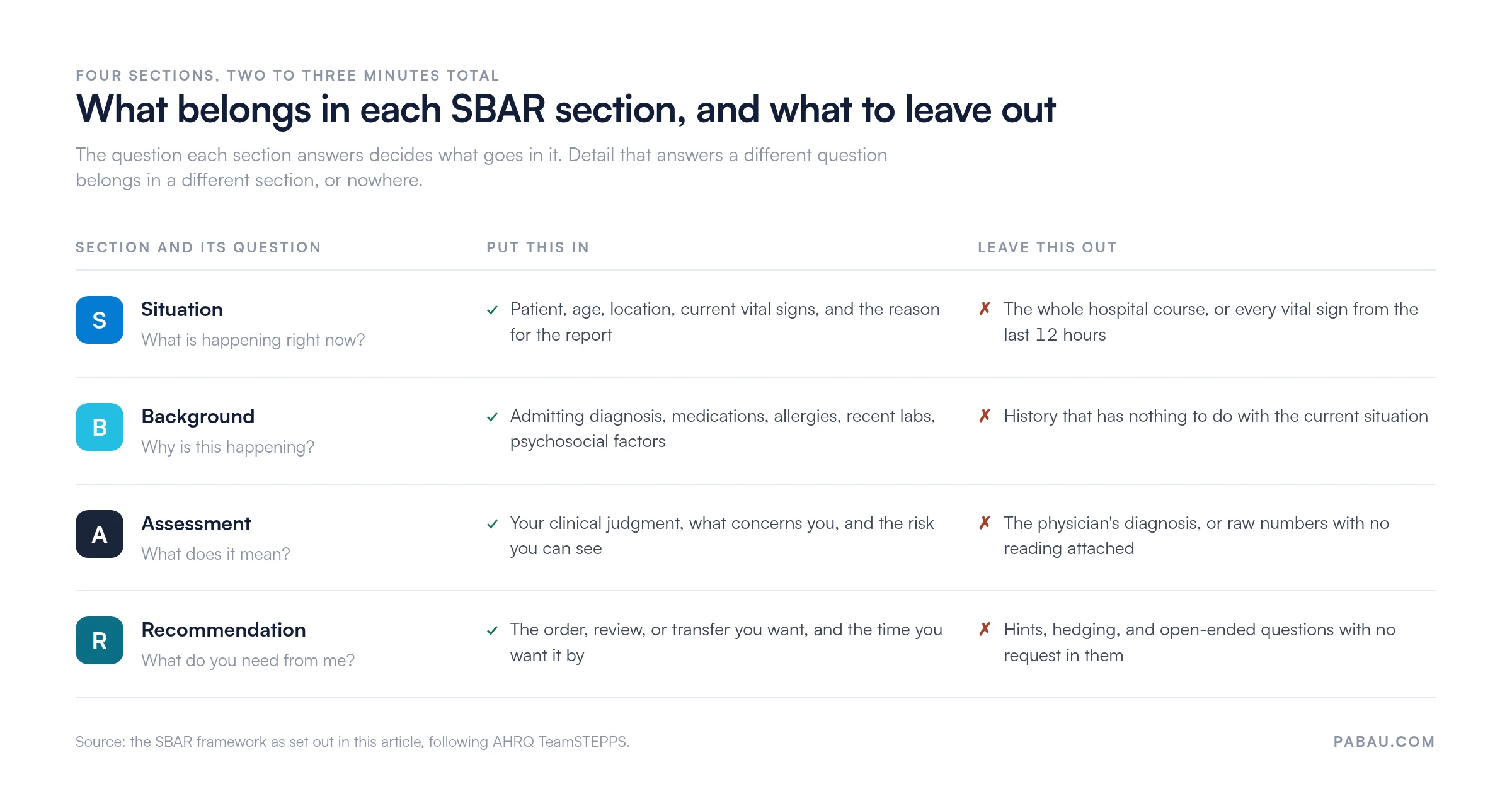
The Situation section answers one question: what prompted this handoff? Include the patient’s name and age, the diagnosis, current vital signs, and the reason you are communicating. Examples: new onset chest pain, post-op day 2 with increased drainage, or a request to adjust pain medication.
What to leave out: the entire hospital course, and every vital sign from the last 12 hours. Situation is the snapshot as of now.
Background connects the Situation to the patient’s history. Include the admitting diagnosis, relevant past medical history, current medications, and allergies with their reactions. Add recent procedures, lab or imaging findings, and psychosocial factors that affect care, such as dementia or a language barrier.
What to leave out: history unrelated to the current Situation. Keep Background tied to why the patient is presenting this way today.
Assessment is your clinical judgment, not the physician’s diagnosis. It is your reading of what is happening, drawn from the Situation and the Background you just gave.
Examples: “I’m concerned he’s having a vasovagal response to the procedure.” “Her pain is not controlled on the current analgesics.” “He is more confused than baseline and showing early signs of delirium.”
Be explicit about what you are requesting. Do not hint, and do not ask an open-ended question. Say it plainly: “I need a new pain medication order.” “Can you assess this wound before shift change?” “I recommend transfer to the ICU for continuous monitoring.”
A recommendation the listener can act on is one they can agree with, push back on, or replace with an alternative.
SBAR applies to any clinical handoff. These are the scenarios where teams reach for it most:
Shift change is only the most visible case. Wherever a clinician has to pass on critical information under time pressure, the structure is what prevents an omission.
Situation: “This is Mr. Ahmed, 67, room 312. He’s post-op day 1 from a total knee replacement. His pain is 8/10 despite morphine 4 mg IV at 14:00. He’s refusing to get out of bed because of the pain.”
Background: “He’s on metformin for type 2 diabetes, and his last glucose was 142. He’s allergic to penicillin, which gives him a rash. He had hypertension pre-op and his blood pressure is now running 148/92. His wife is here during the day but leaves at 17:00.”
Assessment: “I think his pain is poorly controlled. He’s anxious about mobilizing and worried about falling. Without better pain control he won’t do his physical therapy tomorrow, which raises his clot and pneumonia risk.”
Recommendation: “Can you call the surgeon before night shift? I’d like to discuss switching to scheduled oxycodone instead of as-needed morphine. It would also help if the physical therapist saw him first thing, because seeing the plan should settle his anxiety.”
Situation: “Hi Dr. Singh, this is Emma, RN on the respiratory unit. I’m calling about your patient James Wong in bed 14. Over the last 2 hours his oxygen saturation has dropped from 94% to 89% on 4 liters of supplemental oxygen. He’s more short of breath than he was this morning.”
Background: “He was admitted 3 days ago with community-acquired pneumonia and he’s on IV cefuroxime. Yesterday’s chest X-ray showed bilateral infiltrates. He’s a 58-year-old smoker with chronic bronchitis. He has no fever, his last temperature was 98.2, and he’s alert and oriented.”
Assessment: “I’m concerned his pneumonia is not responding. His saturations are trending down despite antibiotics and he’s becoming more symptomatic. I’m worried about progression to sepsis or respiratory failure.”
Recommendation: “I’d like you to review him before the end of shift. He may need escalation of antibiotics or a move to step-down or ICU-level monitoring. What would you like me to do in the meantime?”
Both scripts follow the same order every time. Our SBAR examples guide works through more scenarios if you want additional wording to adapt.
SBAR reduces handoff errors because every clinician follows the same structure. A systematic review in BMJ Open found moderate evidence that SBAR improves patient safety. The effect was clearest for handoffs conducted by phone.
SBAR is not the only structured handoff framework in use. I-PASS and ISOBAR are the two alternatives you are most likely to meet. Here is how they compare:
Which should you use? If your organization already uses SBAR, stay with it. Consistency across the team matters more than the framework you pick. If you are building handoff protocols from scratch, SBAR has the widest support and the best fit with existing clinical software.
ISOBAR suits UK teams that want a formal read-back step. I-PASS is the framework most pediatric hospitals have adopted.
A paper SBAR form works for one nurse on one shift. Holding the same standard across a dozen clinicians, three shifts, and two sites is a different job. Pabau’s structured clinical notes handle that by building the four sections into the patient record itself.
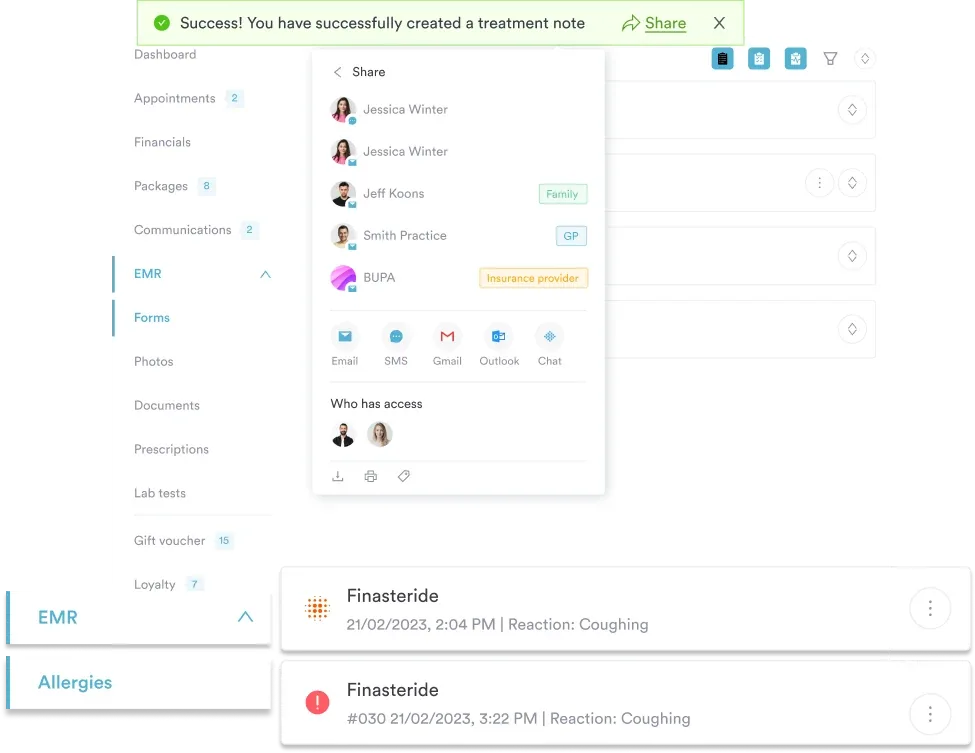
An AI medical scribe takes the typing out of it. Pabau Scribe, our AI scribe, drafts the note from the consultation audio and sorts it into Assessment, Background, and Recommendation. The incoming clinician then opens the full handoff history in context.
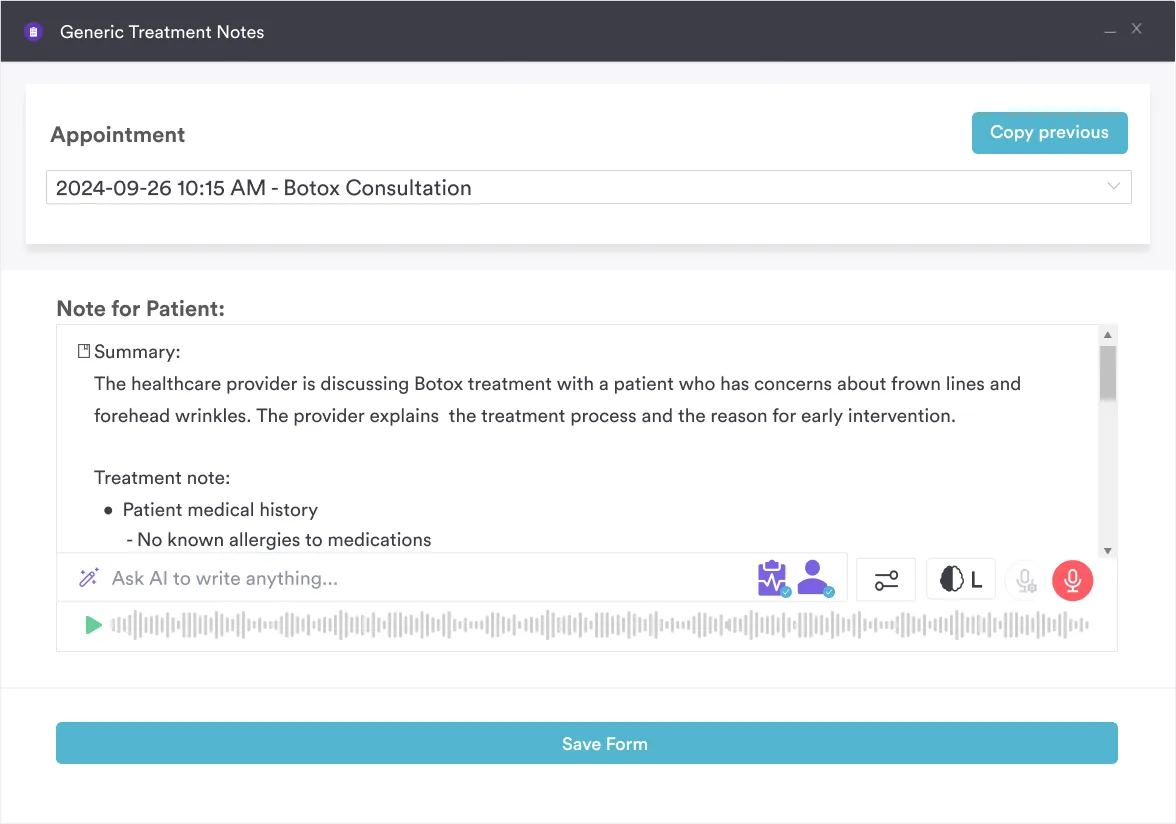
The result is fewer transcription errors, faster handoffs, and an auditable record of each one. Multi-location practices and care networks gain the most, because every site works from the same structure.

Pabau’s structured clinical notes and AI-drafted documentation keep your team on the same page at every shift change.

Handoffs fail on omission, not on effort. SBAR answers that by deciding in advance what has to be said, and in what order. That is why it holds up on a busy unit when a free-form report does not.
Download the template, walk your team through the five steps, and use it at the next shift change. Expect the first few handoffs to feel slow. The two-to-three-minute version arrives once the order stops needing thought.
If you are standardizing handoffs across several clinicians or sites, the form is only half the work. Book a demo to see how Pabau keeps every handoff note structured and searchable inside the patient record.

Need a form for the first assessment, not the handoff? Emergency nursing assessment template structures the primary and secondary survey so nothing is recorded twice.
Writing up the shift after the handoff? Nursing documentation covers what belongs in the note and how to keep it defensible.
Standardizing safety checks in theater? WHO surgical safety checklist applies the same read-back logic to sign-in, time-out, and sign-out.
Comparing systems to hold all of this? Clinical documentation software explains what to look for before you move your notes off paper.
SBAR stands for Situation, Background, Assessment, and Recommendation. It is a structured communication framework used by nurses and other clinicians to transfer critical patient information clearly during handoffs, provider calls, and care transitions.
A complete SBAR handoff usually takes two to three minutes. If it takes longer, you are probably including history the listener does not need, or explaining your assessment at length. Use the template to stay focused.
Nurses use SBAR at shift change, on provider escalation calls, during transfers between units, in interdisciplinary rounds, in rapid response situations, and on admission briefings. Any moment that calls for clear reporting of patient status benefits from the structure.
The Joint Commission does not mandate SBAR by name, but it does require standardized handoff communication under its National Patient Safety Goals. SBAR is the most widely recommended framework for meeting that requirement.
Yes. SBAR works in hospitals, practices, aged care, mental health, physical therapy, and community health settings. Any environment where clinicians report on patients can use it. Some settings prefer a variant such as ISOBAR or I-PASS.
Ask them to explain their reasoning. A good handoff is a dialogue: you give your assessment and recommendation, the provider gives theirs, and you agree on the next step. Document the conversation and the agreed plan in the patient’s notes.