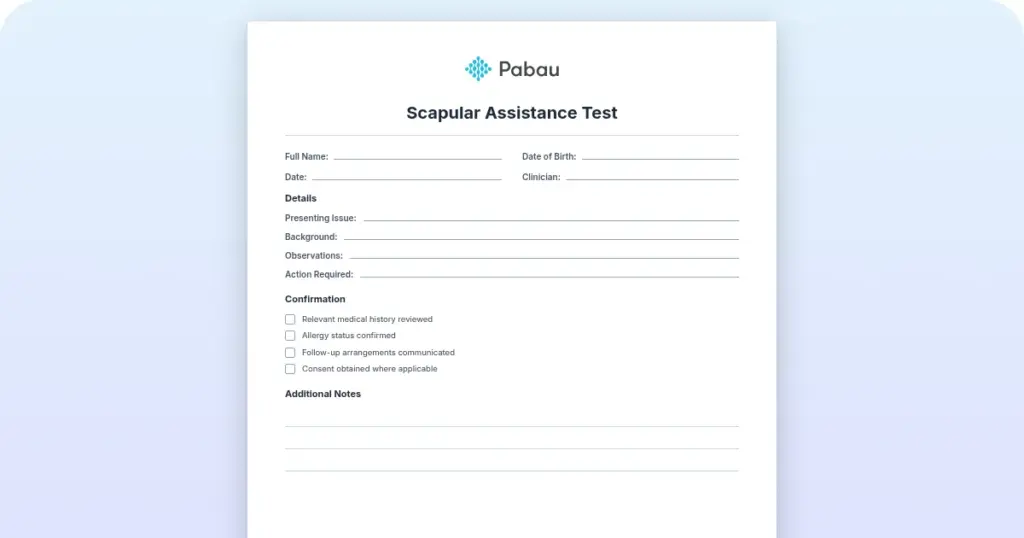
Scapular assistance test: Procedure, interpretation and free template
The scapular assistance test is a manual examination in which the clinician supp...

1
Last Updated: Oct 19, 2026

A nursing handoff report transfers a patient’s clinical status, medications, allergies, and pending orders from one nurse to the next.
The Joint Commission names handoff failures as a leading cause of sentinel events, and I-PASS cut preventable adverse events by about 30%.
Essential content includes demographics, diagnosis, medications, allergies, vital signs, recent changes, pending orders, the discharge plan, and safety alerts.
Pick one framework and use it every shift. SBAR suits acute care, I-PASS suits unstable patients, and PACE suits primary care.
Pabau’s digital forms and patient records template the handoff and pre-fill patient data, so nurses type less at shift change.
One page covering demographics, diagnosis, medications, allergies, vital signs, clinical status, pending orders, and discharge planning. It has sections for SBAR, I-PASS, and PACE, so you can pick a framework and use it from the next shift.
Download templateA nursing handoff report is the structured summary a departing nurse gives the incoming nurse at shift change. It covers the patient’s current status, active medications, allergies, pending orders, and the risks the next nurse has to watch for. When it is thin or rushed, a dose gets missed or an allergy gets overlooked.
This guide sets out what belongs in the report and how the three common frameworks differ. It also covers how to roll the template out in your own practice. The free PDF above is ready to print or import into your patient records.
A nursing handoff report is a structured tool for transferring patient care responsibility from one nurse to another, most often at shift change. It documents the patient’s current status, active treatments, medications, allergies, recent clinical events, and any pending orders or interventions.
The format varies by facility and clinical setting. Some practices use a simple paper form. Others build handoff documentation into their structured clinical record system. Consistency matters more than the format, because every nurse needs to know what to convey and in what order.
The handoff report is not the same as general nursing notes. It focuses on what the incoming nurse needs in order to assume care safely. That keeps it concise, problem-focused, and action-oriented rather than a full historical record.
Structured handoffs prevent harm because they stop information falling out of the conversation. The Joint Commission has identified poor handoff communication as a leading cause of sentinel events. Those are the serious safety incidents a facility has to report and investigate.
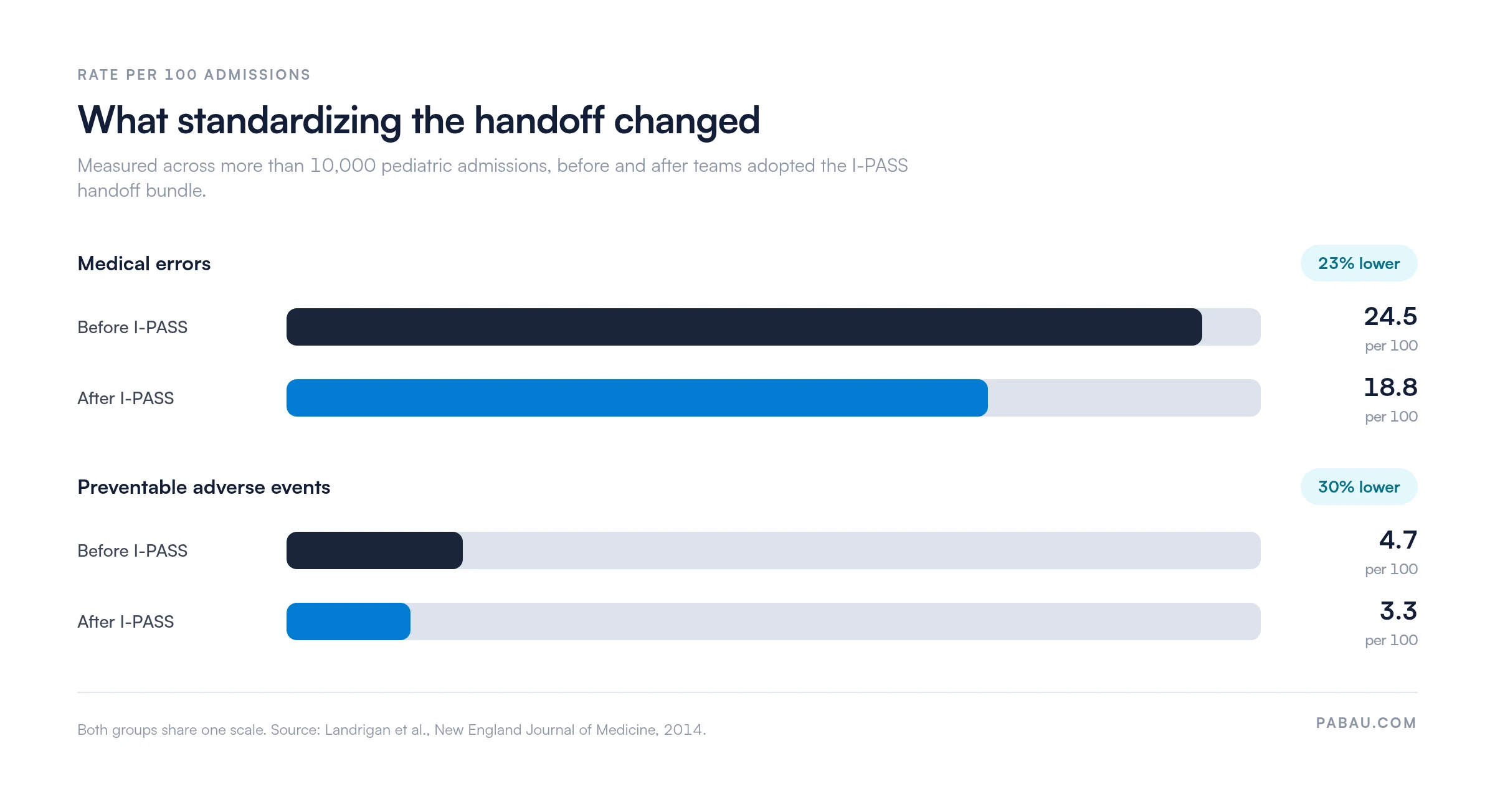
The clearest evidence comes from the I-PASS study, published in the New England Journal of Medicine in 2014. Across more than 10,000 pediatric admissions, preventable adverse events fell by roughly 30% after teams adopted a standard handoff. The overall medical error rate dropped by 23%.
The two measures moved by different amounts, and they are worth seeing side by side.
Bedside handoffs push those numbers further. Taking the report at the bedside lets the incoming nurse ask questions in the moment, and lets the patient confirm allergies and history out loud.
For your practice, that means fewer follow-up problems, better adherence to the care plan, and less liability exposure. A structured handoff protects the patient and the team at the same time.
A complete handoff captures the data the incoming nurse needs to provide safe, continuous care. Formats vary, but these core elements belong in all of them:
Your medical forms should carry a labeled section for each of these. On paper or on screen, every field has to be easy to find mid-handoff. A nurse skim-reading at 7 AM will not hunt for a buried allergy.
Three standardized frameworks dominate clinical handoff practice. Each suits a different setting and patient population. The point is to pick one and use it consistently across the team.
SBAR is the most widely used handoff framework in acute care. Each letter names a section of the report:
SBAR works because it follows how clinicians already think through a problem. Situation, then context, then interpretation, then action. It runs two to three minutes per patient and leaves little room for an omitted detail.
Want that structure on its own page? The SBAR report template breaks the four sections out into fields your team can fill in order.
The AHRQ TeamSTEPPS program endorses I-PASS as a best-practice framework, especially in pediatric and acute care. The mnemonic stands for:
The synthesis step is what sets I-PASS apart, because it catches misunderstandings while both nurses are still in the room. The framework also flags deterioration risk explicitly, which makes it a good fit for unstable patients.
The I-PASS handoff template lays those five sections out as prompts, which is useful if you want to trial the framework with one team first.
PACE is common in community health and home care, where updates are shorter and the nurse already knows the patient:
PACE is looser than SBAR. It suits primary care, where you know your patients well and changes are usually incremental rather than acute.
One thing no mnemonic does is cover the whole field list above. None of the three prompts by name for lines and drains, isolation status, or fall risk. That is why the template keeps those as separate checkboxes, whichever framework your team adopts. Critical care units track more fields than that, so an ICU handoff sheet also holds drips, ventilator settings and line details.
A bedside handoff means the incoming nurse takes the report at the patient’s bedside, usually with the patient present. It is standard in many hospitals and increasingly common in outpatient practices.
The benefits are immediate clarification, patient verification of allergies and history, and less miscommunication. Patients also feel more involved in their care, and they can raise a concern on the spot.
A bedside report takes a couple of minutes longer than a corridor one, and it pays that time back in safety. Ask nurses to make eye contact with the patient, verify key facts aloud, and invite questions before they close the handoff.
Practices have to decide whether handoff reports stay on paper or move into an electronic medical record (EMR) or practice management system. Each route has tradeoffs.
For most practices, electronic documentation wins on both safety and audit trail. Practice management software like Pabau combines patient intake software with structured clinical records, so a handoff form opens pre-filled with demographics, medications, and allergies.
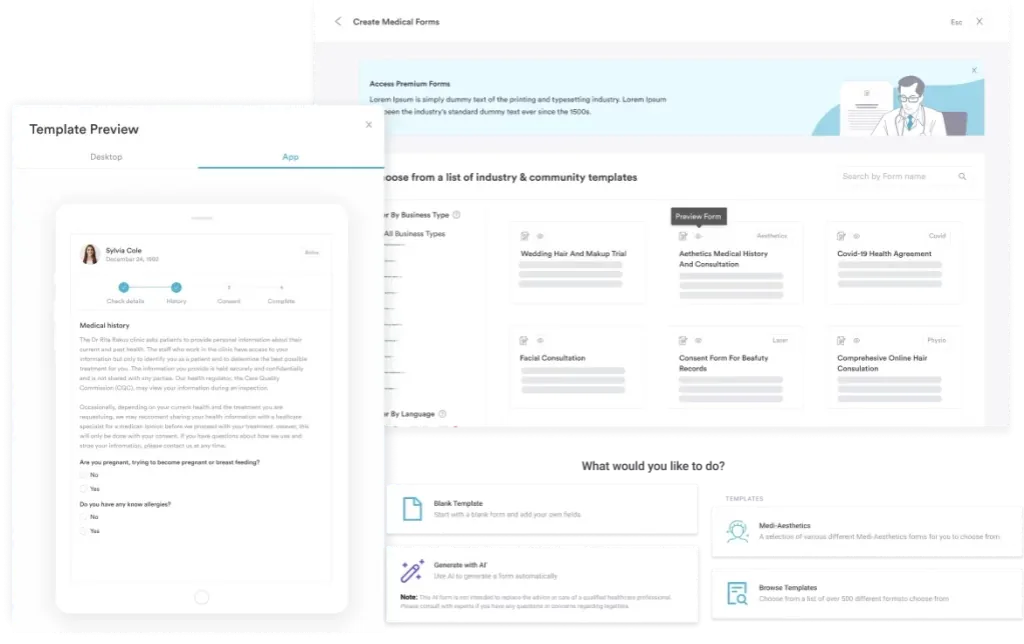
The free template above is ready to use as it is. Here is how to put it into practice:
Test the template with one nursing team for a week before it goes practice-wide. Ask which fields were confusing and what was missing, then adjust the layout before it becomes the standard.
Most practices still run the handoff on paper. The departing nurse writes out demographics, medications, and allergies that already sit in the patient record. The page then gets shredded at the end of the day. It leaves no audit trail, and the same data gets written twice.
Pabau moves that work into the patient record instead. You build the handoff once as a digital form, and each report opens pre-filled with the patient’s demographics, current medications, and flagged allergies. The nurse adds what changed on this shift, rather than what was already known.
Because the form saves against the patient file, every report is timestamped and attributed to whoever completed it. That gives you a documented handoff for each shift change, with no filing cabinet to keep. Several parts of the job stop being manual:
What your team feels day to day is a shorter handoff and less typing. Nurses spend those minutes with patients instead of transcribing information the system already holds.

Pabau’s digital forms and patient records pre-fill the handoff and save it against the patient file. Nurses type less, and every shift change leaves a timestamped record.

Standardizing the handoff is the cheapest patient-safety change most practices can make. It costs a printed form and a short team briefing, and the evidence behind it is stronger than for most process changes.
Pick one framework and hold the team to it. Consistency is what does the work here, not the particular mnemonic. A team that uses SBAR every shift is safer than a team switching between three frameworks.
Download the template above, run it with one team for a week, then make it the standard. Book a demo to see how Pabau turns each shift handoff into a timestamped record in the patient file.

Need a report that covers the whole shift? Nursing shift report template documents a full shift rather than the moment of transfer.
Running handoffs at the bedside? Bedside shift report template structures the report for a conversation with the patient in the room.
Closing out a shift? End of shift report template gives the departing nurse a checklist to work through before the handoff starts.
Want a working sheet for the shift itself? Nurse brain sheet keeps vitals, tasks, and timings in one place while you work.
Reviewing how your team documents care? Nursing documentation explains what the record has to show and where paper falls short.
Use one framework and follow it every time: SBAR, I-PASS, or PACE. The departing nurse reviews the patient’s current status, medications, allergies, and pending orders. That summary goes to the incoming nurse, either at the bedside or in a dedicated handoff area. Budget two to five minutes per patient, depending on complexity. Then ask the incoming nurse to summarize it back, so you know it landed.
SBAR stands for Situation, Background, Assessment, Recommendation. Situation describes the current problem and the patient’s status. Background gives the relevant history. Assessment is your clinical interpretation. Recommendation states what should happen next. SBAR is the most widely used framework in acute care, because it is quick and its four sections are hard to skip.
SBAR suits acute care and fast handoffs. I-PASS adds illness severity and a synthesis step, so the incoming nurse repeats the report back to confirm it. AHRQ endorses I-PASS, and it is the strongest fit for unstable patients. PACE is simpler and works well in primary care and home health, where you already know the patient. Pick the one that fits your setting, then stick with it.
Two to five minutes per patient is typical. A stable patient with little change takes two or three minutes. An unstable patient with recent events and several pending orders can take five to ten. Use a framework to stay focused, and leave out detail the incoming nurse does not need to act on.
A bedside handoff is a report given at the patient’s bedside, usually with the patient present. The patient can confirm allergies and history, and ask questions on the spot. It takes two to three minutes longer than a corridor report. In exchange you get fewer misunderstandings and better patient satisfaction.
Yes. The template at the top of this guide is free to download and use. Print it for the team, or import it into your practice management system as a digital form. It has sections for SBAR, I-PASS, and PACE, so you can pick a framework and train the team on it.