Sulcus Test: Shoulder Instability Assessment
The sulcus test is an orthopedic special test that checks for inferior glenohume...

4
Last Updated: Oct 22, 2026
A head to toe assessment cheat sheet gives you one fixed order at the bedside, so no body system gets lost on a busy shift. Our free version is a printable eight-page form with a short prompt and a Notes box for each of 15 checks.
That matters because a skipped system rarely shows up until handover. The boxes don’t run strictly top to bottom, though, and there’s no section for the abdomen, skin or mood. Pair the form with the sequence below and you’ll know which box to jump to, and what to chart separately.
A fillable eight-page form with patient, clinician and date fields, then a short prompt and a Notes box for 15 checks. They run from consciousness, orientation and vital signs through the head, eyes, neck, chest, heart, arms, legs, ears, genitals, nose, breasts and mouth.
Download template
A head to toe assessment cheat sheet gives you a fixed order for examining each body system and recording findings as you go.
Our printable sheet has 15 prompted Notes boxes but no abdominal, skin or psychosocial section, so chart those in Additional Notes.
A full assessment also includes the abdomen: inspect and listen to bowel sounds before you percuss or palpate.
Pabau, our practice management software, stores treatment notes and client records, so each assessment sits with the patient’s history.
A head to toe assessment cheat sheet is a printable clinical reference listing the checks to make, in order, with room for each finding. Nurses use it on admission, at handover and whenever a patient’s condition changes.
The payoff is consistency. When every assessment follows the same sequence, it’s harder to skip a system on a busy shift. Handover notes also become easier to compare from one shift to the next.
Findings recorded against named systems are easier to audit than a general narrative note, which helps with accurate records and clinical governance. For students, repeating the same order builds the habits that exams and clinical supervisors look for.
The sheet is useful wherever a systematic physical examination is part of routine care. Common settings include:
The table below is a suggested systematic sequence, not the order printed on the sheet. Start with a general survey of appearance and distress, and finish with the psychosocial checks.
A full assessment also includes the abdomen, even though the sheet has no box for it. Listen before you touch. Auscultation comes before percussion and palpation, because handling can change the bowel sounds you’re trying to hear.
Muscle strength is graded on the Medical Research Council (MRC) 0 to 5 scale. That gives you a consistent score to compare across shifts.
Level of consciousness is the first neurological finding to record. The Glasgow Coma Scale (GCS) runs from 3 to 15, and AVPU (Alert, Voice, Pain, Unresponsive) is a quicker alternative when time is short. Our guide to neuro assessment documentation covers what to chart when you need more depth.
Skin checks cover color, temperature, turgor, moisture and wounds. Where pressure injury risk is a concern, many clinical teams also record a Braden Scale score alongside the skin findings.
Use the sheet alongside the sequence above, and jump to each box as you reach that system. Work through these steps at each assessment.
Because the boxes appear in a different order on the page, the map below shows where each step of the sequence lands.
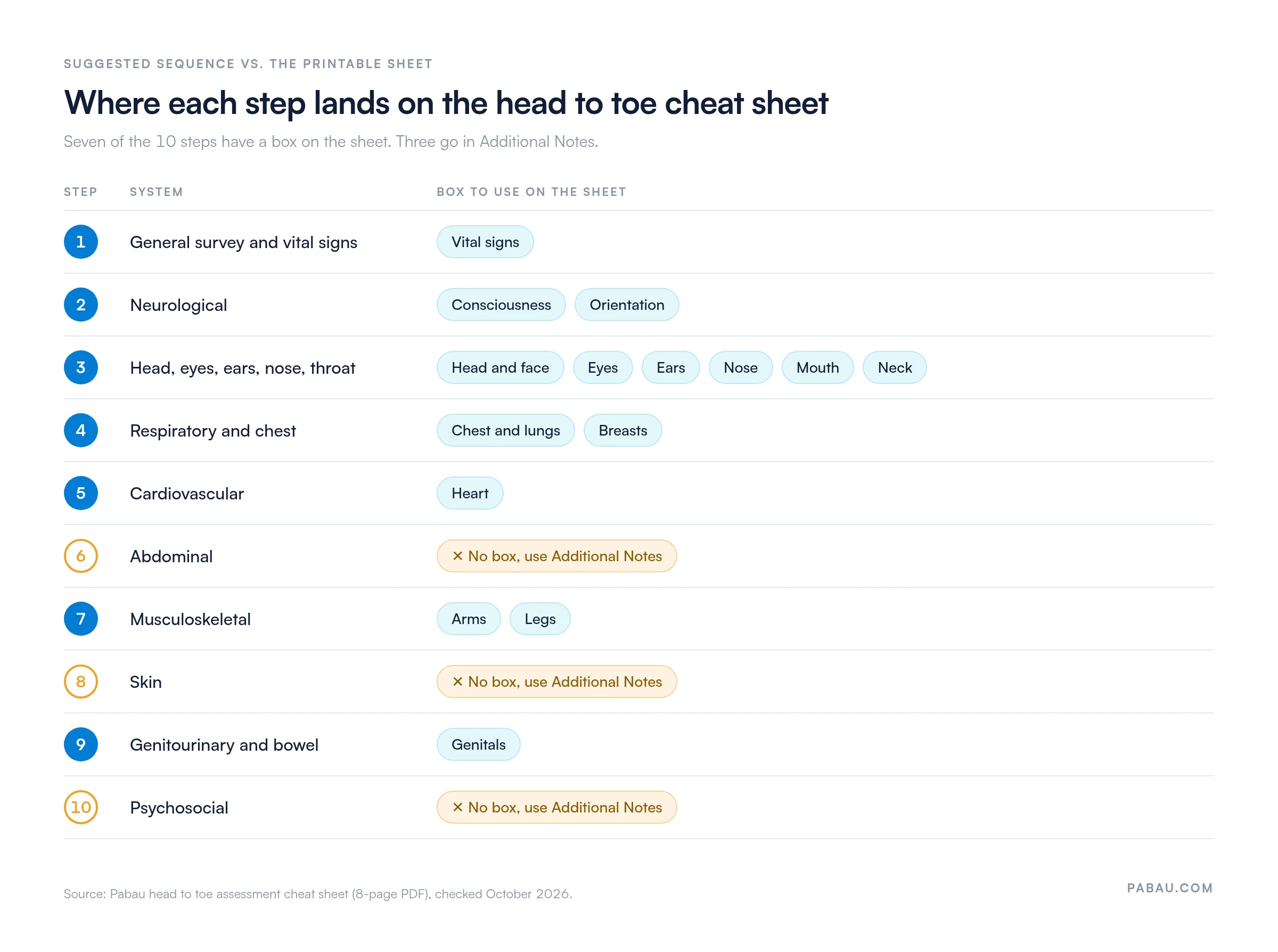
Each prompt on the sheet is a starting point rather than a script. Adapt the depth of each check to the patient in front of you and to your scope of practice.
Document findings against each system in the order you examined them. A structured note is easy to read at handover and easy to audit later.
The principles of good nursing documentation apply here too. Chart what you found, when you found it, and what you did next. When a finding needs escalating, an SBAR handoff turns it into a short, ordered call to the next clinician.
These slips are easy to make on a busy shift, and each one leaves the next nurse guessing.
A rapid head to toe assessment covers the highest-risk checks first, usually within a few minutes. It’s used in emergencies and on busy ward rounds, when a full sequence isn’t possible yet.
A rapid check shows who needs urgent attention. It doesn’t replace the full assessment, which should follow once the situation allows. Injured patients follow a separate rapid trauma assessment with its own sequence.
On paper, a completed sheet ends up in a folder or a scanning queue. Before the next clinician can compare today’s findings with last week’s, they have to find it.
In Pabau, you can rebuild the sheet’s prompts as one of your digital forms and complete it at the bedside. The finished form saves straight to the patient’s record, next to their treatment notes.
Handover gets quicker, because the last set of findings is one click away. Your team stops chasing paper and spends that time with patients instead.

Pabau’s digital forms and treatment notes save each head to toe assessment to the patient’s record. Your team can compare findings across visits without hunting for paper.

Print the sheet, but trust the sequence more than the page. Work from consciousness and vital signs down to the feet, and jump to each box as you reach it. Then put the abdomen, skin and mood in Additional Notes.
Do that every time, and your handover notes start to line up from shift to shift. The cost is a few extra minutes with a stable patient. That’s cheap next to a missed change in a sick one.
If your practice still files assessments on paper, book a demo to see how Pabau keeps each set of findings in the patient’s record.

Working in the emergency department? Emergency nursing assessment template adapts the assessment for acute and emergency care.
Want the techniques behind each check? Physical assessment procedure walks through the core examination techniques.
Need a place to track readings over time? Vital signs record template gives you one place to log readings across visits.
Looking for a simple charting format? Nurse note template gives you a ready structure for routine notes.
Starting your survey from the doorway? General appearance physical examination covers what to observe first and how to record it.
A head to toe assessment cheat sheet is a printable clinical reference listing the body systems to examine, in order. It also names the key checks for each one. It supports a consistent physical examination at admission, at handover and when a patient’s condition changes.
Yes, student nurses can use a cheat sheet as a learning framework during supervised placements. It doesn’t replace clinical training, and findings should be reviewed with a supervisor.
A full head to toe assessment often takes 10 to 30 minutes. The time varies with the patient, the setting and the level of detail. A rapid assessment covering the highest-risk checks is quicker and is used when time is limited.
A focused assessment examines one body system or problem in depth. A head to toe assessment examines every system in a fixed order, to pick up findings that a targeted check might miss.
Usually on admission, once per shift, and again whenever the patient’s condition changes. Your facility’s policy sets the exact frequency for each unit.