Exilis patient treatment record: Free PDF for RF sessions
An Exilis patient treatment record is the session log for BTL’s radiofrequ...

2
Last Updated: Oct 23, 2026

Microneedling aftercare is a structured post-treatment protocol that prevents complications and maximizes collagen induction results.
Recovery spans 1-3 days for visible redness; full skin healing continues for 4-6 weeks below the surface.
Key contraindications: retinoids, AHAs, BHAs, vitamin C for 48-72 hours; sun exposure, exercise, and alcohol for 24-48 hours minimum.
Practice management software like Pabau, with digital forms and pre-care features, lets practices deliver structured, compliant aftercare guidance instantly to every patient.
A ready-to-use post-treatment guidance document covering day-by-day recovery timeline, product recommendations, dos and don’ts, warning signs, and practice contact instructions for microneedling patients.
Download templateA microneedling aftercare template gives every patient the same clear, clinician-approved recovery instructions the moment they leave your treatment room. The first 24 to 48 hours decide whether skin heals smoothly or runs into infection, prolonged redness, or weaker collagen remodeling, so the guidance you hand over has to be specific and consistent. Practice management software like Pabau lets you deliver that guidance automatically, so no patient walks out relying on memory alone.
This guide breaks down what a clinician-facing microneedling aftercare template must include, from the day-by-day recovery timeline to product dos and don’ts. It also covers how RF and PRP microneedling change the protocol, and how to deliver the template to every patient without extra admin.
A microneedling aftercare template is a standardized post-treatment instruction document that guides patients through the healing process following microneedling or radiofrequency (RF) microneedling procedures.
Microneedling works by creating controlled micro-injuries in the skin to stimulate collagen production and improve skin texture, firmness, and appearance of scars. During treatment, the skin barrier is temporarily compromised, creating open micro-channels that require careful management to prevent infection and allow optimal healing.
An aftercare template documents the expected healing timeline, product recommendations, activity restrictions, and warning signs that require clinical follow-up. It protects both patient safety and practice liability by ensuring every patient receives identical, evidence-based guidance regardless of appointment time or practitioner seniority. The template also reduces phone calls and email inquiries by answering the most common post-treatment questions upfront.
In clinical practice, aftercare templates are typically printed at the end of the appointment. Delivering aftercare consistently and immediately, rather than leaving it to memory.
A structured set of microneedling aftercare instructions, delivered as a template, guides both practices and patients through five operational steps:
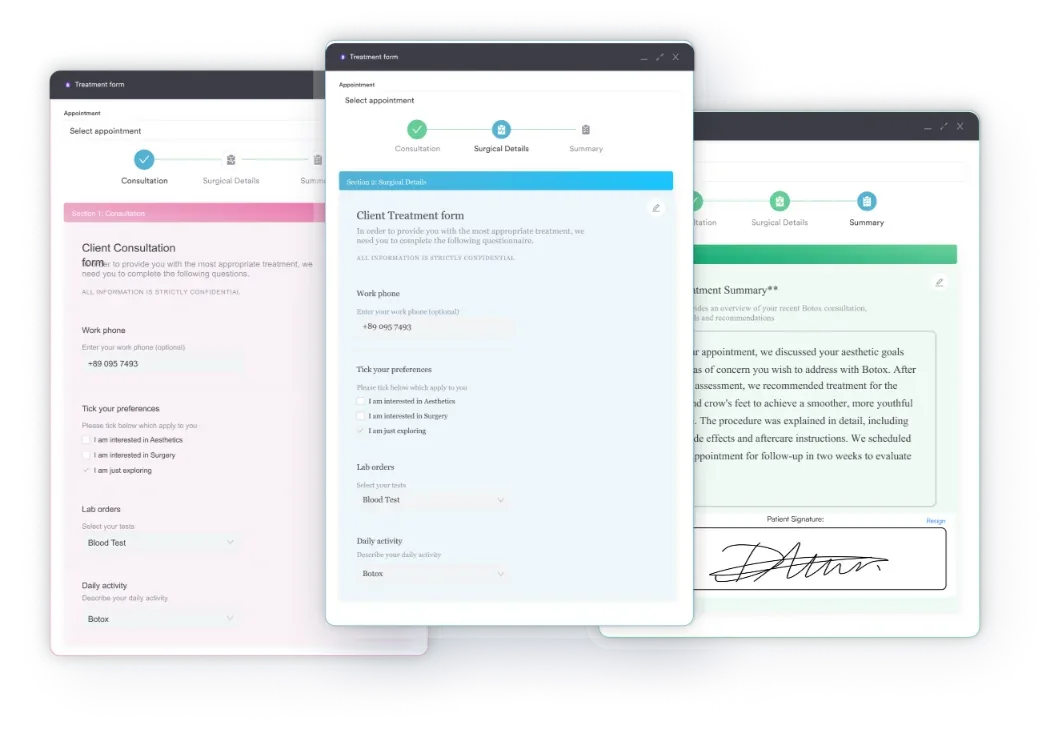
The digital aftercare form can be delivered through capture forms software, automatically emailed immediately post-appointment, or printed as a take-home sheet.
Microneedling aftercare templates are essential for aesthetic practices, dermatology practices, medical spas, and laser practices offering microneedling or RF microneedling services. They apply across multiple specialties:
Practices offering PRP microneedling or microneedling with platelet-rich plasma require additional aftercare guidance on managing PRP-specific side effects (additional bruising, extended redness). A medical spa running high-volume microneedling schedules relies on standardized aftercare to keep quality consistent across every provider.
Most medspas store completed forms like this in a medical spa EMR, beside photos and consents.
Compliance and legal protection: Written, signed aftercare instructions create a documented record of patient education. If complications arise, the practice can demonstrate informed consent and standard-of-care adherence. State medical boards and professional standards expect practices to give evidence-based post-treatment guidance and to document that patients received it.
Workflow efficiency: Standardized aftercare instructions. Patients who receive clear written guidance experience fewer complications and need fewer follow-up calls.
Documentation clarity: A template ensures every patient receives the same critical safety information, regardless of appointment time or which practitioner delivered the treatment. This reduces the risk of contradictory advice and inconsistent standards across your practice team.
Patient safety and infection prevention: By clearly flagging contraindicated products (retinoids, active ingredients, makeup) and infection warning signs, aftercare templates help prevent preventable complications. Open micro-channels post-microneedling increase infection risk if patients introduce bacteria through non-sterile products or behaviors.
Treatment outcomes optimization: Patients who follow aftercare protocols experience better collagen remodeling, faster resolution of redness, and superior aesthetic outcomes. Documented adherence also provides valuable data for tracking which aftercare advice produces the best results across your patient population.
Most visible recovery occurs in the first 24-72 hours, but full skin barrier repair extends 4-6 weeks. Your template should map recovery milestones:
This structured breakdown helps patients understand that healing is gradual and sets realistic expectations for when social redness resolves versus when full skin recovery completes.
A patient’s most common question is what to put on skin after microneedling, so the microneedling aftercare products section carries real weight. Your template must distinguish between safe products and forbidden ones, each with a clear clinical rationale.
Patients need to understand why retinoids are restricted, since they accelerate skin cell turnover when the barrier is already compromised, increasing irritation and erythema. Flagging existing retinoid use during intake.
Specify physical (mineral) sunscreen over chemical sunscreen for the first 48-72 hours due to reduced irritation potential with already-sensitive skin. Mineral sunscreen sits on the skin surface without chemical absorption, minimizing post-treatment inflammation.
Standard microneedling creates superficial to mid-dermal micro-injuries. Radiofrequency (RF) microneedling combines micro-needling with radiofrequency energy, creating deeper thermal injury and requiring more conservative aftercare protocols.
RF microneedling specific aftercare: Patients need intermittent cooling with cold packs through the first 24 hours, extended heat avoidance (no hot showers, exercise, or saunas for 48-72 hours), and longer product restriction windows (avoid active ingredients for 72-96 hours). RF microneedling drives deeper collagen remodeling but carries greater inflammation risk, so aftercare has to be stricter than standard microneedling.
PRP microneedling aftercare: When platelet-rich plasma is applied immediately post-microneedling, patients often see more bruising and a few extra days of redness than with standard microneedling. PRP accelerates collagen induction but raises the inflammatory response, so aftercare should emphasize gentle cooling, elevation, and arnica if tolerated, alongside standard microneedling guidance.
Create separate template variants for each treatment type so patients receive protocol-specific guidance.
Your template must include clear warning signs and practice contact instructions. Patients should reach out immediately if they experience:
Include a prominent practice phone number and automated aftercare emails so patients know when and how to escalate concerns. Modern scheduling software can track aftercare follow-ups and flag patients who need a proactive check-in.
Aftercare templates are most effective when integrated into your practice’s pre-and-post-care management system. Digital delivery ensures every patient receives the template immediately post-appointment, reducing the chance of lost paper instructions or forgotten verbal guidance.
Create a templated email that goes out automatically post-appointment with the PDF attached. Include the practice’s phone number and a direct link to schedule a follow-up appointment if complications arise. Track which patients download and read the aftercare document – high engagement correlates with fewer post-treatment issues and shorter recovery times.
Train all clinical staff (doctors, nurse practitioners, registered nurses, aestheticians) on the specific aftercare protocol so verbal guidance matches written instructions. Inconsistent messaging erodes patient trust and complicates post-treatment support.

Automate post-treatment guidance delivery, track patient engagement with aftercare resources, and reduce post-treatment support inquiries with integrated pre-and-post-care management.

Strong microneedling aftercare is what stands between a smooth recovery and a preventable complication. A comprehensive, clinician-approved aftercare template sets clear expectations for healing, prevents product mistakes, and creates a paper trail of informed consent.
Practices that deliver structured post-treatment guidance via digital forms see fewer emergency calls and stronger patient outcomes. Download the template above, customize it with your practice logo and contact details, and deploy it at the end of every microneedling appointment.

Need a consistent way to collect patient details? Patient information form template gathers demographics, medical history, emergency contacts, and insurance details in one form.
Need a consultation form before microneedling sessions? Med spa consultation form template outlines the intake questions that set clear expectations and support compliance.
Adding pressotherapy to your service menu? Pressotherapy consent and intake form covers contraindication screening, treatment consent, and aftercare guidance in one document.
Microneedling aftercare is a structured post-treatment protocol that guides patients through the healing process following a microneedling procedure. It covers day-by-day recovery milestones, product recommendations, activity restrictions, and warning signs requiring clinical follow-up.
Most visible redness resolves within 1-3 days post-treatment, but full skin barrier healing continues for 4-6 weeks. The timeline varies based on needle depth, device type (standard vs RF), skin type, and individual healing capacity.
Avoid makeup for at least 24 hours post-treatment. Some practices recommend waiting 48-72 hours to allow the skin barrier to begin sealing. Makeup introduces bacteria to open micro-channels and can increase infection risk if applied too early.
Avoid retinoids, AHAs, BHAs, vitamin C serums, glycolic acid, and benzoyl peroxide for at least 48-72 hours post-treatment. These active ingredients can irritate newly damaged skin and delay healing. Stick to gentle hyaluronic acid, ceramides, and mineral sunscreen during the first week.
Avoid strenuous exercise for 24-48 hours post-treatment. Increased blood flow, sweating, and heat exposure can prolong redness, increase inflammation, and introduce bacteria to open skin channels.
RF microneedling creates deeper thermal injury than standard microneedling, so aftercare is more conservative. RF patients need longer cooling through the first day, extended heat avoidance (48-72 hours), and stricter product restrictions (avoid actives for 72-96 hours vs 48-72 hours for standard microneedling).
Patients can shower a few hours after treatment, but keep the water lukewarm and the rinse brief for the first 24 to 48 hours. Hot water, steam, and strong pressure irritate freshly treated skin, so advise keeping the treated area out of the direct stream and patting it dry gently rather than rubbing.
Hold off on exfoliation until the skin barrier has fully settled, usually 7 to 10 days. Physical scrubs and chemical exfoliants such as glycolic or salicylic acid can disrupt healing and should wait until the provider clears them.
Yes. You can download the free microneedling aftercare template at the top of this page, then customize it with your practice name, logo, and contact details. It includes the day-by-day recovery timeline, product dos and don’ts, and warning signs, ready to hand to every patient.