HIPAA compliant texting: What you can send patients & how to communicate securely
HIPAA compliant texting is possible when a text holds no protected health inform...

Last Updated: Oct 16, 2026

The template on this page is a blanket representative-access release, authorizing any and all of a patient’s health information to two named representatives.
Its only blanks are the patient’s name, their address, two representative blocks with name, address and phone, and a signature.
The form carries no description, purpose or expiration field. Clause 9 fixes its term at two years after the patient’s death, or their written revocation.
A fully customizable HIPAA authorization needs those extra elements added, including a specific description of the records, a purpose, and an expiration date or event.
Practice management software like Pabau turns either form into a digital, audit-tracked authorization your Texas practice can retrieve in seconds.
A two-page authorization that lets a patient name up to two designated representatives who can request and discuss any of their health information. It carries the full HIPAA authorization clauses, the re-disclosure and no-conditioning statements, and blanks for name, address, representative details, and signature.
Download templateA patient’s daughter calls to ask how her mother’s biopsy went. Without a signed authorization on file, your front desk cannot tell her a thing.
The form on this page answers that call in advance. It is a blanket HIPAA authorization, so one signature lets two named people ask any provider for any of the patient’s health information.
This form works differently from the itemized authorization most guides describe. There is no field for a description of records, no purpose line, and no expiration date, because the form’s own clauses settle all three. Texas law then layers its own duties on top of the federal rules.
A HIPAA release form is a written authorization signed by the patient. It lets a covered entity disclose their protected health information, known as PHI, to someone they name. Federal rules at 45 CFR 164.508 set out what it has to say.
Texas then adds a second layer. The Texas Medical Records Privacy Act, passed as HB 300, defines a covered entity far more broadly than HIPAA does. It reaches any person who assembles, collects, uses, stores, or transmits PHI in the state.
Employers, schools, gyms, and wellness programs can all fall under it. Skip the authorization and you face two enforcement paths instead of one. The federal Office for Civil Rights can act, and so can the Texas attorney general under Chapter 181.
This template is a standing access release. Once signed, it directs every covered entity holding the patient’s records to hand over any health information either named representative asks for.
The form also defines its own terms. Clause 1.1 reads “covered entity” broadly, from physicians and dentists through pharmacies, laboratories, nursing homes, and insurers. Health information under clause 1.2 covers history, condition, diagnosis, testing, prognosis, treatment, and billing.
Clause 3 then reaches beyond records. It also lets a representative discuss the patient’s health information with your staff and ask questions about it. That holds whether or not the patient is incapacitated.
Because the scope is fixed, this form cannot carry a narrower disclosure. Two everyday requests show where the line falls.
The file has no interactive form fields. So print it and complete it by hand, or add text with a PDF annotation tool.
There is also no date line on either page, not even beside the signature. Log the day it reached you in your records management system, so you can show when the authorization took effect.
HIPAA sets the national floor. HB 300 raises it for anyone who handles health information in Texas.
That first row has a practical edge to it. A Texas employer or school holding employee health records answers to HB 300, even though HIPAA never reached it. Your authorization has to satisfy both layers.
The notice of privacy practices you already publish covers the federal duty to inform patients. Texas wants a second notice as well, posted where patients will see it, saying PHI may be disclosed electronically.
Practices holding records in more than one state need a release that satisfies each of them. Our Illinois release form and Florida release form cover those two states. A Massachusetts HIPAA release form covers a third, where state practice is to take the authorization in writing every time.
Digital forms sit at the center of practice management software, feeding records, billing, and follow-ups from one entry.
A customizable authorization has to carry every element in 45 CFR 164.508(c). Miss one and the authorization is invalid, which puts every disclosure you made on it at risk.
How this list relates to the template above
The downloadable form is not a fill-in-the-blanks version of this list. It settles the description, the purpose, and the term in its own printed clauses. The patient completes only their name and address, the two representative blocks, and the signature. Clause 12 already carries the conditioning statement, and clause 13 carries the re-disclosure statement.
Use the list above when you need a disclosure limited to particular records, dates, or recipients. For that job, start from our HIPAA authorization form and add what the situation calls for. The Texas attorney general also publishes a standard authorization form, adopted under Health and Safety Code §181.154(d).
Practices working from a HIPAA compliance framework can build these elements straight into a digital form, so a required field cannot be left blank.
Federal compliance is not the finish line in Texas. Five HB 300 obligations sit on top of that baseline.
HB 300 also sets a training deadline. Train anyone who handles PHI by their 90th day of employment, on material matched to their duties. Keep their signed verification for six years.
Two commonly quoted restrictions are federal rather than Texan. Psychotherapy notes need their own separate authorization under 45 CFR 164.508(a)(2). Federally protected substance use disorder records need one under 42 CFR Part 2.
Both rules apply in every state, so treat them as national requirements you meet in Texas. A mental health practice will keep a second authorization on file for notes alone.
A third federal rule covers marketing. Publishing a patient’s words or image needs its own authorization under 45 CFR 164.508, so use a testimonial release template for it.
Six steps cover the whole form. There is no purpose step and no expiration step, because neither field exists on the page.
If the patient wants a narrower release, stop and switch documents. Build a customizable authorization with the nine elements above, and keep the blanket form for family and representative access.
Tracking the medical forms and documentation side of this by hand gets slow. Digital forms pre-fill the patient’s details and capture the signature before they arrive.

This template ends at the first of two events. Those are two years after the patient’s death, or the day your practice receives their written revocation. Clause 9 sets both, and nobody selects a shorter term.
Right to revoke. A patient may revoke any HIPAA authorization in writing at any time, under 45 CFR 164.508(b)(5). Clause 9 asks for proof that the revocation was received, by certified mail, registered mail, fax, or any other receipt showing it arrived.
What revocation does not undo. It takes effect when you receive it, except where the practice has already acted in reliance on the authorization. Information already sent to a representative cannot be pulled back, and clause 6 warns the patient that the recipient may re-disclose it.
Later incapacity changes nothing. Clause 9 states that the authorization survives the patient’s subsequent disability or incapacity. That is the point of this form, and it is why families use it.
A customizable authorization behaves differently. There, the expiration date or event you wrote on the form controls the end date, and any disclosure after it needs a fresh authorization.
Either way, keep the signed page long after it stops working. Federal rules ask for six years.
The patient signs, unless someone else holds legal authority to sign for them. Verify that authority before you accept the form.
Contraception is not on the minor self-consent list. Texas requires parental consent for a minor’s contraceptive care, which the Fifth Circuit confirmed in Deanda v. Becerra in 2024.
This template adds one more route after a death. Clause 9 runs for two years, so representatives named on a signed form keep their access during that window. That often resolves a records request without an estate document.
Paper authorizations fail in two familiar ways. Staff leave fields blank on a form nobody checks. Then the signed page goes missing on the day a request or a chart audit lands.
Practice management software like Pabau moves the whole workflow onto the patient record. You build your authorization as a digital intake form, send it before the appointment, and mark the fields that have to be completed.
The patient then signs electronically, and the signed version files itself against their record with a timestamp. Paper works the same way. Scan the signed form, attach it to the record, and the representative names sit alongside the rest of the chart.
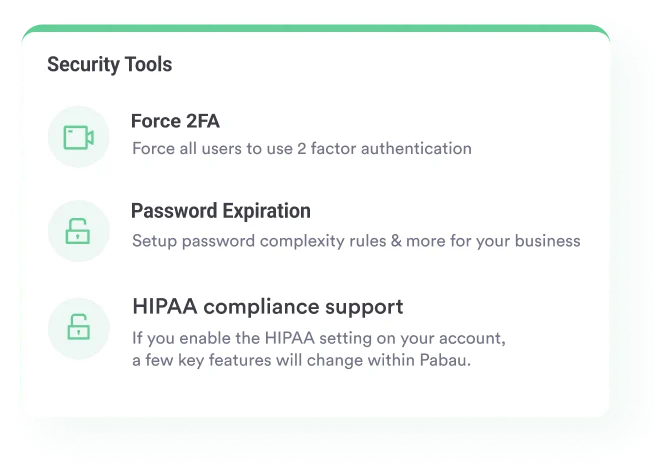
Access control matters just as much as storage. Pabau’s security settings let you force two-factor authentication and set password rules. For a multi-site Texas practice, every location then works from the same set of authorizations.

Pabau’s digital forms take the authorization, capture the patient’s signature, and file it on the patient record with a timestamp. Your team stops chasing paper, and a Texas records request or HB 300 audit gets answered in seconds.

Match the document to the job before anyone signs. The template on this page gives two named people standing access to everything, for two years past the patient’s death. That is exactly right for family and representative access.
It is the wrong tool for a single disclosure to an attorney, an employer, or an insurer. Those need the nine federal elements, including the description, the purpose, and an expiration you choose. Keep both on hand and the choice takes seconds at the front desk.
Then keep the signed page somewhere you can find it, because Texas gives you two regulators to satisfy rather than one. Book a demo to see how Pabau captures these authorizations digitally and keeps them audit-ready for your practice.

Working outside Texas? HIPAA medical release form gives you the general version, with no state layer on top.
Practicing in Illinois specifically? Illinois HIPAA release form covers the separate authorizations Illinois requires for mental health, HIV, and substance use records.
Running a dental practice? Dental records release form handles chart requests without reworking this template.
Need a broader disclosure authorization? authorization for disclosure of information covers designated recipients, disclosure purposes, expiration dates, and the consent declarations a release needs.
Need the form itself, not just the rules? authorization to use and disclose health information lists the eight required elements, including the redisclosure notice, so you can fill in the form correctly.
No. HIPAA asks for the patient’s signature, and nothing more. Some practices add a witness line for their own comfort. Keep the signed original and hand the patient a copy.
No. It opens access to information only. Decision-making authority comes from a medical power of attorney under Texas Health and Safety Code Chapter 166.
Sometimes. Under 45 CFR 164.510(b) you may share information relevant to a person’s involvement in care, if the patient agrees or does not object.
Within 15 business days of the written request, under Texas Occupations Code 159.006. A denial needs a signed, dated written explanation.
Yes, within Texas Medical Board caps. Paper runs $25 for the first 20 pages, then 50 cents each. Electronic copies cap at $25 for 500 pages.
Six years, under 45 CFR 164.530(j). The record itself stays seven years past the last treatment under Texas Medical Board rules.
Not on this form, because it carries two representative blocks. A patient who needs a third can sign a second copy naming that person.
Verify them against the form first. Match the name and phone number in the representative block, log the call, then release the records.