Professional development record
A professional development record is a structured log of a healthcare practition...

8
Last Updated: Oct 8, 2026
A HIPAA release form in Massachusetts is a signed authorization to disclose a patient’s protected health information (PHI).
It names who may receive the records, what they cover, and when the permission ends. Two bodies of law govern it. Federal HIPAA sets the baseline at 45 CFR 164.508, and M.G.L. c. 111 § 70E adds the Massachusetts patient rights layer.
A valid authorization carries six core elements and three written statements. The free template below sets out the six elements. This guide shows the three statements to add before you hand it to a patient.
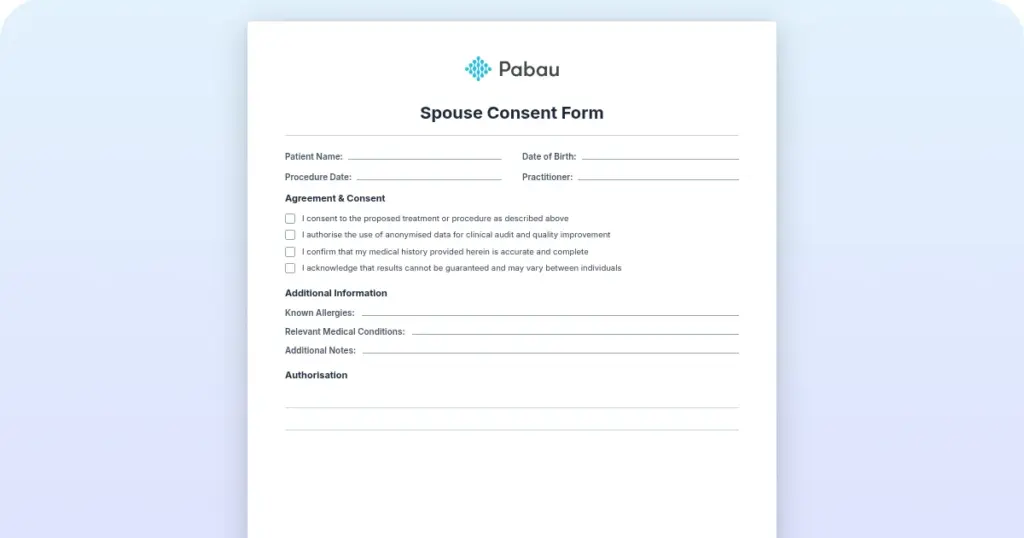
The form covers patient identification, the records being released, the authorized recipient, the purpose, an expiration date, and a signature line. Add the three statements listed below before you use it with patients.
Download template
A HIPAA release form in Massachusetts lets a provider disclose protected health information to a named person or organization.
Six core elements make the authorization valid, from patient identification through to a dated signature.
Federal law also requires three written statements: the right to revoke, a conditioning notice, and a re-disclosure warning.
Psychotherapy notes and substance use disorder records need their own authorization, separate from the standard form.
Practice management software like Pabau collects the signature digitally and tracks each authorization’s expiration date.
A HIPAA release form gives a provider written permission to send a patient’s records to someone outside their care team. That recipient might be a family member, an attorney, an insurer, an employer, or another practice.
Federal HIPAA sets the floor at 45 CFR 164.508. Massachusetts law sits on top of it and wins wherever the state rule is stricter. The Massachusetts Department of Public Health publishes a model authorization that many practices use as their starting point.
Without a signed authorization, the provider cannot release the records at all. That holds even when a spouse or an adult child is the one asking, and even when the request sounds reasonable.
Massachusetts codifies patient privacy in M.G.L. c. 111 § 70E, the patient rights statute. It requires providers to keep written policies covering the release of confidential patient information. Federal HIPAA permits verbal agreement in a narrow set of cases. Massachusetts practice is to take the authorization in writing every time.
Using the Department of Public Health model form is not a legal requirement, though it keeps you close to what state reviewers expect. What matters more is the paper trail behind it. Compliance software for practices stores each signed authorization against the patient record, so you can produce it during an audit or a complaint.
Several categories of record sit outside the standard form. Each one has its own rule:
Which rule applies depends on who holds the record and what kind of record it is. The table below routes the six requests a Massachusetts front desk sees most often.

Six core elements have to appear on the form under 45 CFR 164.508(c)(1) and M.G.L. c. 111 § 70E. Three further statements are required by 45 CFR 164.508(c)(2), and they are the ones a downloaded template usually leaves out.
The last three rows are the ones to check before you print anything. The downloadable template above sets out the six core elements, so write the three statements into it in your own wording first. Your legal counsel should read the finished version.
One missing element is enough to invalidate the authorization. Patient intake software can make every field mandatory before submission, which stops an incomplete form from reaching the record in the first place.
Six steps take the form from blank to enforceable:
Customize the template with your practice name, logo, and contact details before you distribute it. A practice operating in more than one state can start from the general HIPAA medical release form. Layer the Massachusetts rules on top of it.
A Massachusetts practice needs a signed authorization on file in these situations:
There is one large exception. No separate authorization is needed to use PHI for the patient’s own treatment, for payment, or for healthcare operations. That trio is known as TPO, and the paperwork signed at intake normally covers it.
Signing does not hand over control permanently. Three rights survive the signature:
Keep a log of who signed what, when it was signed, when it expires, and whether it was revoked. That log is what you produce in an audit. Releasing records against a lapsed or revoked authorization is reportable, and the steps that follow a HIPAA violation run on a deadline.
Paper authorizations arrive incomplete, take time to find, and expire without anyone noticing. Collecting them through digital capture forms changes each of those:

The bigger win is the one you never see. Records do not go out against an authorization that quietly expired six months ago.
In most practices the authorization lives apart from the chart. It sits in a filing cabinet, a scanned folder, or an e-signature tool nobody checks. Answering “do we have consent for this?” means opening files one at a time.
Pabau keeps the authorization with the patient instead. The form goes out before the appointment, the patient signs on their phone, and the signed copy files itself against the patient record. Staff can see who has a current authorization, who the named recipient is, and when the permission runs out.
For a Massachusetts practice, that also makes the M.G.L. c. 111 § 70E paper trail easy to produce. The authorization, its date, and the disclosures made under it all sit in one place. A records request is then answered in minutes rather than an afternoon.

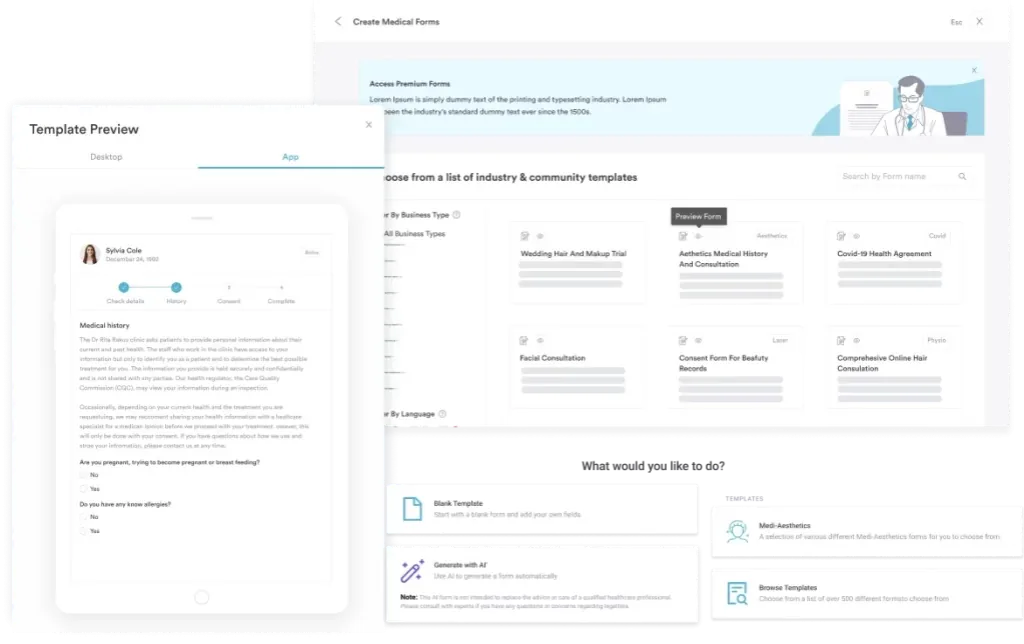
Pabau’s digital forms capture the patient’s signature before the visit and file the authorization against the patient record. Your team can see what is on file and what is about to expire.

The form itself is the easy part. A Massachusetts authorization holds up when it carries the three federal statements alongside the six core elements. The expiration date has to be one that has not already passed.
Download the template, write those statements into it, and have your counsel read the version you plan to use. Then decide where the signed copies will live, because the authorization you cannot find is the one an auditor asks for.
Book a demo to see how Pabau collects HIPAA authorizations digitally and flags each one before it expires.

Want to know when you can disclose without authorization? HIPAA compliance for medical offices walks through the treatment, payment, and operations exceptions in practice.
Need the policy that sits behind these forms? The HIPAA privacy policy template sets out how your practice handles PHI day to day.
Wondering how long to hold the signed authorizations? How long to keep medical records covers retention periods and what you can safely destroy.
Looking for a waiver rather than a release? The HIPAA waiver form covers the situations where a waiver is the right document to use.
A HIPAA release form is written authorization allowing a healthcare provider to disclose a patient’s protected health information to a third party. Federal HIPAA prohibits that disclosure without the patient’s explicit consent, and Massachusetts law expects the authorization in writing.
Yes, if you sign a release form naming that family member as the recipient. Minor patient records, psychotherapy notes, and substance use disorder records follow their own rules, and parental access is limited in those contexts.
An authorization is valid until the expiration date or event written on the form, such as December 31, 2026. With no end point stated, federal law ties the authorization to the purpose the patient agreed to and sets no maximum term. Setting a clear date avoids the argument.
Yes. You can revoke the authorization in writing at any time, and you must tell the provider in writing. Revocation works forward only, so information already disclosed before your notice arrived cannot be retrieved.
Yes. M.G.L. c. 111 § 70E, the patient rights statute, requires written authorization for nearly all PHI disclosures. Substance use disorder records held by a Part 2 program follow 42 CFR Part 2. Psychotherapy notes need their own authorization under 45 CFR 164.508(a)(2), and Department of Mental Health facility records follow 104 CMR 27.16 and 27.17.
45 CFR 164.508(c)(2) requires three. The first is the patient’s right to revoke and how to exercise it. The second says whether treatment or payment is conditioned on signing. The third warns that the recipient may re-disclose the information outside HIPAA protection.
No. MassHealth publishes dedicated HIPAA forms for its members on mass.gov, and those are specific to MassHealth enrollment and plan changes. A standard release form covers other patients and other purposes.