GLP-1 usage by state: Who’s taking, searching and paying in 2026
GLP-1 usage by state peaks in West Virginia, America’s GLP-1 capital, with...

Last Updated: Oct 16, 2026
A tattoo waiver form is the document a client signs before a session to confirm they understand the risks and have disclosed their medical history. It also releases your studio from liability for foreseeable outcomes, such as infection, scarring, or fading, provided you followed safe practice.
The template below covers six sections: client ID, medical history, design approval, the liability release, aftercare acknowledgment, and an optional photo release. It also includes a parental consent section, for use only where local law lets you tattoo minors. Leave that section out in the UK, where nobody under 18 can be tattooed.
A ready-to-use waiver with sections for client ID, medical history, design approval, the liability release, aftercare acknowledgment, and a photo release. It also includes a parental consent section for minors, where local law allows tattooing them.
Download template
A tattoo waiver form records a client’s informed consent and releases the studio from liability for foreseeable risks, but never for negligence.
The core sections are client ID, medical history, design approval, the liability release, aftercare acknowledgment, and an optional photo release.
Some US states allow tattooing 16- and 17-year-olds with parental consent, while the UK bans tattooing anyone under 18 outright.
EU countries set their own age rules, and Germany and France permit tattooing 16- and 17-year-olds with parental consent.
Digital waivers are legally valid under the US ESIGN Act and EU and UK eIDAS rules, and they leave a stronger audit trail than paper.
A tattoo waiver form does two jobs. It documents informed consent, meaning the client understands the procedure and its risks. It also records a liability release covering foreseeable outcomes like infection, allergic reaction, scarring, or fading.
In practice, the form combines three documents:
Treat it as a risk-management document that protects the client too. They leave the chair knowing how to care for the tattoo and which warning signs to watch for.
A signed waiver protects your studio in four ways.
A complete tattoo waiver has six core sections, plus a parental consent section where minors can legally be tattooed. The diagram below shows what each one captures, in the order a client fills them out.
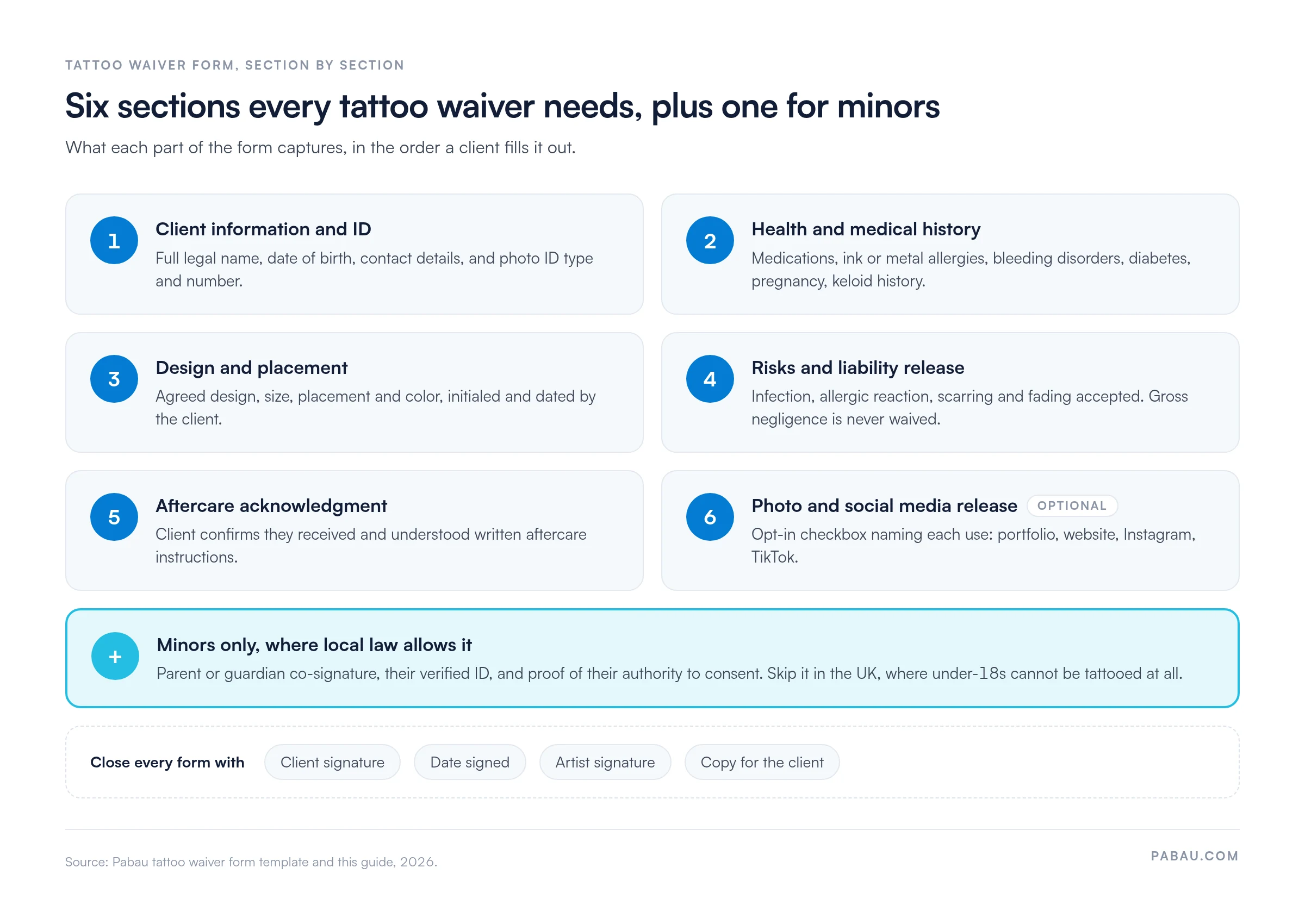
Collect the client’s full legal name, date of birth, contact details, and photo ID. This confirms they’re old enough to be tattooed where you work (see the minors section below). It also links the signed form to the person who received the tattoo.
Ask about conditions that affect healing, infection risk, or allergic reaction. Standard questions cover blood thinners (aspirin, warfarin), diabetes, immunosuppression (HIV, transplant medications), pregnancy, keloid history, and skin conditions.
Add a dedicated field for ink or metal allergies. Digital intake forms for studios can make that field required, so no client skips it.
Record the agreed design, size, placement, and color or style. This heads off disputes about whether the client expected something different once the tattoo is finished. A tattoo pain chart lets the client weigh each placement against its expected pain. Leave space for the client to initial and date their approval of the sketch or digital preview.
This is the core legal section. The client acknowledges the known risks of tattooing and accepts them voluntarily. List each one: infection, allergic reaction to ink or numbing agents, scarring, keloids, fading, color distortion, nerve damage, and dissatisfaction with the result.
The release frees the studio and the artist from liability for those risks. It can’t cover gross negligence or willful misconduct. For a closer look at how release clauses are built, see our indemnity waiver form.
Keep the wording plain. For example: “I understand that tattooing carries inherent risks, including infection, scarring, and allergic reaction. I accept these risks and release [Studio Name] and [Artist Name] from liability for these foreseeable outcomes. This release does not apply where harm is caused by negligence or failure to follow infection control standards.”
Clients sign to confirm they received and understood written aftercare instructions. Record what you told them, which typically includes these points:
Include an optional checkbox for consent to photograph the finished tattoo for your portfolio, website, or social media. Clients must be free to say no. If they agree, name each use, such as your studio portfolio, Instagram, or TikTok. For a standalone version, use our photo release form.
If you give discounted or free work in exchange for those images, a model waiver records that trade and the uses it covers.
Tattooing a minor adds legal safeguards, and the rules change sharply by jurisdiction.
United States: State law decides whether a minor can be tattooed at all. New York bans tattooing anyone under 18, even with a parent’s permission. Florida allows 16- and 17-year-olds with written parental consent. Hawaii’s parental consent window is wider, covering ages 14 to 17.
Where minors are allowed, verify the parent or guardian’s identity and their legal authority to consent. An adult who simply claims to be a parent isn’t enough. Have both the minor and the parent or guardian sign the same form, and add a witness where your state requires one.
United Kingdom: The Tattooing of Minors Act 1969 sets 18 as an absolute minimum, with no parental consent exception. UK studios don’t need a minor consent section, because nobody under 18 can be tattooed.
European Union: There’s no single EU rule, so each member state sets its own age limits. Germany and France, for example, permit tattooing 16- and 17-year-olds with parental consent. EU studios should check their national law, and most will still need a minor consent section.
Wherever you work, check current local rules before tattooing anyone under 18. Record that check on the form itself, for example: “Parent/guardian ID verified: [Type/Number].”
If your studio also pierces, keep a separate piercing consent form, because the risks and the rules for minors both differ.
More studios now send consent forms before the appointment and capture e-signatures on a tablet or phone. Here’s how the two approaches compare.
Best practice: Go digital if your studio’s software stores signed forms securely. If you stay on paper, keep forms in a locked cabinet and follow a written retention schedule (see below).
No US federal law sets a retention period for tattoo consent forms. Industry practice is to keep signed forms for three to seven years after the tattoo.
Why three to seven years? Personal injury statutes of limitations mostly run two to six years, depending on the state and the type of claim. Keeping forms for at least three years covers most standard claims. Some states set their own retention periods, so check your state or local tattoo rules.
Storage best practices: Keep signed forms in a locked cabinet or an encrypted digital records system. Put your retention period in writing, for example: “Signed consent forms are kept for five years from the date of service, then securely destroyed.” Log how you destroy them, by shredding or secure deletion, so you can show compliance to a regulator or a court.

GDPR in the UK and EU: Health details on the form count as special category data under GDPR Article 9. That brings stricter handling and data minimization rules. Keep forms only as long as you need them to document consent and defend a claim. When a client asks for deletion, erase the form unless you still have a lawful reason to hold it.
If you use compliance management software, record your retention schedule there so the whole team follows the same rule.
An unsigned or half-finished form offers little legal protection. Watch for these errors.
Many studios still hand each client a clipboard at check-in, then file the paper form in a cabinet. Others use a standalone form tool that collects signatures but keeps them apart from bookings and client history.
Practice management software like Pabau links the waiver to the appointment itself. Build your tattoo waiver once in the form builder and send it automatically before each booking. Clients sign on their own phone through the Client Portal, and the signed copy is saved to their record.
Your artists open that record and see allergies, medical history, and design approval before the session starts. Nobody chases missing signatures at the front desk, and you can find any signed form in seconds if a client disputes a result.

Pabau sends your waiver before each appointment, collects the e-signature, and saves the signed form to the client’s record. Your artists start each session with the medical history in front of them.

A waiver only protects your studio if it’s complete, signed, and easy to find later. Start from the six-section template, then adapt the minors section to the law where you work, because that part varies most.
The trade-off is where the effort goes. Paper costs little to start, but the work shifts to filing and retrieval, and a missing signature only surfaces when a dispute does. Digital forms move that work to before the appointment, when the client has time to read.
Book a demo to see how Pabau gets every tattoo waiver signed and stored before the client sits down.

Want waivers signed before clients arrive? Digital patient intake forms sets out five steps that get forms completed before the appointment.
Tattooing 16- or 17-year-olds where the law allows it? Consent to treat minor form covers parent and guardian details and the scope of their authorization.
Writing your aftercare handout? Aftercare guidelines template covers post-treatment care, activity restrictions, and wound care.
An enforceable form includes client ID and age verification, medical history and allergies, the approved design and placement, and a clear list of risks. It also needs the client’s voluntary acceptance of those risks, a liability release, and signed confirmation of aftercare instructions. Finish with the date and the artist’s signature, because a missing signature, date, or risk statement weakens enforceability.
Yes, wherever minors can legally be tattooed, such as Florida, which allows 16- and 17-year-olds with parental consent. The form needs a parent or guardian co-signature, their verified ID, and proof of their authority to consent. UK studios don’t need one, because the UK bans tattooing anyone under 18. EU countries set their own rules, so most EU studios still need a minor consent section.
It reduces liability by placing the assumed risk of foreseeable outcomes, like infection, scarring, and fading, on the client. It doesn’t protect against gross negligence, willful misconduct, or breaches of safety standards, such as unsanitary equipment. Treat the waiver as one layer of protection alongside infection control and professional standards.
Ask about current medications, especially blood thinners and immunosuppressants, and allergies to ink, metals, or antibiotics. Cover conditions like diabetes, bleeding disorders, pregnancy, keloid history, eczema, or psoriasis, plus recent surgeries and alcohol or drug use. Each one affects healing, infection risk, or allergic reaction, so the client’s disclosure is central to informed consent.
A consent form records that the client understands the procedure and its risks. A waiver is a liability release that frees the studio from responsibility for foreseeable outcomes. Most studios combine both in one document, often called a tattoo consent and waiver form or a tattoo release form.
Yes. E-signed waivers are valid under the ESIGN Act in the US and eIDAS rules in the EU and UK. The platform must securely record the timestamp, IP address, and signature. Many studios prefer them because they leave a stronger audit trail than paper, and they don’t get lost, water-damaged, or smudged.
Keep them for three to seven years from the date of the tattoo. Personal injury statutes of limitations mostly run two to six years, so a five-year period covers most claims. Some states set longer periods, so check your local tattoo board rules and follow a written retention schedule.
Yes, provided the platform uses encryption, access controls, and a secure deletion process. Digital storage often makes GDPR compliance easier, because deleting data on schedule takes less manual work. Forms that collect health data also fall under GDPR Article 9 for special category data, so confirm your platform protects it accordingly.