HIPAA compliant texting: What you can send patients & how to communicate securely
HIPAA compliant texting is possible when a text holds no protected health inform...

Last Updated: Oct 16, 2026
A medical consent form for grandparents is a signed document that lets a grandparent approve treatment for a grandchild when the parents can’t be reached.
It names the child, the grandparent, the care they may approve, and the dates the permission covers. With it, a pediatrician, urgent care center, or hospital can treat the child without first tracking down a parent.
Grandparents often step in during school breaks, family vacations, or a parent’s work trip abroad. Without written authorization, a provider can’t let them consent to treatment or share the child’s medical information. This free printable template covers each field. The guide below explains state notarization rules and how the form differs from a medical power of attorney.
A printable form with sections for the child’s medical and insurance details, the parent’s authorization, and the grandparent’s contact details. It also covers the scope of consent, emergency contacts, the child’s healthcare providers, and an expiry date.
Download template
A medical consent form for grandparents lets a grandparent consent to a minor’s medical treatment when the parents can’t be reached.
Most states do not require notarization, but Texas requires it in most cases; Florida and others recommend it. Always check your state’s requirements.
The form needs the child’s details, the parent’s signature, the scope of treatment allowed, emergency contacts, and the child’s healthcare providers.
A consent form is limited and time-bound, while a medical power of attorney grants broader, often durable authority.
Practice management software like Pabau collects the signed form through digital forms and stores it in the child’s patient record.
It’s a written authorization, signed by a parent, that lets a grandparent consent to treatment, emergency care, and information sharing for a minor. It gives a provider documented permission to treat the child when no parent is present.
Hospitals, urgent care centers, pediatricians, dentists, and mental health practices generally need consent before they treat a minor. That consent has to come from a parent, a guardian, or someone a parent has authorized in writing. This form is that written authorization. It typically specifies:
Once a provider has the completed form, the grandparent can approve treatment and emergency care without waiting for a parent to call back. That matters most when a delay would harm the child.
A grandparent needs the form whenever they’re caring for a grandchild and the parents can’t be reached to give consent themselves. Common situations include:
Without the form, a provider may hold off on treatment while staff try to reach a parent. In an emergency, that search costs time the child may not have. Practices can also ask for the form when the appointment is booked, so it’s on file before the child arrives.
A complete form has four parts: the child, the parent, the grandparent and their scope of consent, and the dates and signatures. The diagram below maps each part to the fields it needs.
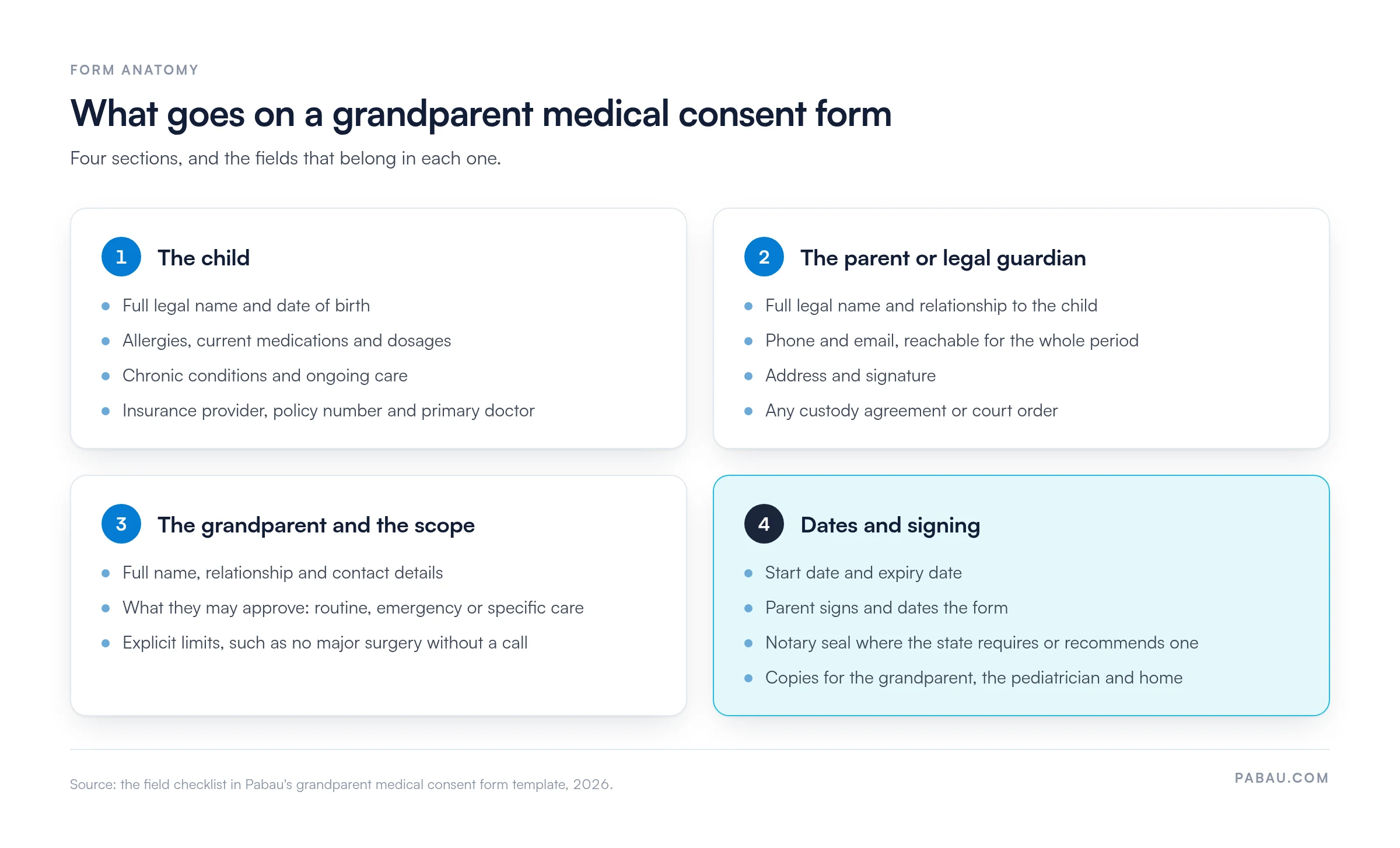
The form must identify the minor clearly:
The form must show who is giving consent and confirm their legal authority:
This section identifies who is authorized and what they can approve:
It depends on your state. Some states don’t require a notary, while others require one for the form to be valid. Check your state’s family law statutes or ask a local attorney before the form goes to a provider.
Notarization is worth doing even where it’s optional. A notarized signature shows the provider that the parent signed the form on purpose and understood it. Many hospitals and urgent care centers accept unnotarized forms, but some don’t. A quick call to the child’s regular provider tells you which rule they follow.
Medical authorization rules differ by state. The table below compares notarization, witness requirements, and typical validity across six representative states. Confirm your own state’s rules with your state bar association or department of health.
Most states don’t require a notary for a parent’s consent to a minor’s treatment, unless the document is part of a broader power of attorney. A notary still strengthens the form and makes providers less hesitant to rely on it.
Rules outside healthcare can be stricter. Florida’s body piercing consent rules require a notarized parent or guardian signature before a studio pierces a minor.
Families often mix the two up, but they do different legal jobs. The table below shows where they split.
For school breaks, summer visits, or family trips, a consent form is the right choice. It’s simpler to complete, rarely needs legal review, and covers the exact dates you need. A medical power of attorney fits better when a grandparent becomes a child’s guardian or takes on long-term decision-making.
If an aunt, a family friend, or another caregiver is stepping in instead, a general consent form for minors covers the same ground.
Adults need a different document. A patient who wants a relative to handle their own records and insurance claims must appoint an authorized representative in writing.
HIPAA, the Health Insurance Portability and Accountability Act, limits who can receive a patient’s health information. A consent form authorizes treatment, but it doesn’t automatically let a provider share the child’s records with the grandparent.
HIPAA does let providers share a minor’s information with someone acting “in loco parentis,” meaning in the parent’s place. That often includes an authorized grandparent. Some providers still ask for a separate HIPAA authorization that covers test results, medication lists, or mental health notes.
Before the grandparent takes over, parents should ask the child’s providers whether a separate release is needed. Many pediatricians accept the consent form on its own, while others want a dedicated release of information authorization. Practices that request both documents upfront, and track them with HIPAA compliance tools, avoid a scramble at check-in.
Follow these five steps to complete and use the form:
Practices using paperless patient intake can send the form for electronic signature before the child’s appointment, so it arrives already filed in the patient record.
Today, a grandparent often turns up with a printed form that the front desk photocopies, scans, and files by hand. If the form has expired or is missing a signature, it tends to surface only when a provider asks for it.
Practice management software like Pabau moves that step online. Parents sign the consent form digitally before the visit, and it’s saved to the child’s patient record automatically. Staff see the scope and expiry date at check-in instead of hunting through a paper file.
The result is a shorter check-in, fewer calls to parents, and a signed record on file if the treatment is ever questioned. See how Pabau streamlines form collection and storage for your front desk.

Pabau sends consent forms for digital signature ahead of the appointment and stores each one in the patient record. Your front desk can confirm a grandparent’s authorization at check-in.

Fill out the form before the grandparent needs it, not in the waiting room. Set an expiry date that matches the visit, follow your state’s notary rule, and hand copies to the grandparent and the child’s pediatrician.
Do that, and a sprained wrist on a summer visit stays a routine appointment. Nobody has to reach a parent in another time zone first. The cost is a few minutes of paperwork and, in some states, a trip to a notary.
If you run a practice that treats children, book a demo to see how Pabau collects signed consent forms before the child walks in.

Need a form any caregiver can use? Medical consent form for minors explains each field and who can legally sign it.
Leaving the children with a sitter instead? Medical consent form for babysitter authorizes emergency care when a parent can’t be reached.
Want the state rules for any caregiver? Medical release form for minor covers caregiver consent with state-by-state guidance.
Treating patients under 18 at your practice? Consent to treat minor form sets out the consent your practice needs on file.
A medical consent form for grandparents is a legal document, signed by parents, that lets grandparents or other caregivers consent to a minor’s medical treatment. It’s used when parents are unavailable, so providers can treat the child in routine and emergency situations.
In an emergency, healthcare providers may treat a child based on verbal consent or in the child’s best interest to prevent serious harm. However, for routine care, scheduled procedures, and non-emergency treatment, healthcare providers require written documentation of authorization. A form protects both the child and the grandparent legally.
Notarization requirements vary by state. Some states (e.g., Texas) mandate notarization; others make it optional. Even when optional, notarization is recommended. It strengthens the form’s legal standing and signals to healthcare providers that the parent intentionally authorized the grandparent.
Validity depends on the expiry date parents specify on the form, typically one week to one year. The form expires automatically on that date. Parents should review and renew the form before each extended visit or trip with the grandparent.
No. A medical consent form is time-limited and specific to the authorization period and treatments. A medical power of attorney grants broader, often durable authority over healthcare decisions for an extended or indefinite period. Use a consent form for temporary childcare; use a power of attorney for formal, long-term guardianship.
Parents must personally sign the consent form. It cannot be signed by grandparents or delegated. If parents are unavailable, the grandparent cannot legally use the form. In genuine emergencies, healthcare providers can treat the child without parental consent to prevent serious harm, but advance planning and signed forms are always better.