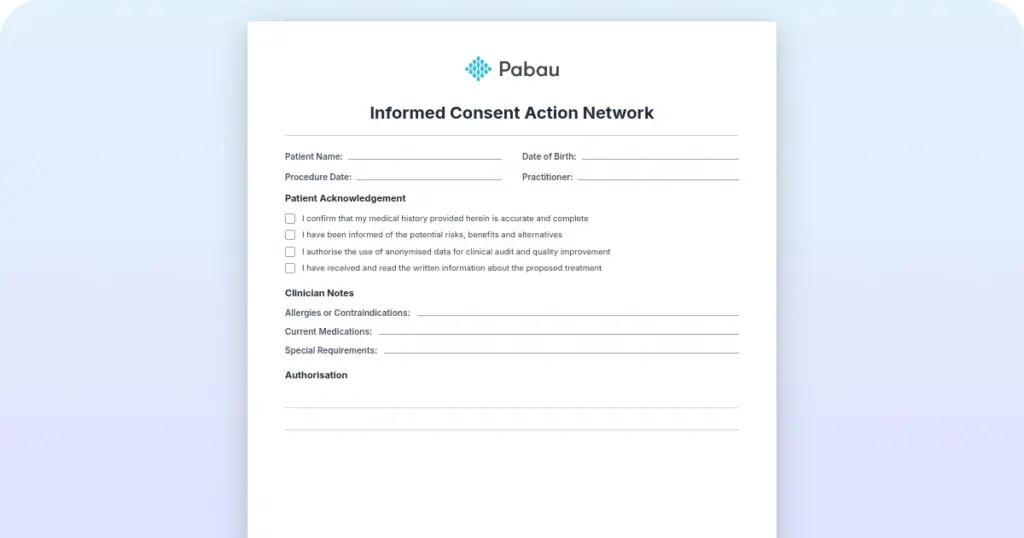
Informed consent action network
The Informed Consent Action Network (ICAN) is a US vaccine-policy advocacy group...

2
Last Updated: Oct 14, 2026
A testimonial release form is a legal document that authorizes a healthcare practice to use a patient’s name, likeness, and treatment experience in marketing.
Get it signed before you publish any patient testimonial, whether it goes on your website, your social feeds, or printed material. A valid form names the content it covers and the channels you may publish in. It also sets how long consent lasts and how the patient withdraws it.
This guide covers the HIPAA and FTC rules behind the form, plus the five elements a valid one has to carry. It also shows where signature collection belongs in your patient workflow. Practice management software like Pabau collects the signature through its digital intake forms. The signed release then sits in the patient record, next to the treatment history it refers to.
A ready-to-use consent form for practices collecting patient testimonials. It covers name disclosure, the channels you may publish in, how long consent runs, and HIPAA-compliant storage instructions.
Download template
A testimonial release form is a signed agreement letting a practice use a patient’s name and treatment story in marketing.
HIPAA, the FTC endorsement rules, and state privacy laws all require written authorization before a testimonial is published.
A valid form names the content covered, the permitted channels, the duration, and the patient’s route to withdrawing consent.
Collect photo permission separately from written permission, so a patient can approve one and decline the other.
File the signed release on the patient record, so you can check the scope before publishing and act fast on a withdrawal.
A testimonial release form is a written agreement between your practice and a patient. It grants permission to use their name, likeness, and treatment experience in marketing. The patient consents to publishing their opinion and their visible results, never their clinical details.
In healthcare the form does three jobs at once. It records the patient’s authorization under HIPAA, it secures your right to publish the testimonial, and it fixes the scope of that use. Scope means the specific channels: your website only, or social media and print as well.
Publish a patient’s name and testimonial without a signed release and you carry two exposures. The patient can claim compensation for unauthorized use of their likeness, and a regulator can treat the disclosure as a HIPAA violation. Both start with a complaint you then have to answer in writing.
Three regulatory frameworks require written consent before a patient testimonial goes out:
Regulation is not the only reason to bother. Complaints usually start with something small, like a patient’s first name published without consent, or treatment details attached to a quote. Tracking which patient authorized which use is one of the jobs HIPAA compliance software does. A signed release is then the record an auditor asks for first.
Five elements make a testimonial release enforceable, and the downloadable template already carries all five.
Read the five as one permission that narrows at every step, from who is consenting down to what you may actually publish.
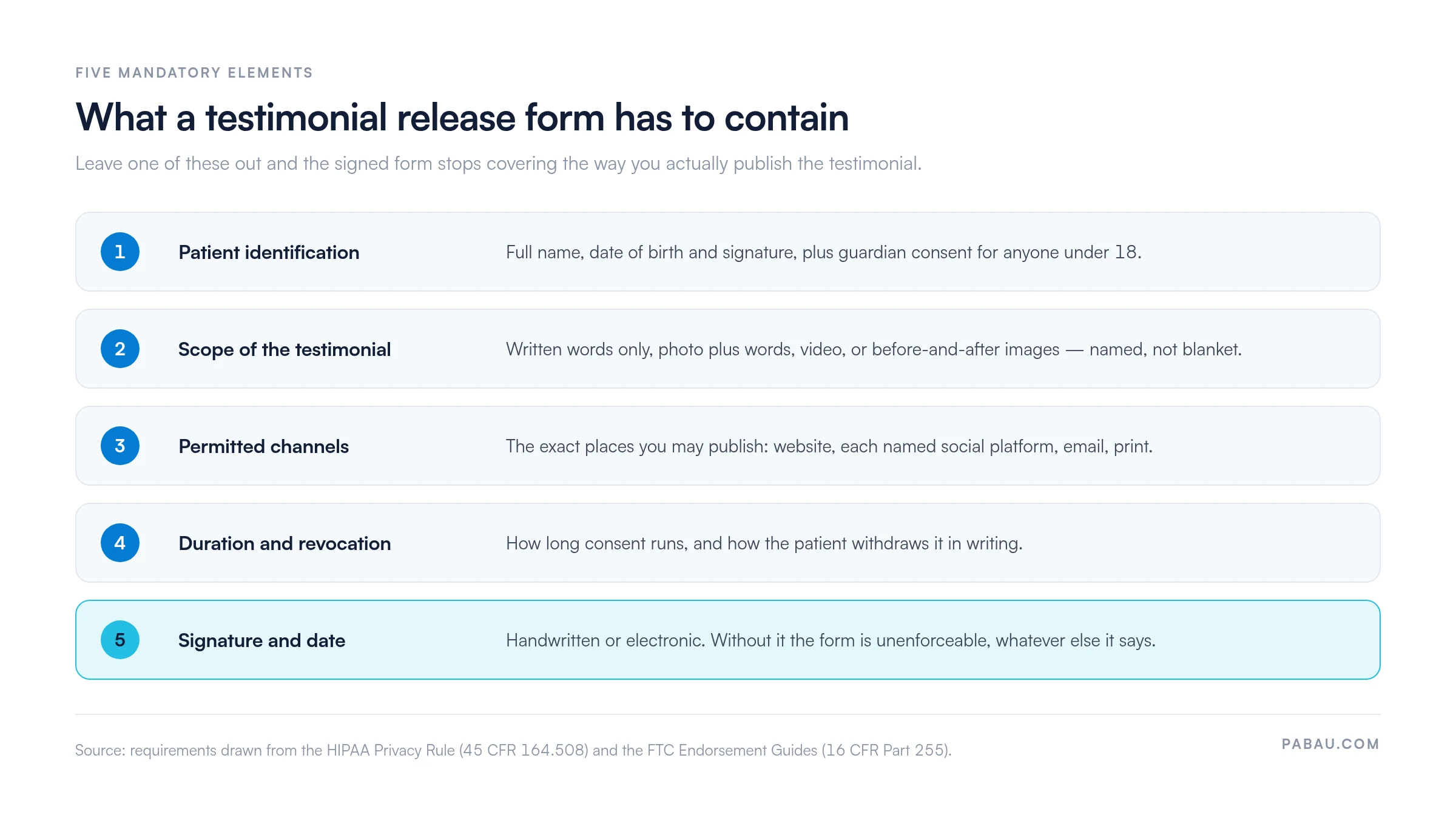
Present the form as a standard step rather than a special request. Explain each section in plain language, take the signature, and file the signed copy in the patient record. Keep clinical detail out of the testimonial itself, so no diagnosis, no treatment specifics, and no medication names.
Collecting a written testimonial and a photograph means collecting two consents. Permission to publish a written statement does not extend to a person’s image, and permission for an image does not cover their words. A patient may be happy with a written review on your website and still refuse to appear in a photo.
A combined form handles both in one document, as long as it keeps them separate:
Separate checkboxes give the patient granular control, so they can approve the text and decline the photo. That matters in aesthetics and med spa work, where some patients want their results shown and others want anonymity. Honoring the difference also gives your front desk something concrete to say when a patient hesitates.
The HIPAA Privacy Rule (45 CFR 164.508) separates using patient information for treatment from using it for marketing. A testimonial is marketing, so it needs written authorization of its own. The routine treatment consent the patient already signed does not cover it.
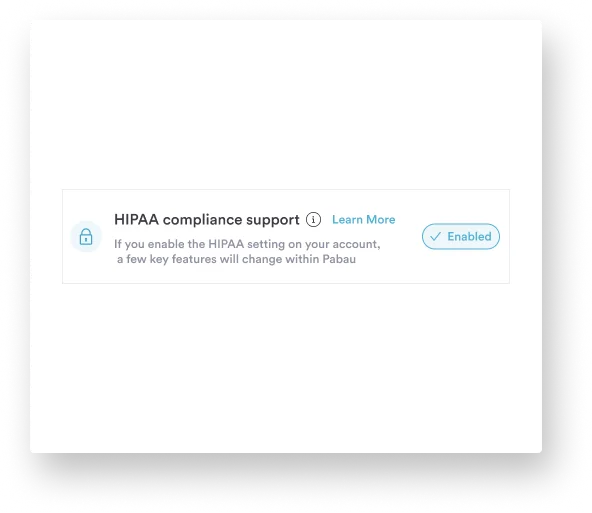
The rule also limits what a signed release can cover. Your form should state plainly that protected health information stays out of the testimonial unless a separate, specific HIPAA authorization covers it. That means diagnoses, medication names, treatment dates, and clinical measurements. Compliance management software records who authorized testimonial use and what scope they agreed to, which is what stops a publication going past the consent.
Two examples make the boundary concrete. A compliant testimonial reads: “I struggled with acne for years. After treatment my skin is clearer and I feel confident again.” A non-compliant one reads: “I was diagnosed with rosacea in 2024 and prescribed doxycycline before switching to IPL therapy here.” The second names a diagnosis and a medication, so it needs a specific HIPAA release before it goes anywhere.
The Federal Trade Commission’s endorsement and testimonial guides apply to healthcare advertising. Two rules do most of the work:
Put both disclosures in the form itself. One line has the patient acknowledge they are a patient of the practice. A second has them confirm the testimonial will be published as written, and may disclose that relationship. Your FTC position is then documented at the point of signature rather than argued afterward.
Collection rates depend almost entirely on timing. These five steps are the sequence that works:
The downloadable template is yours to adapt. Change the practice name and contact email, then edit the permitted-channels list so it matches the places you actually publish.
Record consent status against the patient rather than in a spreadsheet. A flag reading “testimonial approved: website, social; expires 2027-09-24” is enough. That one field prevents accidental breaches and answers an auditor’s question in seconds.
A signed release is a legal record and has to survive as one. How you store it protects the patient’s privacy and your own defense at the same time.
Practices that keep consent records inside the practice management system avoid the scramble through email approvals and loose paper. It also means the answer to “may we publish this one?” sits one click from the patient’s file.
Most practices run consent on two systems that never meet. The signed release sits in a shared drive or a filing cabinet, and the marketing calendar sits somewhere else. Checking a scope before a post means asking someone to go and look it up.
In Pabau the release is a form on the patient’s own record. The patient signs it on a tablet at the front desk, or from a link before they arrive. The signed copy then files itself against their record. Marketing staff can read the scope without opening a drive.
The same record holds the clinical notes the testimonial refers to. Pabau Scribe, our AI medical scribe, writes the treatment note straight into it, so the note, the photos, and the signed release stay together. When a patient withdraws consent, you can list every asset tied to them instead of guessing.
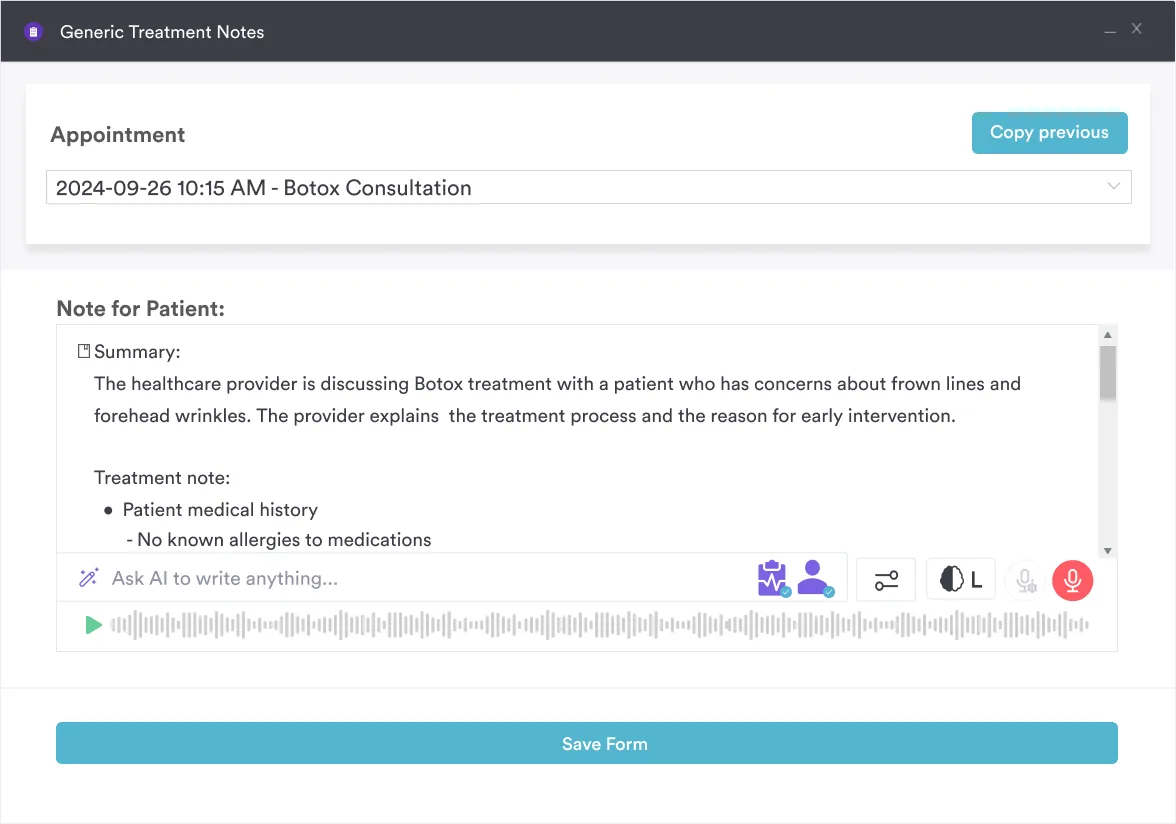

Pabau collects the signed release on the patient’s record and keeps its scope visible to your marketing team. Every published testimonial traces back to the consent that allows it.

The form is the cheap part. What decides whether your testimonial program holds up is something else. It is whether anyone can find the signed release six months later, when a patient asks you to take a photo down.
So adapt the template once, then settle where the signed copies live before you collect the first one. A practice that files consent against the patient can publish quickly, because checking the scope costs nothing. A practice that files it in a drive ends up publishing cautiously, or publishing and hoping.
Book a demo to see how Pabau collects, stores, and audits patient consent alongside the treatment records it refers to.

Publishing testimonials on Instagram or Facebook? HIPAA and social media sets out what a practice can and cannot post about a patient.
Need to release records rather than a quote? The HIPAA medical release form covers disclosure of protected health information to a named third party.
Unsure how long to keep a signed release? How long to keep medical records explains the retention periods that apply to patient documentation.
Writing the privacy notice that sits behind it? The notice of privacy practices template tells patients how their information is used and shared.
Yes, once it is properly signed. The release is a contract: the patient grants permission to use their testimonial, and the practice can enforce the scope of permitted use. Without a signature the form is guidance rather than an agreement, so never rely on an unsigned release.
A template is enough for most small practices. Download this form, then change the practice name and the permitted channels. Have a healthcare attorney review it if you operate across several states or countries, or if testimonials will carry a national advertising campaign. Local privacy laws such as UK GDPR and the California CCPA are where the wording usually needs adjusting.
No. Notarization is not required for a release form to be valid. The patient’s signature, handwritten or electronic, is sufficient. Notarization adds cost and friction with no legal benefit. The exception is a state law requiring it for a specific contract type, which is rare for testimonial releases.
Honor the request immediately. Remove the testimonial from your website, your social accounts, and any printed material within 30 days. Ask third-party platforms such as Google Business Profile or Trustpilot to delete the post where one exists. Keep the withdrawal letter on file for three years as proof of compliance.
Anonymous testimonials still need consent where a reader could identify the patient. One example is “a local aesthetic nurse saw a marked reduction in fine lines after our treatment”. Anonymity on its own satisfies neither HIPAA nor the FTC rules. A genuinely generic line such as “this practice is great” carries less risk. Even so, collecting written permission from every patient you quote is the safer habit.
Yes, with proper consent. Take a signed testimonial release, which doubles as the HIPAA authorization, and keep it on file. Disclose no protected health information the patient did not approve. HHS guidance on the Privacy Rule permits testimonials where the scope stays with the patient’s opinion and general results rather than clinical specifics.
A model release authorizes use of a person’s photograph or likeness, and is common in photography, film, and talent work. A testimonial release authorizes use of their name and their endorsement. A healthcare testimonial release usually combines both, covering the patient’s name, their quote, and their photograph. Use a testimonial release for endorsements, a model release for images alone, and a combined release when you collect both.