HIPAA compliant texting: What you can send patients & how to communicate securely
HIPAA compliant texting is possible when a text holds no protected health inform...

Last Updated: Oct 16, 2026
A hazardous medication list is the cornerstone of safe medication management and USP 800 occupational safety compliance in healthcare settings. It identifies drugs that pose occupational exposure risks to healthcare workers through inhalation, skin absorption, ingestion, or needlestick.
The National Institute for Occupational Safety and Health (NIOSH) publishes the hazardous drug list used across US practices and pharmacies. Its current edition, the NIOSH List of Hazardous Drugs in Healthcare Settings, 2024, sorts hazardous drugs into two tables. Table 1 holds drugs with manufacturer’s special handling information or a known or probable carcinogen classification. Table 2 holds every other drug that meets the NIOSH definition.
This guide is for anyone running a hospital pharmacy, medical spa, IV therapy practice, or multi-specialty practice. It covers what qualifies as hazardous, how to classify medications, the personal protective equipment (PPE) each activity needs, and how to keep records current.
We’ve included a free downloadable template to help you build hazardous medication protocols into your daily workflows. It supports compliance with USP 800 and occupational safety standards.
A printable checklist with header fields for name, record or MRN number, preparer, and date. Its item rows track quantity, owner, and confirmation, with blank rows and a notes section for each hazardous drug your practice records.
Download template
A hazardous medication list identifies drugs with occupational exposure risks. The 2024 NIOSH list sorts them into two tables, replacing the three tables used in 2016.
USP 800, enforceable since 2019, sets handling standards for hazardous drugs in healthcare settings. It references the NIOSH list to define which drugs require special precautions.
PPE depends on the handling activity and dosage form. USP 800 requires two pairs of chemotherapy gloves for compounding hazardous drugs and for administering antineoplastic drugs.
Practice management software like Pabau helps track medication records, staff training completion, and hazardous drug protocols across multiple locations.
A hazardous medication list is a reference document identifying drugs that present occupational health risks to healthcare workers. Healthcare workers can be exposed via four routes: Inhalation (breathing in aerosols or dust), skin absorption (direct contact), ingestion (accidental hand-to-mouth transfer), and needlestick injury. The goal is to protect staff through engineering controls, PPE, training, and safe handling protocols.
Drugs qualify as hazardous based on these criteria: Carcinogenicity (cancer-causing potential), teratogenicity (fetal harm risk), reproductive toxicity, genotoxicity (genetic damage), and organ toxicity. NIOSH publishes the official hazardous drug list, and the United States Pharmacopeia (USP) sets the handling standard that relies on it. NIOSH’s list is the most widely adopted in US healthcare. The Institute for Safe Medication Practices (ISMP) publishes a separate list of high-alert medications, which tracks medication-error risk to patients rather than occupational hazard.
The current edition is the NIOSH List of Hazardous Drugs in Healthcare Settings, 2024 (DHHS Publication No. 2025-103), published in December 2024. It supersedes the 2016 list, adds 25 drugs, and removes 7.
The biggest change is structural. The 2016 list used three tables, often called groups: antineoplastic drugs, non-antineoplastic hazardous drugs, and drugs that were only a reproductive or developmental hazard. The 2024 list cuts that to two tables:
Several familiar drugs changed table in the move, as the map below shows.
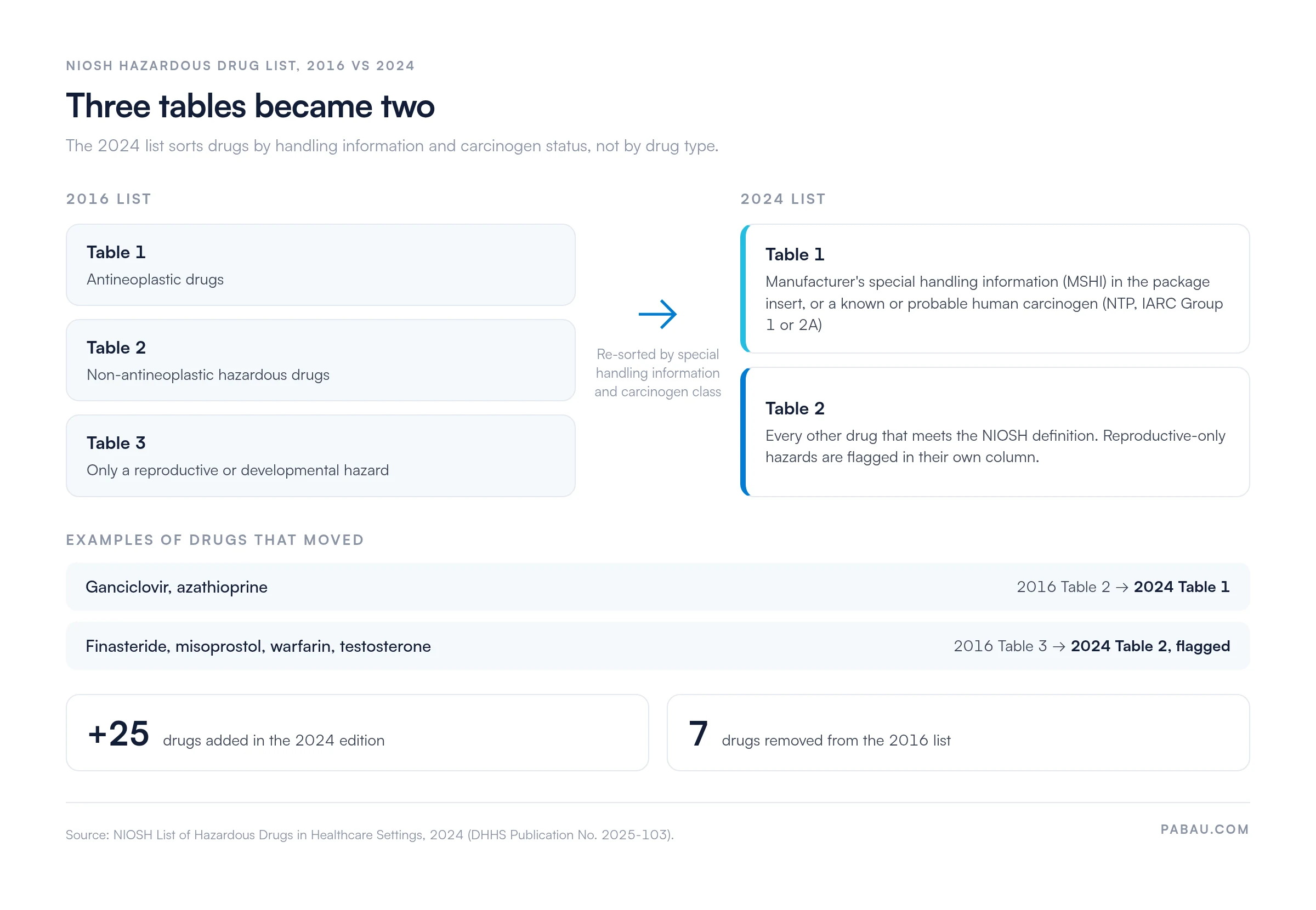
In the 2024 document, “Group” refers only to IARC carcinogen classes, such as Group 1 “carcinogenic to humans.” NIOSH also dropped the old exposure-controls table. PPE and engineering controls now sit in a separate NIOSH document, Managing Hazardous Drug Exposures: Information for Healthcare Settings.
The list has no fixed update schedule. The 2024 edition reviewed drugs that were approved, or received new FDA safety warnings, between January 2014 and December 2015. NIOSH warns that newer drugs may be missing, so check the package insert of any recently approved drug before you treat it as non-hazardous.
A hazardous medication list template helps practices record the NIOSH table for every drug in one place. Every staff member then knows which drugs require heightened precautions and what PPE is mandatory.
The NIOSH table a drug sits in tells your team why that drug is hazardous. It does not set PPE on its own. This table shows how the 2024 list sorts drugs, with examples checked against the NIOSH document:
Note: The 2024 list places each drug in one table only. Use the blank rows in the downloadable template to record each drug’s NIOSH table, so staff can spot medications that need elevated precautions.
USP 800 and the NIOSH hazardous medication list are complementary but distinct. USP 800 sets enforceable handling standards for hazardous drugs in healthcare settings, while NIOSH defines which drugs are hazardous based on occupational health criteria. USP 800 became enforceable on December 1, 2019. It applies to any healthcare facility preparing or handling hazardous drugs, including hospitals, practices, and pharmacies.
USP 800 explicitly references the NIOSH hazardous drug list as the basis for determining which medications require special handling. The standard mandates closed system transfer devices (CSTDs) for certain drugs and biological safety cabinets (BSCs) for high-risk compounding. It also requires specific PPE for each handling activity and staff training documentation.
Your hazardous medication list template should align with USP 800 by including fields for required controls, staff training dates, and compliance sign-offs.
Five steps build the list into daily practice.
Cold storage carries its own paperwork. Any drug on your list kept in a refrigerator needs a fridge temperature log, so you can show storage stayed in range.
Using a standardized hazardous medication list template reduces the risk that a staff member unknowingly handles a hazardous drug without proper precautions.
The 2024 NIOSH list no longer sets PPE. The requirements come from USP 800 and the NIOSH Managing Hazardous Drug Exposures guidance, and they depend mainly on the activity and dosage form. This table summarizes the core USP 800 requirements:
Context-dependent exceptions exist. USP 800 lets a practice perform a documented assessment of risk for some dosage forms, such as antineoplastic tablets that only need counting or repackaging. That assessment sets alternative containment and work practices, and it must be reviewed at least every 12 months.
A documented assessment of risk still needs a scoring method. Rate each dosage form on likelihood and severity, the two measures healthcare risk management applies to every other risk a practice tracks.
Your hazardous medication list template should record each drug’s exposure route and the PPE adjustments you document. Filing each assessment in compliance management software keeps its 12-month review date in view.
Beyond handling and PPE, the disposal of hazardous drug waste is regulated under the EPA’s Resource Conservation and Recovery Act (RCRA). Not all hazardous drugs are RCRA-regulated waste, but certain antineoplastic and other hazardous drugs are classified as P-listed or U-listed hazardous wastes.
P-listed drugs (acutely hazardous) include specific chemotherapy agents and must be disposed of as hazardous waste. U-listed drugs (toxic hazardous) include certain antivirals and other compounds. Practices must segregate P- and U-listed drug waste into designated containers, label them clearly, and arrange disposal through a licensed hazardous waste contractor. Flushing hazardous drugs down the drain or placing them in regular medical waste is illegal.
Verify the EPA’s P-list and U-list before assuming a hazardous drug requires special waste disposal. Add an “RCRA status” column to your hazardous medication list template to flag drugs requiring hazardous waste protocols at the point of disposal.
NIOSH revises its hazardous drug list on no fixed schedule, and each revision has to reach your practice policies. Three steps keep your list current.
Many practices keep the hazardous medication list as a printed sheet or a spreadsheet, with training sign-offs filed somewhere else. When NIOSH or a manufacturer changes the handling information, someone has to update every copy by hand. An inspector then sees whichever version was printed last.
Practice management software like Pabau keeps the list, the stock, and the staff sign-offs in one system. Digital forms turn the template into a form your team completes and signs, so each review carries a date and a name. Inventory and stock management records each hazardous drug from delivery onward.
The result is one current record for every location. Staff check the same list before they handle a drug, and your audit trail is ready when an inspector asks for it.

Pabau’s digital forms and inventory tools keep your hazardous medication list, staff sign-offs, and stock records in one system across every location. Each review carries a date and a name, so audits take less preparation.

The 2024 NIOSH tables tell your team why a drug is hazardous. USP 800 and your own documented assessment of risk decide how staff handle it. A list that records the table without the PPE and storage rules leaves staff guessing at the moment of exposure.
Rebuild your list around the two-table structure now, and check any drug approved after 2015 against its package insert. Then review the list every quarter so it keeps pace with your stock. Book a demo to see how Pabau keeps your hazardous medication list, training sign-offs, and stock records in one audit-ready system.

Need a written safety program to file this list in? OSHA handbook sets out the workplace safety requirements and gives you a free template for your practice.
Had a spill or needlestick with a hazardous drug? Incident report form covers what to record after an exposure so the event is documented the same day.
Tracking work-related injuries and exposures? OSHA Form 300A explains the posting deadlines, filing rules, and penalties for the annual injury summary.
Preparing for an inspection of your records? Medical chart audit walks through how to review documentation before an auditor does.
A hazardous medication list identifies drugs that pose occupational exposure risks to healthcare workers through inhalation, skin absorption, ingestion, or needlestick. In the US it is based on the NIOSH List of Hazardous Drugs in Healthcare Settings, 2024, which sorts hazardous drugs into two tables.
The 2024 NIOSH list spans two tables. Table 1 examples include methotrexate, doxorubicin, cisplatin, ganciclovir, and azathioprine. Table 2 includes finasteride, isotretinoin, warfarin, and tacrolimus. Consult the official NIOSH list to verify whether a specific medication is included.
No. The 2024 NIOSH list replaced the three tables of the 2016 list with two. Table 1 covers drugs with manufacturer’s special handling information or a known or probable carcinogen classification. Table 2 covers every other hazardous drug, including drugs that are only a reproductive or developmental hazard.
USP 800 is an enforceable standard (effective since December 2019) that sets safe handling requirements for hazardous drugs in healthcare facilities. USP 800 references the NIOSH list to define which drugs require special controls. Those controls include closed system transfer devices, biological safety cabinets, and PPE for each handling activity.
Hazardous drugs are identified by NIOSH based on FDA-labeling data and occupational health evidence. Drugs are classified if they meet one or more criteria: Carcinogenicity, teratogenicity, reproductive toxicity, genotoxicity, or organ toxicity. The 2024 NIOSH list then places each drug in Table 1 or Table 2, based on its special handling information and carcinogen classification.
PPE depends on the handling activity and dosage form. USP 800 requires chemotherapy gloves for handling hazardous drugs, and two pairs for compounding or administering antineoplastic drugs. Gowns that resist hazardous drug permeability are required for compounding and for administering injectable antineoplastics. Goggles are needed when splashes are possible, and respirators when airborne exposure is possible.
NIOSH has no fixed update schedule. The current edition, published in December 2024, reviewed drugs approved or given new FDA safety warnings between January 2014 and December 2015. NIOSH posts interim additions and removals on its website, so check there and in the package insert for newer drugs.
A high-alert medication (per ISMP) is one that carries the highest risk of patient harm if used in error. A hazardous drug (per NIOSH) poses occupational health risks to the healthcare worker handling it. A drug can be both high-alert and hazardous, but they are distinct classifications serving different safety purposes.