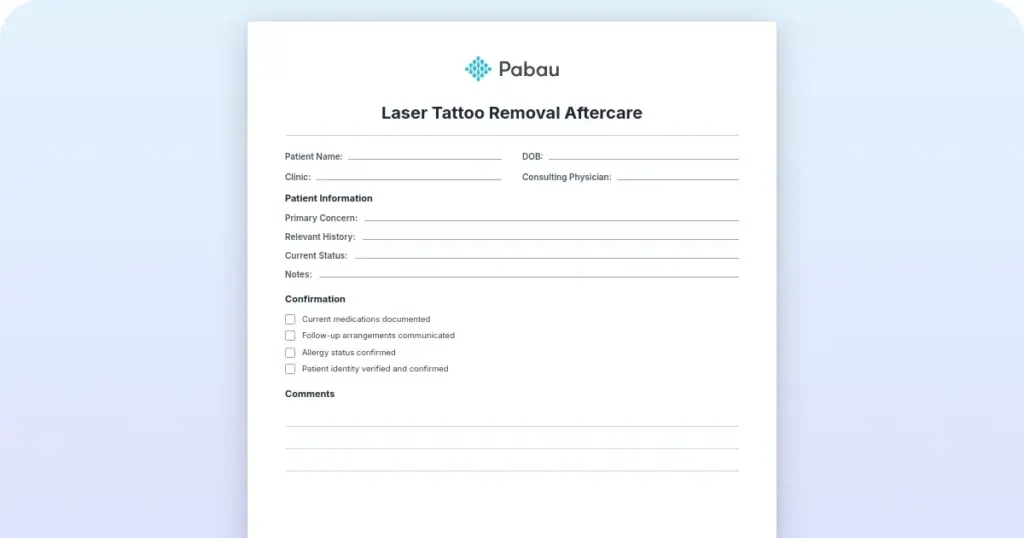
Laser tattoo removal aftercare instructions template
Download your free laser tattoo removal aftercare instructions template A ready-...

24
Last Updated: Sep 4, 2026

Full body exfoliation removes dead skin cells to reveal smoother, brighter skin, but requires structured aftercare.
The first 24-48 hours are critical: hydrate skin, apply moisturizer to damp skin, avoid sun exposure, and prevent irritation.
Clients should wait 48+ hours before exfoliating again and follow a recovery timeline that respects their skin’s healing phase.
Pabau’s digital forms and automated reminders help practitioners send consistent, personalised aftercare guidance to every client.
Contraindication screening and client communication prevent complications and boost satisfaction with treatment outcomes.
A ready-to-use aftercare guideline template covering immediate post-treatment steps, recovery timeline, product recommendations, do’s and don’ts, and contraindication flags for clinic teams to share with clients post-treatment.
Download templateFull body exfoliation treatments deliver visible results: smoother texture, improved circulation, and brighter, renewed skin. But the first 48 hours after treatment are crucial. How your clients care for their skin in this window determines whether they experience optimal results or post-treatment complications like irritation, hyperpigmentation, or premature skin breakdown. This guide provides the structured digital aftercare form template you need to communicate clear, evidence-based aftercare instructions that protect your clients and support your practice’s reputation.

A full body exfoliation treatment aftercare guideline is a structured set of clinical instructions practitioners give clients immediately after a professional exfoliation service (mechanical scrub, chemical peel, or enzymatic treatment) to manage post-treatment healing and prevent complications. The guideline covers the timeline from minutes post-treatment through 7+ days of recovery, addressing hydration, sun protection, activity restrictions, product use, and warning signs that require clinical attention.
These guidelines serve three purposes: first, they protect client safety by clearly stating what to avoid (sun exposure, exfoliation, irritating products); second, they optimise outcomes by reinforcing proper hydration and moisturising; and third, they provide legal documentation that the client received professional aftercare instruction-a critical compliance safeguard for practitioners. Under UK Health and Safety Executive (HSE) standards and international aesthetic treatment protocols, documented aftercare is a standard of care expectation.
Implementation of the aftercare guideline template follows a five-step clinic workflow:
Medical spas and aesthetic clinics offering full body exfoliation treatments-mechanical body scrubs, chemical peels (AHAs, BHAs), enzymatic exfoliants, or dry brushing services-rely on clear aftercare guidance to protect clients and reduce post-treatment complaints. This template is invaluable for dermatology clinics, skin-focused spas, beauty therapy teams, and wellness practitioners offering body treatments. Spa management software keeps treatment history, preferences and bookings against one client record.
Specifically, the guideline serves solo practitioners and multi-location clinic teams by standardising the information every client receives, ensuring consistency regardless of who delivered the treatment. It also supports practitioners managing clients with varying skin types, sensitivities, and risk factors-the template includes branching guidance for sensitive skin, darker skin tones, and post-inflammatory hyperpigmentation risk. When embedded in your clinic’s client communication platform, aftercare guidelines become a touchpoint that strengthens the client-clinician relationship and signals professionalism.
With digital medical records, forms like this stay attached to the patient’s full history.
Safety and risk reduction: Documented aftercare instruction reduces the risk of post-treatment complications. By clearly communicating what to avoid-sun exposure, aggressive exfoliation, irritating actives-you protect clients from hyperpigmentation, persistent irritation, and premature skin breakdown. Clear contraindication screening catches clients with sunburned, broken, or inflamed skin before treatment begins.
Clinical compliance: Under American Academy of Dermatology (AAD) standards and UK HSE treatment safety guidelines, aftercare documentation is a standard of care. A signed or acknowledged copy of your aftercare guideline in the client’s record demonstrates that you provided professional, evidence-based guidance-a critical defence in any complaint or liability claim.
Client satisfaction and outcomes: Clients who follow proper aftercare recover faster, experience better aesthetic results, and are more likely to rebook. When aftercare is clear, achievable, and personalised to the client’s skin type, compliance improves.
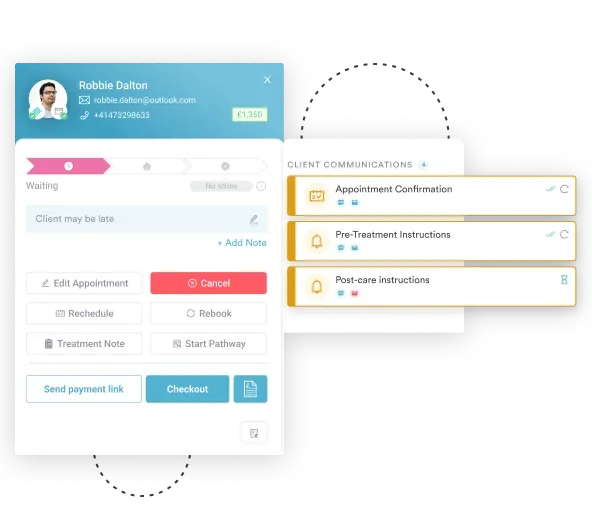
Workflow efficiency: A standardised template reduces the time practitioners spend explaining aftercare verbally at every appointment. Handing a client a printed guideline (or texting a digital link) takes 30 seconds and delivers far more consistent information than relying on memory or ad-hoc verbal instruction.
Professional reputation: Clinics that provide detailed, thoughtful aftercare guidance stand out. Clients perceive practitioners who invest in aftercare as more competent and trustworthy. This translates to higher review ratings, stronger word-of-mouth referrals, and increased client lifetime value.
Document the specific exfoliation modality (mechanical scrub vs. chemical peel vs. enzymatic treatment) on the client’s copy of the guideline, as recovery timelines and product restrictions vary. Chemical exfoliants require longer sun protection windows; mechanical scrubs may allow makeup resumption sooner. Personalisation prevents client confusion and reduces post-treatment support requests.
Understanding the skin’s healing phases helps practitioners counsel clients on what to expect and when complications are most likely.

Pabau’s digital forms and automated reminders help you deliver consistent, personalised aftercare guidance at scale.

Do’s: Apply moisturiser to damp skin within 1 hour of treatment. Drink plenty of water. Use a gentle, fragrance-free cleanser. Wear sunscreen (SPF 30+) daily for at least 7 days. Wear loose, soft clothing to avoid friction. Keep the treated area clean and dry. Take cool (not hot) baths or showers after 4 hours. Resume gentle skincare after 24 hours. Sleep with your head elevated. Document any concerns and contact your practitioner if irritation worsens.
Don’ts: Avoid exfoliating again for at least 48 hours. Stay away from direct sun exposure for 7+ days (or longer for darker skin tones or chemical peels). Stay away from hot water, saunas, or steam rooms for 48 hours. Avoid makeup, deodorant, perfume, and fragrant lotions for the first 24 hours. Skip self-tanner, retinoids, vitamin C serums, and acids for at least 7 days. Avoid shaving, waxing, or plucking the treated area for 48+ hours. Skip vigorous exercise or activities that cause heavy sweating for 24-48 hours. Resist the urge to scratch or pick at flaking skin, even if tempted.
Before recommending full body exfoliation, screen clients for absolute and relative contraindications. Never exfoliate over sunburned, broken, actively inflamed, or recently cut skin. Use caution with clients who have active acne, rosacea, eczema, or psoriasis-exfoliation may worsen these conditions. For clients taking isotretinoin (Roaccutane), photosensitising medications (tetracyclines, NSAIDs), or immunosuppressants, modify the treatment or defer based on medical consultation.
Communicate contraindications clearly and supportively. Rather than saying “You can’t have this treatment,” frame it as: “Your skin is currently managing [condition], so we recommend postponing exfoliation for [timeframe] to ensure the best and safest result.” This approach respects the client’s autonomy while protecting them. Document the screening conversation in their record using comprehensive clinic management systems that track consent and clinical notes together.
Sensitive skin: Extend the “no active products” window to 10+ days. Use only fragrance-free, hypoallergenic moisturisers (ceramides, non-denatured hyaluronic acid). Avoid all actives for 2 weeks. Consider a lower-intensity exfoliation modality (enzymatic rather than mechanical).
Oily or acne-prone skin: Use a lightweight, non-comedogenic moisturiser. Oil-free sunscreen is essential. Gentle exfoliation can resume after 48 hours with a low-pH chemical exfoliant (if skin feels comfortable). Avoid heavy occlusive products that trap bacteria.
Darker skin tones (Fitzpatrick III-VI): Extend sun protection to 10-14 days and emphasise daily, broad-spectrum SPF 50+. Risk of post-inflammatory hyperpigmentation is higher, so avoid triggers: sun, heat, retinoids, and strong actives. Consider a lower-intensity exfoliation and longer intervals between treatments (every 6-8 weeks rather than 4).
After exfoliation, clients benefit from a simplified skincare routine during the recovery window. Recommend: a gentle, pH-balanced cleanser; a hydrating moisturiser with ceramides or hyaluronic acid; and a broad-spectrum sunscreen (SPF 30+). Avoid actives (retinoids, acids, vitamin C) for 7-10 days. After recovery, clients can resume professional exfoliation every 4-8 weeks depending on skin type and goals. Those with active acne or darker skin tones may benefit from 6-8 week intervals to prevent sensitivity and hyperpigmentation.
Help clients understand that home exfoliation (via loofahs, scrubs, or at-home chemical exfoliants) should occur no more than 2-3 times weekly and never in the 7 days following a professional treatment.
To embed the full body exfoliation treatment aftercare guideline into daily practice, store a printed or PDF copy at every treatment station. During the pre-treatment consultation, review the guideline with the client, highlight any personalised modifications, and ask if they have questions. At the end of treatment, hand them a copy and verbally summarise the key first-24-hour steps. Schedule an automated SMS or email reminder for 24 hours and 48 hours post-treatment-messages that reference the guideline and invite questions. At 7 days, send a brief follow-up asking about their recovery experience and scheduling the next appointment. This structure ensures every client receives consistent, professional aftercare guidance that protects your practice and elevates the client experience.

Offering reflexology alongside exfoliation treatments? Foot reflexology charts gives a one-page checklist of common trigger points for reflexology sessions.
Want to sell spa gift certificates? Massage gift certificate template covers the eight required fields and the state rules that override the federal minimum.
Want to build a wellness plan with clients? Personal wellness plan template covers a baseline health assessment, short- and long-term goals, and progress tracking.
Full body exfoliation treatment aftercare guidelines are a non-negotiable component of safe, professional aesthetic practice. They protect client safety, optimise treatment outcomes, reduce post-treatment complications, and provide legal documentation of informed consent. By using a structured, clinic-ready template-and automating reminders and communication through your clinic management system-you elevate the standard of care your team delivers and build lasting client trust. Book a demo to see how Pabau’s digital forms and automated workflows simplify aftercare communication at scale.
Do not shower for 4 hours. Hydrate with water, apply fragrance-free moisturiser to damp skin within 1 hour, wear loose clothing, avoid sun exposure, and refrain from all makeup and perfumed products for 24 hours.
Wait at least 48 hours before any exfoliation (professional or at-home). Skin needs time to recover; premature exfoliation risks irritation, inflammation, and sensitivity. Most practitioners recommend 4-8 weeks between professional treatments.
No. Wait at least 7 days post-exfoliation before applying self-tanner. Freshly exfoliated skin is permeable and sensitised; self-tanner applied too soon can cause uneven absorption, irritation, and orange streaking.
For most clients, every 4-8 weeks is recommended, depending on skin type and goals. Those with sensitive skin or darker skin tones may benefit from 6-8 week intervals to prevent irritation and post-inflammatory hyperpigmentation.
Avoid retinoids, vitamin C, active acids (AHAs, BHAs, salicylic acid), self-tanners, fragrant lotions, essential oils, and deodorants for at least 7 days post-treatment. Stick to gentle cleansers, hydrating moisturisers, and sunscreen only.
Skin usually recovers in 24-48 hours with proper hydration, sunscreen, and gentle care. Mild flaking or tightness may persist until day 5-7 as dead skin cells shed naturally. If irritation worsens after 48 hours, contact your practitioner.