









ICD-10 Code M45.6: Ankylosing spondylitis lumbar region
ICD-10 Code M45.6 is the billable ICD-10-CM diagnosis code for ankylosing spondy...

Last Updated: August 3, 2026


CPT Code 97802 covers an initial individual MNT assessment, billed in 15-minute units for face-to-face nutrition counseling
Medicare Part B covers one initial 97802 assessment per benefit year, requiring a physician referral and a qualifying diagnosis such as diabetes or chronic kidney disease
Only qualified registered dietitian nutritionists (RDNs) meeting CMS credentialing standards may bill 97802 under Medicare; follow-up visits use 97803 instead
Pabau’s claims management software helps nutrition practices track MNT billing units, manage physician referrals, and reduce 97802 claim denials
CPT Code 97802 is the code for an initial medical nutrition therapy (MNT) assessment and intervention, delivered face-to-face with an individual patient and billed in 15-minute increments. This guide covers what Medicare and commercial payers require to pay the claim, how documentation needs to look, current reimbursement rates, and how 97802 differs from the related codes practices bill alongside it.
The American Medical Association (AMA) maintains CPT Code 97802 within the medical nutrition therapy CPT codes range (97802–97804), the core nutrition counseling codes dietitians use to bill insurance. The full descriptor reads: “Medical nutrition therapy; initial assessment and intervention, individual, face-to-face with the patient, each 15 minutes.”
Two billing constraints define every 97802 claim: it applies to the initial visit only, and each 15-minute unit must be documented separately. A 45-minute initial session generates three units of 97802.
MNT is a clinical service, not a wellness counseling session. It involves a comprehensive nutritional assessment, diagnosis of nutrition-related problems, and a tailored intervention plan developed by a credentialed nutrition professional. For weight loss clinics and metabolic health practices billing insurance, correctly categorizing that first encounter is what separates a clean claim from a denial.
Provider eligibility for 97802 differs by payer. Under Medicare, only registered dietitian nutritionists (RDNs) and nutrition professionals who meet CMS credentialing requirements may bill this code. A physician, nurse practitioner, or health coach cannot substitute. Commercial payers often apply broader definitions, but verify each plan’s policy before assuming equivalence.
Practices that bill 97802 across multiple payer types need a referral tracking workflow. Without one, it is easy to submit a Medicare claim without a documented physician order and receive an automatic denial. Claims management software that flags missing referral documentation before submission prevents that specific failure point.
Medicare Part B covers MNT services under a National Coverage Determination (NCD). The coverage rules are specific and non-negotiable. Getting them wrong means a denied claim that is difficult to appeal because the limitation is structural, not a documentation dispute.
Verify the current NCD and applicable Local Coverage Determinations (LCDs) through the CMS fee schedule lookup or your Medicare Administrative Contractor (MAC) before billing. The Noridian MAC publishes jurisdiction-specific guidance for 97802 that supplements the national NCD. Rules for functional medicine practices serving Medicare patients are the same as for any other setting; there are no specialty exemptions.
Medicare reimbursement for 97802 is calculated per 15-minute unit using the Resource-Based Relative Value Scale (RBRVS). Rates vary by geographic location through the Geographic Practice Cost Index (GPCI).
The table below reflects the confirmed 2026 national, unadjusted Medicare rates from the CMS Physician Fee Schedule relative value file (RVU26A, non-facility, non-QP conversion factor). Use the CMS PFS Look-Up Tool to confirm the adjusted rate for your specific locality.
Important: Rates above are the national, unadjusted, non-facility figures. Your actual payment depends on your locality’s GPCI, whether the practice accepts assignment, and the patient’s coinsurance or deductible status. Confirm your locality-adjusted rate with your MAC or through the CMS PFS Look-Up Tool before projecting revenue.
Commercial payers negotiate rates independently. Some pay significantly above Medicare; others apply Medicare rates as a floor. Practices billing nutrition coaching CPT codes under commercial plans should request a fee schedule from each payer during credentialing. Assuming Medicare rates for commercial claims leads to systematic under-collection.
Documentation is where 97802 claims most commonly fail audit. Each 15-minute unit must be supported by a note that demonstrates clinical work occurred during that time. A single undated SOAP note for a 45-minute session, without time notation, creates a MUE (medically unlikely edit) risk and an audit exposure.
Use structured digital intake forms to capture the assessment components systematically before the visit begins. When anthropometric data, diet recall, and medical history arrive via a pre-visit form, the RDN’s documented session time reflects actual clinical analysis, not data collection. That distinction matters during a payer audit.
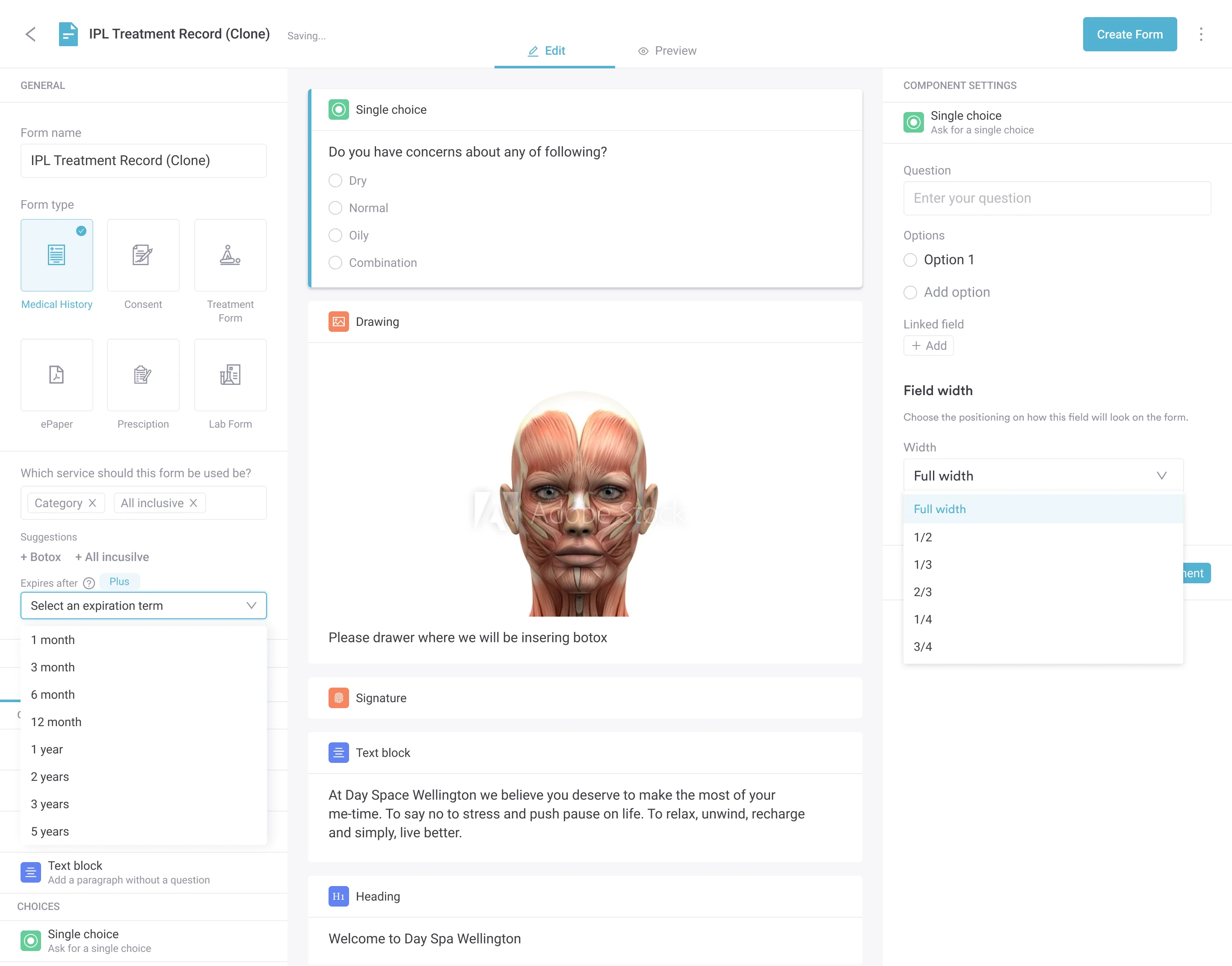
Pabau’s client record tools allow practices to attach the referring physician’s order directly to the patient’s chart, create time-stamped progress notes, and flag visits where referral documentation is incomplete before the claim is submitted.
Document face-to-face time in minutes at the top of every 97802 note, not buried in the narrative. Auditors checking for time-based billing look for explicit time statements first. A note that says ’45 minutes spent with patient in initial MNT assessment’ at the outset is cleaner than one where time must be inferred from the narrative length.
Medical necessity for 97802 requires a covered diagnosis. Under Medicare’s NCD, covered conditions are limited to diabetes, non-dialysis CKD, and kidney transplant within the past 36 months. Commercial payers generally allow a broader list. The table below shows the most commonly billed ICD-10-CM codes paired with 97802 for Medicare claims; verify current coverage against your MAC’s LCD before billing.
Patients with obesity, hypertension, or hyperlipidemia alone do not qualify for Medicare-covered MNT under 97802 unless a covered primary diagnosis (diabetes or CKD) is also present. Commercial plans often cover a wider range of diagnoses, including E66.01 and metabolic syndrome. Document the specific covered diagnosis, not a symptom or risk factor, as the primary ICD-10 code on the claim.
For preventive or wellness-oriented visits that sit outside a covered medical diagnosis, some commercial plans accept Z71.3, “Dietary counseling and surveillance,” as the reason for the encounter. Z71.3 cannot serve as the primary, qualifying diagnosis on a Medicare MNT claim. Current MAC guidance still allows it as a secondary code alongside the primary qualifying diagnosis, such as E11.x or N18.x.

Pabau helps nutrition practices capture referral documentation, track 15-minute billing units, and submit clean 97802 claims. See how it works for your practice.

The distinction between 97802 and 97803 comes down to visit type, not session length. Using the wrong code is a common audit target because the two codes are billed at different rates and have different annual coverage limits.
A patient returning after their first MNT visit requires 97803, regardless of how much time has passed since the initial assessment. The only exception: if the patient was discharged and re-referred more than 12 months later, a new initial assessment under 97802 may be appropriate. Confirm with your MAC whether a new physician referral is also required in that scenario.
Practices billing coaching CPT codes alongside MNT should keep a clear record of each patient’s first MNT visit date, so 97802 doesn’t get billed twice by mistake.
Two related codes round out the set. Use CPT 97804 for group medical nutrition therapy with two or more patients, billed in 30-minute units rather than 15.
When a Medicare patient needs MNT hours beyond the annual limit, the physician must issue a new referral documenting a change in medical condition, diagnosis, or treatment regimen. Those additional hours are then billed as G0270 (individual) or G0271 (group).
Build a simple flag in your scheduling system: when a patient is booked for a nutrition visit, the system should automatically check whether they have a previous 97802 charge in the current benefit year. If yes, default to 97803. This prevents the most common MNT coding error before the note is even written.
Telehealth nutrition services became widely reimbursable during the COVID-19 public health emergency. Coverage for 97802 via telehealth has continued post-PHE under certain conditions, but the rules are payer-specific and evolving. Always verify current policy with your specific payer before billing telehealth MNT.
Medicare Fee-for-Service identifies telehealth delivery through the Place of Service (POS) code on the claim rather than a modifier: POS 02 for a patient not located at home, or POS 10 for a patient located at home. Commercial payers and Medicare Advantage plans vary, and some still expect Modifier -95 in addition to the POS code.
The HHS tele-nutrition billing guide (updated September 2025) provides current guidance on which CPT codes are eligible for telehealth billing. For practices using integrated telehealth software, the platform should capture the session delivery method and automatically prompt for the correct POS code and modifier at the time of billing.
Medicaid telehealth coverage for 97802 varies by state. Some state plans adopted permanent telehealth coverage for MNT; others reverted to in-person requirements after the PHE ended. Direct primary care practices billing MNT for Medicaid patients need to check current state-level policy directly with their Medicaid MAC before billing telehealth visits under 97802.
97802 denials cluster around a handful of preventable errors. Most are not medical necessity disputes. They are process failures.
Practices with recurring denial patterns on MNT codes benefit from a systematic review process. Pabau’s claims management tools allow staff to track denial reasons by code, identify patterns, and build pre-submission checklists specific to 97802 requirements. The AAPC CPT code lookup also provides crosswalk references to help coders identify related codes and modifier requirements.
Nutrition practices billing MNT alongside chronic disease management programs should also check bundling edits. If 97802 is billed on the same date as an Evaluation and Management (E/M) service, the E/M must reflect a separately identifiable service. Use modifier -25 on the E/M code to indicate this distinction.
Most 97802 denials are preventable. Missing referrals, duplicate initial assessments, undocumented session time, and wrong diagnosis codes each trace back to a broken process, not a clinical one. The fix is systematic documentation and claim verification before submission.
Pabau’s claims management software helps nutrition and dietitian practices build that verification process into every patient encounter: referral tracking, time-stamped clinical notes, and pre-submission checklist automation. If your practice is losing revenue to preventable 97802 denials, book a demo to see how Pabau handles MNT billing workflows end to end.

Billing across multiple nutrition-related codes? Coaching CPT codes covers the billing codes used for health coaching and wellness programs that often run alongside MNT services.
Serving patients with metabolic conditions? Metabolic health EMR software outlines how purpose-built platforms support metabolic clinics billing MNT and related services.
Need HIPAA-compliant documentation practices? HIPAA compliance guide covers the documentation and data security requirements relevant to every nutrition practice billing insurance.
Running a weight-loss or metabolic program? Weight loss clinic EMR covers documentation and billing workflows for programs that often incorporate MNT.
Building your intake workflow? Weight-loss intake form template shows how to capture history before an MNT assessment begins.
CPT Code 97802 is used to bill for the initial face-to-face medical nutrition therapy (MNT) assessment and intervention provided by a qualified dietitian or nutrition professional, billed in 15-minute units. It covers the comprehensive nutritional evaluation, diagnosis, and individualized intervention plan created during the first MNT encounter with a patient.
Yes, Medicare Part B covers CPT Code 97802 once per benefit year for beneficiaries with a diagnosis of diabetes mellitus, non-dialysis chronic kidney disease (CKD), or a kidney transplant within the past 36 months. A written physician referral is required before services begin, and the treating provider must be a qualified RDN enrolled in Medicare.
CPT 97802 is for the initial MNT assessment only and may only be billed once per year under Medicare. CPT 97803 covers all subsequent reassessment and follow-up visits, billed in the same 15-minute units. Using 97802 for a return visit is a common error that triggers denial and audit risk.
Documentation must include the total face-to-face time in minutes, a comprehensive nutrition assessment (diet history, anthropometric data, biochemical review), the nutrition diagnosis, an individualized intervention plan, the qualifying ICD-10 diagnosis code, and the written physician referral or order. Each 15-minute unit billed must be supported by documented clinical work during that time.
Yes, 97802 can be billed for telehealth using synchronous audio and video. Medicare identifies the encounter through a place-of-service code (POS 02 or 10) rather than a modifier, while commercial payers and Medicare Advantage plans may still request modifier -95. Audio-only sessions do not qualify, and coverage varies by payer and state.
Under Medicare’s National Coverage Determination, covered ICD-10 diagnoses for 97802 include diabetes mellitus codes (E10.x, E11.x), non-dialysis chronic kidney disease codes (N18.3, N18.4, N18.5), and kidney transplant status (Z94.0) within 36 months of transplant. Obesity or hypertension alone do not qualify for Medicare MNT coverage. Commercial payers typically allow a broader range of diagnoses.
CPT Code 97804 is the group medical nutrition therapy code, used when a dietitian counsels two or more patients together. Unlike 97802 and 97803, which are billed in 15-minute units, 97804 is billed in 30-minute units. Medicare covers it under the same MNT benefit as individual sessions.
Beyond 97802, the main nutrition counseling CPT codes dietitians bill are 97803 for individual follow-ups and 97804 for group sessions. For Medicare patients who need more hours than the annual limit allows, G0270 and G0271 cover physician-ordered additional MNT. Some commercial and private payers also recognize S9470 for nutritional counseling that falls outside the MNT code range.
No. Medicare’s medical nutrition therapy benefit has no age limit for CPT Code 97802. Eligibility is based on diagnosis, not age, so any beneficiary with diabetes or non-dialysis chronic kidney disease can qualify with a physician referral. Commercial payers set their own rules, so confirm coverage with each plan.