Piercing consent form
A piercing consent form is a signed record that a client understood a piercing&#...

4
Last Updated: Oct 2, 2026
Vanderbilt scoring counts only the answers rated 2 (often) or 3 (very often) on the NICHQ Vanderbilt Assessment Scale. A child screens positive for ADHD with six of nine positives on inattention or on hyperactivity/impulsivity. The performance section must also show impairment, meaning two items scored 4 or one item scored 5.
Getting the count right decides what happens next for the child. The parent and teacher forms use different item numbers after item 18, so one misread range can flag the wrong condition. Even a clean positive screen only starts an evaluation. It never confirms ADHD.
Below, our Count, Cross, Check sequence turns these rules into three passes over a completed form, then runs them on a worked example.

Only answers of 2 (often) or 3 (very often) count as positive, so ratings of 0 and 1 never add to a symptom count.
A child screens positive for ADHD with six of nine positives on inattention (items 1–9) or hyperactivity/impulsivity (items 10–18), plus performance impairment.
Impairment means two performance items scored 4 or one item scored 5, and the average performance score has no official cutoff.
The teacher form combines ODD and conduct in items 19–28 and screens anxiety/depression at 29–35, so parent ranges never transfer to it.
The Vanderbilt has no total-score cutoff, so a number like 39 has no official meaning on its own.
The Vanderbilt assessment measures how often a child shows the 18 DSM ADHD symptoms, screens for common co-occurring conditions, and rates school and home performance.
The National Institute for Children’s Health Quality (NICHQ) publishes it with the American Academy of Pediatrics. You’ll also see it called the Vanderbilt ADHD diagnostic rating scale. The parent form (VADPRS) has 55 items, and the teacher form (VADTRS) has 43.
According to the NICHQ scoring instructions, validation studies covered children aged 6 to 12. The same instructions say the scale also applies to other groups, particularly preschoolers, because it collects DSM criteria.
The scale screens rather than diagnoses. NICHQ states that it “should not be used alone to make a diagnosis” and expects interviews with at least the primary caregivers.
Adults need a self-report tool instead, such as the adult ADHD self-assessment scale.
Match the form to its item map before you count anything, because the parent and teacher layouts only line up for items 1–18. Use this map every time you pick up a form.
Every symptom item uses the same four-point scale:
Performance items use a separate five-point scale, covered below. The parent form asks raters to think about the child’s behavior over the past six months. A form answered about last week deserves a quick conversation before you score it.
To score the Vanderbilt assessment, mark every item rated 2 or 3, then count positives separately for inattention (items 1–9) and hyperactivity/impulsivity (items 10–18).
These five steps form the Count stage of the Count, Cross, Check sequence. None of them adds ratings together, because the screening decision rests on counts alone.
Pro tip: A column of identical answers, such as every item marked 2, is a response pattern rather than a symptom profile. Ask the rater about it before you record a count.
Score the parent form by counting 2s and 3s in items 1–9 and 10–18, then checking performance items 48–55 for two 4s or one 5.
Items 19–47 hold the comorbidity screens: ODD (19–26), conduct (27–40) and anxiety/depression (41–47). Items 48–55 rate overall school performance, reading, writing and math. They also cover relationships with parents, siblings and peers, plus participation in organized activities.
The 2012 scoring sheet lists parent performance as items 48–54, but the form itself runs to item 55. Score all eight performance items.
Score the teacher form exactly like the parent form for items 1–18, then switch to the teacher’s own ranges for every item from 19 onward.
Items 19–28 are one combined ODD and conduct set, and items 29–35 screen for anxiety and depression. Performance items 36–38 cover reading, math and written expression. Items 39–43 cover classroom behavior, including relationships with peers, following directions, disrupting class, assignment completion and organization.
Our NICHQ Vanderbilt teacher template walks staff through the teacher version before it goes out to schools.
To calculate the average performance score, add the ratings on the eight performance items and divide by the number of items the rater answered.
Each performance item uses its own five-point scale:
The office-use box on both forms has a line for an average performance score, but the NICHQ instructions give no cutoff for it. Dividing by the items answered is a common convention, borrowed from how the 2019 scoring instructions handle symptom means on follow-up forms.
So if a chart needs an average, use that convention and label it as one. Impairment is still decided by counts.
A parent form rated 4, 4, 3, 3, 2, 3, 3, 2 averages 3.0 and meets the impairment rule, because two items scored 4. A form with one 5 and seven 1s averages 1.5 and meets the rule too.
Once the ADHD sections are counted, the same forms screen for other conditions. The behavior and mood screens count 2s and 3s like the ADHD sections, but their ranges change between forms.
The ODD, conduct and anxiety/depression screens also need the performance criterion, exactly as the ADHD thresholds do. A positive screen tells the clinician which conditions to assess alongside ADHD, which can change who the child is referred to.
Vanderbilt scoring interpretation rests on symptom counts and impairment, because the scale has no official total-score cutoff for ADHD or for any comorbidity screen.
Both forms have a Total Symptom Score line for items 1–18. With 18 items rated 0 to 3, a Vanderbilt score on that line ranges from 0 to 54. NICHQ gives no cutoff or severity band for it.
That settles the common question about a score of 39. On the Vanderbilt, 39 has no official meaning, and two children with 39 can screen very differently.
A total of 39 does guarantee one thing. A subscale with five or fewer positives can total 19 at most, so two such subscales cap at 38. Any total of 39 or more means at least one subscale has six positives.
The reverse fails too. A child with six inattention items rated 2 and every other item rated 0 totals just 12, yet meets the inattentive threshold.
Each symptom item scores 0 to 3, so each ADHD subscale ranges from 0 to 27 and the 18 core items from 0 to 54. Performance items run from 1 to 5.
Research norms exist, but they aren’t NICHQ cutoffs. One norms study found that a subscale sum of 16 or higher placed a child at or above the 89th percentile in its sample.
A positive screen means the child needs a full diagnostic evaluation. The NICHQ instructions also say to consider information from multiple sources.
DSM-5 separately requires several symptoms in two or more settings, which is why the parent and teacher forms both matter. The NICHQ instructions don’t require both forms to score either one. A DSM-5 ADHD checklist keeps that clinical review structured.
Here is the Count, Cross, Check sequence on a hypothetical eight-year-old we’ll call Sam. Sam is an illustrative example, not a patient, and the responses were made up to show the method.
Count. Sam’s parent form has seven inattention items rated 2 or 3, which meets the six-of-nine threshold. Hyperactivity/impulsivity has three positives, and item 16 is blank. NICHQ gives no blank-item rule for the count, so the blank stays not positive and gets noted. ODD shows two positives in items 19–26, below the threshold of four.
Cross. Sam’s parent performance items read 4, 4, 3, 3, 2, 3, 3, 2. The two 4s meet the impairment rule, and the average performance score is 3.0. Next, cross to the teacher form, which shows six inattention positives, two hyperactive positives, and reading (item 36) scored 5.
Check. Before charting, confirm three points. The teacher form was read with teacher ranges, so items 29–35 went to anxiety/depression. The blank item is recorded for the parent rather than guessed. Even if item 16 were positive, hyperactivity/impulsivity would reach only four of nine, so the blank does not change the result. Neither rater marked the same answer down the whole column.
Sam screens positive for the inattentive presentation on both forms. The teacher’s reading score of 5 also meets the learning-disabilities screen, so the referral should mention it. The panel below lays out each pass and what it found.
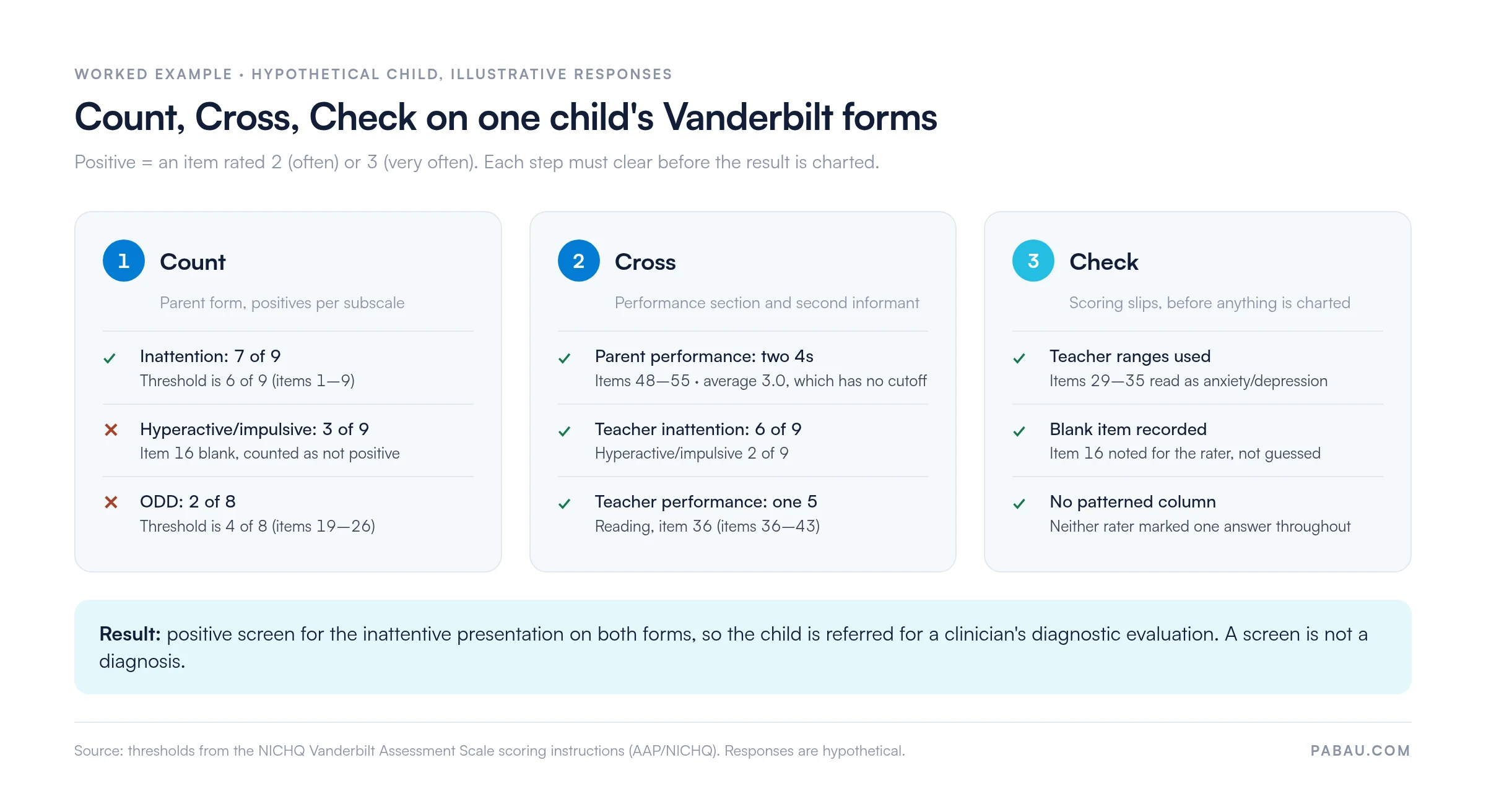
That result goes to the clinician as a reason for a diagnostic evaluation. It is not a diagnosis, and the chart note should say so.
Score follow-up forms by averaging, totaling items 1–9 and 10–18 separately and dividing each total by the number of items answered.
The 2019 scoring instructions give the example of a parent who answered 7 of the first 9 items. Those responses are totaled and divided by 7. Track the two means across visits to see whether symptoms improve with treatment.
On the current NICHQ follow-up forms, performance items are numbered 19–26 on both versions. The 2012 scoring sheet cites older numbering, so score from the form in front of you.
Side-effect questions cover the past week, and the teacher follow-up asks how long the teacher has observed the child. An ADHD medication side effects sheet fits alongside it between visits.
Most scoring errors are slips the Check step catches. When we build scored forms for practices, we keep the parent and teacher layouts apart first, because their item numbers stop matching at item 19.
A quick pass through these six points catches nearly every slip in the list above.
On paper, each Vanderbilt round means printing forms, chasing the teacher’s copy, hand-counting positives, and typing results into the chart. Each handoff is a chance to misread an item range.
Pabau’s practice management software lets you rebuild your scoring sheet as a digital questionnaire with its measurement tracking tools. You define how each answer maps to a value. Pabau then calculates the score the moment the form is submitted and stores it against the patient record.
Parents can complete their form before the appointment, so the clinician opens a scored result instead of a stack of paper. On follow-up visits, Pabau plots each score across visits, so you can see whether the averages move with treatment.
The questionnaires sit inside Pabau’s therapy practice management software, next to scheduling, notes and billing. Practices built around ADHD care can see the full setup on our ADHD clinic software page.

Pabau calculates questionnaire scores the moment a form is submitted and stores them against the patient record. Clinicians see each result, and its trend across visits, before the appointment starts.

The Vanderbilt rewards discipline more than expertise. Count only 2s and 3s, use the item map for the form in your hand, and let the performance rule decide impairment. Treat the total score as a tracking number, never as evidence.
The payoff is a screen you can defend. When the parent and teacher forms agree, the clinician has a clear reason to evaluate. When they disagree, the difference becomes the first question at the next visit.
Book a demo to see how Pabau scores your rating scales on submission and keeps every result in the patient record.

Tracking symptoms between visits? ADHD symptom tracker shows how to log day-to-day symptoms so follow-up ratings have context.
Need an intake form for younger patients? Childhood ADHD questionnaire gathers developmental and family history before the rating scales go out.
Screening before a full workup? ADHD screening test template gives you a quick first-pass screen to decide who needs the full Vanderbilt.
Planning care after a positive screen? ADHD treatment plan structures goals, interventions and review dates once a diagnosis is confirmed.
Explaining the process to families? ADHD handout for parents explains ADHD and next steps in plain language for parents.
Count answers of 2 or 3 in items 1–9 and 10–18 separately. Six or more in either set meets a symptom threshold. Then check performance items 48–55 for two 4s or one 5.
That depends on which scale produced it, and the Vanderbilt sets no total-score cutoff. As a Vanderbilt Total Symptom Score out of 54, 39 does guarantee six positives on at least one subscale. Impairment still has to be checked.
On the Vanderbilt, each symptom item scores 0 to 3, so the 18 core ADHD items total 0 to 54. Performance items are rated 1 to 5. Screening decisions use counts, not totals.
Only the initial teacher form does. It flags a possible learning disability when reading (item 36) and written expression (item 38) both score 4, or one scores 5.
Partly. The follow-up forms keep the 18 core ADHD items and the oppositional-defiant screen, which the teacher version combines with conduct. They also add a medication side-effect scale.
Record both results and the difference. The scoring instructions score each form on its own, and a mismatch is a question for the clinical interview rather than an error.