Despina Petrushevska
Ethical consent form: free template and what to add
An ethical consent form is a written record that a patient or participant agreed...

2
Last Updated: Oct 26, 2026
Free PDF 2 pages, print-ready Clinician-reviewed
Adult patients have the legal right to understand a proposed treatment and to agree to it freely. A medical consent form for adults records that agreement. It also protects your practice by proving the conversation behind the signature happened.
This guide sets out the areas a defensible consent form has to cover, and how HIPAA applies once it is signed. It compares digital and paper workflows, then maps the free template field by field. That includes the two changes worth making before you hand it to a patient.
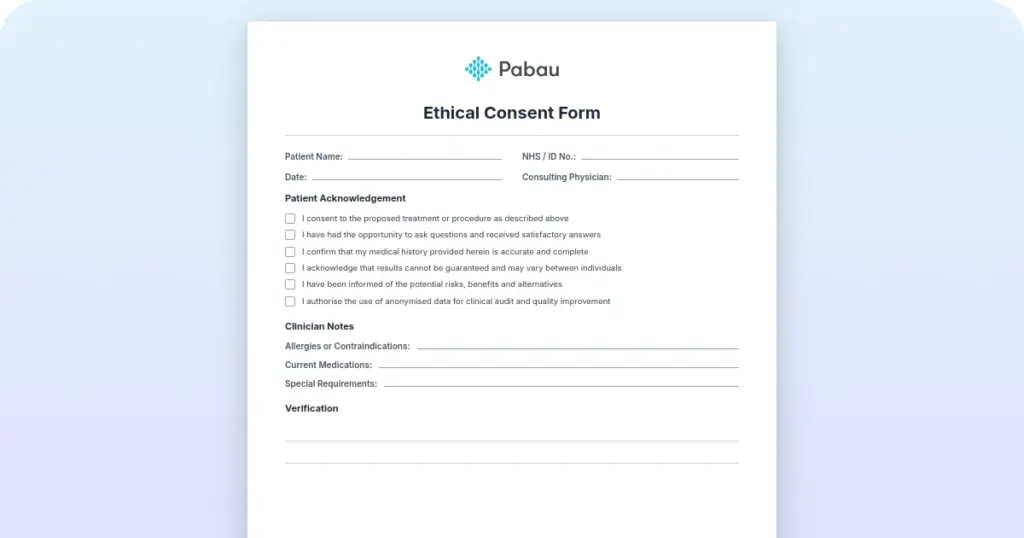
A two-page consent form covering patient information, emergency contact details, and nine numbered consent acknowledgments. It closes with signature and date lines for the patient and a witness.
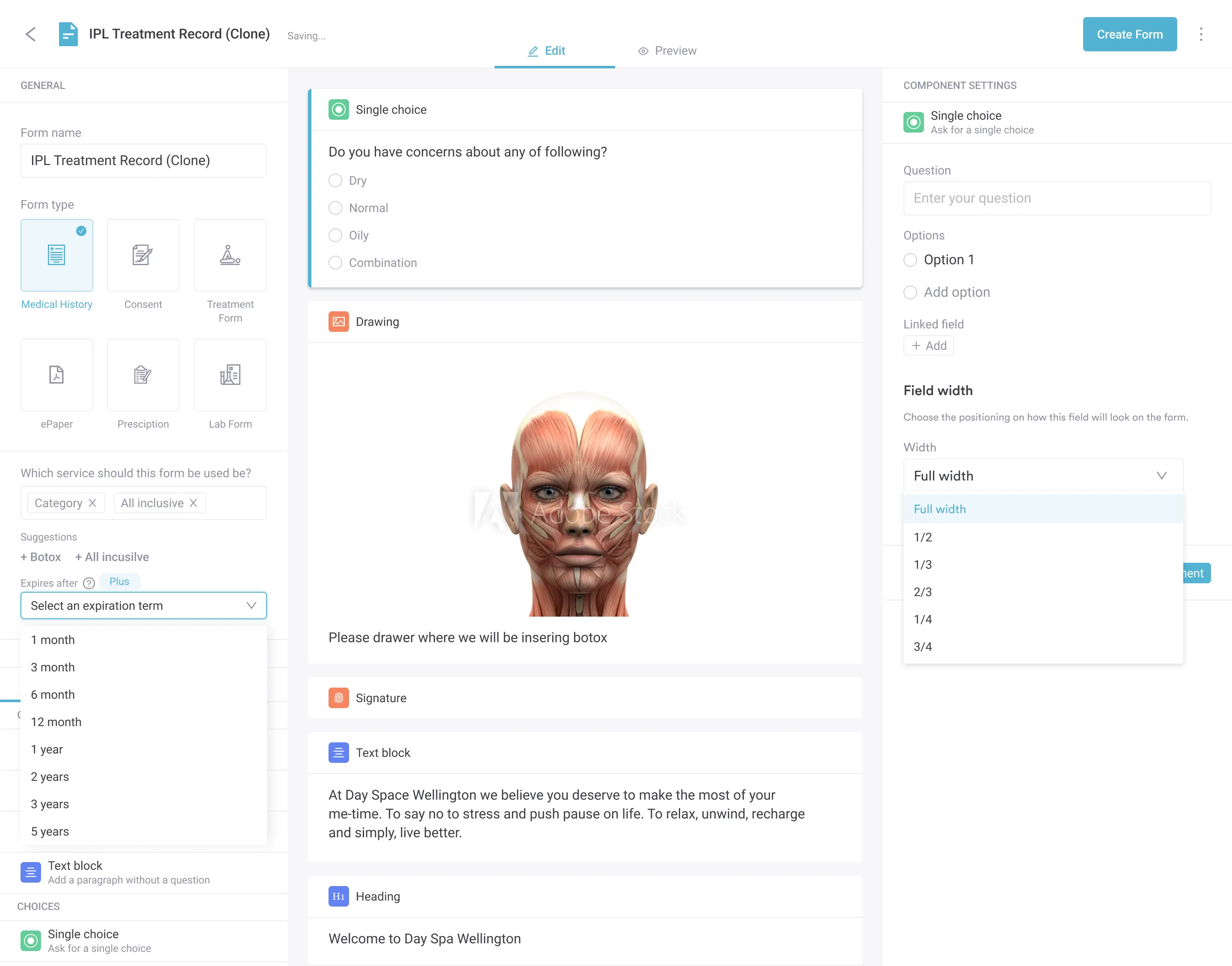
Start from scratch, or upload this PDF or any form you already use, and Pabau's AI Form rebuilds it with tick boxes, text fields and a signature. Attach it to the treatment once, and every patient gets it on time.
AI Form rebuilds the consent, history and aftercare forms you already use. You review each one, then publish.
Patients complete forms on their phone before they arrive, so the front desk stops retyping paper.
Every signed form is versioned and attached to the treatment record, ready when you need it.
Set how long a consent stays valid. Returning patients skip forms they have already signed.
Supports HIPAA and GDPR compliance AES-256 encryption 4.8 on G2 4.7 on Capterra Trusted by 4,000+ practices worldwide

A medical consent form for adults records a patient’s informed agreement to a specific treatment or procedure.
Our free template collects patient information, an emergency contact, nine numbered consent acknowledgments, and two signature lines.
Signature lines cover the patient and a witness only, so record the consent conversation in your clinical note.
HIPAA treats a signed consent as protected health information, so it needs secure storage and an access audit trail.
Practice management software like Pabau can send consent forms before the visit and file them in the patient record.
A medical consent form for adults is a legal document that records a patient’s permission before treatment or a procedure. It shows the patient was told the diagnosis, the proposed treatment, the risks and benefits, and the alternatives. It also shows they agreed voluntarily.
Adult patients are presumed to have decision-making capacity. That presumption covers their right to decide, not proof they understood you, so ask them to explain the plan back.
The form does two jobs. It documents the patient’s right to make choices about their own body, and it proves consent was obtained before treatment began.
According to MedlinePlus, informed consent means a patient receives information about a procedure and agrees to it after understanding the risks, benefits, and alternatives. A valid process has three parts. The patient understands the information, decides voluntarily, and signs documentation confirming that agreement.
Consent forms carry ethical, legal, and operational weight. They put the treatment decision where it belongs, with the patient, and they give your practice a record that the conversation took place.
A defensible adult consent form covers five areas. Leave one out and the form becomes far harder to rely on if the treatment is ever questioned.
Identify the patient at the top of the form with their full name, date of birth, phone number, email, and address. The template also collects an emergency contact, including that person’s relationship to the patient and their phone number.
There is no insurance field on the template, and that is deliberate. Payer details belong on your intake paperwork rather than on the document that records a clinical decision. Behavioral health practices draw the same line, keeping history and risk screening on a counselor intake form.
Write a plain-language description of what will be done. Avoid medical jargon, and define any clinical term you cannot avoid. “You will receive an injection of botulinum toxin into the forehead muscles to soften frown lines” beats “administration of neurotoxin to frontalis muscle groups.”
List the specific risks, the expected benefits, and the alternatives, including doing nothing at all. Be concrete. “Bruising for one to two weeks” tells the patient more than “potential bruising.” This is the core of informed consent, and the first section anyone reviews in a dispute.
The template gives you a single numbered field for risks and benefits, with no separate box for alternatives. Write the alternatives into that same field so the disclosure is complete.
State that the patient agrees of their own free will, without pressure, and can change their mind before treatment begins. The template carries a numbered field for exactly this, headed as the right to refuse or withdraw consent.
Some patients exercise that right and leave without starting treatment. A medical AMA form records that refusal, the risks you explained, and the patient’s acknowledgment of the consequences.
The template closes with two signature lines. The patient signs and dates the form, and a witness signs and dates it underneath. Both lines are part of the form, so arrange for a witness to be on hand when the patient signs.
There is no line for the clinician who ran the consent conversation. Record that discussion in a progress note instead, or add your own attestation line before you print the form. If you want a model to copy, the dental implant SOAP note lays out all four sections.
A typed name or an electronic signature is usually acceptable under your state’s version of the Uniform Electronic Transactions Act. Some states still want a handwritten signature for specific procedures, so check before you go paperless.
Fix one detail on the printed copy first. The date fields are laid out in day, month, year order. US staff will read 03/04/2026 as March 4, so write the month in words or relabel the field.
The file runs to two pages. It carries patient information, an emergency contact, the nine-part consent statement, and the signature block.
The consent statement opens with the line “I understand and acknowledge the following” and gives you nine numbered fields to fill in:
Nothing in the file is pre-filled, so every numbered field is yours to write for the treatment in front of you. Two additions are worth making before the form goes into use.
Add a clinician attestation line if your policy or your insurer expects one, since the template does not carry it. Relabel the date fields too, because they run day, month, year rather than the US order.
Not all consent scenarios are identical, and different treatments call for different forms. A dental treatment consent reads differently from a counseling consent, even though both cover the same five areas. A vaccination consent form adds its own step, recording that the patient received the Vaccine Information Statement.
Most practices run a combination. A general consent covers routine care, and a treatment-specific consent covers anything carrying material risk. A group therapy consent adds a confidentiality promise from every member, not just from your practice. Patients who read that detail before they arrive also make for better consultations.
A signed consent form contains protected health information, so it sits squarely inside HIPAA’s security requirements. Treat it with the same controls you apply to the rest of the patient record. A spouse has no automatic right to see that record, so a spouse consent form captures the patient’s written permission.
Note: This guidance is general, and requirements vary by practice size, location, and specialty. Check how your practice management software stores consent forms, and ask a compliance officer or attorney about your state’s retention and security rules.
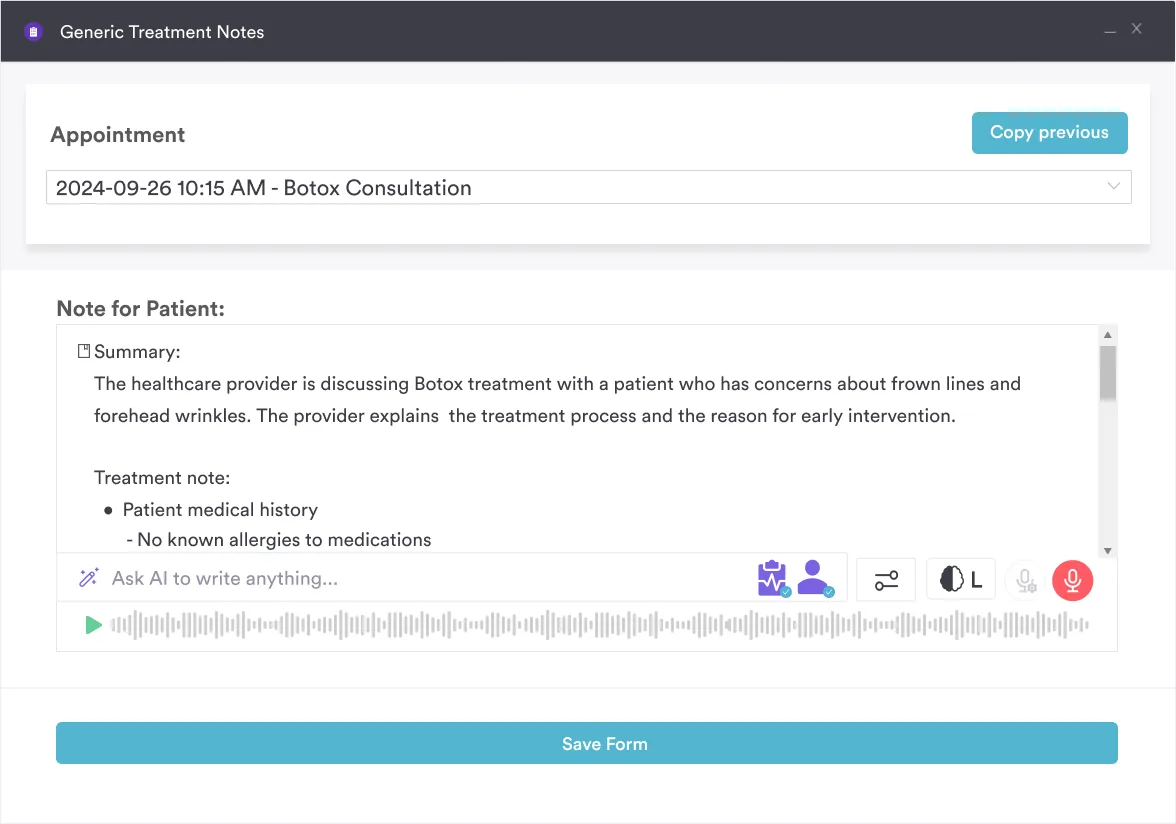
Electronic consent is now common, and the downloadable template works either way. Print it, or rebuild its fields inside your practice management system.
Practices with a digital workflow usually prefer electronic consent, because the signed form files itself into the patient record. Sending it alongside your intake forms means the patient completes both in one sitting.
One caveat if you go digital with this template. The witness line has to survive the move, so build a witness field into your electronic version rather than dropping it.
A tight consent workflow protects the practice and reads better to the patient. Five operational steps cover it.
In most practices the consent form is printed, handed over at the front desk, and skim-read in the waiting room. The signed copy then joins a filing cabinet or a scanning queue, where nobody can find it quickly.
Pabau, our practice management software, turns that into a step the patient finishes at home. The completed consent then lands in the patient record, with a timestamp and an access log.
Because the template has no clinician signature line, the consent conversation still needs somewhere to live.
The result is a consent record you can produce on demand, and a front desk that is not chasing signatures on the day of treatment.

Pabau’s digital forms send the consent form ahead of the appointment, capture the signature, and file it in the patient record with an audit trail.

Consent is the conversation, and the form is the receipt for it. Get the conversation right and the paperwork is straightforward. Skip it, and a signature on its own is thin protection.
Download the template, write the nine numbered fields for your own procedures, and add a clinician attestation line if your policy calls for one. Then decide where the signed copy will live before the first patient signs.
The trade-off worth remembering is time. A consent form completed at home is read properly; one handed over at the desk rarely is. Book a demo to see how Pabau sends adult consent forms ahead of the visit and files them automatically.

Releasing patient records to a third party? HIPAA authorization form sets out how to disclose protected health information beyond routine treatment and billing.
Charting a patient with a weak cough? Airway clearance care plan covers the respiratory assessment, five interventions with rationale, and the evaluation section.
Referring a patient to another provider? Medical referral form template streamlines patient transfers between providers and keeps documentation HIPAA compliant.
Need consent paperwork for a dental procedure? Dental treatment consent form covers treatment description, risks, alternatives, and signature blocks for informed consent.
Informed consent is a patient’s voluntary agreement to treatment, given after a proper explanation. That means the diagnosis where applicable, the proposed treatment, the risks and benefits, and the alternatives. It also means being told they can refuse or withdraw consent. For adults, capacity to decide is assumed unless proven otherwise.
Yes, in most circumstances. Any procedure carrying material risk (surgery, injections, diagnostic procedures) requires documented informed consent. For routine office visits, a general consent on intake paperwork typically suffices. Emergency situations may be an exception. Document why consent was not obtained.
No. The template has two signature lines, one for the patient and one for a witness, each with its own date field. If you want the clinician to sign, add an attestation line yourself, or record the discussion in the clinical note.
Yes. A patient can change their mind at any time before treatment begins. If they withdraw consent, stop and reschedule. If they withdraw during a procedure, stop immediately and document what happened. Proceeding against a patient’s wishes is a serious legal and ethical violation.
Yes, under the federal ESIGN Act. Electronic signatures on consent forms are legally valid. However, a few states and specific high-risk procedures still require handwritten signatures. Check your state medical board and your malpractice insurance policy for requirements.
Yes, a patient always has the right to refuse treatment. If they refuse to sign a consent form, do not proceed with the procedure. Document the refusal in the patient record with the date and time. Note the alternatives you offered, including no treatment at all.
General consent covers routine office exams and non-invasive care. Informed consent is specific to a particular procedure or treatment, with detailed disclosure of risks, benefits, and alternatives. Informed consent requires a documented conversation and is legally heavier than general consent.
Emergency exceptions let you treat without documented consent when the patient cannot communicate and waiting would cause serious harm. Document those circumstances in the patient record. An emergency label is never a routine reason to skip consent.
No. Each state sets its own medical practice and consent requirements. If you practice in more than one state, you may need different consent language for each. Ask a healthcare attorney in every state where you treat patients.